


Introduction
English composition can quietly become one of the most stressful parts of homework time. A child sits down, looks at the question, writes a few lines, then says they have no ideas. Parents see the same pattern again and again, and it is frustrating because composition looks manageable from the outside, until it suddenly is not.
Many parents searching for help with writing a good English composition are not looking for theory. They want practical guidance, a clear composition structure, and a way to stop the same weak writing habits from showing up every week.
In Singapore, English Paper 1 tests more than grammar. Whether the task is picture-based or topic-based, schools usually look at content, organisation, and language. A good composition needs a clear plot, sensible paragraphing, believable character actions, and enough language control to keep the story moving. That is why learning how to write a good English composition is not about memorising bombastic phrases. It is about understanding what makes a story work under exam conditions, then practising those habits until they feel natural.
Key Takeaways
- Start with a clear story problem. A composition becomes interesting when something goes wrong, changes, or needs to be solved.
- Plan before writing. Even two to three minutes of planning can prevent off-topic stories and weak endings.
- Use a strong composition structure. A clear beginning, development, conflict, climax, and resolution make the story easier to follow.
- Show actions and reactions, not just big vocabulary. Specific actions, thoughts, and consequences usually make a composition stronger than memorised phrases.
- Pay attention to the opening and ending. A confusing opening can make students lose direction early, while a rushed ending makes the whole story feel unfinished.
- Edit with purpose. The final minutes should be used to check tense, punctuation, missing words, and whether the story answers the question.
- Practice with feedback, not just more writing. Targeted feedback, whether from school, home, or an English tutor, is usually what helps students improve.
What Examiners Actually Look For
Parents often feel confused because their child’s composition seems “not bad”, yet the marks stay average. In most Singapore schools, English composition is not judged on vocabulary alone. For English Paper 1, teachers usually look at three broad areas: content, organisation, and language.
A common pattern among students is this: they focus on sounding impressive, but overlook whether the story actually works. That is where marks often slip away.

Content must answer the question
A common issue is writing a story that sounds dramatic but does not really fit the topic or pictures. A child may include a robbery, a storm, and a hospital visit, but if the topic is really about honesty or responsibility, the story can drift badly off course.
A strong composition stays tied to the question from start to finish, so every major event should support the theme or prompt.
Organisation shows whether the story makes sense
Teachers expect a logical flow. That means a clear beginning, a middle where the problem develops, a climax where the main tension peaks, and an ending that resolves the issue. If a child writes three paragraphs of build-up and then ends with “Suddenly I woke up and realised it was a dream,” most teachers will see that as a weak shortcut.
Good organisation also helps the examiner follow the story easily. When the sequence of events is clear, the writing feels more controlled and mature.
Language should support the story
Language matters, but not in the way many children assume. Examiners do notice vocabulary, sentence variety, grammar, and punctuation. Still, a simple sentence used accurately is often better than an ambitious sentence full of errors. In many scripts, the biggest problem is not a lack of “good words”. It is awkward phrasing, repeated sentence patterns, and grammar mistakes that interrupt meaning.
For parents trying to understand how to help a child write better English compositions in Singapore, this is the key point: a good story is built, not decorated.
Build The Composition Around A Clear Structure
When children ask how to write better compositions, they often expect a list of descriptive words. What they usually need first is structure. A messy story is hard to save, even with good vocabulary.
Start with a simple story arc
A reliable English composition structure does not have to feel rigid. It simply gives the child a path to follow.
For example, if the topic is about helping someone, the opening could show a student rushing home after CCA. The problem appears when he sees an elderly woman drop her groceries. The climax comes when he must choose between helping her and being late. The resolution shows the consequences of that choice and what he learns from it.
Keep paragraphs purposeful
A common upper primary weakness is treating paragraphs like random breaks. Each paragraph should do a job. One paragraph introduces the situation, another develops the problem, and another shows the turning point. This makes the story clearer for both student and examiner.
Avoid overcomplicating the plot
Many children believe exciting means complicated. They throw in kidnappers, car accidents, and police investigations in a short composition. The result is usually rushed and unrealistic. A smaller, believable conflict often works better.
A lost wallet, a broken promise, or a moment of dishonesty can produce a much stronger piece of writing if handled well.
Start Strong Without Freezing Up
The blank page is where many students lose confidence. It is very common for children to say they know what to write at home, but in school exams they suddenly blank out.
Use the question to anchor the opening
The safest way to start a composition is to stay close to the topic. If the composition is about a lesson learnt, the first few lines should already place the character in a situation that can lead to that lesson.
Instead of a generic line about the weather, a stronger start moves straight into the situation.
“I was hurrying out of school after remedial class when I noticed a wallet lying near the gate.”
This kind of opening creates movement and a possible problem immediately.
Choose a few dependable opening styles
Children do not need many opening techniques. A few useful ones are enough:
- Action opening: Begin when something is already happening.
- Dialogue opening: Begin with a line of speech that creates tension.
- Thought opening: Begin with a worry or realisation.
These are practical composition writing tips because they help students move quickly into the story instead of wasting time on generic descriptions.
Do not force memorised introductions
A child may memorise polished openings and try to squeeze one into every question. The sentences may sound impressive, but they often feel unnatural and unrelated. If your child tends to freeze, the answer is usually not more model introductions. It is learning how to recognise the core situation and begin there.
Make The Plot More Engaging
A good composition is not just a series of events. Something must be at stake. The reader should feel that the main character faces a real difficulty, even if the situation itself is simple.
Every story needs a problem
One major reason children score poorly is that nothing truly happens. They go to school, play with friends, eat lunch, go home, and end with “It was a memorable day.” That is not really a plot.
A stronger story introduces a complication. Maybe the child sees a classmate cheating. Maybe a promise is broken. Maybe fear stops the character from doing the right thing. Conflict gives the story direction and makes the ending meaningful.
Show the character through actions
When teaching composition writing, it helps to remind children that character is shown through behaviour. Instead of writing “I was very scared,” they can show it through action and reaction. Instead of saying “He was kind,” show him staying back to help when others walked away.
This makes the writing more convincing and less repetitive.
Make the climax the turning point
The climax should feel like the peak of the problem. It is the moment of decision, discovery, or consequence. In many weak compositions, the climax is missing because the student spends too long on background details and rushes the important part.
A useful home question is, “What is the biggest moment in this story?” If your child cannot answer that clearly, the plot may not be focused enough.
Use Vocabulary Naturally And Vary Sentences
Parents often worry that their child’s composition is too simple. Sometimes that is true. But just as often, the bigger problem is unnatural language.
Precise words beat fancy words
“Ran” may be too plain in some situations, but replacing it with “sprinted”, “stumbled”, or “raced” only works when the meaning fits. Good vocabulary should make the scene clearer, not show off.
A child writing about a lost item does not need ten dramatic adjectives. What helps more is accuracy.
Sentence variety improves flow
Many scripts sound repetitive because every sentence begins the same way: “I went… I saw… I was… I felt…” Better writing mixes short and long sentences, actions and reflections, and different sentence openings.
That does not mean every sentence must sound fancy. It simply means the writing should not move in one flat rhythm all the way through.
Be careful with memorised phrases
In Singapore, many children memorise expressions from assessment books or tuition notes. A few can be useful. Too many make the writing sound artificial. Real improvement comes from using language your child can control consistently, not borrowing impressive lines they cannot adapt.
Edit Carefully And Practise With Purpose
It is painful when a child writes a decent story but loses marks through avoidable mistakes. This is especially common in school exams, when fatigue sets in and the last few minutes disappear.
Watch for common composition mistakes
Some issues appear again and again, and they are worth watching for because they affect marks even when the story idea is decent.
Edit with a simple checklist
During practice, children can learn to check:
- Did I answer the question clearly?
- Is there a clear problem and ending?
- Are my paragraphs in a sensible order?
- Did I keep the same tense throughout?
- Are there missing full stops, capital letters, or spelling errors?
Practise one skill at a time
Some families make the mistake of asking the child to write composition after composition every weekend. More writing alone does not guarantee improvement.
A better approach is focused practice. One week, work on openings. Another week, focus on building a clear climax. Another week, revise weak endings. If your child keeps repeating the same mistakes and school feedback feels too brief, structured guidance from an English tutor can help identify specific weak spots and break bad habits. Families who want more personalised support can learn more about our tutors.
How Parents Can Help At Home
By the time homework starts after school, CCA, and dinner, composition practice can easily turn into a power struggle. Many parents want to help, but the moment they say, “Write a better sentence,” the child shuts down.
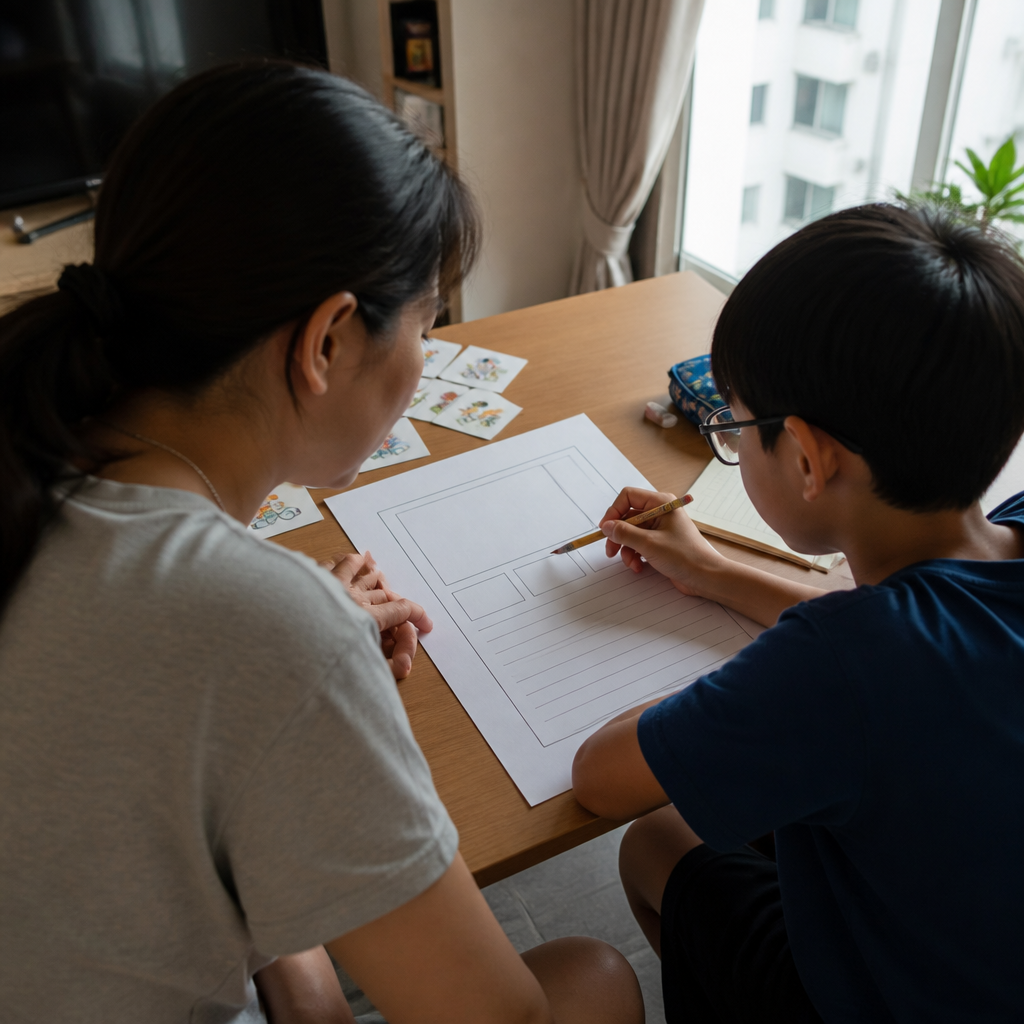
Discuss ideas before asking for full writing
For children who struggle, talking is often easier than writing. Before your child starts, ask what the problem is, who the main character is, what the most exciting part will be, and how the story will end.
This is one of the most practical ways parents can help with English composition at home. Oral planning reduces panic and makes the writing task feel smaller.
Focus on one improvement area at a time
Trying to correct grammar, punctuation, vocabulary, plot, and handwriting all at once usually overwhelms children. If the main issue is weak content, work on story ideas first. If the plot is fine but the language is repetitive, focus there instead.
Read and notice good storytelling
Children improve when they see what effective writing looks like. Short storybooks, newspaper reports, and even school model compositions can help if used properly. Instead of saying “memorise this”, ask, “Why is this opening interesting?” or “Where is the problem introduced?”
Frequently Asked Questions
How long should my child spend planning before writing a composition?
For most upper primary students, about two to five minutes is enough. The plan does not need to be detailed. A few key points for the opening, problem, climax, and ending can already prevent the story from drifting and save time later.
What if my child keeps writing off-topic stories during English Paper 1?
This usually happens when the child chases excitement instead of meaning. Ask them to underline the key idea in the question first, such as honesty, courage, or kindness. Then check whether each major event in the story supports that idea.
Are model compositions helpful, or do they make writing worse?
They can help if used as examples of structure, paragraphing, and storytelling choices. They become harmful when children copy them blindly or memorise phrases without understanding how to adapt them to a new question.
How can I support my child if I am not confident in English myself?
You do not need perfect English to help. You can still ask useful questions about the story, such as what happened, why it mattered, and whether the ending makes sense.
When should I consider English composition tuition?
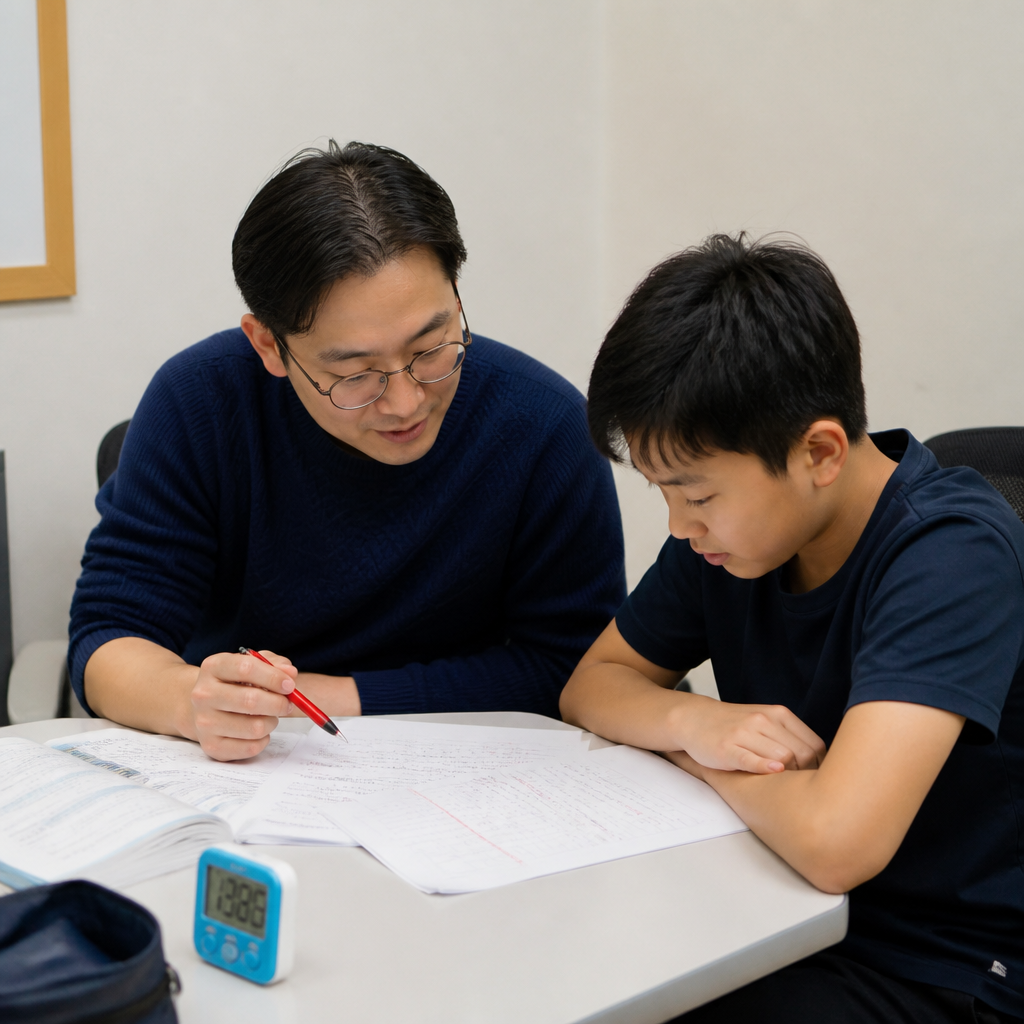
If your child keeps repeating the same writing mistakes, avoids composition tasks, or does not know how to improve even after practice, extra support may be useful. Good tuition does not just give more worksheets. It gives structured feedback, correction of recurring mistakes, and guidance on writing with more confidence.
Conclusion
Learning how to write a good English composition is really about mastering a few core habits well. A strong composition has a clear structure, a meaningful problem, sensible paragraphing, believable actions, a real climax, and an ending that feels earned. On top of that, students need language control, not just fancy vocabulary, and enough editing discipline to catch careless mistakes before time runs out.
For Singapore parents and students, the goal is not to produce dramatic stories filled with memorised phrases. It is to write clearly, stay on topic, and build a story that examiners can follow and appreciate. That is the foundation of good composition writing, whether your child is in Primary 3, upper primary, or lower secondary.
If your child understands the basics but still struggles to apply them consistently, extra feedback can make a big difference. For personalised support and structured composition guidance, you can learn more about our tutors.
For official information on the English syllabus and exam authorities, parents can also refer to MOE’s English Language syllabus page and SEAB.