


Introduction
English exam season in Singapore can feel especially draining at home. Your child may be sitting at the table with worksheets open, you are reminding them to revise, and yet the results still do not seem to move. Unlike Math or Science, English progress can feel frustratingly hard to measure. A student can finish pages of practice and still lose marks in composition, comprehension, oral, or grammar.
That is why so many parents end up asking the same question, how do you actually study English effectively? Should your child do more papers? Read more? Memorise vocabulary? Or is everyone just getting more stressed without fixing the real problem?
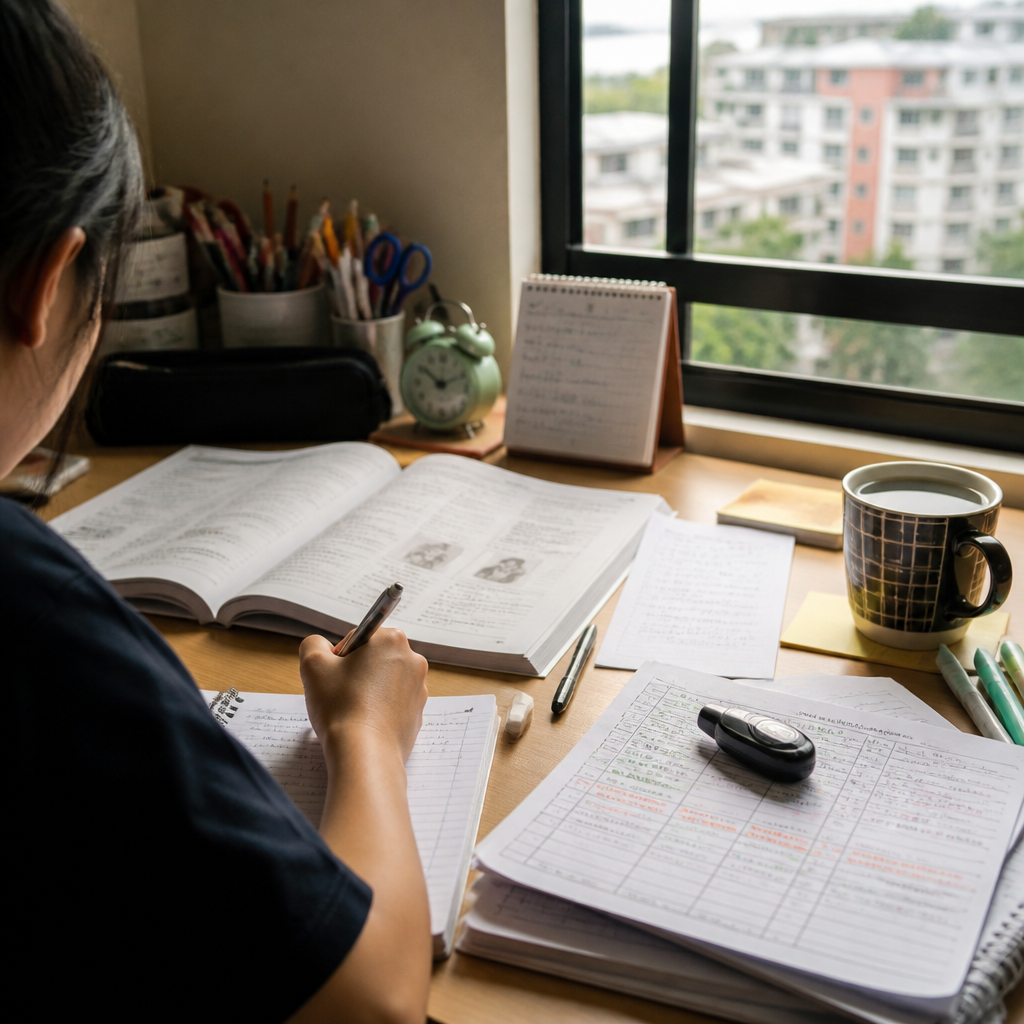
If you have been wondering the same thing, the key is this. English should be prepared as a set of connected skills, not as one subject that can be memorised. For students preparing for primary school exams, PSLE, secondary school tests, or O-Level English, the most effective approach is steady, component-based practice. A strong English study plan in Singapore should include Paper 1 writing, Paper 2 language use and comprehension, oral communication, listening comprehension, grammar, vocabulary, and regular reading habits. Once revision is organised this way, it starts to feel much less random and far more manageable.
Key Takeaways
- Study English by component, not by guesswork. English exams test different skills, so revision should cover Paper 1, Paper 2, oral, listening, grammar, and vocabulary separately instead of doing whatever worksheet appears first. This helps students identify where marks are actually being lost.
- Review mistakes more carefully than you complete practices. A student who does three papers but never studies corrections often repeats the same errors in tenses, phrasing, and answering style. Careful review is usually where the real improvement happens.
- Build a weekly English routine. Short, regular sessions work better than last-minute cramming, especially when school, CCA, and tuition already make weekdays tiring. A predictable routine also reduces resistance at home.
- Grammar and vocabulary improve faster with active use. Simply memorising word lists rarely sticks. Students retain language better when they rewrite sentences, apply new words, and notice patterns while reading.
- Paper 1 and oral need feedback, not just effort. Many students write long compositions or practise reading aloud, but without correction, they may reinforce weak expression, poor structure, or unnatural delivery.
- Parents can help without turning revision into nightly conflict. Small support at home, such as checking a vocabulary log or listening to one oral response, is often more effective than constant scolding. Calm consistency usually works better than pressure.
- Structured help can be useful when a child is weak across several areas. If English difficulties show up in writing, comprehension, grammar, and oral together, targeted support or English tuition may provide clearer feedback and consistency.
Understand What The English Exam Is Really Testing
Before deciding how to revise English, students need to know what they are revising for. This is where many children get stuck. They say they are “studying English”, but that can mean anything from reading model essays to doing one random comprehension worksheet.
The problem is simple. English is not one single skill. In Singapore schools, English exam preparation usually covers several components, and each one needs a different kind of practice.
Paper 1, Paper 2, oral, and listening test different strengths
For many students, composition, comprehension, oral, and listening feel like one giant pile called “English”. That is usually why revision becomes messy.
Paper 1 tests writing, idea development, language control, and organisation. Paper 2 usually checks grammar, editing, vocabulary use, language understanding, and comprehension. Oral looks at reading aloud and spoken interaction. Listening comprehension tests attention, accuracy, and the ability to catch detail in real time.
A child who writes imaginative stories may still struggle badly in grammar editing. Another may score reasonably for comprehension but freeze during oral because spoken English feels completely different from written English.
This is often the turning point for parents. Once these are seen as separate areas, revision becomes targeted instead of vague.
Why some students work hard but still do badly
Tutors often notice the same pattern. A student says, “I studied English for two hours,” but most of that time was spent rereading notes, copying model answers, or flipping through corrections without really processing them.
That feels productive, but it often is not. English marks improve when students practise the exact skill being tested, then review what went wrong. Without that second step, the same mistakes keep returning.
For exam formats and updates, parents can refer to MOE’s English Language information and SEAB. The broad preparation principle stays the same whether a child is in upper primary or preparing for O-Levels: understand the tested component, practise it specifically, and review it honestly.
Build A Weekly English Revision Routine That Is Realistic
A practical study plan for English exams matters more than good intentions. Without a routine, English often gets pushed aside because it feels less urgent than content-heavy subjects. Then exam season gets closer, panic sets in, and students start doing random papers.
That usually creates more stress, not better results.
A manageable weekly plan for busy Singapore students
A good English revision schedule for secondary students or upper primary students should be manageable, not idealistic. If your child already has school, homework, CCA, and other subjects to revise, a daily intensive English plan is unlikely to last.
A more realistic routine might look like this:
This kind of structure is usually much easier to sustain than saying, “Do English every day,” and then giving up halfway through the week.
Keep one notebook for patterns, not just corrections
A strong habit during English exam revision in Singapore is keeping a mistake notebook. Not a thick pile of worksheets that no one looks at again, but one simple place to record recurring problems.
A common pattern among students is that they treat every error as separate. One tense mistake here, one weak oral answer there, one misread comprehension question somewhere else. But when patterns are written down clearly, they become easier to catch.
That notebook might include:
- Confusing past and present tense in narratives
- Using informal phrases in situational writing
- Giving oral answers that are too short
- Misreading Paper 2 questions and lifting blindly
- Overusing basic words like “nice”, “good”, and “bad”
Once students start noticing patterns instead of isolated mistakes, improvement usually becomes faster and less frustrating. It also makes revision sessions more focused, because the student knows exactly what to watch out for in the next practice instead of just hoping to “do better”.
Improve Paper 1 Without Memorising Model Compositions
Paper 1 can make students feel exposed. There is no single correct answer, and for children who are used to memorising, that can feel uncomfortable very quickly.
Still, when parents ask how to study English, writing is one of the clearest areas where practice plus feedback really pays off.
Practise planning, not just full writing
Many students believe they need to write more and more full compositions. Sometimes that helps. But very often, the real issue starts before the first paragraph.
Weak planning leads to weak writing. A student may spend 45 minutes writing a story that drifts off-topic almost immediately.
A better routine is to spend 10 minutes planning three possible openings or mapping out one clear story arc before writing the full piece. For situational writing, practise identifying audience, purpose, and tone first. If the task is an email to a teacher, it should not sound like a message to a friend.
Another useful habit is to review the question after planning and ask, “Have I answered exactly what was asked?” This sounds simple, but many students lose marks because they write a decent piece that does not fully match the task.
Learn from model answers without copying their voice
Reading good samples is useful. Blind memorisation is not.
Teachers and examiners can usually tell when a student forces polished phrases into the wrong context. It often makes the writing sound stiff and unnatural. Tutors often notice this when students use “fancy” vocabulary they do not fully understand.
“The boy sauntered hurriedly.”
That kind of sentence sounds impressive only until someone reads it properly.
Instead, use model answers to study specific features:
- How the introduction sets up the purpose
- How each paragraph stays focused
- How details make writing believable
- How sentence lengths vary naturally
- How conclusions do not feel rushed
Learning fewer things properly is usually more effective than trying to sound impressive.
Study Paper 2, Grammar, And Vocabulary More Effectively
Parents often ask how to improve English grammar and vocabulary quickly. The honest answer is that improvement feels quicker only when practice is active and repeated. Passive reading of corrections rarely changes exam performance.

Use grammar in sentences, not only in exercises
Grammar revision becomes much more useful when students apply rules in context. If a child keeps making subject-verb agreement errors, stopping at the worksheet is not enough. Ask them to write five original sentences using the corrected structure.
If they keep mixing tenses in storytelling, get them to rewrite one paragraph fully in the past tense.
This takes more effort, but it tackles a very common problem. Many students understand a correction when it is explained, yet still repeat the same mistake later.
Build a vocabulary log that is actually usable
A vocabulary notebook only works if it is practical. Copying word meanings alone usually does not stick.
A better vocabulary log includes the word, a short meaning, one sentence from reading, one original sentence by the student, and a note on tone, such as formal, informal, positive, or negative.
That makes vocabulary easier to remember and much easier to use later in composition or oral. It also helps students avoid another common problem: using a word that is technically correct in meaning but awkward in tone.
Balance comprehension practice with language basics
Some students spend almost all their revision time on comprehension because it feels the most exam-like. But if grammar is shaky and vocabulary is limited, performance across the paper suffers.
Better Paper 2 revision balances language use, editing, vocabulary development, and comprehension practice. The goal is not just to get through one section, but to strengthen overall English ability for exams.
A simple way to do this is to split one Paper 2 session into parts: a short editing practice, one vocabulary review, and one comprehension passage with careful correction. That usually gives better results than rushing through an entire paper without understanding the mistakes.
Prepare For Oral And Listening Before Exam Week
Oral and listening are often neglected because they seem harder to revise. Then oral exam week arrives, and students suddenly realise they have not spoken proper English aloud in days.
Oral improves with regular, low-pressure speaking practice
For oral, practice should include both reading aloud and spoken interaction. Reading aloud is not just about fluency. It also involves pronunciation, pacing, expression, and punctuation awareness.
Spoken interaction is where many students struggle more. Some give one-line answers because they are nervous. Others memorise points and end up sounding robotic.
A better method is to practise short responses on familiar topics and make sure each answer includes a point, a reason, and a simple example. That usually sounds far more natural than reciting prepared lines.
Students can also record themselves occasionally. Hearing their own pacing, unclear pronunciation, or repeated fillers like “um” and “like” can be surprisingly helpful.
Listening comprehension needs attention control
Listening is easy to underestimate. Yet students often lose marks because they drift off, misread options, or start writing before hearing the full detail.
Simple practice helps. Listening to short audio clips and summarising key points can sharpen attention over time. Even small, regular exposure is often better than leaving listening practice until the last minute.
If a child consistently struggles with oral confidence, listening accuracy, and spoken expression together, structured coaching can help. Families who want guided support across these areas can learn more about our tutors.
Help Your Child Revise English At Home Without Constant Conflict
By the time English exams are near, many parents are exhausted too. It is late, your child is tired, and every reminder seems to turn into irritation. That is why helping at home needs to be realistic.
The goal is not to become your child’s full-time English teacher.
Support consistency, not constant pressure
What often works better than repeated nagging is a small, predictable routine. Every Tuesday night, your child reads one oral passage aloud to you. Every Saturday morning, they show you their vocabulary log and explain three new words.
These tasks are short, specific, and easier to maintain. Children usually resist less when expectations are clear and limited. “Let’s do one task properly” often works better than “Go and study English.”
Focus on effort quality, not only marks
A child may say they revised, but what did that revision actually look like?
Parents can ask:
- What mistakes did you notice from your last paper?
- Which component are you weakest in now?
- Show me one corrected paragraph.
- Which new words can you use in a sentence?
These questions shift the conversation away from accusation and towards reflection. That matters, especially when a child already feels discouraged.
Know when extra help may be needed
Some children are not simply being careless. They may genuinely lack structure across multiple components. If writing, grammar, oral, and comprehension are all weak, school worksheets alone may not be enough.
In such cases, targeted support or tuition can provide regular feedback, which is often hard to replicate at home without creating tension. Extra help is usually most useful when it is specific, consistent, and tied to the child’s actual weak areas rather than just adding more worksheets.
Frequently Asked Questions
How many times a week should a student revise English for exams?
For most students, three to five shorter sessions a week is usually better than one long cram session. English improves through regular exposure, correction, and active use. Even 30 to 45 minutes per session can be effective when each session has a clear purpose, such as Paper 1 writing, grammar review, or oral practice.
What is the best way to study English before PSLE or O-Levels?
The best approach is balanced revision across components. A student preparing for PSLE or O-Level English should revise Paper 1, Paper 2, oral, listening, grammar, and vocabulary, while also reviewing past mistakes. A common mistake is spending too much time on comprehension alone and neglecting the other areas that also affect marks.
How can I improve English grammar and vocabulary quickly?
The fastest realistic improvement comes from active practice. Rewrite incorrect sentences, keep a usable vocabulary log, read regularly, and apply new words in speech and writing. Memorising lists without using them tends to fade quickly, so it is better to focus on grammar patterns and vocabulary that the student can actually use.
Should students do full English papers every week?
Not always. Full papers are useful closer to exams, but many students benefit more from targeted practice first. If a child is weak in editing, oral, or writing structure, doing full papers every week may create fatigue without fixing the core issue.
Can tuition help if my child is weak in all English components?
It can, especially when the difficulty is broad rather than isolated. Some students need structured feedback on writing, grammar, oral, and comprehension together. Tuition does not guarantee results, but it may help students who need clearer guidance, accountability, and regular correction.
Conclusion
Understanding how to study English in Singapore is really about preparing the subject in the way it is actually tested. English exams reward steady practice across Paper 1, Paper 2, oral, listening, grammar, vocabulary, and reading exposure. Students usually improve faster when they review mistakes carefully, practise each component with intention, and follow a weekly routine instead of relying on last-minute panic revision.

For parents, steady support often matters more than pressure. A simple home routine, a focus on real corrections, and calm awareness of where a child is struggling can make English revision far less stressful. If your child needs more structured help across multiple components, you can learn more about our tutors and explore support that fits their needs.