


Introduction
Some exam nights in Singapore feel painfully familiar. It is already late, the assessment book is open, highlighters are everywhere, and your child has been “studying” for two hours, but very little seems to have gone in. For students, that creates panic. For parents, it can feel frustrating and helpless. You can see the effort, but the results do not always match the time spent.
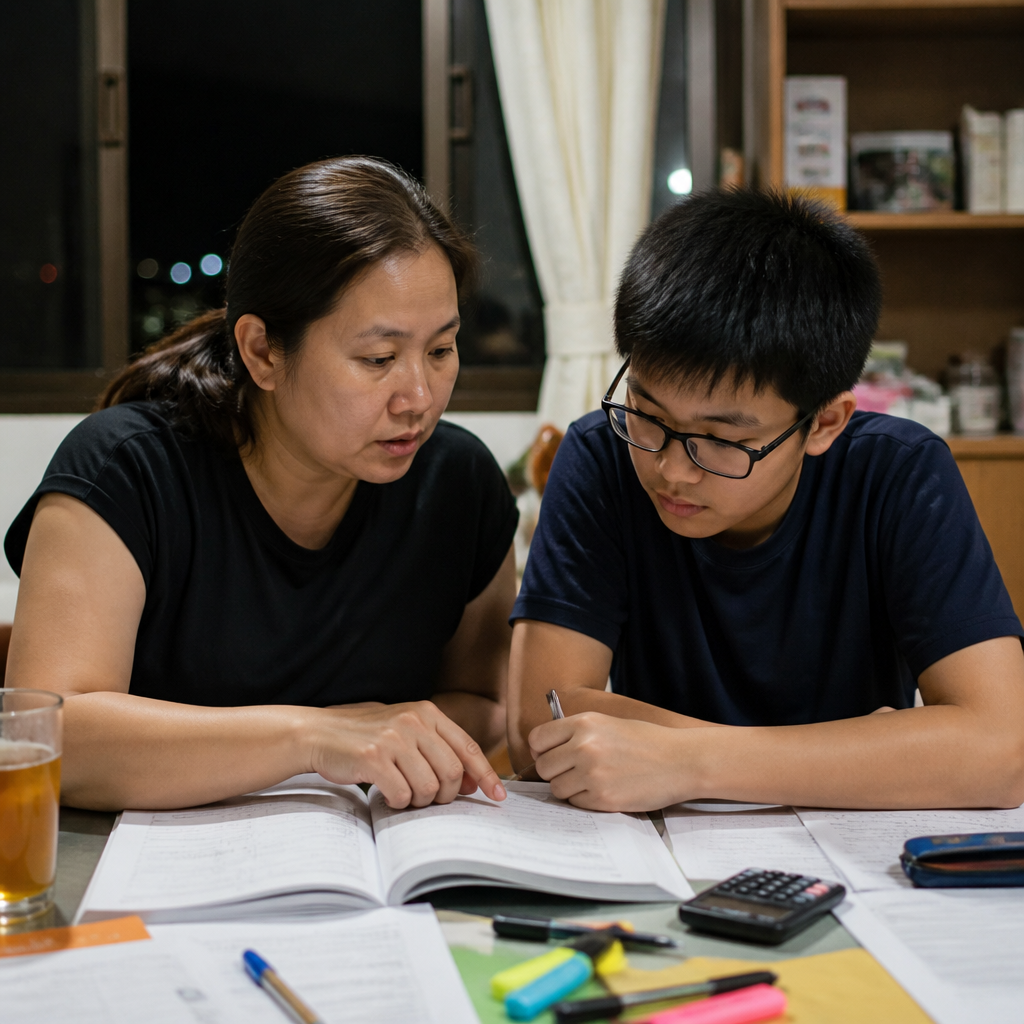
That is exactly why learning how to study smart matters. Smart exam revision is not about squeezing in more hours. It is about using study methods that improve recall, accuracy, speed, and exam performance. This matters even more for PSLE, O-Levels, A-Levels, school weighted assessments, and prelims, where students are expected to apply concepts under time pressure, not just recognise them from notes.
If you are wondering what the best study method is, the short answer is this: the best method helps a student remember, retrieve, apply, and correct mistakes consistently. In this guide, we will look at practical ways to revise better, not just longer.
Key Takeaways
- Smart studying is active, not passive. Reading notes repeatedly may feel productive, but it often creates false confidence.
- Weak topics need a plan, not avoidance. Marks usually improve faster when weak areas are identified clearly and worked on deliberately.
- Practice papers only work when corrections are reviewed properly. Finishing a paper is not enough.
- Spaced revision beats last-minute cramming. Several short sessions usually work better than one long marathon.
- Timed practice matters for exam subjects. Exam readiness includes answering accurately under realistic time limits.
- Different students need different revision adjustments. There is no single perfect study strategy for every child.
- Structured support can make revision more strategic. A tutor can help spot patterns and focus revision more effectively.
What Smart Studying Really Means During Exam Revision
A lot of students confuse being busy with being effective. They sit at the desk, copy notes, underline keywords, rewrite textbook definitions, and feel tired by the end. Yet when a school paper or prelim asks them to explain, compare, infer, or solve unfamiliar questions, they freeze.
Passive revision versus active revision
Passive revision often looks neat and reassuring, especially from the outside. But neat work is not always strong revision. A Secondary 3 student may spend an hour rereading Chemistry notes on acids and bases, then feel prepared because the content “looks familiar”. The problem is that familiarity is not the same as mastery.
In the exam, if the question asks for application in an experiment setup, that same student may suddenly not know what to write. Tutors often notice this gap clearly. The student feels confident while the notes are open, but once the page is closed, the answer falls apart.
Smart revision is more active. Instead of rereading the chapter, the student closes the book and writes down everything remembered about strong and weak acids, indicators, and neutralisation. Then the student checks what was missed. That retrieval process is powerful because it trains memory the same way exams do.
Why this matters in Singapore exams
For students preparing for exams in Singapore, the exam format matters. School papers, PSLE, O-Levels, and A-Levels do not reward memory alone. They reward application, precision, and exam discipline.
Math requires students to solve accurately under time pressure. English requires comprehension, editing, composition, and situational writing skills. Science often tests explanation, keywords, and data interpretation. Humanities requires students to select evidence and answer in the correct format.
This is why studying smart has to match what the paper actually tests. A child can revise for hours and still underperform if the revision method does not train the right skill.
Start With The Topics That Matter Most
Before students dive into revision, they need to know what deserves the most attention. This is where many go wrong. They revise based on mood, not importance. Easier chapters get repeated. Difficult topics get postponed.
Identify weak areas with evidence, not guesswork
A smarter starting point is to look at recent school papers, weighted assessments, class tests, and homework patterns. Which topics repeatedly pull marks down? Which question types keep appearing in corrections? A Primary 6 student might realise that fractions and problem sums are the real issue, not all of Math. An O-Level student may discover that Elective Geography content is fine, but source-based skills are weaker.
That matters because the study method that improves grades fastest is usually not “study everything equally”. It is “study the right things first”.
A useful way to sort topics is shown below.
This kind of sorting helps students stop revising based on comfort alone. It also helps parents see why a child can be “studying a lot” but still not moving the needle.
Turn weak topics into action plans
Saying “I am weak in Science” is too vague. A smarter plan sounds more like this: “I lose marks in open-ended questions because I miss keywords and do not link cause and effect clearly.” Once the problem is specific, the revision can become specific too.
Now the student can practise five open-ended questions a day, compare with answer keys, and build a list of common phrasing patterns. That is far more useful than just saying a subject is weak and hoping more time will solve it.
This is also where experienced tutors often help most. Not by giving endless worksheets, but by spotting recurring mistakes that students and parents may not notice on their own. If your child needs more structured revision support, learn more about our tutors and how they can help build stronger study habits, subject understanding, and exam confidence at Singapore Tuition Teachers.
Use Active Recall And Spaced Repetition
When families ask about the best study methods, these two are usually among the strongest, especially when used together. They work because they target memory in a realistic way.
Active recall: stop looking, start retrieving
Active recall means forcing the brain to bring information out without looking at the answer first. This is far more effective than reading notes again and again.
Examples include:
- For History, read a chapter, close the notes, then explain the causes aloud.
- For Biology, cover the labelled diagram and redraw it from memory.
- For vocabulary, test meaning and usage without looking.
- For Math, do a few questions from memory after reviewing the concept briefly.
This is one of the most practical smart study techniques for secondary school students because it fits almost every subject. It also reveals what the student only thinks they know.
Spaced repetition: revise before forgetting
Spaced repetition means revisiting a topic across several days or weeks instead of cramming it once. A Secondary 2 student revising Literature themes on Monday, again on Thursday, and again the following week will usually retain more than a student who studies it intensely for one night only.
This is especially useful for content-heavy subjects and formula-based topics. It is also one of the most effective study techniques for students with a short attention span, because the revision can be broken into shorter, more focused sessions.
Instead of a 90-minute block of pure memorisation, a student might do 20 minutes of recall, take a short break, then spend another 20 minutes on corrections. Shorter, repeated contact with a topic often beats one exhausting study marathon.
Make Practice Papers And Corrections Count
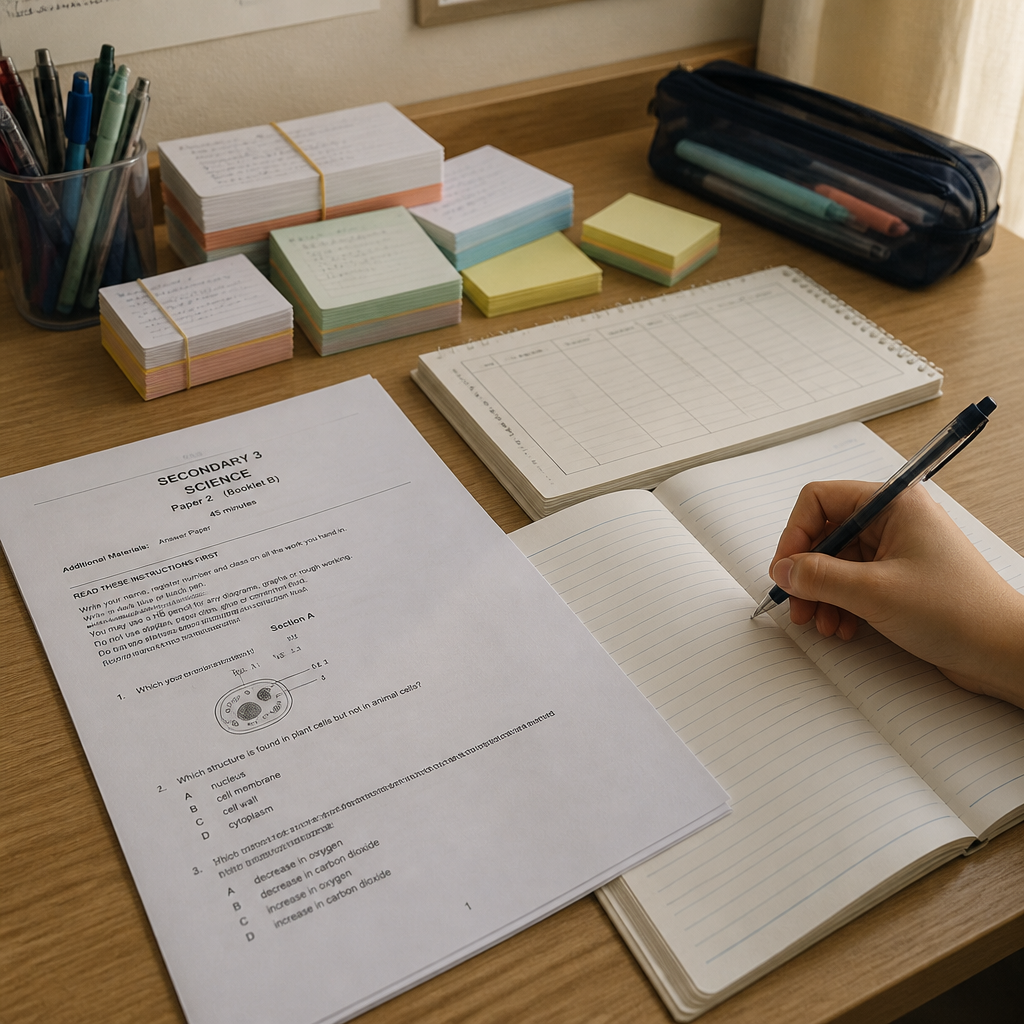
A lot of exam preparation becomes more effective once students move from chapter-by-chapter revision to practising under paper conditions. But simply doing more papers is not enough.
Use practice papers with a clear purpose
A Ten-Year Series paper can be used in different ways, depending on what the student actually needs at that stage.
Likewise, an O-Level E Math student may gain more from doing a timed set of algebra questions than repeatedly attempting full papers too early. This is often one of the best revision methods for PSLE and O-Level students because exam success depends not only on knowing content, but on handling familiar question formats under pressure.
Review corrections properly
This is the part students often skip when they are tired. They finish a paper, mark it, sigh, and move on. That wastes the paper.
A smarter correction process is to ask:
- Was this a content mistake or a careless mistake?
- Did I misunderstand the question?
- Did I know the method but apply it wrongly?
- Did I run out of time?
- Is this a repeated error?
If a student keeps losing marks in Science open-ended answers because explanations are too short, the correction should include rewriting the answer in proper full form, not just circling the answer key. If a Math student repeatedly expands expressions wrongly, the error log should include a few more similar questions in the same week.
That is how corrections turn into better grades. The paper itself is only the start. The real value comes from what the student learns after getting it wrong.
Match The Study Method To The Subject And The Student
There is no single universal answer to the best study method for exams. A revision method works only when it fits both the subject and the student’s actual weakness.
Match revision to the subject
Different exam papers test different skills. This is why a method that works well for one subject may do very little for another.
So if a parent asks, “My child studies a lot, why no improvement?”, the issue may be method mismatch. A student memorising model answers for Social Studies without practising source-based inference may still struggle. Another may read Science notes nightly but avoid open-ended application questions.
Adjust for attention span and study habits
Some students can handle 45-minute focused blocks. Others lose focus after 15 to 20 minutes. That does not mean they cannot revise well. It simply means the method has to be adjusted.
For students with a short attention span, shorter task-based revision often works better than vague long sessions. For example:
- 15 minutes to recall one chapter from memory
- 15 minutes to complete five exam questions
- 10 minutes to mark and log mistakes
This is more productive than telling a restless Secondary 1 student to “study Science for one hour” with no clear target.
When families ask how to make a study timetable that works, the answer is not just about time slots. A timetable only works if each block has a specific revision task.
Avoid Revision Habits That Waste Time
Many students are sincere, but stuck in weak revision habits that look disciplined from the outside.
Common habits that feel productive
Rewriting full notes is a classic example. It feels hardworking, especially before exams, but often becomes copying rather than thinking. Highlighting entire textbook pages has the same problem. So does watching solution videos passively without attempting the question first.
Another weak habit is overdoing familiar topics. A student may spend three evenings revising manageable chapters while postponing harder ones. The result is effort without real score movement.
Some students also rely too heavily on model answers. They memorise them, then panic when the exam question is phrased differently. Recognition is mistaken for readiness.
Smarter replacements
Replace note copying with blurting, where the student writes everything remembered on a blank page first. Replace endless reading with self-quizzing. Replace generic revision with topic-specific goals based on actual mistakes.
These are among the best ways to revise faster and remember more because they reduce empty repetition. The point of revision is not to feel busy. It is to become more exam-ready.
Frequently Asked Questions
What is the best study method for exams?
The best study method is usually a combination of active recall, spaced repetition, targeted practice, and correction review. Methods that force retrieval and fix mistakes tend to work better than rereading notes.
How can my child study smart if exams are very near?
If the exam is close, focus on high-weightage weak topics, recent mistakes, and timed practice in likely question types. Avoid spending precious time rewriting full notes.
What is the best revision method for PSLE and O-Level students?
For PSLE and O-Level students, one of the strongest revision approaches is to combine school papers or Ten-Year Series practice with detailed correction review and weak-topic follow-up.
My child studies for long hours but still forgets. Why?
Long hours do not guarantee strong memory. Many students forget because they use passive methods like rereading, highlighting, or copying notes.
Can tuition help if my child already has revision materials?
Yes. A good tutor can identify recurring error patterns, decide which topics need priority, and help your child practise more strategically instead of studying blindly.
Conclusion
Learning how to study smart is really about replacing low-impact effort with methods that build recall, accuracy, and exam confidence. For Singapore students facing PSLE, O-Levels, A-Levels, school exams, and prelims, that means prioritising weak topics, using active recall, spacing revision across time, doing targeted practice papers, and reviewing corrections properly. It also means being honest about what is not working. A long study session is not automatically a useful one.

For parents, this can be a relief to hear. If your child has been working hard but not seeing results, the answer may not be “study more”. Very often, it is “study better”. Small changes in revision method can make a big difference, especially when the student starts recognising repeated mistakes and turning them into a clear plan.
For official exam information and updates, you can refer to the Ministry of Education Singapore and the Singapore Examinations and Assessment Board. If your child needs more structured revision support, learn more about our tutors and how they can help build stronger study habits, subject understanding, and exam confidence at Singapore Tuition Teachers.