


Introduction
One evening, your child says there is barely any homework. Ten minutes later, a worksheet appears. Then a file needs signing. Then they remember a test. For many Singapore parents, this is the moment secondary school starts to feel very different from primary school.
The jump to secondary school often catches families off guard. In Primary 6, your child may have managed with reminders, worksheets, and a more predictable routine. Then Secondary 1 arrives, and suddenly there are more subjects, different teachers, weighted assessments, CCA commitments, faster lessons, and far more independence expected. Many parents are not dealing with a child who is lazy. They are dealing with a child who has not yet learnt how to manage secondary school well.
If you have been wondering how to build study skills without turning every evening into a battle, you are not alone. The goal is not to force long study hours early on. It is to help your child build reliable study habits that make homework, revision, note-taking, and test preparation less chaotic over time. For lower secondary students in Singapore, these foundations matter because they shape how well they cope later with subject combinations, upper secondary demands, and bigger exam stakes.
Key Takeaways
- Build routines before marks become a crisis. Study skills are easier to develop in Sec 1 and Sec 2, before poor habits harden and weighted assessments start piling up.
- Focus on systems, not just effort. A child can spend two hours at the desk and still achieve very little if homework tracking, note-taking, and revision habits are weak.
- Teach independence in small steps. Guide your child to check instructions, list tasks, review mistakes, and ask questions on their own.
- Make study skills subject-specific. Math revision, History review, and Science correction work differently.
- Use realistic schedules. CCA days, tuition, long commutes, and tired evenings are part of Singapore secondary life.
- Review mistakes early and often. Many teenagers keep doing homework but never learn from corrections.
- Support does not mean over-controlling. Steady support from home, and sometimes outside help, can rebuild confidence without constant conflict.
Start With The Secondary School Adjustment
Many parents try to fix study habits when the real issue is transition shock. A lower secondary student is not just handling more content. They are adjusting to a new school culture where teachers may not chase every missing task, lesson notes are less spoon-fed, and assessments carry weight throughout the year.
Why Secondary 1 often feels messier than expected
A common scene goes like this: it is 9.30pm, your child says there is “nothing much” for homework, then suddenly remembers a Science worksheet, a Geography file, and a Literature reading log. The problem is not always unwillingness. Often, they genuinely have not learnt how to track and organise multiple subjects properly.
In primary school, many children survive on adult structure. In secondary school, that structure loosens. Students now need to remember deadlines from different teachers, bring the correct materials, and revise even when no one tells them exactly what to do. This is why some children who were “fine” in primary school suddenly look careless or disorganised.
What to build first
Before chasing more practice papers, build three basic habits:
- A daily homework check.
- A weekly subject review.
- A simple system for recording deadlines.
Instead of asking, “Finished your homework?” ask, “Show me what was assigned today for each subject.” That small shift matters. It trains your child to think across all subjects, not just react to pressure.
This is also where many families push too hard too early. They see slipping marks and respond with more scolding or more hours at the desk. But if the problem is weak study structure, extra hours may only create more frustration.
Fix Homework Tracking And Daily Time Use
One of the most practical ways to build study skills is to improve what happens between school dismissal and bedtime. Lower secondary students often underestimate how much time is lost to unpacking late, drifting between tasks, or forgetting what needs to be done.
Use one visible homework system
A notebook, planner, phone note, or whiteboard can all work. The tool matters less than consistency. What usually fails is having information scattered across class chats, memory, random worksheets, and verbal reminders.
A simple daily entry can include:
For example: “Math worksheet due Thurs, Chinese ting xie revise, Science file bring Fri, ask teacher about graph question.” That last part matters. It turns the list into a learning tool, not just a checklist.
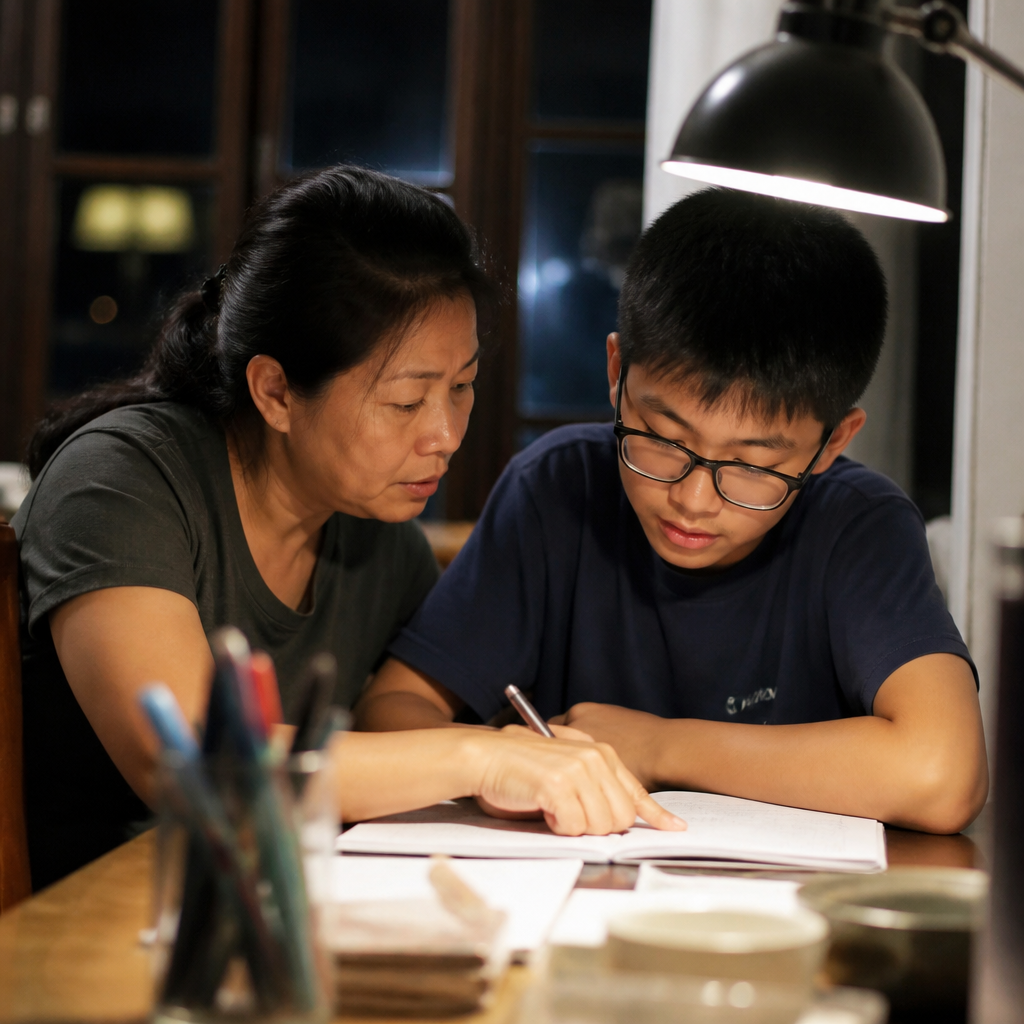
Build a routine that fits real family life
Teenagers usually respond better to a predictable pattern than a perfect timetable.
A workable weekday rhythm might look like this:
- 20 to 30 minutes to settle down after school.
- One focused homework block.
- A short break.
- A second block for revision or next-day preparation.
- Bag packing before dinner or bedtime.
On heavy CCA days, keep expectations smaller. Maybe only urgent homework and 15 minutes of review. On lighter days, add more. What works in real Singapore households is flexibility inside a stable routine.
A common mistake is planning four hours of study on paper, then feeling frustrated when only one hour gets done. Start with what your child can actually sustain. Study habits grow from repeatable routines, not heroic plans.

Make Notes And Lesson Follow-Up More Useful
A lot of lower secondary students copy notes without really processing them. Their files look full, but their understanding is thin. If you want study skills that last beyond one test, note-taking is one of the best places to start.
What useful note-taking looks like
At this stage, good notes are not beautifully rewritten pages in five colours. They are clear, usable, and connected to what the teacher actually taught.
Encourage your child to capture:
- Key definitions.
- Worked examples.
- Teacher emphasis.
- Common mistakes mentioned in class.
- Questions they did not understand.
In Math, writing down one corrected example of algebra expansion is often more useful than copying the full textbook explanation. In Science, a short note like “don’t mix up accuracy and precision” can prevent repeated marks loss later.
Review lessons within 24 to 48 hours
This is one of the most effective study habits for teenagers in Singapore, especially when school moves fast. Waiting until the next test to revisit a chapter is too late for many students.
A practical routine is simple:
- Skim that subject’s notes on the same day or the next day.
- Mark unclear points.
- Do one or two related questions.
- Check whether corrections are needed.
This can take 10 to 20 minutes, not an entire evening. Yet it makes a big difference. Many struggling lower secondary students are not always incapable. They simply let small gaps sit for weeks.
If your child struggles to process lessons independently, steady external support can help rebuild that habit. Parents who want structured guidance can learn more about our tutors for support with study routines, subject understanding, and revision confidence.
Build Independent Revision Before Assessments Pile Up
Secondary school is often the first time students realise that tests are not always announced far in advance, and marks from different weighted assessments can affect confidence all year. This is why exam preparation should begin with regular revision habits, not last-minute cramming.
What independent revision really means
Independent revision does not mean your child sits alone for two hours and magically studies well. It means they know how to revisit older work without waiting for instructions every time.
That may include:
- Rereading corrected classwork.
- Testing themselves on key terms.
- Redoing a few wrong Math questions.
- Summarising one chapter in their own words.
- Checking what topics have already been tested.
If a Sec 1 student has a History source-based class test next week, revision should not begin with memorising every page. It may start with understanding the chapter timeline, reviewing teacher comments, and practising how to answer in complete sentences.
Why cramming backfires
Parents sometimes feel tempted to push hard only when marks fall. The problem is that lower secondary content starts building towards upper secondary expectations. A child who crams enough to survive a class test may still have weak foundations in explanation, accuracy, and recall.
The better approach is weekly review. Even 30 to 45 minutes per subject across the week can help your child remember older chapters and feel less panicked before weighted assessments.
Teach Questions And Mistake Review As Core Study Skills
Some teenagers stay quiet not because they understand, but because they are afraid of looking slow. Others ask for help only when the test is near. One of the most overlooked parts of building study skills is teaching students to notice confusion early and do something about it.
Asking questions is a skill
A child does not need to become outspoken overnight. Start smaller. They can:
- Circle confusing parts in notes.
- Write down one question after homework.
- Ask a friend what the teacher meant.
- Clarify with the teacher after class.
- Bring one doubt to tuition or a parent discussion.
A realistic example, “I don’t understand why this answer uses ‘however’ in Literature,” is far more useful than “I don’t get anything.” Help your child learn how to ask specific questions.
Reviewing mistakes properly
Many students glance at corrections, nod, and move on. Then the same mistake appears again in the next worksheet. This is especially common in Math, Science, and language subjects.
A proper mistake review can be simple:
If your child got a Science answer wrong because they copied a keyword inaccurately, they need to understand that the issue is not just memory, but careless reading or weak concept precision. If they lost marks in English because they gave vague evidence, they need to see the pattern, not just the score.
Help Your Child Manage Different Subjects Without Burning Out
By lower secondary, students are already managing a broader mix of content. Foundational study skills now make later transitions smoother.
Different subjects need different methods
A common lower secondary mistake is using one revision style for everything. Reading alone may help for some content-heavy chapters, but it will not be enough for Math problem-solving or language application.
This is why “study harder” is too vague. Better to say, “For Geography, let’s test key terms aloud,” or “For Math, redo three mistakes from the last worksheet.”
Watch for overload, not just laziness
When a secondary student says, “I don’t know where to start,” they may be overwhelmed rather than unwilling. A common pattern is shutdown when too many unfinished tasks pile up at once. In those moments, reduce the task load and choose the next best step:
- Finish tomorrow’s urgent homework.
- Review one weak chapter.
- Pack the bag.
- Leave non-urgent filing for the weekend.
For school structure and course context, families can refer to the Ministry of Education Singapore. For national assessment information, the Singapore Examinations and Assessment Board is the official source.
Frequently Asked Questions
Why is secondary school suddenly so difficult for my Sec 1 child?
The jump is usually about independence, pace, and volume, not intelligence. Secondary school brings more subjects, different teaching styles, weighted assessments, and less hand-holding.
How much daily study time does a lower secondary student need?
There is no fixed number that suits every child. On some days, 45 minutes of focused work may be enough. On heavier days, they may need more. What matters more is whether time is used well.
What if my child refuses help and says they can manage?
This is common, especially when teenagers want more independence. Instead of hovering, ask for visible proof of their system. Can they show their homework list, upcoming tasks, and revision plan?
Should I start tuition just to build study skills?
Not always. Some students improve when home routines become clearer and more consistent. But if your child is repeatedly lost, falling behind in subject understanding, or unable to revise independently despite effort, tuition can provide structure and accountability.
Conclusion
Learning how to build study skills for secondary school students is really about helping your child become more organised, more aware of their own learning, and less dependent on last-minute rescue. In lower secondary, the most useful habits are not dramatic. They are small, repeatable actions: tracking homework properly, reviewing lessons within a day or two, taking usable notes, asking specific questions, correcting mistakes carefully, and learning how to manage different subjects without shutting down.
For Singapore parents, this stage can feel frustrating because the child standing in front of you may look capable, yet still forget tasks, revise too late, or panic before weighted assessments. That does not mean they cannot cope. It usually means they are still learning the study habits that secondary school expects.

If your child needs more steady support with routines, understanding, and revision confidence, you can learn more about our tutors here. You can also visit Singapore Tuition Teachers for more support options.