


Introduction
If you have been asking around about university timelines and getting completely different answers, you are not imagining it. One parent says it is three years. Another insists it is four if there is honours. Then a diploma holder hears that exemptions might shorten everything. It can feel like everyone is talking about the same thing, but actually describing different routes.
 Families often start by comparing different study routes.
That is exactly why the question of how long university is in Singapore needs a clearer answer than just one number.
In reality, university duration in Singapore depends on the student’s pathway, the institution, the course structure, and whether the degree is full-time or part-time. A-Level and IB students often enter the usual full-time degree route. Diploma holders may get advanced standing in some programmes. Adult learners may choose part-time options that take longer, but fit work and family life better.
This guide walks through the timelines parents and students usually want to know, from autonomous universities such as NUS, NTU, SMU, SUTD, SIT, and SUSS to common private degree routes. The goal is simple, to help your family plan with fewer assumptions and fewer last-minute surprises.
Key Takeaways
- Most full-time bachelor’s degrees take 3 to 4 years. In Singapore, many standard degree programmes fall within this range. However, architecture, law, some specialised professional courses, and honours structures can change the timeline, so it is worth checking the exact programme rather than relying on general advice.
- Honours can extend the duration. If you are wondering how long it takes to finish an honours degree in Singapore, the answer is often 4 years for direct honours routes. That extra year usually reflects added research, advanced modules, or a final-year project rather than just “more of the same”.
- Polytechnic graduates may finish faster in some cases. The difference in university duration for polytechnic graduates often comes down to exemptions or advanced standing. Still, not every diploma leads to a shorter university journey, especially in tightly structured courses with fixed core modules.
- Part-time university usually takes longer. If you are asking how long part-time university takes in Singapore, expect around 4 to 6 years in many cases. The pace depends on workload, work commitments, family responsibilities, and how many modules a student can realistically manage each term.
- Local and international students often study the same programme length. Once admitted into the same degree, the duration is usually similar. The main differences tend to appear before enrolment, such as entry qualifications, bridging requirements, or whether prior learning is recognised.
- Private degree routes can be shorter, but compare carefully. Some private programmes are marketed as quicker pathways, yet the actual pace depends on prior qualifications, transfer credits, trimester systems, and how intensive the course load is.
- Always verify the latest structure before deciding. Check current information from MOE and the specific university website, such as NUS undergraduate admissions, because programme structures and graduation requirements can change.
What University Duration Looks Like For Most Students
The short answer is that most students spend about 3 to 4 years in a full-time bachelor’s degree in Singapore. But this is where many families get tripped up. They are often comparing different pathways, not just different degrees.
A student who takes A-Levels, enters university, and completes a 4-year direct honours programme is on a very different timeline from a diploma holder who gets exemptions and starts at a more advanced stage. On paper, both are “in university”, but the route is not the same.
Typical full-time degree duration
For many university programmes in Singapore, the usual full-time duration looks like this:
When parents ask, “How many years is a bachelor’s degree in Singapore?”, they are usually not asking out of curiosity alone. They are trying to plan time, finances, and the family’s expectations. One extra year can mean another year of tuition fees, another year before full-time work, and another year of managing projects, internships, and pressure.
Why one simple answer causes confusion
A common misunderstanding happens when people compare universities without checking whether the programme is direct honours, whether internships are compulsory, or whether exemptions apply. Two students may both say they are studying business, but one may be in a 3-year route while another is in a 4-year honours structure.
Tutors often notice that families focus on the course title first and only later realise the structure is different. That is where stress starts creeping in.
Before choosing a pathway, it helps to check more than the course name. Look at the official graduation requirements, internship structure, and exemption policy. That small step can save a lot of confusion later.
How Entry Pathway Changes The Timeline
Not every student starts from the same point. So when parents ask how long university takes in Singapore, the real answer often begins with, “It depends on how the student enters.”
A-Level and IB students
For A-Level and IB students entering full-time local universities, the most common route is a standard 3-year or 4-year degree, depending on the course and university. In many cases, these students start from Year 1 with no advanced standing. If the programme is direct honours, 4 years is often the norm.
This catches some families off guard. After years of school exams, tuition schedules, and revision, it is easy to assume university is simply “another three years”. Then the actual programme turns out to be four years because of honours, compulsory internships, or a broader curriculum.
Polytechnic graduates
The difference in university duration for polytechnic graduates can be significant. Some diploma holders receive exemptions or advanced standing, especially when the diploma is closely related to the degree. That can shorten the journey. In other cases, especially in tightly structured courses, the student may still complete the full programme duration.
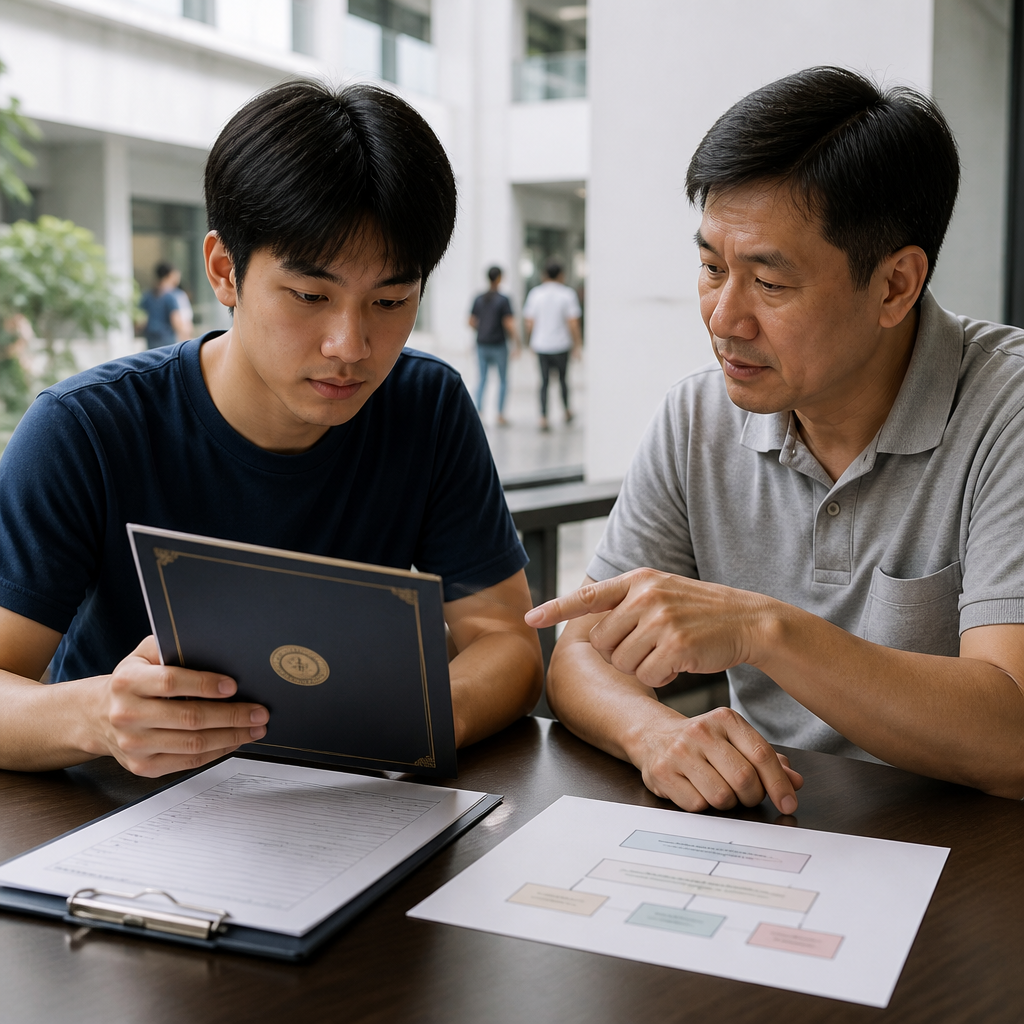 Exemptions can change the timeline quite a lot.
This is one of the most misunderstood areas. A common pattern among students is hearing, “Poly grads can finish faster,” and assuming that applies across the board. It does not.
Some courses are built in a fixed sequence, so exemptions are limited. Others recognise prior learning more generously. Polytechnic does not automatically mean a shorter university route.
Adult learners and working adults
Adult learners often take part-time degree routes, especially through institutions that offer more flexible schedules. Here, the question is usually not about the fastest route. It is about what is sustainable.
A working adult taking two or three modules a term may take longer than a full-time student, but that pace may be far more manageable. For many families, that matters. A slower route is not a weaker route. It may simply be the route that allows someone to keep working, support dependants, and still complete a recognised degree without burning out.
Students changing course or direction
Another factor that families sometimes overlook is course switching. A student may enter university, realise the subject is not a good fit, and transfer to another programme or restart in a different field. That can extend the overall timeline, even if the final degree itself is still officially a 3-year or 4-year course.
This is not always a bad outcome. In some cases, taking a little longer leads to a much better long-term fit. It is usually better to adjust early than to force a poor match all the way to graduation.
Comparing Full-Time Degree Timelines Across Singapore Universities
When families compare autonomous universities, they usually want practical estimates, not broad impressions. The general picture is that many bachelor’s degrees in Singapore take around 3 to 4 years full-time, but the structure behind those years can differ.
Autonomous universities
NUS, NTU, SMU, SUTD, SIT, and SUSS offer programmes with different academic models. Many bachelor’s degrees are around 3 to 4 years full-time. Some universities include broader curricula, interdisciplinary components, internships, or capstone requirements, and these affect planning even when the official duration looks similar.
For example, a 4-year programme may include honours by default, while a 3-year programme may be more streamlined. SIT and SUSS may also have pathway structures that feel unfamiliar to parents who are more used to older university models. That is why programme-specific checking matters more than relying on general impressions.
Honours structures
Families often ask how long it takes to finish an honours degree in Singapore because honours is where a lot of confusion begins. In some universities, honours is built into the programme from the start, making the degree 4 years. In others, honours may depend on performance, progression rules, or whether the student continues into an additional honours year.
That means two students in similar subject areas may not graduate at the same time. If your child is thinking about postgraduate study later on, honours classification, research exposure, and final-year project requirements may matter just as much as the number of years.
Private degree routes
Private institutions and partner-university degree routes may be shorter in some cases, especially for diploma holders who enter with credit recognition. But shorter does not always mean easier, and it does not always mean a better fit.
A compressed programme may come with trimester systems, tighter deadlines, or a heavier pace. So if your family is comparing local autonomous universities with private degree routes, it helps to compare more than duration alone.
How Long Part-Time University Takes In Singapore
For working adults and some diploma holders, this is often the most practical question of all. In many cases, part-time university in Singapore takes around 4 to 6 years, though there can be shorter or longer variations.
Why part-time study takes longer
Part-time study is designed around real life. That may mean evening classes, weekend lessons, reduced module loads, and semesters built around students juggling work, NS commitments, caregiving, or financial responsibilities.
A slower pace is not a sign of weaker ability. Often, it is the only sustainable way to keep going.
Tutors often notice that students begin part-time university with very ambitious plans, especially if they are determined to “finish quickly”. But once work deadlines rise and assignments start stacking up, the strain becomes obvious. In many cases, a manageable load leads to better results and fewer setbacks.
What can shorten or lengthen part-time study
A part-time degree may move faster if the student receives exemptions, manages time well, and can consistently take a heavier load. It may take longer if there are work disruptions, failed modules, leave of absence periods, or limited module availability in certain semesters.
Before enrolling, ask very specific questions. How many modules can be taken per term? Are compulsory modules offered every semester? If one required module is missed, does graduation get pushed back by another half year or more?
Those details matter much more than a simple headline about duration.
If your child is preparing for a demanding university pathway and needs academic support, you can explore our private home tuition options.
What Can Make University Faster Or Slower
Even within the same course, not everyone finishes on the original timeline. This is where university duration becomes very individual.
Polytechnic exemptions and advanced standing
Some diploma holders enter university with advanced standing, which may reduce total time. This is more likely when the diploma is closely aligned with the degree and when the university formally recognises relevant prior learning. Even then, the exact reduction differs by programme.
A student with a business-related diploma may receive some exemption in a related degree, while another student with the same diploma entering a less related field may receive none. That is why families should be careful not to assume that polytechnic always means a shorter route.
Direct honours versus non-honours routes
The answer to how many years a bachelor’s degree takes in Singapore becomes more complicated once honours enters the picture. A non-honours degree may take 3 years. A direct honours route often takes 4 years.
For some students, that extra year is worthwhile because it strengthens preparation for research, postgraduate applications, or more specialised roles. For others, the additional workload may not match their goals. The better option depends on fit, not just prestige or speed.
Other factors that affect graduation timing
Compulsory internships, final-year projects, exchange planning, double majors, second majors, minors, failed modules, and leave of absence can all affect graduation timing. A student who takes time off for health reasons or family issues may need longer, and that does not mean the pathway has failed.
This matters emotionally too. Parents sometimes panic when graduation shifts by one semester. But university is not always a perfectly straight path. Delays can happen because of recovery, rethinking course fit, or simply managing a heavy programme responsibly.
Local and international students
The university course duration for local and international students in Singapore is often similar once both are enrolled in the same degree. However, admission route differences, language requirements, prior qualification mapping, and credit recognition may affect whether exemptions apply.
So while the programme length may look the same on paper, the route into that programme may still look quite different.
A Simple Way To Estimate Your Likely Timeline
If the different pathways still feel confusing, a practical way to estimate duration is to work backwards from the student’s starting point. Ask four questions: What qualification is the student entering with? Is the course standard or direct honours? Are exemptions possible? Is the study mode full-time or part-time?
For example, an A-Level student entering a direct honours programme will often plan around 4 years. A diploma holder with relevant exemptions may complete a related degree faster. A working adult taking a part-time route may need 4 to 6 years even if the degree itself is similar in content.
This kind of simple framework helps families compare options more realistically. Instead of asking for one universal answer, they can ask, “What is the most likely duration for this student in this exact programme?” That usually leads to much better planning.
What Families Should Check Before Choosing A University Route
At this stage, the more useful question is no longer just “how long is university in Singapore?” It is “how long will this specific route take for this specific student?”
Check the official programme structure
Review the current university website carefully. Look at the normal candidature length, honours structure, internship requirements, exemption policies, and whether direct entry to a later year is possible.
Official sources such as MOE and university admissions pages like NUS undergraduate programmes are the safest starting points.
Think about suitability, not just speed
A shorter university route may save time, but families should still check whether the course structure, workload, and study mode are suitable.
A student who chooses a faster course that does not suit their strengths or interests may struggle, repeat modules, or lose confidence. Speed matters, but fit matters more.
Plan for the academic transition
 A smooth transition into university takes preparation.
The jump into university is real. Some students who were coping reasonably well in school start wobbling when lectures become less guided and deadlines pile up.
If your child is entering a demanding course and there are already weak areas in writing, quantitative skills, or subject foundations, early support can make the transition smoother. Families exploring preparation help can read more about university tuition support.
Frequently Asked Questions
How many years is a bachelor’s degree in Singapore?
Most bachelor’s degrees in Singapore take about 3 to 4 years full-time. Some professional or specialised programmes can take longer, and honours structures often push the duration closer to 4 years.
How long does part-time university take in Singapore?
Part-time university commonly takes around 4 to 6 years, depending on the student’s module load, exemptions, work schedule, and whether there are interruptions along the way.
Is university shorter for polytechnic graduates?
Sometimes, yes. Polytechnic graduates may finish faster if they receive exemptions or advanced standing, but this varies widely by university and course. Some diploma holders still complete the full standard duration.
Do local and international students take different numbers of years?
Usually, the degree length is the same if they are enrolled in the same programme. However, the route into the programme may differ because entry qualifications, bridging, or exemption rules are not always identical.
How long does it take to finish an honours degree in Singapore?
In many cases, an honours degree takes 4 years, especially in direct honours programmes. Still, honours structures differ across universities, so always check the specific course requirements.
Conclusion
So, how long is university in Singapore? For many students, the answer is 3 to 4 years full-time, but that is only the starting point.
A-Level and IB entrants often follow the standard full-time route. Polytechnic graduates may or may not receive exemptions. Part-time students usually take longer because they are balancing study with work and life responsibilities. Honours, internships, double majors, advanced standing, and leave periods can all shift the final timeline.
The most practical way to plan is to stop looking for one universal number and start comparing exact programme structures. Check the latest details from MOE and the relevant university website before making decisions, especially for exemptions, honours pathways, and graduation requirements.
If your child may need extra academic support while preparing for university or adjusting to a new course load, learn more about our tutors on our private home tuition page.