


Introduction
By the time PSLE is around the corner, many parents have seen the same frustrating pattern at home. Your child can speak quite fluently, has read plenty of storybooks, and may even memorise good phrases, yet the composition marks still do not move. If you have been wondering how to score well in PSLE English composition, the answer is usually not “use more difficult words” or “write a more exciting story”.
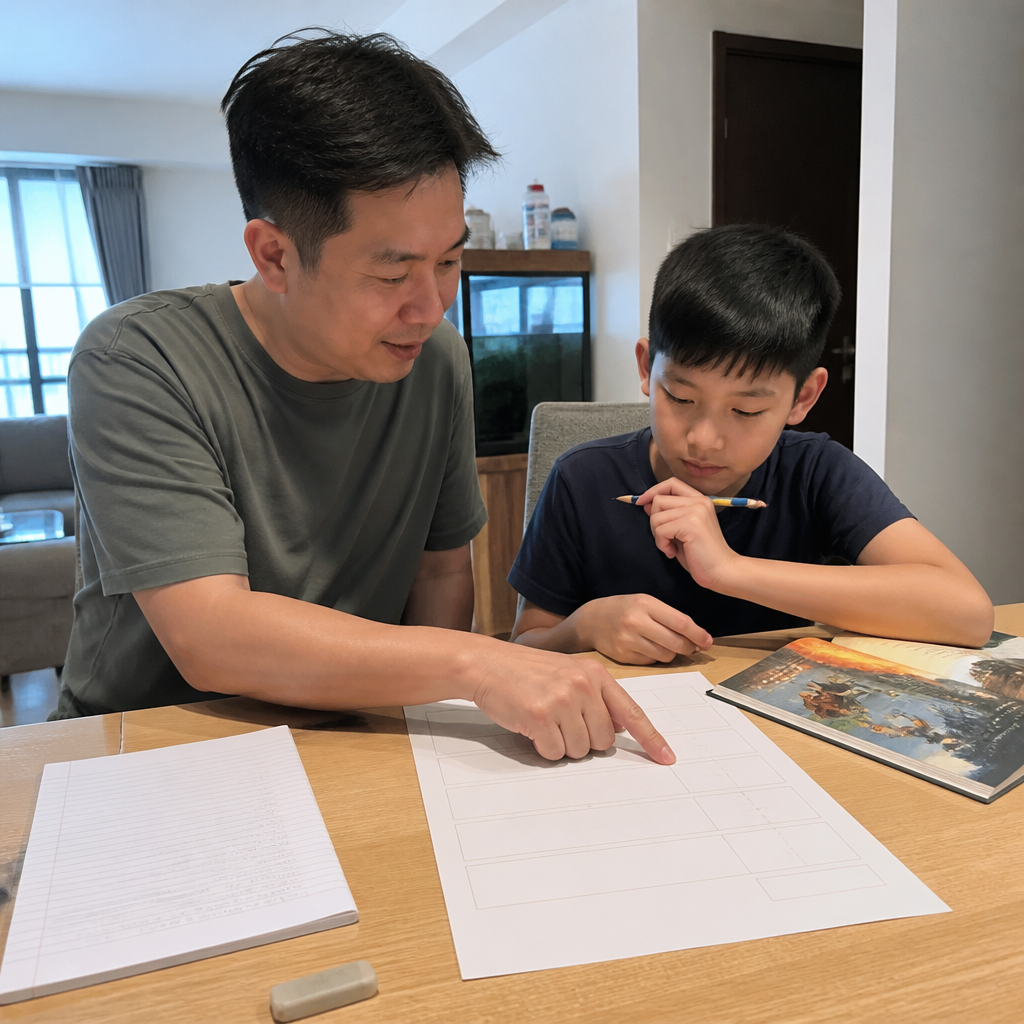
In PSLE English, students usually score better when they understand what the exam is really looking for, then write with focus, relevance, clear language, and good control under time pressure.
That is why some children write long, dramatic stories and still underperform, while others use simpler language and do surprisingly well. PSLE composition rewards relevant ideas, sensible development, accurate grammar, and a storyline that fits the topic closely. This guide breaks down what matters most, where marks are often lost, and how parents can help Primary 5 and Primary 6 children build exam-ready writing habits at home.
Key Takeaways
- Focus on relevance first. A strong PSLE composition is not the most dramatic story. It is the one that answers the topic clearly and keeps every major event connected to the given theme or pictures. Children who stay close to the task usually score better than those who chase excitement but drift off-topic.
- Good planning saves marks. Even two to three minutes of quick planning can prevent weak storylines, missing details, and common composition mistakes such as going off-topic halfway through. A short plan gives the child a clearer path from beginning to ending.
- Language must be controlled, not flashy. Impressive vocabulary helps only when used naturally. A simple sentence with correct grammar usually scores better than an awkward sentence packed with memorised phrases that do not fit the scene.
- The ending matters more than many children realise. A rushed last paragraph often weakens the whole piece. Examiners look for a complete, believable ending that reflects the lesson, feeling, or consequence of the story.
- Editing is part of scoring well. Many Primary 6 students lose marks through preventable tense slips, missing punctuation, and repeated words. Leaving even five minutes to check can make a real difference to the final score.
- Practice should be targeted, not repetitive. Doing many compositions without feedback may only repeat bad habits. Children improve faster when they review storyline, grammar, paragraph control, and relevance after each piece.
- Support works best when feedback is specific. If your child needs closer guidance on structure, accuracy, and exam habits, PSLE English tuition can provide regular correction and coaching, not just more worksheets.
Understand What PSLE Composition Is Really Testing
A lot of stress comes from not being fully sure what examiners want. Parents see low marks and assume the story was “not creative enough”, when the real issue may be poor relevance or grammar errors throughout. To understand how to do well in PSLE English composition, it helps to look at what the paper is testing in practical terms.
For the latest official syllabus and exam information, refer to MOE’s primary syllabus page and SEAB’s PSLE information.
PSLE composition is not just about writing a nice story
In the PSLE English paper, composition writing tests more than imagination. Examiners are looking at whether a child can develop a clear idea, organise it logically, use language accurately, and stay relevant to the given task. So a child who writes an exciting rescue scene but ignores the picture theme may still lose significant marks.
This is where many children slip. They have read plenty of PSLE composition model essays, but instead of learning how those essays are built, they try to lift the same plot into every topic. The result often feels forced. A model essay should teach structure, pacing, and relevance, not become a script to recycle.
What examiners tend to reward
Without oversimplifying PSLE composition marking, parents can think of it in two broad areas: content and language. Content includes relevance, idea development, organisation, and storyline control. Language includes grammar, vocabulary, punctuation, sentence structure, and clarity.
A common pattern among students is this: they overestimate how much “fancy” vocabulary can save a weak composition. It cannot. If the plot does not fit the topic, or the grammar repeatedly breaks down, marks will still suffer.
Here is a simple way to look at it:
Strong writing for PSLE is usually clear, relevant, and controlled, not dramatic for its own sake.
Start with the Topic and Pictures Properly
The first few minutes matter more than many students realise. Some children see one familiar picture, panic with excitement, and immediately decide to recycle an old story. That is often where the trouble begins.
Read the theme, not just the most exciting picture
In many PSLE tasks, students are given a theme and a set of pictures to guide them. The pictures are there to spark ideas, not to be copied mechanically. A strong writer asks, “What is the central situation here?” not just “Which picture can I use?”
If the topic suggests honesty, responsibility, or helping someone, then the whole composition should revolve around that idea. A child who writes a thrilling chase scene but only mentions honesty in one sentence is unlikely to score well. The best PSLE English composition answers keep the theme visible from start to finish.
Avoid the memorised story trap
This is one of the most common PSLE English composition mistakes to avoid. A child memorises a “lost wallet” essay, a “fire drill” essay, or a “sports day accident” essay, then tries to force it into unrelated topics. Parents usually sense something is off when the story sounds polished in parts but strangely disconnected overall.
Examiners can usually tell when a composition has been bent unnaturally to fit. The storyline may suddenly include a dramatic hospital scene when the theme only needed a simple act of kindness. What scores better is often a fresh but manageable story that matches the question closely.
Quick planning prevents messy writing
Children do not need a long outline. Even a short plan helps. A useful habit is to jot down the beginning, main problem, key turning point, and ending. If the child cannot explain the story in four short points, the plot may already be too complicated.
Tutors often notice that children who skip planning do not actually save time. They usually lose it later by wandering, repeating themselves, or getting stuck halfway.
A quick plan can look like this:
One more useful habit is to ask one final planning question before writing: “Does every major event connect back to the topic?” If the answer is no, the child should simplify the plot before starting.
Build A Focused Plot Instead Of An Overly Dramatic One
Parents often assume a more exciting story will automatically get higher marks. In reality, exaggerated plots can backfire badly in PSLE composition. The exam rewards controlled storytelling, not movie-style chaos.
Keep the problem believable and easy to develop
A good PSLE story usually has one main problem, not three different disasters in a row. If a child starts with a missing bag, then adds a thunderstorm, a runaway dog, and a car accident, the composition often becomes shallow because there is no room to develop each event properly.
Compare the difference:
A simpler plot is often much easier to write well under exam conditions.
Character motivation must make sense
Weak character motivation is another issue that quietly costs marks. Sometimes children make a character act bravely, cruelly, or generously with no explanation at all. The story then feels artificial.
A more convincing composition shows why the character acted that way. Small motivations make the writing feel more real, and realistic writing is usually easier for examiners to follow.
Use model essays to learn control, not copy plots
Good PSLE composition examples are useful when children study how the writer introduces the setting, builds tension, and ends the story clearly. They are much less useful when children try to memorise whole paragraphs.
The same goes for model essays for Primary 6. Read them to notice structure and relevance, not to produce clones. Otherwise, children may sound polished but inflexible, and that usually shows when the exam topic changes.
A practical way to use model essays is to ask your child to identify three things after reading one: how the writer started the story, how the main problem was developed, and how the ending linked back to the theme. This turns reading into analysis instead of memorisation.
Use Language That Is Accurate, Specific, And Exam-Safe
By the time it is late in the evening and your child is still rewriting one paragraph because “it doesn’t sound good enough”, it is easy to focus only on stronger vocabulary. But in PSLE, language marks are not about sounding advanced at all costs.
Accurate grammar often beats ambitious vocabulary
Many students lose marks because they try to write beyond their control. A sentence can sound impressive but still feel awkward or contain tense and usage issues. A cleaner sentence with accurate grammar is often more effective.
Careless tense errors are especially common. Children may begin in past tense, switch into present tense during an exciting part, then return to past tense without noticing. This happens often when they rush or when they memorise phrases from different essays. Grammar control is one of the clearest ways to improve PSLE English composition marks.
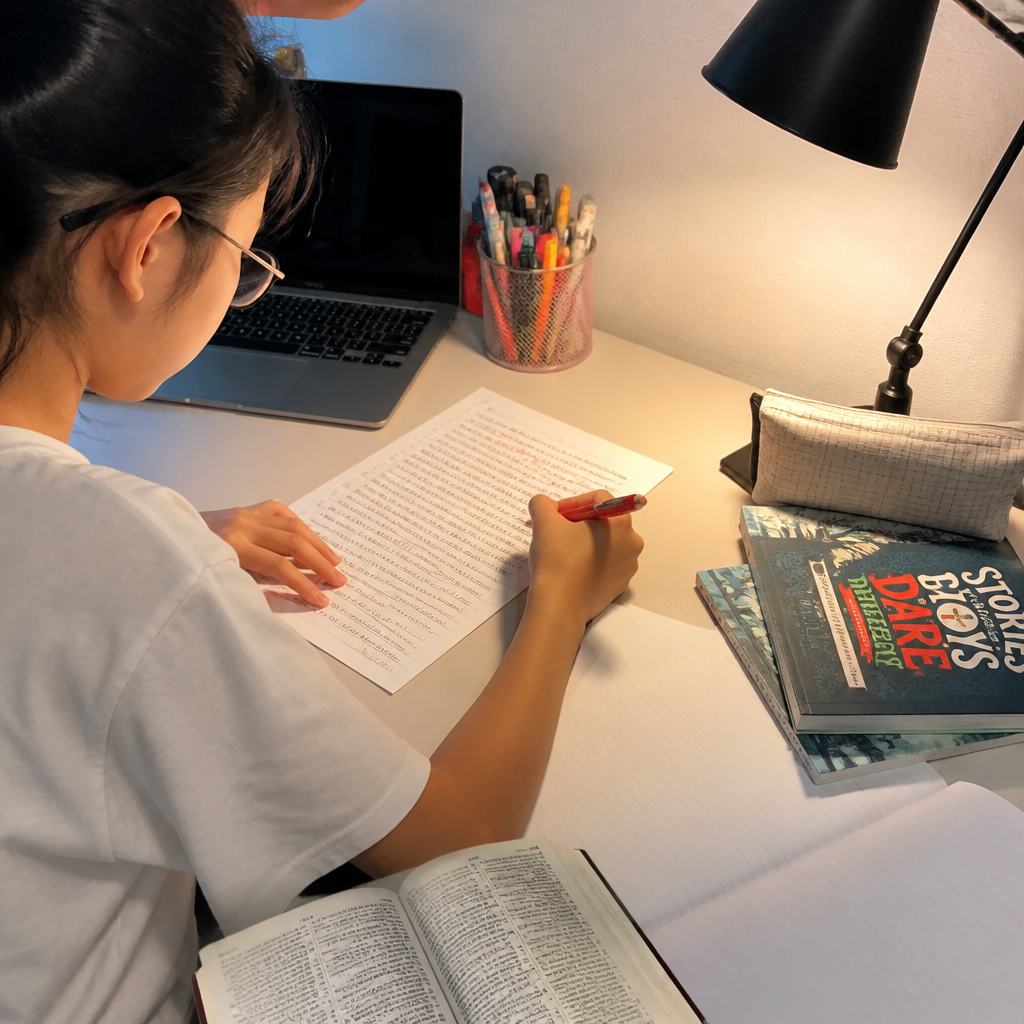
Vocabulary should match the scene
A Primary 6 child does not need difficult words in every paragraph. What matters is choosing words that fit the situation. Sometimes a simpler word is not weaker, it is simply more precise.
This is a key part of how to improve composition writing at home. Rather than drilling long vocabulary lists, help your child build smaller banks of useful feeling words, action verbs, and simple descriptive phrases tied to familiar PSLE themes such as honesty, courage, friendship, responsibility, and kindness. These are easier to remember and more likely to be used correctly.
Sentence variety matters, but clarity comes first
Some children write every sentence in the same pattern, which makes the composition flat. Others overdo long sentences and end up confusing themselves. The best balance is a mix of shorter and slightly longer sentences, with clear punctuation.
When children learn to vary sentence length without losing clarity, their writing sounds more natural and more confident.
Another useful habit is to teach children to read one paragraph silently after writing it. If they cannot follow their own sentence easily, the examiner probably will not either. Clarity is not boring. In exam writing, clarity is a strength.
Manage Time Well, Write A Strong Ending, And Leave Room to Edit
Some of the saddest scripts are not weak in ideas at all. They simply collapse at the end. A child spends too long on the first two paragraphs, then rushes the climax and scribbles a flat ending in the final minute.
A complete ending can lift the whole composition
In PSLE, the ending should not feel like an afterthought. It should show the outcome and leave the examiner with a clear sense of closure. That does not mean every composition must end with “I learnt a valuable lesson”. Repeated moral endings can sound mechanical.
A better ending shows the emotional result or consequence. Simple endings often work best because they feel earned and believable.
Editing is where many marks can be saved
Five minutes of checking can catch repeated names, missing capital letters, subject-verb agreement problems, and accidental tense slips. Yet many children leave no time because they believe finishing the story is enough.
A common pattern among students is this: those who practise timed writing regularly become much more realistic about pacing. They stop spending too long on one introduction and learn to move the story forward. Editing is not optional polishing, it is part of exam technique.
Home practice should include timing, not just writing
If you are looking for practical ways to help your child with PSLE English composition, this is one of the most useful. Once or twice a week, let your child write under near-exam timing, then review not just the essay but also where time was lost. Did they over-plan, freeze during the middle, or rush the ending?
A simple routine can help: a few minutes to read and plan, most of the time to write, and the last few minutes to edit. Children who practise this regularly usually become calmer because they know what to do at each stage instead of guessing under pressure.
For children who need more structured correction and guided practice, our PSLE tuition support can help them build stronger composition habits before the exam pressure peaks.
Help At Home Without Making Writing More Stressful
Composition can become a surprisingly emotional subject at home. A child stares at the paper, says “I don’t know what to write”, and the parent, already tired from work and weekday homework battles, feels frustration rising. This is where support needs to be practical, not pressure-heavy.
Do not correct everything at once
When parents mark every grammar error, awkward phrase, and idea weakness in one sitting, children often shut down. They stop seeing composition as something they can improve and start seeing it as a subject where everything is wrong.
A better approach is to focus each practice on one or two targets at a time. One week, work on relevant story planning. Another week, focus on tense consistency and ending quality. This makes feedback easier to act on and often leads to faster improvement.
Discuss stories orally before writing
Some children think more clearly when speaking first. Ask simple prompts: “What is the problem?”, “Why does the character care?”, “What changes by the end?” This helps children sharpen the plot before they start writing.
It also reduces panic. Very often, the child does have ideas, just not in organised form. A short discussion can turn a blank page into a workable plan.
Build confidence through review, not just correction
One overlooked way to help is to review what went well after each composition. If a child finally stayed on topic, wrote a clearer climax, or used dialogue more naturally, point that out. Children improve faster when they know which habits to keep, not only which mistakes to remove.
When tuition may be worth considering
Not every child needs intensive support, but some do benefit from consistent external feedback. If your child keeps repeating the same errors, writes irrelevant plots, or cannot transfer school feedback into better exam writing, guided help can make practice more productive.
If your child needs more structured support with PSLE English composition, learn more about our PSLE tutors and request a suitable tutor when you are ready: Contact us for private home tuition
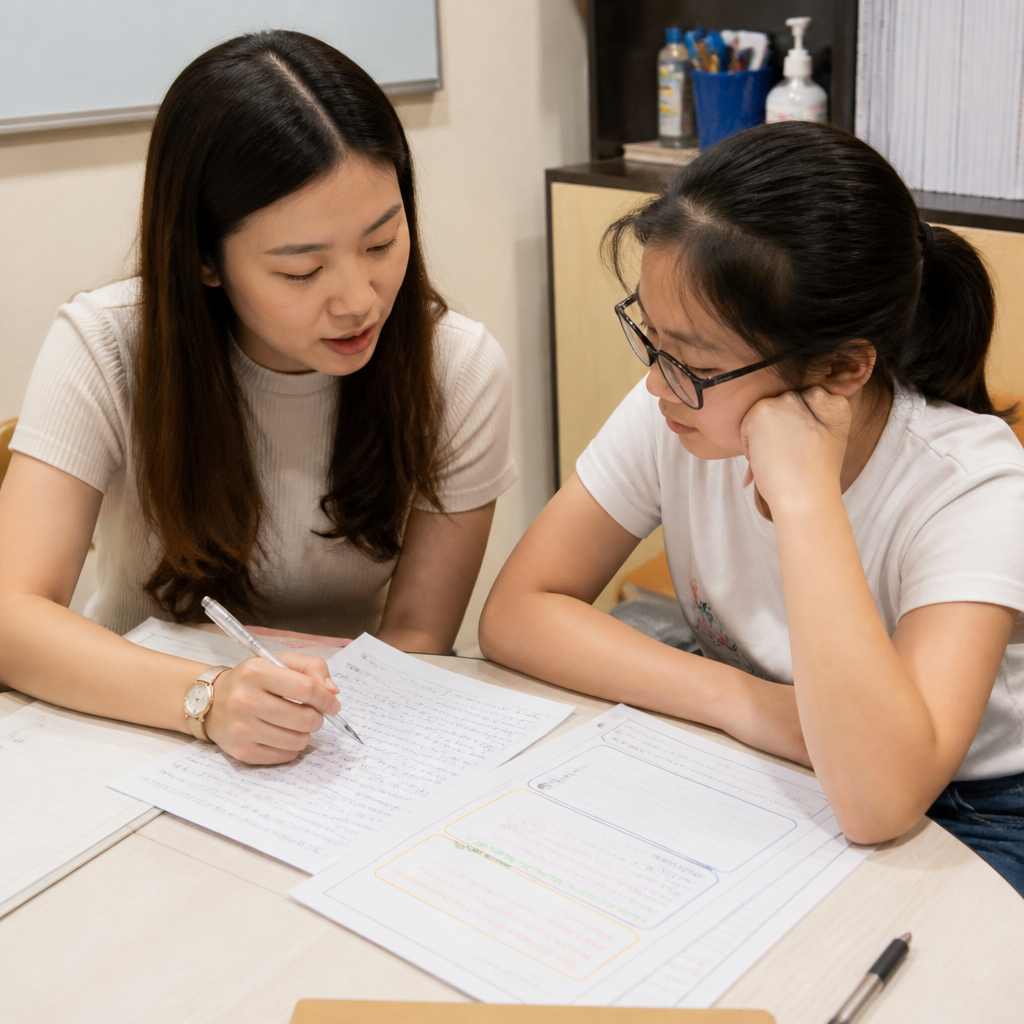
When parents search for the best PSLE English composition tutor in Singapore, it helps to look beyond “notes” and “model essays”. The more useful support usually comes from a tutor who can explain why a storyline is weak, where grammar is breaking down, and how to write under timed exam conditions.
Frequently Asked Questions
How many model essays should my child memorise for PSLE composition?
Memorising many essays is usually not the goal. A child may remember beautiful phrases but still go off-topic in the exam. It is better to study a smaller number of strong essays and learn how they handle the opening, problem, climax, and ending. Use model essays as learning tools, not scripts to copy.
What are the most common PSLE English composition mistakes to avoid?
Some of the biggest mistakes are forcing memorised stories into the wrong topic, writing overly dramatic plots, losing tense control, giving weak character motivation, and ending too abruptly. These mistakes matter because they affect both content and language marks. In many cases, a simpler but more relevant composition will score better than a dramatic but messy one.
My child has good ideas but still gets low marks. Why?
This happens more often than parents expect. Good ideas alone are not enough if the story is not organised well or the grammar keeps breaking down. In PSLE, a sensible, relevant composition with accurate language often beats a creative but confusing one. Children need both ideas and control.
How can I help if I am not confident in English myself?
You do not need to be an English expert to help. Focus on whether the story fits the topic, whether the events make sense, and whether the ending feels complete. Even simple support such as timing the practice, discussing the plot aloud, and checking for obvious repeated errors can help a lot.
Conclusion
If you have been trying to figure out how to score well in PSLE English composition, the core answer is this: children need to write relevantly, plan quickly, build a focused storyline, use language they can control, and save time to edit. Marks are often lost not because a child lacks imagination, but because the story does not fit the task, the grammar is careless, or the ending is rushed.
For parents, the goal is not to turn every practice session into another stressful correction exercise. Better results usually come from targeted feedback, realistic timed practice, and regular review of what keeps going wrong. Over time, children learn that good PSLE composition writing is less about showing off and more about writing clearly, accurately, and purposefully.
If your child needs more structured support with PSLE English composition, learn more about our PSLE tutors and request a suitable tutor when you are ready: Contact us for private home tuition