


Introduction
By 7.30pm, many Singapore homes start to feel tense. Dinner is barely cleared, school bags are open, spelling lists and Math worksheets are out, and someone is already saying, “Faster finish your homework.” If you have been wondering how to help kids with homework without nagging, repeating instructions, or ending the night in frustration, you are not alone.
For many parents, the struggle is not laziness. It is the daily mix of tired children, working parent schedules, tuition timings, CCA fatigue, and school tasks that look manageable on paper but feel heavy in real life. A child may be slow, distracted, careless, or constantly asking for help. A parent may feel torn between stepping in and backing off.
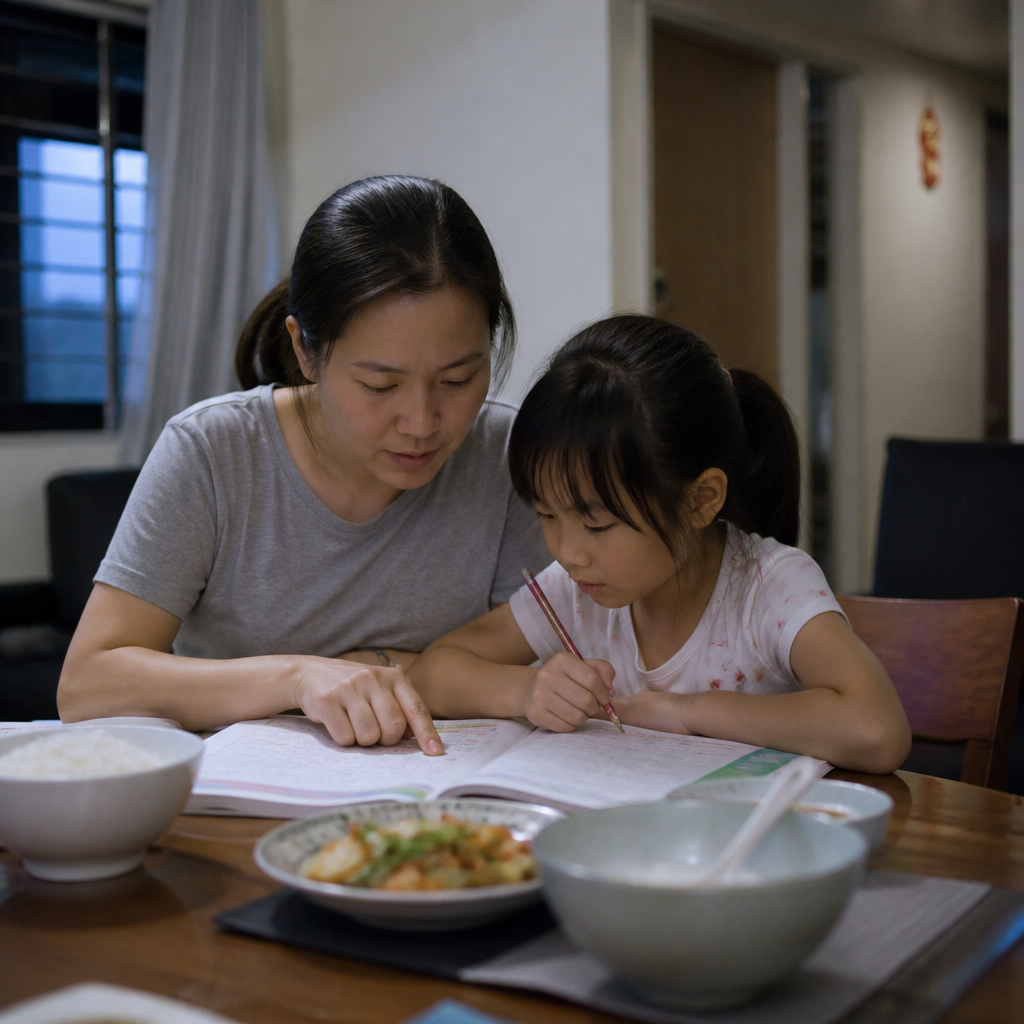
The good news is this, helping children with homework is usually less about pushing harder and more about adjusting the home setup, your role, and the rhythm of the evening. The aim is not perfect homework. It is a calmer routine that feels more independent and less emotionally draining for everyone.
Key Takeaways
- Start with calm, not control. Children usually do homework better when the evening begins with a predictable routine instead of immediate pressure. A tired child often needs a transition, not another command, especially after a long school day or CCA.
- Create a homework routine that fits your real weekday life. Good routines do not have to look ideal. They need to work around dinner, showers, tuition, enrichment, and your work hours so that the plan is sustainable.
- Support without taking over. If you are always giving answers, checking every line, or sitting beside your child throughout, homework can become parent-dependent instead of child-managed. Over time, that makes evenings harder, not easier.
- Use guiding questions to build thinking. Asking “What is the question asking?” is often more useful than explaining the whole page. This helps children focus, recall what was taught in class, and build confidence in solving problems.
- Reduce stress before trying to improve speed. Slow homework is often linked to tiredness, confusion, or fear of making mistakes. Lowering pressure is one of the best ways to reduce homework stress at home and improve consistency.
- Notice patterns, not just bad nights. Occasional distraction is normal. Repeated struggle in one subject, especially if your child forgets basics or cannot work independently, may signal a learning gap rather than a motivation issue.
- Get extra support when needed. If homework battles are really about weak understanding or low confidence, a tutor may help lighten the emotional load at home. You can learn more about our tutors if your child needs gentle academic support to build confidence, improve homework routines, and reduce daily stress.
Change The Evening Flow Before You Change Your Child
A common mistake is starting homework the moment your child walks in. It sounds efficient, but it often backfires. After a full school day, maybe followed by CCA, enrichment, or a long bus ride home, many children are mentally flat. That is when small corrections can quickly become big arguments.
Build a transition, not a sudden command
Instead of “Go and do your homework now”, try a short reset period. For a Primary 3 child, that might mean a snack, shower, and 15 minutes to decompress. For a Secondary 1 student, it may mean dinner first, then starting at 7pm.
This matters because younger children often need help switching gears. A child who has just finished 听写 corrections and Chinese oral preparation in school may not be ready to sit down instantly for Math. A smoother transition often leads to less resistance later.
Use a repeatable weekday rhythm
Routines work best when they are boring in a good way. Children argue less when the sequence is familiar because they know what comes next.
A realistic example:
For families with late working hours, the order may differ. Good homework routines for busy working parents in Singapore often include a visible timetable, preparing books the night before, and setting a clear start time even if a helper or grandparent is present before you return.
Avoid turning homework into a nightly power test
Some parents become very firm because they are afraid their child will fall behind. That fear is understandable. But when every evening becomes a test of obedience, homework starts carrying emotional weight far beyond the worksheet itself.
Tutors often notice that children who hear constant pressure do not always become faster. Sometimes they become more avoidant, more dependent, or more anxious. Calm consistency is usually stronger than intensity.
Set Up A Study Space That Makes Focus Easier
When parents ask why homework takes two hours for what should take 40 minutes, the answer is often not just attitude. Very often, it is the environment.
Make the space easy to work in
The study area does not need to be fancy. It just needs to reduce friction. A clear table, proper chair, good lighting, stationery within reach, and school books organised before starting can make a surprising difference.
You see this especially with younger children. A Primary 2 child who leaves the table three times to find an eraser, ruler, and spelling file loses momentum each time. Then the parent assumes the child is dragging, when the setup itself is part of the problem.
Remove the distractions that create “fake homework”
Many children look busy without getting much done. They sharpen pencils too often, stare at one question for five minutes, or suddenly need water again. For older students, the bigger issue is usually the phone.
If you want to help children focus on homework after school, start with what is competing for their attention. Keep the phone outside the study area unless needed for schoolwork. Turn off background TV. Even siblings can be distracting if one is playing while the other is trying to revise Science open-ended questions.
Match the setup to the child
Not every child works best in total silence. Some do better with a parent nearby doing their own work. Others become dependent if an adult is always next to them.
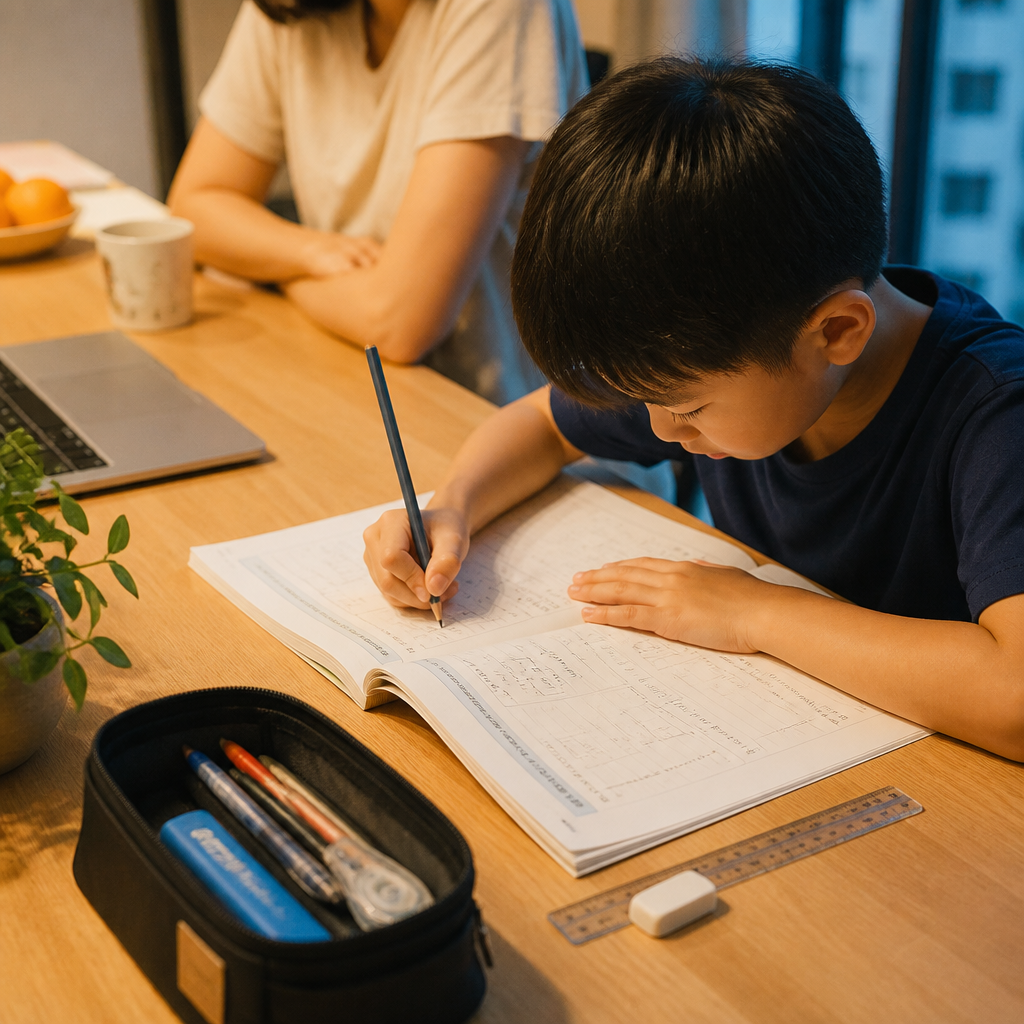
A practical middle ground is presence without hovering. Sit nearby for the first 10 minutes, help them settle in, then step away. That often lowers stress because the child feels supported without feeling watched.
Help With Homework Without Doing It For Them
This is where many well-meaning parents get stuck. You want to help, but each time you explain one answer, your child asks for the next one too. Very quickly, the homework has become yours.
Ask guiding questions instead of giving answers
A helpful question sounds like this:
- “Can you show me which part you don’t understand?” This helps your child identify the exact problem instead of saying everything is hard.
- “What did your teacher do in class?” This prompts recall and encourages your child to use what was already taught.
- “What is the question asking you to find first?” This breaks a difficult task into a manageable first step.
A less helpful response is immediately reteaching the whole topic.
If your child is stuck on a fraction word problem, for example, there is no need to launch into a full lecture. Ask them to underline the key information and tell you what operation might be needed. Even if they are unsure, they are still thinking. That thinking process is what builds confidence.
Check understanding, not just completion
Many parents focus on whether the page is finished. But a completed worksheet full of guessed answers teaches very little.
A more useful habit is to ask your child to explain one or two answers aloud. If they can describe why they chose a method, understanding is likely there. If they say, “I just anyhow put”, then the issue is not speed. It is confusion.
Independence does not mean leaving a child alone with work they do not understand. It means giving enough support for them to think and try on their own.
Know when too much correction backfires
Some children shut down when every tiny mistake is pointed out. You may have seen this during English composition corrections or Chinese spelling review. The child starts erasing nervously, rushing more, and making even more careless mistakes.
Correct the most important errors first.
If the worksheet has 12 issues, choose the three that reveal a pattern. That keeps homework from becoming a nightly confidence drain.
Encourage Better Homework Habits Without Nagging
Most parents know nagging is not ideal. The problem is that without reminders, some children drift. The answer is not to say nothing. It is to change the type of prompting.
Use clear expectations before homework begins
Children cope better when they know what “done” means. A vague instruction like “Go finish your work” often leads to repeated checking.
A clearer version is, “Finish your English worksheet and your Math corrections before dinner. If you get stuck after trying two questions, call me.” That small bit of structure helps children start homework with less resistance.
Praise effort that builds habits
One of the most effective positive reinforcement strategies for homework habits is noticing specific behaviour:
- “You started on time today without me calling twice.” This reinforces initiative.
- “You checked your Science answers before showing me.” This encourages self-monitoring.
- “You packed your files properly after finishing.” This supports organisation, which affects the next day too.
This works better than broad praise like “Good boy” because it tells the child what to repeat. A common pattern among students is that they respond better when praise is tied to something concrete.
Be careful with rewards
Rewards can help, but they can also become expensive emotionally. If every worksheet needs bubble tea, screen time bargaining, or a shopping promise, homework becomes a transaction.
A better approach is a simple weekly system. If your child follows the homework routine independently on four weekdays, Friday can include extra play time or choosing dinner. The reward is tied to routine, not perfect answers.
Reduce Homework Stress When Your Child Is Slow Or Overwhelmed
The parent fear behind slow homework is very real. You look at the clock, tuition is at 8pm, there is still 听写 to revise, and your child has only finished half a page. It is hard not to panic.
Slow does not always mean lazy
Some children work slowly because they are distracted. Others are perfectionistic and erase repeatedly. Some have weak confidence in one subject and spend too much mental energy trying not to get things wrong.
Before pushing speed, identify the real cause. A child who is confused needs clarity. A child who is tired needs a better schedule. A child who is anxious needs less pressure, not more.
Reduce the load where possible
If your child is exhausted after school and tuition, the answer may not be more pressure. It may be better sequencing. Finish urgent school homework first. Leave extra assessment books for weekends. Shorten revision on heavy CCA days.
Not every weekday needs to carry the same workload. Families usually cope better when they recognise energy limits instead of expecting every evening to run the same way.
Teach one simple checking habit at a time
Careless mistakes frustrate parents because the child often knows the content. But “Check properly” is too vague. Instead, give one checking job at a time.
- For Math, check all signs and units.
- For English, look for capital letters and full stops.
- For Science, make sure every part of the question is answered.
Specific checking lowers stress because it feels manageable.
Use short breaks before frustration becomes a meltdown
One small change that helps many families is using breaks earlier, not later. Parents often wait until a child is already crying, sulking, or arguing. By then, the break feels like damage control.
A better approach is to plan a short pause before emotions spike. After 25 to 35 minutes of focused work, let your child stand up, drink water, stretch, or walk around for five minutes. Younger children especially benefit from movement. The break should be brief and predictable, not a chance to disappear into videos or games.
This works because attention drops before behaviour does. If you protect your child’s attention, you often prevent the argument that would have followed.
Build Homework Independence Gradually
Independence does not appear overnight. It grows when parents gradually reduce support in the right areas.
Shift from full supervision to checkpoints
If you currently sit through the entire session, try changing that to checkpoints. Stay for the first five minutes, return after one page, then review at the end.
This prevents overreliance on parent help. Tutors often notice that some primary and lower secondary students are not unable to do the work, they are simply used to asking before trying.
Let your child experience manageable struggle
Many parents rescue too quickly because they cannot bear the frustration. That is understandable, but not always helpful.
If your child pauses, frowns, and thinks for one minute, that is not suffering. That is learning. If they are stuck for 15 minutes and clearly lost, support is needed. If they are thinking, wait.
Make independence visible
Try using a simple self-check habit:
- Did I read the instructions?
- Did I try first?
- Did I check one answer before asking for help?
For older students, especially those moving toward weighted assessments and heavier school demands, this kind of self-management matters more than parent reminders alone.
A simple checklist on the table can help younger children too. It reduces repeated verbal reminders and gives them something concrete to follow. Over time, the goal is for the checklist to move from paper to habit.
Know When Extra Academic Support May Help
Not every homework issue needs tuition. Sometimes the problem is routine, fatigue, or parent-child tension. But there are also times when homework battles are pointing to deeper academic strain.
Look for patterns that point to learning gaps
Consider extra help if your child:
- Regularly cannot start homework without full explanation.
- Makes the same mistakes after repeated correction.
- Avoids one subject because they feel “stupid” or scared.
- Takes far too long because basic skills are weak.
- Depends on you every day despite your efforts to build independence.
The goal is not to outsource parenting. It is to reduce daily conflict when the work itself has become too difficult for your child to manage confidently.
Tuition should support understanding, not just completion
A good tutor should not simply sit beside your child and feed answers. The role is to strengthen foundations so homework becomes less draining at home. A child who keeps guessing Science open-ended answers, for example, may need help understanding keywords and answering techniques, not more scolding over unfinished worksheets.
If your family needs that kind of support, you can learn more about our tutors or contact us for private home tuition. Gentle academic support can sometimes make evenings feel like family time again instead of a second school shift.
Keep expectations realistic
Even with tuition, children still need routines, sleep, and emotional breathing room. Tuition may help with confidence and clarity, but it is not a magic fix for every homework habit.
For broader parenting and child wellbeing guidance, parents can also refer to the MOE Parent Kit and HealthHub’s child and teen health resources.
Frequently Asked Questions
My child takes very long to finish homework. Should I sit beside them the whole time?
Usually no. Sit with them at the start to help them settle, then move to short check-ins. If you stay throughout, some children become more dependent and slower because they wait for help before trying.
How can working parents manage homework if we come home late and everything already feels rushed?
Keep the routine simple and repeatable. Prepare books the night before, use a fixed start time with whoever is at home, and focus on priority tasks on weekdays. The goal is not a perfect evening. It is a predictable one that your child can recognise and follow.
Should I correct every mistake during homework, or will that make things worse?
No, not every mistake needs immediate correction. Too much correction can make children tense and discouraged. Focus on recurring mistakes or major misunderstandings first, then leave smaller issues for later review if needed.
What if my child keeps asking for help even when they probably know the work?
This often means they are seeking reassurance, not answers. Ask them to attempt one question first, then explain their thinking to you. Over time, this is usually more effective than jumping in immediately if your goal is to build homework independence.
How do I know whether homework stress is normal, or a sign of a bigger problem?
Occasional tiredness is normal. Repeated tears, extreme delay, strong fear of certain subjects, or inability to work without adult support may suggest deeper gaps in understanding or confidence. That may be the point to consider whether extra school support or tuition would help.
Conclusion
If you are trying to figure out how to help kids with homework without turning every evening into a battle, the answer is rarely to become stricter or more involved in every question. In many homes, things improve when the routine becomes more predictable, the study space is less distracting, the parent gives guidance instead of answers, and the child is gradually trusted to do more independently.
Some nights will still be messy. That is normal. A tired Wednesday before 听写, a long CCA day, or a week packed with weighted assessments can test any family. What matters is not perfection, but a home rhythm that lowers pressure and supports learning without damaging the relationship.
And if homework struggles are revealing deeper academic gaps, confidence issues, or subject-specific stress, outside help can make a real difference. You can learn more about our tutors if your child needs gentle academic support to build confidence, improve homework routines, and reduce daily stress at home.