


Introduction
It often starts in a way that is easy to miss. Your child says school was “fine”, but suddenly does not want to go for CCA. They pause before opening the class WhatsApp chat. Monday morning stomachaches appear out of nowhere. As a parent, that uneasy feeling can stay with you the whole day. You do not want to overreact, but you also do not want to miss the moment when your child needs you most.

If you have been wondering how to talk to your child about bullying, the first goal is not to force a confession or fix everything in one sitting. It is to create enough safety for your child to speak honestly before the situation becomes heavier, more hidden, or more painful. In many Singapore families, where school life is packed with homework, tuition, spelling, revision, and early bedtimes, these conversations can easily get pushed aside. But a calm, gentle start can make a real difference.
Key Takeaways
- Notice the small shifts early. A child who is being bullied may not say it directly. School avoidance, missing items, fear of group chats, or sudden mood changes can be quiet warning signs. Paying attention to these changes helps you step in before the problem grows.
- Choose a calm moment, not a pressured one. A car ride, walk home, or bedtime chat usually works better than questioning your child right after school when everyone is tired and defensive. The setting often shapes whether your child feels safe enough to talk.
- Keep the first conversation gentle. Start with open, everyday questions about recess, classmates, CCA, and group chats instead of asking, “Are you being bullied?” This lowers your child’s guard and makes the conversation feel less frightening.
- Explain bullying in simple, age-appropriate language. Children need help understanding that bullying is not only hitting. It can also be repeated teasing, exclusion, rumours, mocking, or peer pressure that makes them feel small or unsafe.
- Respond calmly when your child opens up. Phrases like “Thank you for telling me” and “We will figure this out together” help your child feel safe. Blaming or dismissive comments can shut the conversation down quickly.
- Get a clearer picture without turning it into an interrogation. Ask lightly about who was involved, where it happened, whether it was repeated, and how your child felt. The aim is understanding what happened at school, not cross-examination.
- Know when a gentle chat is not enough. Repeated bullying, threats, fear of school, cyberbullying, physical harm, or strong emotional distress may need further action with the school or other support.
Notice The Early Signs Before Your Child Says Anything
Many parents picture bullying as something obvious, a child coming home in tears, a visible injury, or a teacher calling. But in real life, the early signs are often much quieter. That is why learning how to talk to kids about bullying usually begins with noticing behaviour before words.
Signs your child may be facing bullying
Sometimes the signs can look like “bad attitude” at first. A normally chatty child becomes snappy at dinner. A child who used to enjoy school starts dragging their feet every morning. Another suddenly says they want to quit CCA, even though they used to look forward to it.
Tutors often notice this in subtle ways too. A child who used to focus during lessons may keep glancing at their phone, not because of games, but because they are anxious about what is being said in a group chat. Another may suddenly dread oral practice because classmates have been mocking the way they speak.
Here are some signs your child may be bullied:
Why children often do not tell parents right away
Silence does not mean nothing is wrong. Children stay quiet for many reasons. Some feel embarrassed. Some worry you will march to school the next day. Some think they should be able to handle it themselves. Older primary school children, especially, may fear being seen as weak or dramatic.
A common pattern among students is that they stay quiet not because the problem is small, but because they do not yet know how to describe it. So when a child says “nothing happened”, it may simply mean, “I do not know how to say this yet.”
Choose The Right Time And Setting For A Bullying Conversation
Timing matters more than many parents realise. If your child has just reached home, is sweaty from school, hungry, and already thinking about homework, that is rarely the best time for a serious conversation. Even a caring question can feel like pressure.
Better moments to talk
The best conversations often happen sideways, not face-to-face across a table. A car ride helps because your child does not need to maintain eye contact. A walk home gives both of you something else to look at. Bedtime check-ins can work when the house has finally gone quiet.
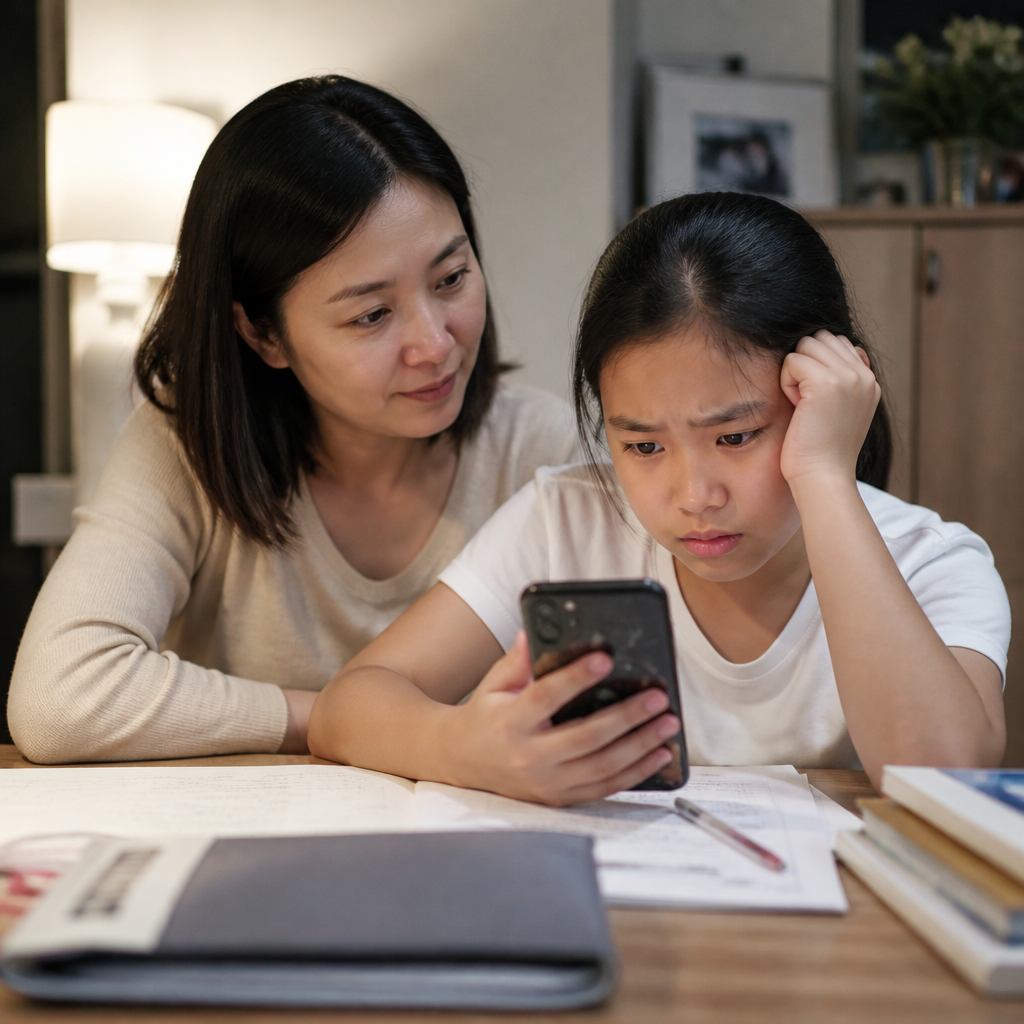
Picture this. It is 9.30pm, spelling is done, the school bag is packed, and the usual evening rush has settled. Instead of launching into “Tell me what is going on”, you sit beside your child and say, “You’ve seemed a bit quieter lately, especially on CCA days. I might be wrong, but I wanted to check in.”
That feels very different from an interrogation.
What usually backfires
Worry makes many parents ask in the heat of the moment. That is understandable. But a sharp “What happened in school today?” when everyone is tired can make a child retreat instantly.
What often backfires includes questioning your child the second they walk in, asking in front of siblings or grandparents, sounding angry before your child has even spoken, demanding immediate details, or bringing it up during a homework battle. A child who already feels powerless at school may shut down if home also feels intense.
Explain Bullying In A Way Your Child Can Understand
Some children do not speak up because they do not realise what they are experiencing counts as bullying. This is especially true when it is not physical. Knowing how to explain bullying to primary school children can help them recognise when something is wrong.
Use concrete, child-friendly examples
You do not need a long lecture. Keep it simple. You might say:
Bullying is when someone keeps being mean in a way that hurts, scares, embarrasses, or isolates another person. It is not only hitting. It can also be teasing someone again and again, leaving them out on purpose, calling them names, spreading rumours, laughing at them in class chats, or pressuring them to do things they do not want to do.
This matters because many children think bullying only means fighting. They may not realise that repeated exclusion at recess, mocking in a Telegram group, or being dared to do something embarrassing are also serious.
Include peer pressure in the conversation
Talking to children about bullying and peer pressure often needs to happen together. In school settings, the line between the two can blur. A child may not be directly bullied, but may be pressured to laugh along, pass messages, gang up on someone, or stay silent to protect their own place in the group.
You could say:
Sometimes children do things because they want to fit in, even when they know it is wrong. If someone makes you feel you must do something uncomfortable just to be accepted, that is not real friendship.
For a primary school child, examples usually help more than labels. Clear language gives them a way to describe what they are seeing and feeling.
Start Gently Instead Of Forcing A Confession
When parents search for what to say when your child is being bullied, many hope for one perfect sentence. In reality, it is usually a series of small, gentle questions that opens the door.
Questions that feel safe
Instead of asking, “Are you being bullied?”, try softer entry points:
- “How are things during recess these days?” This helps your child talk about daily school life without feeling labelled.
- “Who have you been hanging out with lately?” Friendship changes often reveal more than direct questions.
- “How is CCA feeling for you recently?” If your child has become reluctant to attend, this can uncover social tension there.
- “Anything happening in the class chat that feels uncomfortable?” This is especially useful now that so much school stress spills into digital spaces.
- “Have there been moments in school where you felt left out or uneasy?” This gives your child emotional language without forcing the word bullying.
- “Did anyone say or do anything this week that made you feel small or upset?” This can help children describe teasing, exclusion, or humiliation more clearly.
Each question works because it gives your child room to answer gradually. A child might not respond to the word “bullying”, but may admit, “I don’t like recess anymore”, or “They keep laughing in the group chat.”
If your child keeps saying “fine”
Some children will insist they are fine even when something feels off. Instead of challenging that directly, reflect what you notice.
Try saying, “Okay, I hear you. I just noticed you’ve been quieter on school nights.” Or, “You may not feel like talking now, but I’m here if something at school is bothering you.” You could also say, “I might be wrong, but you seem worried when your phone buzzes.”
That lowers the pressure. It tells your child, “I notice, but I am not going to corner you.”
If school stress is affecting your child’s confidence more broadly, whether in class participation, homework, or tuition lessons, some families also find it helpful to get gentle outside support. If your child is feeling stressed, withdrawn, or needs extra academic support while coping with school challenges, learn more about our tutors for gentle, confidence-building help at Singapore Tuition Teachers.
What To Say When Your Child Finally Opens Up
When your child finally starts talking, the first few sentences from you matter a lot. They can either calm shame or deepen it. If you have been wondering what to say when your child is being bullied, think reassurance before solutions.
Helpful responses that build safety
Simple lines often work best:
- “Thank you for telling me.” This shows your child they did the right thing by speaking up.
- “I am glad you told me.” This reduces the fear that they will be blamed or judged.
- “You did not deserve that.” Children often quietly wonder whether the treatment was somehow their fault.
- “That sounds really hurtful.” Naming the pain helps your child feel seen.
- “We will figure this out together.” This reminds them they are not carrying the problem alone.
These phrases are powerful because they remove blame and reduce isolation. A child who has been laughed at, excluded, or pressured may already feel foolish for not handling it better. They need to feel that home is the safe place.
Responses to avoid
Even well-meaning comments can sting. “Just ignore them” may sound practical, but it can feel dismissive. “Why didn’t you tell me earlier?” may come from worry, but a child may hear blame. “You must be stronger” can deepen shame.
A calmer response is often better: “I’m sorry this happened. Can you tell me a little more?”
Help Your Child Describe What Happened Without Interrogating Them
Once your child starts talking, it is natural to want every detail immediately. But if you push too hard, they may clam up. At this stage, your goal is not a full report. It is to understand enough to know what is happening and how to support your child.
Keep the questions light and clear
You can ask who was involved, where it happened, whether it happened once or more than once, whether it was in person or online, and how your child felt when it happened.
That is often enough for a first conversation. If your child says, “They always leave me out during recess,” you might follow with, “Who is usually there?” and “Has this been happening for a while?” If they mention a class chat, ask, “Were they saying things directly to you, or talking about you?” Small clarifying questions help. Rapid-fire questioning usually does not.
If your child struggles to describe it
Children sometimes minimise because they are confused. They may say, “It’s nothing” while clearly looking upset. You can help them name the experience gently by asking whether it felt like joking or meanness, whether they felt scared, embarrassed, or left out, and whether it seemed to keep happening.
This kind of language helps children make sense of repeated teasing, exclusion, or peer pressure without feeling like they must produce a perfect explanation.
Know When The Problem May Be More Serious
This article is about starting the first conversation, not managing every next step. Still, some signs suggest the issue may need further action beyond a calm talk at home.
Situations that should not be brushed aside
Pay closer attention if your child mentions repeated bullying, fear of going to school or CCA, cyberbullying in class or school-related chats, threats, humiliation, intimidation, physical harm, or strong emotional distress such as crying, panic, sleep disruption, or hopelessness.
In these cases, a supportive talk still matters, but it may not be enough on its own.
Helping your child report bullying at school
If needed, keep the message simple: “What happened is important, and adults can help.” This can be the first step in helping kids report bullying at school without overwhelming them. Some children fear that telling a teacher means losing control. Reassure them that you will think through next steps together.
For broader parenting guidance, MOE has useful resources at Supporting Your Child and Parenting Stages: Primary.
Frequently Asked Questions
What if my child refuses to talk about bullying at all?
Do not force the conversation in one sitting. Keep the door open. You can say, “You don’t have to talk right now, but if anything at school is making you feel uncomfortable, I’m here.” Then continue noticing patterns calmly. Trust often builds over several short conversations, not one big one.
How do I know whether it is bullying or just normal friendship conflict?
Look at repetition, power imbalance, and emotional impact. A one-off disagreement between friends is different from repeated exclusion, mocking, name-calling, rumours, or pressure that makes your child feel scared or small. If your child starts dreading school, CCA, or class chats, take that seriously.
How do I talk to a primary school child without scaring them?
Use simple examples and avoid dramatic language. You can explain that bullying means repeated meanness that hurts or excludes someone, whether in person or online. Keep your tone steady so your child feels safe, not alarmed.
Should I ask my child every day if anyone is bullying them?
Daily direct questioning can feel intense and may make your child avoid the topic. A better approach is regular, low-pressure check-ins about recess, classmates, CCA, and group chats. That keeps the conversation feeling normal rather than frightening.
What is the best way to support a bullied child at home?
Start with emotional safety. Listen calmly, believe what your child is sharing, and avoid blaming language. The first step is helping them feel less alone before rushing into solutions.
Conclusion
If you suspect something is wrong, trust that instinct, but do not let panic lead the conversation. When parents learn how to talk to a child about bullying, the most helpful first move is often the gentlest one. Notice the quiet signs. Pick a calm moment. Ask simple questions about school life, friendships, CCA, and group chats. When your child opens up, respond with steadiness, not blame.
You do not need to solve everything in one conversation. You only need to make it safe enough for the truth to begin coming out.

And if school stress is starting to affect your child’s confidence, mood, or ability to cope with daily routines, gentle academic support can also help restore a sense of stability. You can learn more about our tutors for calm, confidence-building support at Singapore Tuition Teachers.