


Introduction
If you have been asking what is IGCSE, chances are you are not looking for a dictionary definition. You may be sitting with a much more familiar parent worry, whether your child is simply going through a rough patch in the local system, or whether the current route is just not the right fit anymore.
For many Singapore parents, this question appears after years of following the usual path, then suddenly realising there are other school systems out there. That can feel unsettling. One person says IGCSE is “more flexible”. Another warns that it is “not recognised”. Someone else insists it is only for children heading overseas. None of those answers tells the full story.
This guide explains what the IGCSE curriculum is, how it generally works in Singapore, how it compares with the Singapore-Cambridge O-Levels, and what parents should check before making any decision. Because school pathways and admission policies can change, do verify the latest details directly with schools, MOE, examination bodies, and institutions.
Key Takeaways
- IGCSE is an international secondary qualification. It is commonly offered by international schools and some private schools, and it is designed for students in different countries rather than only one national school system. For Singapore families, this means it sits outside the standard MOE pathway and should be evaluated based on fit, not familiarity.
- The learning style can feel different from the local route. Depending on the school and subjects, IGCSE may place more emphasis on understanding, application, coursework, and broader subject choice, rather than only preparing for one local exam format. That can help some students engage more deeply, but it also requires steady effort across the year.
- IGCSE is not automatically the easier path. Some children do better because the curriculum suits them more, but others struggle if they are not disciplined, especially when juggling projects, internal assessments, and several subject combinations. A different curriculum is not the same thing as a lighter workload.
- Parents often compare IGCSE with Singapore O-Levels for practical reasons. The real question is not which system is better overall, but which one better fits your child’s strengths, stress patterns, and future plans. A child who thrives in one system may feel completely mismatched in the other.
- Recognition depends on the next step your child wants to take. If you are wondering whether IGCSE is recognised in Singapore universities, the answer usually depends on the full qualification pathway after IGCSE, such as A-Levels, IB, foundation programmes, or diploma routes. IGCSE is often one stage in a longer academic journey, not the final admissions credential.
- It may suit internationally mobile families or children who need a different academic environment. This is often part of the discussion around who should take IGCSE in Singapore, especially when a child may not fit comfortably into the standard MOE route or may later transfer overseas.
- Always check current requirements directly. For progression to JCs, polytechnics, local universities, or specific schools, do not rely on old forum posts or hearsay. Refer to MOE and SEAB, and confirm with the institution itself.
What Is IGCSE?
When parents ask what is IGCSE, the short answer is this: IGCSE stands for International General Certificate of Secondary Education. It is an internationally recognised secondary-level qualification, commonly associated with Cambridge Assessment International Education, though other examination boards also offer similar international secondary qualifications.
What the IGCSE curriculum means in practice
For most families, the bigger question is not what the letters stand for, but what the IGCSE curriculum actually feels like in day-to-day school life.
In practice, IGCSE is a curriculum and examination pathway used in many international schools. Students usually study a range of subjects over the secondary years, then sit examinations in selected subjects. Because it is designed for international use, it is not built only around Singapore’s national school system. That is why it can feel more flexible in subject choice and, depending on the school, somewhat broader in approach.
You may see students taking English, Mathematics, Coordinated Sciences or separate sciences, Humanities, Business Studies, Economics, Global Perspectives, foreign languages, Art, Computer Science, or other electives. Not every school offers the same combination, so the school’s setup matters just as much as the qualification itself.
Why some Singapore parents start considering IGCSE
This question usually does not come up in a vacuum. It often appears when something already feels off.
Maybe your child is capable, but every term turns into the same exhausting routine, school, CCA, tuition, homework, reminders, and rising stress at home. Or perhaps your family may relocate, and continuity matters more than staying on a very local syllabus.
Tutors often notice that some children are not weak academically at all. They are simply mismatched with the environment they are in. A child who shuts down with repetitive drilling may respond much better in a curriculum that rewards explanation, interpretation, and wider reading. That does not mean IGCSE is automatically better. It just means fit matters more than labels.
How IGCSE Is Taught And Assessed In Singapore
Understanding IGCSE also means looking beyond the name and paying attention to how students actually learn within it.
Subject combinations and school-based delivery
In Singapore, IGCSE is most commonly offered by international schools and some private education providers. This is why parents should not assume all IGCSE experiences are the same.
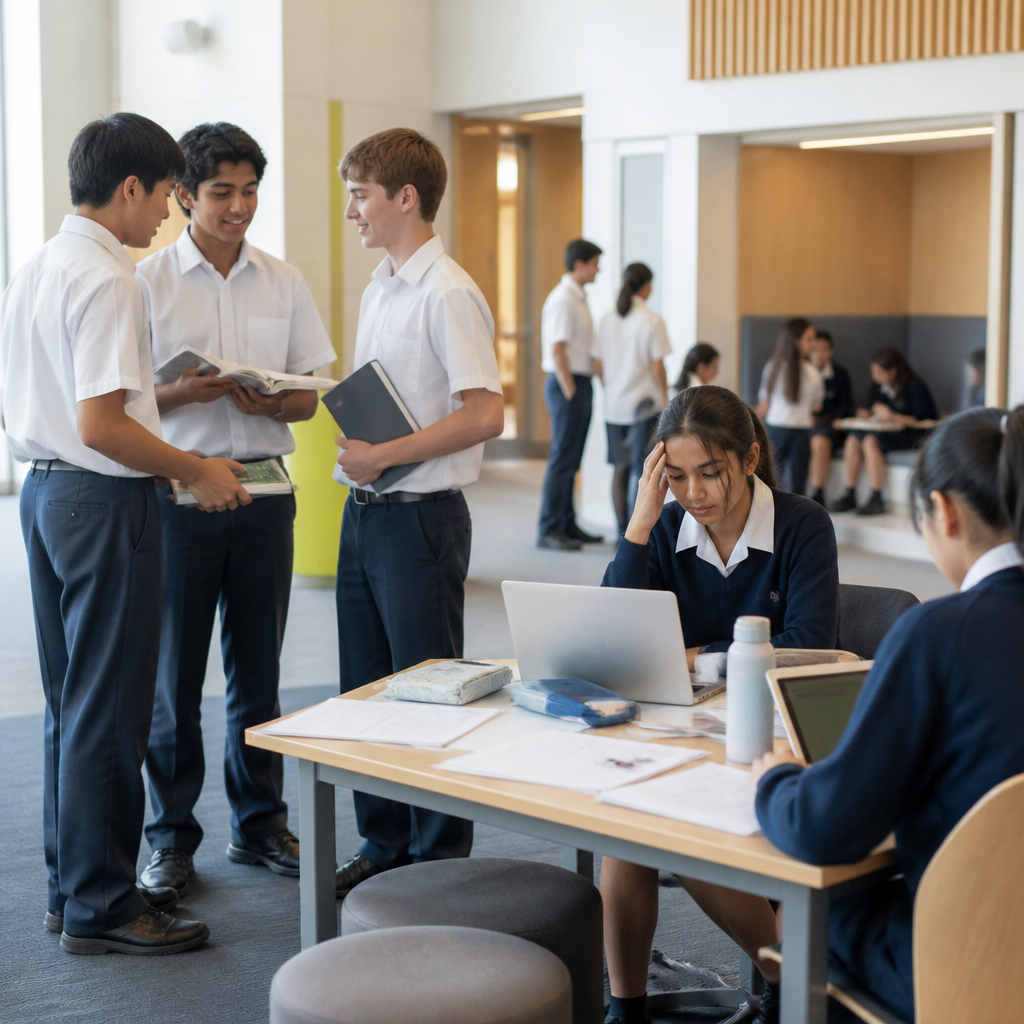
Two students may both be “doing IGCSE” but have very different school lives depending on teaching quality, pacing, available subjects, and whether the school later moves students into the IB Diploma or international A-Levels. A common pattern among students is that the curriculum label gets all the attention, while the school’s teaching style gets overlooked. In reality, the school often shapes the experience more than the qualification name does.
Some schools emphasise inquiry and class discussion. Others remain quite exam-focused, just with a different syllabus. So if you are hoping IGCSE will automatically mean less pressure, it is worth pausing there. A different curriculum does not always mean a gentler school culture.
Exams, coursework, and the skills being tested
Assessment varies by subject and exam board, but IGCSE often includes written exams and, for some subjects, coursework, practicals, speaking components, or school-assessed elements.
That can suit students who do not always perform at their best in one final high-stakes exam. At the same time, it can be challenging for students who procrastinate or need constant external structure. Some children look calm early in the year because there is no immediate exam panic, then suddenly feel swamped when deadlines begin to stack up.
Here is a simple comparison parents often find helpful:
One practical point parents sometimes miss is that assessment style affects family life too. A child with several smaller deadlines may need better weekly planning, while a child in a more exam-heavy setup may need stronger revision habits closer to exam season. Neither is automatically easier. They simply demand different kinds of consistency.
IGCSE vs O-Levels: What Parents Should Really Compare
For many families, the biggest practical question is how IGCSE compares with Singapore O-Levels. Usually, this is not just about academics. It is about daily stress, future options, and whether a child is coping in a way that feels sustainable.
Learning style and classroom culture
The Singapore-Cambridge O-Level route sits within the local school system and is closely tied to national structures, progression options, and familiar expectations. Many parents understand that path because they went through it themselves, or know someone who did.
IGCSE, by contrast, is often seen as more internationally oriented and sometimes more flexible. In some schools, there is more emphasis on explanation, analysis, project work, independent reading, and open-ended responses. In others, it can still be quite structured and exam-conscious.
A child who memorises model answers well and performs strongly under standardised local exam conditions may do very well in the O-Level route. A child who thinks deeply but struggles with rigid answer formats may find some IGCSE subjects more suitable. But this is where nuance matters. Some parents swing too quickly from “my child is struggling” to “therefore a different curriculum must be better”. That is not always true.
Breadth, pressure, and progression
Another difference lies in subject breadth and progression context. O-Levels are part of a clearer local pathway into JC, polytechnic, or other post-secondary routes. IGCSE often sits within international school progression, where the next step may be IB, international A-Levels, or another overseas-linked programme.
The pressure can also feel different rather than lighter. In local schools, the rhythm is familiar. In international school settings, the pressure may come through presentations, research tasks, oral components, and class participation instead.
This side-by-side view can help:
So when comparing IGCSE and O-Levels, the more useful question is not which one sounds better. It is which one fits your child’s learning behaviour, stress pattern, and likely next step.
Who May Benefit Most From IGCSE In Singapore
This is one of the most important questions, and one that deserves honesty rather than hype.
Students and families who may find it a good fit
The question of who should take IGCSE in Singapore usually comes down to suitability rather than status. It may be a good fit for:
- Internationally mobile families. If relocation is possible in the next few years, an internationally recognised curriculum can offer continuity.
- Students planning for international post-secondary pathways. If the likely next step is IB Diploma, international A-Levels, foundation programmes, or overseas university routes, IGCSE may fit more naturally into that sequence.
- Children who may benefit from a different learning environment. Some students are bright but disengaged in a highly standardised system, and may respond better to a different classroom culture.
- Students who need broader subject options. A child interested in combinations like Business Studies, Global Perspectives, or international language options may find more room in an IGCSE school.
When parents should be cautious
Not every struggling child needs a curriculum change. Sometimes the real issue is burnout, anxiety, weak foundations, or a loss of confidence. Moving schools and changing curriculum at the same time can help in some cases, but it can also create fresh instability.
Be cautious if your child already has weak study habits, poor organisation, and a tendency to leave work until the last minute. Because some IGCSE subjects involve longer-term assignments or multiple assessment modes, a child who needs constant structure may not automatically cope better.
It is also worth asking whether the challenge is really the curriculum, or the school environment around it. A child may be unhappy because of pace, peer culture, language demands, or confidence after repeated setbacks. Those issues do not disappear just because the syllabus changes. Sometimes the right answer is a new pathway. Sometimes it is better support within the current one.
If your child may need extra support with IGCSE subjects or adjusting to a different curriculum, you can learn more about our IGCSE tutors and, if useful, discuss suitable support through our contact page. The aim is not to rush into tuition, but to make sure any transition is thoughtful rather than reactive.
Is IGCSE Recognised In Singapore?
This is often the question that really sits behind all the others. A parent may understand the curriculum, but still worry whether IGCSE is recognised in Singapore universities, JCs, or polytechnics.
Recognition depends on the next qualification
IGCSE is widely recognised as a secondary qualification internationally. But recognition does not mean every institution in Singapore will treat it as a direct route for every purpose.
For local pathways, what matters is often not IGCSE alone, but the full progression route after it. If a student takes IGCSE, the next stage matters greatly. That later qualification is often what institutions focus on.
If a family hopes to move from an IGCSE school into a local JC, polytechnic, or another Singapore post-secondary institution, they need to check that institution’s current admissions requirements directly. Policies can change, and subject requirements can differ.
What parents should verify before choosing this path
Before choosing an IGCSE pathway, check the following carefully:
For current official information, review MOE and SEAB, then confirm with the specific JC, polytechnic, university, or school admissions team.

How To Decide If IGCSE Is The Right Fit For Your Child
Once you understand what IGCSE is, the next step is not to ask whether it sounds impressive. It is to ask whether it fits your child, your family plans, and your child’s likely progression route.
Look beyond school branding
A common mistake is focusing on the label instead of the lived experience. Parents hear “international curriculum” and imagine more creativity, less pressure, and better outcomes. Sometimes that happens. Sometimes it does not.
Ask practical questions. How much homework is typical? What support is given if a child transfers in from the MOE system? How are subjects grouped? What happens if a student is weak in English writing, or has gaps in Math foundations? What are the common post-IGCSE destinations of graduates?
These details matter more than glossy brochures.
Pay attention to your child’s actual learning behaviour
Try to separate aspiration from observation. Not what you hope your child is like, but what weekday evenings actually look like.
If your child reads widely, asks questions, and likes discussing ideas, a curriculum with broader interpretation may suit them. If your child needs very clear structures and repeated guided practice to stay on track, some schools may still suit them, but you need to check how much scaffolding is provided.
This is also where parents can be kinder to themselves. Choosing a different pathway can sometimes feel like giving up on the local route. It is not. If a child is constantly exhausted, detached, or anxious, a better fit is not a downgrade. It is simply a different educational decision.
A simple checklist before you decide
Before making a switch, it helps to sit down and answer a few grounded questions:
- Is my child struggling mainly with content difficulty, or with the style and pace of the current system?
- Does the new school offer the subjects my child is likely to need later?
- What is the intended pathway after IGCSE: IB, A-Levels, diploma, foundation, or something else?
- How much transition support is available in the first term?
- Can my child realistically handle coursework and independent study expectations?
- Have I verified recognition and admissions requirements with the next institution, not just the current school?
A calm answer to these questions is usually more useful than any sales pitch.
Frequently Asked Questions
Is IGCSE harder than Singapore O-Levels?
Not in a simple, across-the-board way. Some parents assume IGCSE is easier just because it is different from the local system, but difficulty depends on the subject, school, exam board, and the student’s learning style. A child who struggles with rigid memorisation may find some IGCSE papers more manageable, while another may find coursework, open-ended responses, or broader reading more demanding.
Can an IGCSE student enter a junior college in Singapore?
This depends on the current admissions policies of the specific institution and the qualification requirements in force at the time. It is safest not to assume it will work the same way as the Singapore-Cambridge route. Check directly with MOE and the relevant institution before making any decision.
Is IGCSE recognised in Singapore universities?
Usually, local university admissions depend on the complete qualification pathway, not just IGCSE by itself. If your child takes IGCSE and then progresses to IB, A-Levels, a diploma, or another recognised route, that later qualification often becomes the key admissions basis. Always confirm with the university directly.
What kind of child usually does well in IGCSE?
There is no single profile. Children who benefit often include those from internationally mobile families, those who may continue into international post-secondary routes, and those who respond better to broader subject choices or a different classroom culture. At the same time, IGCSE is not a shortcut. Children who are disorganised or weak in core foundations may still need strong support.
Conclusion
So, what is IGCSE? For Singapore parents, it is best understood as an international secondary qualification and curriculum pathway that may offer a different learning environment, subject mix, and progression route from the local MOE system.
It is not automatically better, easier, or less stressful than the Singapore-Cambridge O-Levels. Its value depends on fit. That is the part many families only realise after looking past the branding and asking harder, more practical questions.If you are comparing the IGCSE curriculum with the local route, thinking through IGCSE versus O-Levels, wondering whether IGCSE is recognised in Singapore universities, or asking who should take IGCSE in Singapore schools, the safest approach is a grounded one. Look at your child’s actual needs, the school’s actual teaching style, and the actual progression requirements for the next stage.
Most of all, do not make the decision based on hearsay. Check the latest information with MOE, SEAB, the school itself, and any future institution your child may be aiming for. If your child may need extra support with IGCSE subjects or adjusting to a different curriculum, learn more about our IGCSE tutors and find suitable academic support through our contact page.