

Introduction
If you have ever opened a preschool website and felt like every term started blending together, infant care, childcare, nursery, kindergarten, K1, K2, MOE Kindergarten, you are not alone. Many Singapore parents start off thinking they just need to answer one simple question, what is early childhood education, then realise the preschool landscape feels much bigger than expected.

In Singapore, early childhood education refers to the care, learning, and developmental support children receive before Primary 1. It is not only about getting ahead in letters and numbers. It also includes routines, communication, play, social interaction, confidence, independence, and the quiet everyday guidance children receive from trusted adults.
That is why a child may be learning during snack time, story time, transitions, or play with classmates, not only during a formal activity. Once parents understand this structure, the whole process becomes less overwhelming. It gets easier to see what kind of setting may suit your child, your family routine, and your comfort level.
Key Takeaways
- Early childhood education means more than academics. In Singapore, it includes care, learning, routines, communication, play, and developmental support before Primary 1.
- Preschool is an umbrella term. Childcare centres, kindergartens, and MOE Kindergarten all sit within the broader early childhood education landscape.
- Childcare is not just babysitting. A full-day childcare setting can still provide structured early learning through teacher interaction, guided play, stories, movement, meals, and everyday care moments.
- Nursery, K1, and K2 describe stages before Primary 1. These labels usually refer to age-based preschool levels and help parents understand what kind of routine to expect.
- MOE Kindergarten is one part of the preschool landscape. It is a recognised preschool option, but not the only one.
- School readiness is only part of the picture. Readiness also includes confidence, listening, routines, independence, emotional regulation, and social adjustment.
- Choosing a programme starts with clarity. Once the preschool system is clearer, parents can compare centres more calmly and more realistically.
What Early Childhood Education Means In Singapore
When parents ask what early childhood education is, they are usually not asking for a textbook definition. They want to know what their child will actually be doing each day, who will be caring for them, and whether preschool is about teaching or simply supervision.
In Singapore, early childhood education generally covers the years before formal primary schooling. It includes both care and education, and that combination matters more than many parents first realise. Young children do not separate “learning time” from “care time” the way adults do.
A teacher helping a child wash hands, take turns, follow instructions, or join a song is also supporting development. That is part of the learning too.
It includes care, learning, and development
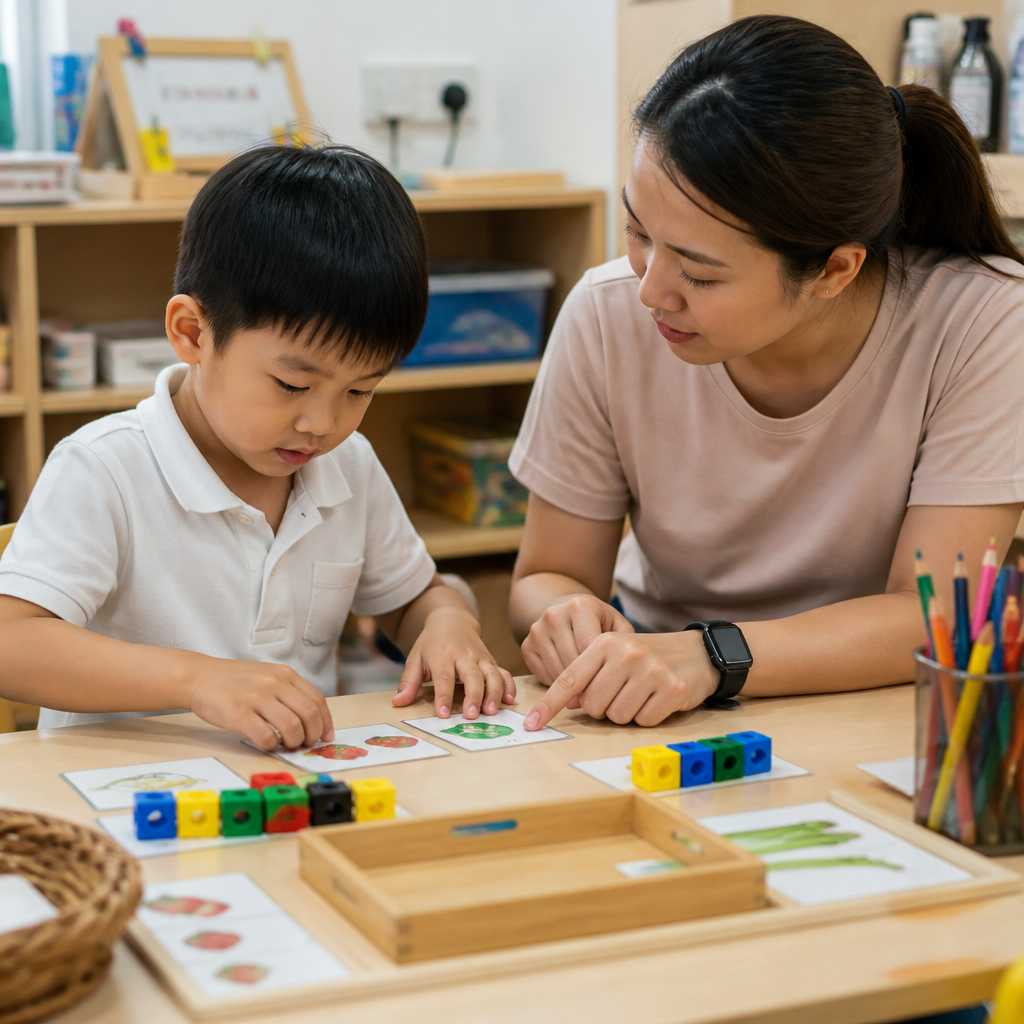
A common misunderstanding is that early childhood education only means classroom-style teaching. In reality, it also includes daily routines, emotional security, language exposure, guided play, movement, and interactions with adults and peers.
For example, a three-year-old learning to pack away toys after play is not just being told to keep tidy. That moment supports listening, independence, and routine-following. A child joining a story circle is not only hearing a book, but also building attention, vocabulary, and comfort in a group setting.
Tutors often notice that children who seem “behind” academically are sometimes simply still developing these foundation habits. That is why looking only at worksheets can give parents a very incomplete picture.
It happens before Primary 1
In Singapore, this phase takes place before children enter primary school. Parents often encounter it through infant care, childcare, nursery, and kindergarten programmes.
At first, the labels can feel confusing, especially when different centres describe themselves slightly differently. Still, the broad idea stays the same. Early childhood education refers to the structured support children receive during their early years before Primary 1 begins.
How Preschool Fits Into Early Childhood Education
One of the biggest sources of confusion is the word “preschool”. Some parents use it to mean kindergarten. Others use it to mean childcare. In Singapore, preschool is better understood as an umbrella term for programmes serving children before Primary 1.
Preschool does not refer to one single type of centre
If one parent says, “My child is in preschool,” that could mean a full-day childcare centre, a half-day kindergarten, or an MOE Kindergarten setting. This is why comparing schools can quickly become frustrating. Two families may both say “preschool”, but their children’s routines may look completely different.
That is also why searching for the right preschool for a nursery child can feel messy. You are often not comparing one category, but several different formats with different hours, structures, and expectations.
Why this umbrella term matters for parents
Once parents understand preschool as a broad category, the comparison becomes more useful. Instead of assuming every preschool works the same way, you can look at the actual setup.
For a working parent, this distinction matters immediately. A beautifully presented programme may still create daily stress if dismissal is at 11.30am and no wraparound care is available. On the other hand, a full-day setting may suit a child who benefits from routine and gradual social exposure.
Childcare, Kindergarten, And Infant Care Explained
This is usually the part parents want clarified most. The terms sound familiar, but they are not interchangeable.
What infant care usually refers to
Infant care generally refers to care and early developmental support for babies and very young toddlers. Parents often first look into this when maternity leave or caregiving arrangements are ending and they need a safe, structured setting during work hours.
At this stage, early childhood education does not look academic. It shows up through caregiving routines, responsive interaction, songs, sensory play, movement, and language-rich engagement. A caregiver talking to a baby during feeding or comforting a child while naming emotions is already part of developmental support.
What childcare means in Singapore
Childcare usually refers to a centre-based programme that combines care and education, often with longer hours. This is where some parents hesitate. They may worry that childcare is mainly supervision.
In practice, childcare is not just babysitting. Children are cared for across the day while also taking part in planned routines, stories, songs, guided play, teacher-led activities, meals, rest time, and social interaction. The learning is woven into the day rather than squeezed into one short lesson.
For families balancing work and caregiving, childcare often becomes the most realistic route because it combines developmental support with longer daily care.
What kindergarten means
Kindergarten usually refers to preschool programmes for older children, often in the years just before Primary 1. These are commonly K1 and K2. Some kindergartens operate for shorter hours than childcare centres.
This is where confusion often starts. Parents may assume kindergarten is the “real” educational option, while childcare is mainly custodial. That is too simplistic. Both can be part of early childhood education. The difference is often in schedule, structure, and operating model, not whether learning exists at all.
To make the terms easier to scan, here is a simple comparison.
What Nursery, K1, And K2 Mean
Once the broad categories are clearer, the next question is usually about levels. Nursery, K1, and K2 are the labels many centres use for preschool stages before Primary 1.
Nursery usually comes before kindergarten levels
Nursery commonly refers to the stage before K1. This is often when children are still adjusting to group routines, shorter attention spans, toileting independence, and separation from parents.
In real life, this stage can feel emotionally uneven. One child runs into class happily by the second week. Another cries at drop-off for a month, then settles beautifully after that. That does not mean one child is more “ready” in every way. It simply shows that readiness develops unevenly.
When parents look for a good nursery programme, what often matters most is not the most advanced curriculum. It is warm routines, patient teachers, and a pace that suits young children who are still learning how to function in a group setting.
K1 and K2 are the later preschool years
K1 and K2 are the kindergarten years before Primary 1. These levels often include more structured routines and more intentional preparation for the transition to primary school.
Even so, this should not be misunderstood as formal schooling brought forward too early. A healthy K1 or K2 setting is still part of early childhood education, not a Primary 1 classroom in disguise. Children may be exposed to language, early numeracy, fine motor tasks, listening skills, and social routines, but the broader goal remains developmentally appropriate support before school entry.
A practical way to think about these levels is that nursery often focuses more on settling in, communication, and basic routines, while K1 and K2 gradually place more emphasis on sustained attention, independence, and readiness for a larger school environment. The shift is usually gradual rather than sudden.
Where MOE Kindergarten Fits In
MOE Kindergarten is one recognised preschool option in Singapore, but it is not the whole preschool system.
MOE Kindergarten is part of the preschool landscape
Some parents hear “MOE Kindergarten” and assume it belongs to a completely different system from preschool. In reality, it sits within the wider early childhood education landscape in Singapore. It is one option among others, alongside childcare centres and other kindergarten providers.
This matters because parents sometimes become overly anxious about choosing the “official” path, as if anything else automatically puts a child behind. That kind of pressure usually makes decision-making harder, not better. A good fit depends on your child, the centre’s environment, the daily routine, and practical family needs.
You can read official information from MOE Kindergarten and broader preschool guidance from the Early Childhood Development Agency. As policies and details may change, it is wise to check the latest updates directly.
It is not the only valid preschool route
Many parents quietly worry about choosing wrongly. They wonder if selecting childcare over MOE Kindergarten means sacrificing quality, or if choosing a kindergarten automatically gives better school preparation.
A common pattern among families is focusing too much on the label and not enough on the actual environment. The more useful question is not which name sounds strongest, but which setting suits your child and your daily reality. Different centres may also use different curriculum approaches. MOE Kindergarten is one part of the preschool picture, not the only definition of early childhood education in Singapore.
What Early Childhood Education Looks Like Day To Day
Parents often imagine preschool in extremes. Either children are drilling worksheets too early, or they are just playing all day. The truth is usually more balanced.
Learning happens through everyday moments
Young children learn through teacher interaction, guided play, songs, stories, movement, routines, and care moments. A teacher helping children line up, greet one another, listen during story time, or clean up after an activity is supporting development in practical, everyday ways.
This is one reason parents often ask whether early childhood education helps social skills. In many settings, social growth is supported not through formal lectures on behaviour, but through repeated small moments. Waiting for a turn, asking for help, joining a group activity, or learning to use words instead of tears are all part of the process.
It is not only about school drills
Yes, early childhood education and school readiness in Singapore are connected. Children may gradually build familiarity with language, early numeracy, routines, independence, and group learning. But early childhood education is not meant to become a race to complete primary-level work early.
Over the years, many educators and tutors have seen children who can recite far ahead of age expectations but still struggle to sit through instructions, manage frustration, or speak confidently in a group. That is why a balanced understanding matters. School readiness includes emotional and behavioural readiness too.
A typical day often blends structure and flexibility
In many preschool settings, the day includes arrival routines, free play, circle time, snacks or meals, outdoor or movement activities, story sessions, rest, and teacher-guided learning blocks. The exact schedule varies, but the pattern is often a mix of predictable routines and child-friendly transitions.
This matters because young children usually cope better when the day feels steady. Predictable routines help them know what comes next, while play and interaction give them space to practise language, problem-solving, and social skills in a natural way.
If you are comparing preschool with extra support at home, some families find it helpful to add light, child-friendly reinforcement rather than more pressure. If that sounds relevant, you can learn more about our preschool tutors for gentle support with early literacy, numeracy, and school-readiness skills at your child’s pace.
How To Choose The Right Early Childhood Education Programme
Once the terms are clearer, choosing becomes less intimidating. The question shifts from “Which label is best?” to “Which environment makes sense for my child and family?”
Start with structure, not marketing terms
When comparing preschool options in Singapore, start with the basics. What age group is the programme for? Is it infant care, childcare, nursery, or kindergarten? What are the hours? What does a typical day look like?
A parent may be drawn to a centre’s polished website, only to realise later that the schedule clashes badly with work, or that the environment feels too fast-paced for a child who still needs gentler transitions.
Look at your child’s readiness and temperament
Some children adapt quickly to group routines. Others need more time, more emotional support, or a smaller-feeling environment. This is especially relevant for nursery-age children. The best option on paper may not be the best emotional fit.
For example, a lively child who enjoys movement and social contact may settle well in a busy full-day setting. A child who is still adjusting to separation may benefit from a calmer transition and warm teacher support. Parents often sense this instinctively, even when they feel pressured by what other families are choosing.
Consider family routine and support needs
This is where practical reality matters. A programme that suits your child but creates daily strain for the whole household may still become difficult to sustain. Families balancing work, transport, sibling schedules, and caregiving arrangements often need an option that works logistically as well as developmentally.
That is why preschool decisions are not only about philosophy. They are also about whether drop-off, pickup, meal routines, and care hours are manageable week after week. A good choice is one your child can grow in and your family can realistically maintain.
Questions worth asking during a visit
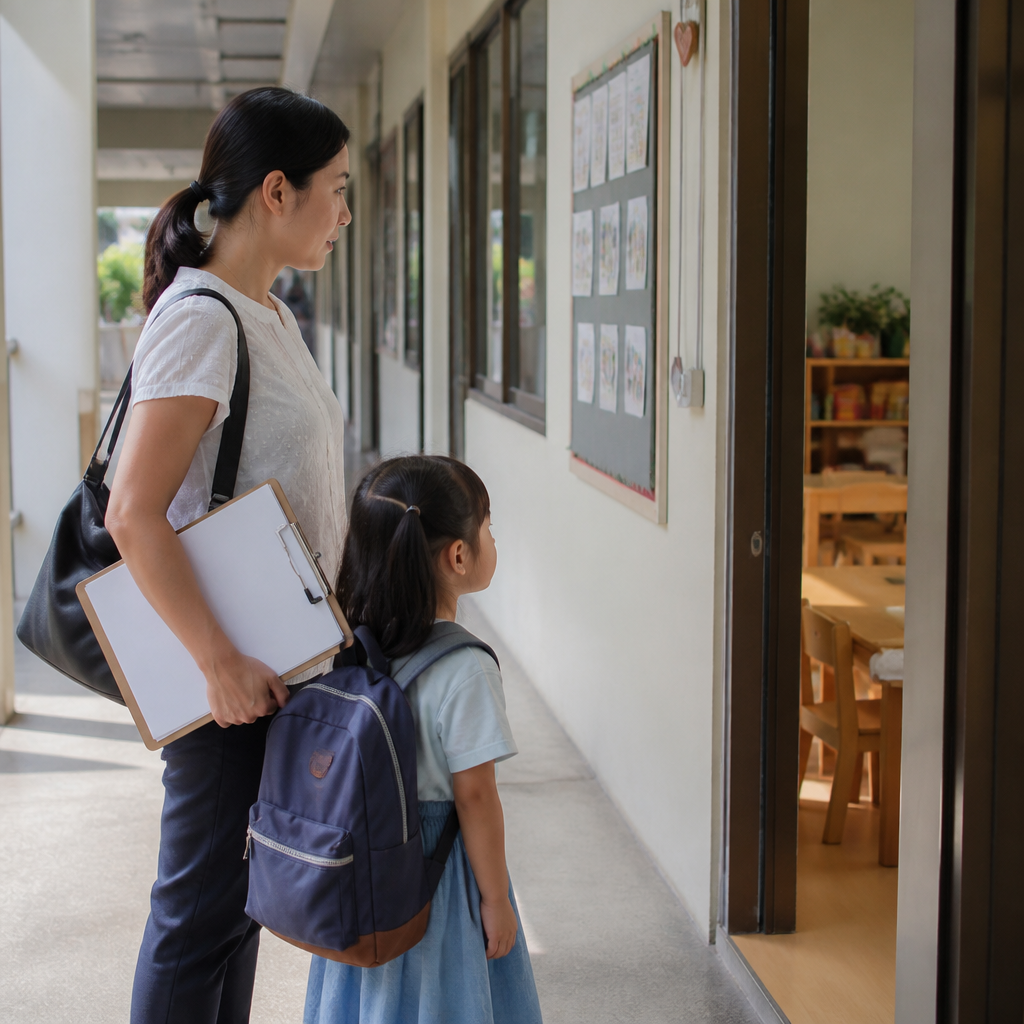
Parents often feel pressure to judge a centre quickly, but a short visit can still reveal useful clues. You can ask how teachers support children who are new to school, how routines are handled, how parents are updated, and what a normal day looks like.
It also helps to observe the atmosphere. Do the adults seem calm and responsive? Do children look engaged? Is the environment organised without feeling overly rigid? These small observations often tell parents more than brochures do.
Frequently Asked Questions
Is early childhood education the same as preschool in Singapore?
Not exactly. Preschool is a broad term for programmes before Primary 1, while early childhood education refers more specifically to the care, learning, and developmental support children receive during those years. In daily conversation, people often use the terms loosely, but early childhood education is the wider concept behind the preschool system.
Is childcare considered early childhood education, or is it mainly care?
Childcare is part of early childhood education in Singapore. It includes care, but it is not just babysitting. Children learn through routines, guided play, teacher interaction, songs, stories, movement, and everyday social experiences across the day.
Does kindergarten mean the same thing as preschool?
No. Kindergarten is one type of preschool, usually referring to the later preschool years such as K1 and K2. Preschool is the umbrella term, while kindergarten is one category within it.
Does early childhood education improve social skills?
It can support social skills, yes, but usually through everyday interactions rather than formal teaching alone. Children practise sharing space, following routines, listening, taking turns, expressing needs, and responding to peers and adults in real situations.
Do I need enrichment if my child is already in preschool?
Not always. Some children are doing well with the support they already receive in preschool. Others may benefit from gentle one-to-one reinforcement, especially if they need more confidence with early literacy, numeracy, or routines. The key is not to rush, but to respond to your child’s pace and needs.
Conclusion
So, what is early childhood education in Singapore? It is the care, learning, and developmental support children receive before Primary 1. It includes more than academic preparation. It also covers routines, play, communication, social interaction, confidence, independence, and the daily adult guidance that shapes early development.
The key terms become much less intimidating once the structure is clear. Preschool is the umbrella term. Infant care supports babies and very young toddlers. Childcare combines longer-hour care with early learning. Kindergarten usually refers to the later preschool years, including K1 and K2. MOE Kindergarten is one preschool option within this larger landscape, not a separate category from early childhood education itself.
For most families, the best decision is not about chasing the most impressive label. It is about finding a setting where a child feels secure, supported, and able to grow steadily. Once parents understand how the system fits together, they can compare options with much more confidence and much less unnecessary stress.
If you are comparing preschool and enrichment options, you can also explore our contact page for private home tuition to find gentle support with early literacy, numeracy, and school-readiness skills at your child’s pace.