


Introduction
If English revision at home has started to feel like the most sensitive part of Primary 6, you are not imagining it. Math feels more clear-cut. Science can seem easier to revise step by step. But PSLE English is often where families get stuck, especially when comprehension answers feel vague, Paper 2 marks keep slipping away, and oral practice turns awkward the moment a parent asks, “Can you say more?”
If you have been wondering how to prepare for PSLE English without making every evening tense, you are far from alone.
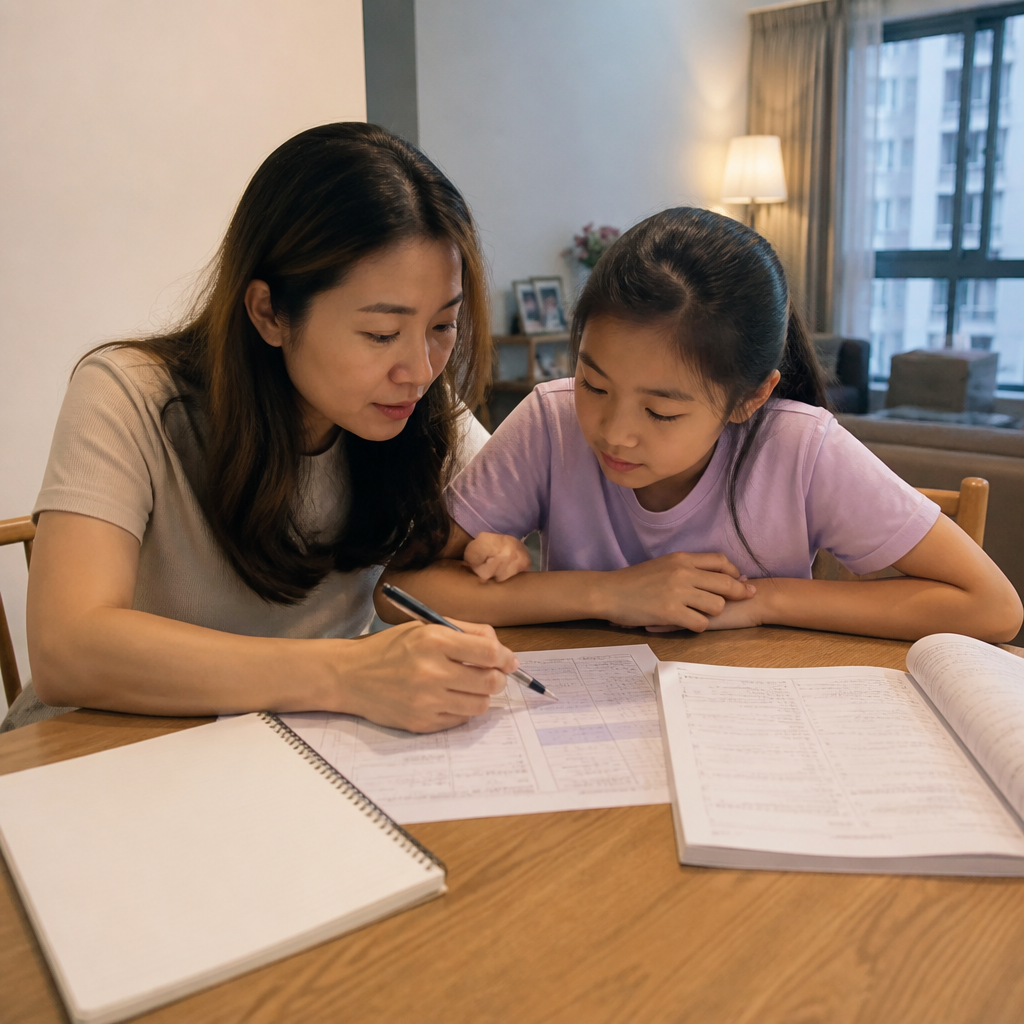
For many Singapore families, the issue is not laziness. It is usually a mix of school workload, CCA fatigue, limited time, exam stress, and uncertainty about what the paper is really testing. A child can read often and still lose marks in synthesis. Another may chat confidently at home but freeze during oral. This guide breaks down PSLE English preparation in a realistic, parent-friendly way, based on the exam components and the struggles many Primary 6 students commonly face.
Key Takeaways
- Know what each PSLE English component tests. Paper 1, Paper 2, Oral, and Listening Comprehension require different skills, so revision has to be targeted rather than general “do more English” practice. A child who writes decent compositions may still struggle badly with synthesis or open-ended comprehension, so it helps to separate the skills clearly.
- Weak comprehension usually needs guided correction, not just more worksheets. If your child keeps getting answers wrong, the issue may be question interpretation, answering technique, or lack of precision, not a lack of effort. Simply adding more practice papers often repeats the same mistakes.
- A manageable weekly plan works better than panic revision. A practical PSLE English study plan should fit around school, CCA, and rest, otherwise it quickly becomes unsustainable. Revision that constantly ends in exhaustion usually stops being effective.
- Oral preparation should sound natural, not memorised. The best ways to prepare for the PSLE English oral exam involve regular spoken practice, idea development, and confidence under pressure, not forcing model answers. Children usually perform better when they can respond like themselves.
- Careless Paper 2 mistakes are often predictable. Common PSLE English Paper 2 mistakes show up again and again, such as copying carelessly, missing tense clues, and lifting without answering the question. Once you spot the pattern, revision becomes much more focused.
- Working parents can still support effectively at home. Even with limited time, there are realistic ways to support reading, comprehension checking, and oral habits. In some cases, extra English support or tuition can help provide structure, but it is not a magic fix.
- Stress management matters as much as practice volume. A child who is tired, defensive, or overwhelmed may stop learning even while doing more work. The tone of revision at home often affects progress more than parents expect.
Understand The PSLE English Exam Before Fixing Weaknesses
Before trying to raise marks, it helps to get clear on what your child is actually being tested on. Many parents naturally fall back on what English looked like during their own school days, but the PSLE English exam rewards very specific skills. The latest details may change, so it is still wise to check the official guidance from MOE and SEAB.
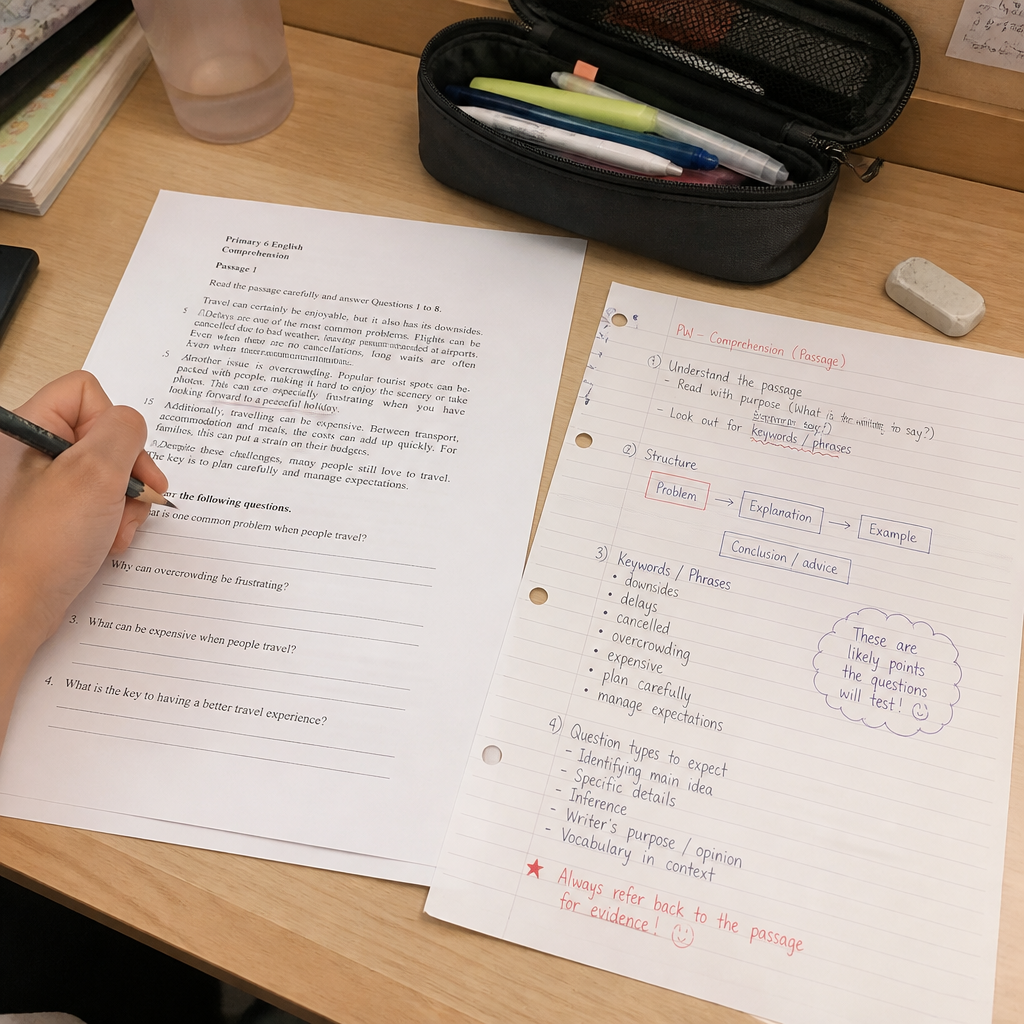
A quick overview helps parents see why one child can seem “okay in English” but still struggle in the exam.
Paper 1: Writing with ideas, clarity, and language control
Paper 1 usually includes situational writing and continuous writing. This is not just about sounding “good” in English. It is about whether your child can organise ideas clearly, stay relevant, and write in a way the reader can follow.
A common trap is memorising impressive phrases without learning how to build a coherent piece of writing. Parents sometimes see strong vocabulary and assume the composition is solid, but the story may drift or the situational writing may miss its purpose. In practice, relevance and control usually matter more than decorative language.
Paper 2: Language use, close reading, and precision
Paper 2 is often the part that frustrates parents most because marks disappear in many small places. Grammar, vocabulary, editing, visual text, grammar cloze, synthesis and transformation, and comprehension all demand different habits.
Tutors often notice that children who struggle here are not always weak in English overall. Quite often, they are inaccurate under pressure, careless with clues, or unsure what the question is asking for. That is why broad reminders like “read more” or “be careful” often do not move the needle much.
Oral and Listening Comprehension: Calm thinking under pressure
Oral tests spoken reading and stimulus-based conversation. Listening Comprehension checks whether a child can follow spoken information carefully and catch key details.
These sections are easy to underestimate because they feel harder to “study” in the usual way. Then oral week arrives and a child who seemed fine at home sounds stiff, rushed, or blank. A common pattern among students is that speaking practice gets pushed aside until the last minute, and that usually shows.
Build A PSLE English Study Plan That Fits Real Life
The best revision plan is not the most ambitious one. It is the one your child can actually keep up with.
If it is already late at night after school, homework, CCA, dinner, and shower, forcing one more full comprehension paper may look productive, but it often leads to poor concentration and more conflict. Sustainable revision usually beats heroic revision.
Work around your child’s actual week
A realistic PSLE English study plan should match your child’s real timetable, not an ideal version of it.
This kind of plan often works better than a strict “one hour of English every day” routine. It sounds disciplined on paper, but many families know how quickly that falls apart once the week gets busy.
Repeat weak skills instead of doing random practice
Children usually improve faster when the same weak area is revisited properly. If your child keeps losing marks in visual text or comprehension vocabulary, jumping to composition practice every other day may feel balanced, but it may not solve the actual problem.
A common pattern among students is doing many school papers while repeating the same mistakes because nobody stops to ask what the pattern really is. If the issue is incomplete comprehension answers, then revision should focus on answer precision. If the issue is poor oral development, speaking needs more regular attention. Focused repetition is often more effective than constant variety.
Keep one simple tracking list
One practical addition that helps many families is a short mistake log. It does not need to be elaborate. A notebook page with headings like “grammar,” “comprehension,” “oral,” and “careless mistakes” is enough.
Each time your child gets something wrong, write the pattern down in plain language: “forgot past tense clue,” “copied too much,” “answered only one reason,” or “stopped after one sentence in oral.” After two or three weeks, you often see that the problem is narrower than it first seemed. That makes revision feel less overwhelming for both parent and child.
Improve P6 English Comprehension At Home Without More Stress
This is one of the biggest worries parents have. When they ask how to improve P6 English comprehension at home, what they often mean is, “We have already done so much. Why are the marks still not moving?”
Stop counting worksheets and start checking answer quality
A child can complete several comprehension practices and still learn very little if the correction is too vague. Telling them to “read more carefully” rarely helps on its own.
What usually helps more is showing exactly where the answer broke down. If the question asks why a character hesitated and your child copies a line about what happened next, the issue may be weak question analysis, not just carelessness. Sometimes one careful discussion about a single question teaches more than another full worksheet.
Train complete but precise answering
Many students swing between two extremes. They either answer too vaguely, or they copy too much because it feels safer.
PSLE comprehension often rewards precision, not just effort. If a question asks for two reasons and your child gives one clear point plus one unsupported guess, marks are lost. At home, it helps to get your child to underline command words and quantity clues such as “why,” “how,” “two ways,” or “what suggests.” That small habit can prevent many avoidable mistakes.
Read short texts aloud and discuss meaning
You do not need a full formal lesson every night. Even 10 minutes can be useful. Read a short article, school passage, or newspaper snippet, then ask simple questions like, “What is the writer worried about?” or “Which line shows that?”
In homes where English correction has become tense, spoken discussion often feels less confrontational than marking with a red pen. That matters more than many parents expect. A child who has already shut down emotionally will not benefit much, even from good advice.
Avoid The Most Common PSLE English Paper 2 Mistakes
If your child often says, “I knew it but I still got it wrong,” this is usually where the problem shows up. The most common PSLE English Paper 2 mistakes are not random. They tend to repeat.
Synthesis: Correct idea, wrong grammar
Synthesis and transformation often reveal shaky grammar control. A child may understand the content perfectly but still lose marks because the sentence structure is wrong or the tense shifts.
This is why doing ten synthesis questions quickly is not always the best use of time. Sometimes three slower questions, with proper checking after each one, teach more.
Comprehension open-ended: Lifting without answering
Many pupils copy chunks from the passage because it feels safer to stick to the text. But lifting only works when it directly answers the question.
A very common pattern is finding the right part of the passage, then writing a response that is too long, too vague, or missing the key idea. If that sounds familiar, train shorter and cleaner answers. Ask, “What is the one point this question wants?”
Grammar and editing: Rushing because it looks easy
Editing is one of those sections that can trick students into overconfidence. Because the passage is short, they rush. Then they miss tense clues, punctuation, or subject-verb agreement.
Instead of just saying “be more careful,” ask your child to explain each correction. If they cannot explain it, there is a good chance they guessed.
Prepare For PSLE English Oral In A Natural Way
Oral preparation should be part of the weekly routine, but it does not need to become a full mock exam every night. A few short sessions each week can help children practise reading aloud clearly, speaking at a steady pace, and developing answers beyond one sentence.
For Reading Aloud, focus on clarity, pacing, pronunciation, and expression. For Stimulus-Based Conversation, encourage your child to give a point, explain it, and add a simple personal example where relevant.
The main goal is natural speaking, not memorised model answers. Children usually perform better when they can respond calmly and flexibly, instead of trying to recite prepared lines.
Support Your Child Even If You Are A Busy Working Parent
There is a very familiar kind of guilt many working parents feel in Primary 6. You get home late, your child is already tired, and revision starts with both of you running on very little patience.
That does not mean you are not doing enough.
Use short, high-value support moments
You do not need two-hour study sessions to be helpful. Ten to fifteen minutes can still matter. During dinner, ask one oral-style question. On the way home, review a vocabulary word from a school passage. Before bed, go through one comprehension correction.
These smaller routines are often more realistic, and because they are easier to sustain, they can end up being more useful.
Keep the home tone calm and specific
One of the easiest things to overlook is tone. When parents are worried, feedback can quickly become broad and discouraging: “Your English is always careless,” or “Why are you still making this mistake?” Even when the intention is to push for improvement, children often hear only criticism.
A calmer alternative is to keep comments specific: “You found the right line, but you did not answer the ‘why’ part,” or “Your oral point is good; now add an example.” Specific feedback is easier for a child to act on, and it reduces the sense that every session is a judgment on their ability.
Know when outside support may help
Some children simply do not respond well when English correction comes from a parent. It does not mean the parent is wrong. It often means the relationship is already emotionally loaded.
By the later part of the year, even a simple correction can trigger tears, defensiveness, or silence. In that situation, a different setup may help. If your child needs more guided practice, especially for comprehension, oral, or a clearer revision routine, you can learn more about PSLE tutors and support options. Families looking for PSLE English support often want help not just with content, but with calmer structure at home.
That does not mean tuition is always necessary. For some children, school support and steady home practice are enough. But when time is tight and stress is rising, the right support can provide structure, accountability, and less emotional friction.

Signs Your Child May Need More Help Before The Exam
Not every weak score is a crisis. Many Primary 6 students improve when correction becomes more focused. But some patterns suggest your child may need more support.
Repeated mistakes with no clear improvement
If your child has been doing comprehension and synthesis for months but still repeats the same answer patterns, they may not understand the marking logic yet.
This is especially common in hardworking children. They keep doing paper after paper, but their answers remain vague or the same grammar mistakes keep returning. That usually points to a skill gap, not a motivation issue.
Oral anxiety that affects performance
Some children know what they want to say but become visibly tense during speaking tasks. They mumble, rush, or give one-line answers.
If school feedback keeps mentioning confidence, clarity, or development, more guided oral practice may be worth considering.
Home revision has become constant conflict
Once every English session turns into an argument, learning quality drops very quickly. Parents start nagging. Children resist. Nobody leaves the table feeling better.
Sometimes the most helpful move is not to push harder, but to change the setup.
Frequently Asked Questions
How early should we start preparing for PSLE English?
Ideally, preparation should build steadily through Primary 6 instead of starting only after prelims. But if your child is starting later, it is still possible to make progress. Focus first on recurring Paper 2 mistakes, comprehension technique, and oral practice, rather than trying to cover everything at once.
How much English revision should a Primary 6 child do each week?
There is no perfect number that fits every child. For many students, three to five focused sessions a week works better than daily drilling that leads to burnout. If your child has heavy CCA commitments, shorter weekday tasks and one stronger weekend session may be more realistic.
My child reads a lot but still scores badly for comprehension. Why?
This is a very common frustration. Reading helps, but comprehension also depends on question interpretation and answer technique. Many children understand the passage generally but still lose marks because they miss keywords, give incomplete answers, or choose the wrong supporting detail.
What if my child hates oral practice with me?
That happens more often than parents think. Some children feel awkward speaking formally in front of a parent, especially when they are already self-conscious. Keep practice short and conversational. If the tension is high, another adult, sibling, or tutor may get a better response than forcing nightly oral sessions.
Is tuition necessary for PSLE English?
Not always. Some children improve well with school guidance, regular home support, and better correction habits. Tuition may help when weaknesses are persistent, parent time is limited, or revision at home has become too stressful. It works best as support for structure and skills, not as a substitute for your child’s own effort.
Conclusion
Learning how to prepare for PSLE English is really about two things, understanding what the exam demands and helping your child practise in a way that can actually last. Paper 1 needs relevant ideas and clear writing. Paper 2 needs precision and careful reading. Oral needs natural speaking and confidence. Listening Comprehension needs calm attention to detail.
If your child is struggling, it does not automatically mean they are not trying. Very often, they are tired, unsure what the question wants, or stuck in revision habits that are not helping. A manageable weekly plan, better comprehension correction, regular oral conversation, and more realistic expectations at home can make a real difference.
Small changes are often more powerful than dramatic ones. A shorter but steadier routine, clearer correction, and less emotionally charged practice can help your child improve without making English the source of constant stress at home.
When the stress at home is growing and your child needs more structured support with comprehension, oral practice, or revision routines, it may help to explore additional guidance. You can learn more about our PSLE tutors here.