


Introduction
If you have ever sat beside your child during revision and thought, “They can explain this to me just fine, so why are they still losing marks on paper?”, you are definitely not alone. Many Primary 5 and Primary 6 students understand the concept when speaking, but once they have to write it down in exam conditions, the answer becomes short, vague, or incomplete. That is why so many parents end up searching for help on how to answer PSLE Science open-ended questions.
Very often, the issue is not just content knowledge. It is how the answer is structured, whether the right science keywords are used, and whether the child explains cause and effect clearly enough for marks to be given. In PSLE Science open-ended questions, marks often depend on whether a child can identify what the question is asking and express the scientific idea in a complete, mark-worthy way.
Once parents understand what examiners are looking for, it becomes much easier to support a child at home without every revision session turning into another round of frustration.
Key Takeaways
- Understanding alone is not enough. Many children can say the idea aloud but still lose marks because their written explanation is incomplete, vague, or missing a key scientific link. In PSLE Science, what matters is what is written on the page.
- Read the question for its task, not just its topic. A question on plants, heat, or forces may actually be asking your child to compare, explain a change, or interpret an experiment.
- Use science keywords carefully. Good answers often depend on precise terms such as “absorbs”, “evaporates”, “friction”, “heat energy”, or “photosynthesis”.
- Explain cause and effect clearly. Strong answers show what changed, how that change affected the system, and what final outcome happened.
- Watch out for vague wording. Phrases like “it happened”, “it changed”, or “it was better” are usually too imprecise for PSLE Science explanation questions.
- Practise improving weak answers. Looking at before-and-after examples helps children see exactly what is missing and how to fix it.
- Home support should focus on answering habits, not just more worksheets. Short, targeted practice is often more effective than piling on extra papers.
Why PSLE Science Open-Ended Questions Feel So Hard
For many children, open-ended questions are where confidence drops fastest. Multiple-choice questions feel safer because there are options to recognise. A child may still get the answer right even if their understanding is shaky. Open-ended questions remove that safety net. Suddenly, your child has to produce the answer from scratch.
At PSLE level, open-ended questions often test whether a student can apply concepts in context. This may involve explaining a process, identifying a reason for a change, comparing two conditions, or interpreting a simple experiment. The paper is not just checking whether your child remembers that plants need light or that evaporation happens faster with heat. It is checking whether they can use that knowledge accurately in the situation shown.
That is why some children say, “I studied this already,” but still score poorly. They recognised the topic, but they did not answer the exact question.
How To Answer PSLE Science Open-Ended Questions Step By Step
If you want a practical way to teach your child how to answer PSLE Science open-ended questions, the most useful approach is not a fancy formula. It is a simple thinking process they can repeat even under exam stress.
Step 1: Identify the task word
Before writing anything, your child should first ask, “What is this question asking me to do?”
Common open-ended task types include:
- Explain — give a reason and show the scientific link.
- State a reason — give one clear cause that matches the concept.
- Compare — mention both items or conditions and show the difference directly.
- Describe what happens — focus on observation, not explanation.
- Suggest why — give a science-based answer that fits the evidence.
- Identify the variable or fair test issue — explain what was changed, measured, or kept the same when the OEQ requires it.
If the question asks, “Why did Plant A grow taller than Plant B?”, your child must explain a difference in conditions and connect it to growth. If they only describe the diagram, they miss the task.
Step 2: Spot the changed factor and the outcome
Most PSLE Science explanation questions involve a change. Something became hotter, moved slower, got less water, received more light, or had a rougher surface.
Train your child to underline two things:
- What changed, such as more sunlight, less water, or higher temperature
- What happened as a result, such as faster evaporation, slower movement, or better growth
Without this pairing, answers often turn into random topic recall instead of focused explanation.
Step 3: Use the correct scientific link
This is where science keywords and answering technique matter. Children often write in everyday language, but PSLE rewards scientific precision.
Instead of writing:
Plant A is healthier.
A better answer is:
Plant A received more sunlight, so it could make more food during photosynthesis and grow taller.
The second answer is stronger because it names the condition, the process, and the result.
Step 4: Check if one line is enough
Many students stop too early. If the question is worth 2 marks, a one-phrase answer is often incomplete. Encourage your child to pause and ask, “Have I explained both the cause and the effect?”
How To Identify What The Question Is Really Asking
A major reason children struggle with PSLE Science open-ended questions is that they answer from the topic, not from the question.
Teach your child to slow down and look at:
- Differences between setups, because these often reveal the changed variable
- Time words such as “after 2 hours” or “before and after”
- Scientific labels such as temperature, amount of light, mass, or surface texture
- Whether the question asks for an observation, a reason, or a conclusion
For example, “Based on the graph, explain why…” is very different from “State what happened…” The first needs reasoning. The second may only need a direct observation.
A quick example:
Weak answer:
The ice melted because of heat.
Improved answer:
The ice in the cup placed under the sun received more heat energy. This caused it to melt faster than the ice kept in the shade.
The improved version identifies the condition, uses the scientific idea, and compares the result clearly.
Science Keywords That Help Answers Score
Keywords are not magic words, but they often show whether the scientific idea is correct and precise enough. Many children are told to “use keywords”, but not shown how to use them properly in a full explanation.
A common mistake is dropping in a science word without understanding it. For example:
The plant adapted and evaporated food.
This sounds scientific, but it is wrong.
A better version is:
The leaves receive sunlight and make food for the plant.
For upper primary, useful science terms often relate to light energy, heat gain or heat loss, water absorbed, air resistance, friction, reproduction, photosynthesis, germination, conductors, and insulators. The real goal is not memorising a long list. It is knowing which term fits which question.
Some children memorise stock phrases and use them everywhere. A wrong keyword used confidently is still a wrong answer. A simpler answer with the correct concept is usually safer and stronger.
If your child needs more targeted help with answering habits rather than just more content drilling, it may help to look at structured PSLE support from experienced tutors who focus on written explanation skills, not only worksheet volume: PSLE tutors who can help build subject understanding, revision habits, and exam confidence. You can also explore broader support here: PSLE tuition.
How To Explain Cause And Effect Without Being Vague
The best PSLE Science answers usually show a clear chain. What changed? What scientific effect did that cause? What was the final result?
A lot of answers have a beginning and an ending, but no middle.
Example:
Plant B got less water, so it died.
Better:
Plant B received less water, so it could not absorb enough water to carry out its life processes properly. As a result, it wilted and died.
The middle link matters because it shows understanding, not just recall.
Questions also often involve change over time or differences between two setups. Children need to compare directly, not describe each separately in a messy way.
Weak answer:
Before there was more. After that it changed.
Improved answer:
Before the lamp was switched on, the surroundings were cooler. After the lamp was switched on, heat from the lamp increased the temperature of the surroundings.
Specific wording earns marks.
PSLE Science Open-Ended Question Examples With Better Answers
Children often learn fastest when they can see exactly how a weak answer becomes a stronger one.
Example 1: Plant growth
Question:
Plant A was placed near a window. Plant B was kept in a dark cupboard. After one week, Plant A was taller. Explain why.
Weak answer:
Plant A had sunlight.
Better answer:
Plant A received sunlight, so it could make food during photosynthesis. With more food, Plant A grew taller than Plant B.
Example 2: Evaporation
Question:
Why did the wet shirt dry faster outdoors than indoors?
Weak answer:
Because outside hotter.
Better answer:
The shirt dried faster outdoors because the temperature outside was higher. More heat caused the water in the shirt to evaporate faster.
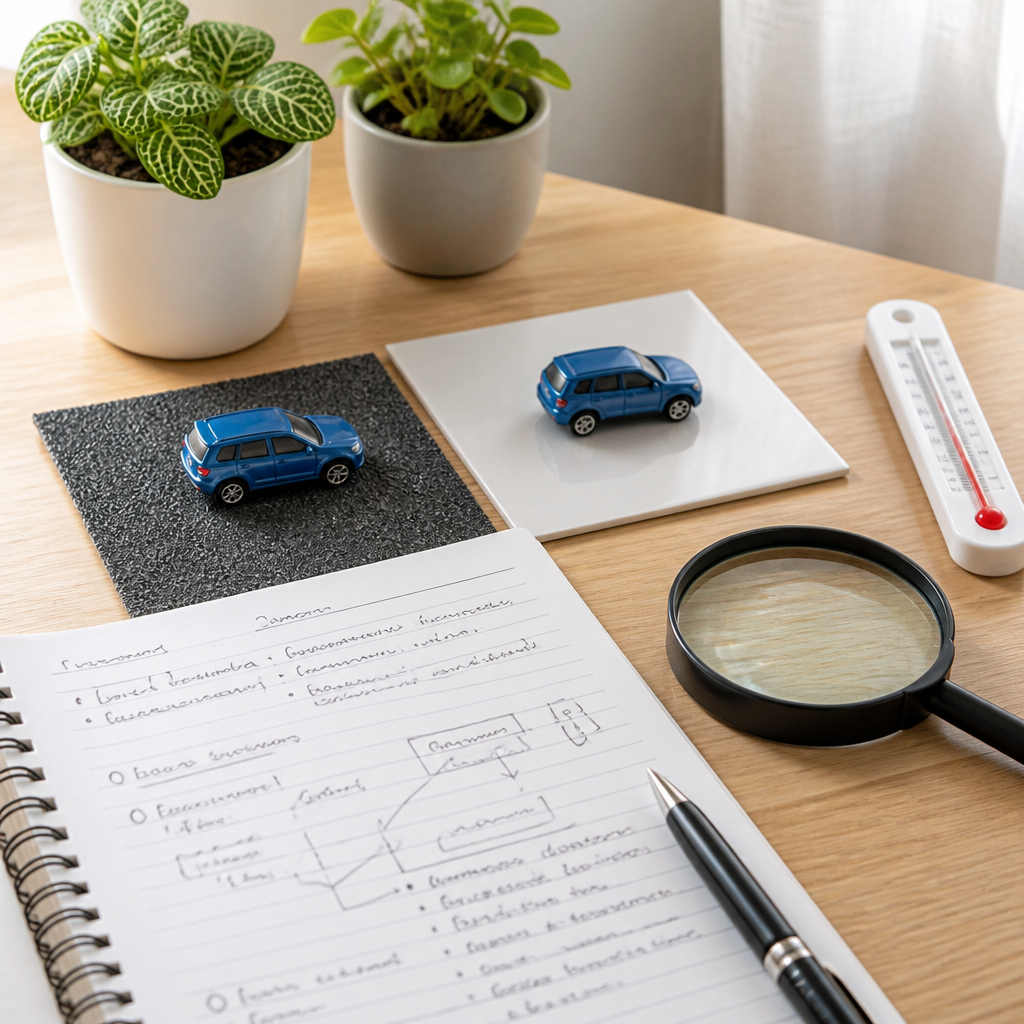
Example 3: Forces and friction
Question:
Why did the toy car move a shorter distance on the rough surface?
Weak answer:
The rough surface stopped it.
Better answer:
The toy car moved a shorter distance on the rough surface because there was more friction between the wheels and the surface. The greater friction slowed the car down more quickly.
Example 4: Fair test
Question:
Why must both plants be given the same amount of water in this experiment?
Weak answer:
So it is fair.
Better answer:
Both plants must be given the same amount of water so that only the amount of sunlight is changed. This makes it a fair test because any difference in growth can then be due to sunlight and not water.
Common Mistakes In PSLE Science Open-Ended Answers
When parents ask how to improve PSLE Science open-ended answering skills at home, the first step is often spotting the exact error pattern.
Giving answers that are too short
A one-line answer may only cover the condition, not the scientific reason.
Example:
The seed did not grow because no water.
A fuller answer is:
The seed did not grow because it did not receive water. Water is needed for germination, so without water the seed could not begin to grow.
Repeating the question without explaining
Question:
Why did the mirror become misty?
Weak answer:
The mirror became misty because there was mist.
That explains nothing, so it earns little or no credit.
Mixing up observation and explanation
If the question asks what happened, your child should not write why. If it asks why, they must go beyond what they can see.
Using vague words
Words like “better”, “stronger”, “bad”, or “changed” are too imprecise unless followed by a proper scientific explanation. Encourage your child to replace vague words with exact terms such as higher temperature, more friction, or less light.
How To Improve Open-Ended Answering Skills At Home
Home support works best when it is focused, calm, and specific.
Do short answer-rewrite practice
Instead of assigning a full paper, pick two weak answers from school worksheets and ask your child to improve them. This is often more effective than doing another full paper badly when they are already tired.
For example, if your child wrote, “The object sank because heavy,” ask:
- Heavy compared to what?
- What property matters here?
- Can you explain using the concept tested?
Ask, “What changed, and what happened?”
This simple question helps children notice cause and effect. It is manageable on a weekday evening and specific enough to sharpen thinking without becoming another stressful revision battle.
Focus on one answering habit at a time
Trying to correct everything at once usually overwhelms a child. It is often better to focus on one habit at a time. One week, work on complete comparisons. Another week, work on explaining the scientific link.
Use official references for exam context
For a better sense of the PSLE Science syllabus and exam information, parents can refer to the MOE syllabus page and the SEAB PSLE page.
Frequently Asked Questions
Why does my child know the concept but still score badly for PSLE Science open-ended questions?
Usually, it is not a total lack of understanding. The bigger issue is incomplete expression. Your child may know the topic, but fail to identify what the question is asking, miss a key scientific link, or write an answer that is too vague for the marking points.
What is the best way to score for PSLE Science open-ended questions?
Train your child to do three things consistently: identify the task, use the correct science concept, and explain the cause-and-effect link clearly.
How often should my child practise PSLE Science OEQ?
Short, regular practice usually works better than occasional overload. Even 10 to 15 minutes spent rewriting two weak answers can improve technique more than one long session.
Should my child memorise model answers?
Memorising can help with scientific wording, but it should not replace understanding. If a child memorises without knowing when to adapt the answer, they may force the wrong explanation into the question and lose marks.
Conclusion
Learning how to answer PSLE Science open-ended questions is not about stuffing more facts into your child’s head. It is about helping them notice what the question wants, use the right science keywords naturally, and explain the scientific link clearly enough for marks to be awarded.
In PSLE Science, many lost marks come from vague wording, missing comparisons, incomplete cause-and-effect chains, or answers that repeat the question instead of explaining it. The encouraging part is that these are trainable habits. With focused practice, before-and-after answer correction, and steady support at home, many children become much more confident with open-ended questions.
If your child needs extra support with PSLE Science answering techniques, you can learn more about PSLE tutors who can help build subject understanding, revision habits, and exam confidence.