


Introduction
It often happens like this. Your child says they have “studied” Social Studies, the notes are highlighted, the textbook has been read, and yet the test comes back with a disappointing mark. Parents are left wondering what went wrong, because on the surface, it looked like revision had been done.
That is why learning how to study for Social Studies in Singapore is not just about putting in more hours. It is about revising in a way that matches the exam format your school uses, especially for lower secondary assessments and upper secondary or O-Level preparation.
For many families, the stress shows up late in the evening. It is already 9.30pm, Math is still unfinished, and Social Studies gets pushed aside because nobody is fully sure what to revise. Parents may feel stuck because the subject looks “general”, while students feel annoyed because they thought they had written enough. The good news is that Social Studies can be studied systematically. Once students understand what the paper is really testing, revision becomes much clearer and much more manageable. For the latest syllabus and exam updates, check MOE’s Social Studies page and SEAB’s GCE O-Level information.
Key Takeaways
- Know what the paper is testing. Social Studies is not mainly about copying textbook facts. It tests source reading, explanation, evaluation, and using examples in relevant ways. Students who see this early usually revise with much more purpose.
- Revise source-based skills separately from essay skills. A child can be decent at memorising content and still lose many marks if inference, purpose, comparison, or reliability questions are weak. When everything is lumped together, improvement often feels slow and confusing.
- Memorise fewer examples, but know them better. A small bank of Singapore-based examples is more useful than long lists that cannot be explained clearly during the exam. The aim is not quantity, but accurate and meaningful use.
- Practise under time pressure. Many students know the answer but write too slowly, over-explain easy questions, or panic when they reach the structured response section. Timed practice helps them judge how much to write and when to move on.
- Weak students need a simpler revision plan. Trying to fix everything at once usually backfires. A short, repeatable weekly routine often works better than marathon sessions that leave the child drained.
- Parents can support without turning revision into nightly conflict. Asking a child to explain a source or give one example is often more effective than repeatedly saying “study harder”. It also helps parents see whether the issue is content, answering technique, or confidence.
Understand What The Social Studies Exam Is Really Testing
Before making notes or planning revision, students need to know what Social Studies exams in Singapore usually involve. This matters because many children revise content only, then feel shocked when the marks do not reflect the effort.
A common pattern among students is this: they assume the subject is mainly about remembering chapters. In reality, the paper tests both knowledge and exam technique.
Source-based questions are a major part of the challenge
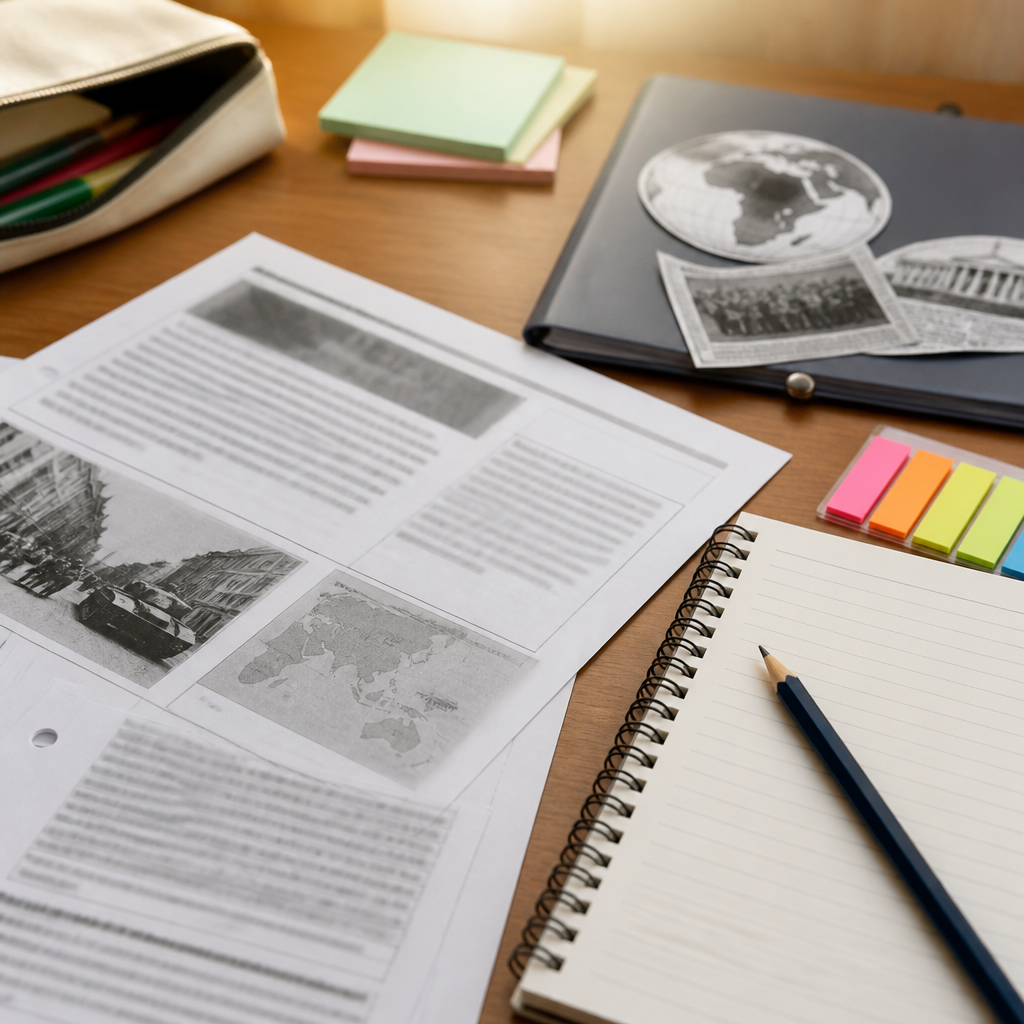
In many secondary school Social Studies exams, students face source-based case study questions. These may test inference, purpose, comparison, surprise, usefulness, reliability, or how sources support and challenge a statement. The wording can vary by school and level, so always follow your school’s latest guidance.
One of the biggest misconceptions is thinking source-based questions are “just comprehension”. They are not. Students often copy lines from the source without explaining what those lines actually mean. If a poster shows a positive message about racial harmony, the answer cannot stop at “the source says people are united”. It must explain what that suggests and why it matters in context. That is where many marks are won or lost.
Structured response needs content plus judgement
The second major component is usually structured response or essay-style writing. This is where students use issue knowledge, examples, and explanation. For O-Level and upper secondary students, the stress often comes from not knowing what to memorise and how much detail is enough.
This is why studying for secondary Social Studies exams in Singapore is not just about reading notes. Students need to understand the difference between knowing a topic and turning that topic into marks. A child may recognise terms like governance, diversity, or citizenship, but still struggle if they cannot explain why an example is relevant to the question.
A useful mindset is to treat Social Studies as a subject of applied understanding. Students are expected to use what they know, not merely repeat it. Once they see that, revision becomes less random. They stop asking, “What chapter should I memorise?” and start asking, “What skill or issue am I weak in?”
Improve Source-Based Skills Without Guessing
Ask many students what they do for Social Studies revision, and the answer is often, “I read the textbook.” That may help content, but it does very little for source analysis. If source-based questions are the weak spot, revision has to be more active and more targeted.
Train one skill at a time
Weak students often feel that every source-based question looks the same. Inference, purpose, comparison, reliability, it all becomes one big blur. Instead of jumping straight into a full paper, isolate one skill.
For example, spend one session doing only inference questions from different school papers. In each answer, identify:
- The idea the source suggests, so you are not just paraphrasing.
- The detail in the source that supports that idea.
- The explanation that connects the evidence to the meaning.
Tutors often notice that once students stop mixing all question types together, panic drops. The source may still be unfamiliar, but the thinking process becomes familiar.
Read the source before hunting for the answer
A recurring problem is rushing to “find the answer” without first understanding the source. Students scan for keywords, then force a memorised template onto the question. That usually leads to shallow responses.

A better habit is to pause for a minute and notice the tone, message, audience, and context. If the source is a speech, ask who is speaking and why. If it is a cartoon, ask what the visual exaggerates. If it is a campaign poster, ask what behaviour it is trying to influence. That short pause often leads to a much stronger answer.
Review mistakes by category, not just score
Getting 6 out of 10 tells a student very little on its own. The more useful question is, why were the marks lost?
This kind of review is often where the fastest improvement happens. Instead of vaguely feeling “bad at source-based”, students start to see their exact habits.
Write Better Essays And Structured Responses
For many students, essays feel more intimidating than source-based questions. The blank page can be enough to make them freeze. They may know a few examples, but struggle to build a full answer around them.
Build answers around explanation, not a memory dump
A very common mistake is listing examples without linking them properly to the question. A student may memorise Total Defence, community programmes, or government campaigns, then try to squeeze them into every answer whether they fit or not.
Markers are looking for relevance and explanation. If the question is about maintaining social cohesion, a stronger answer does not just name an example like Racial Harmony Day. It explains how such activities help students understand different communities, reduce stereotypes, and build shared identity over time. That extra layer is what turns content into marks.
Practise paragraph-building in short bursts
Full essay practice matters, but weaker students often burn out if every revision session becomes a 30-minute essay. After a long school day, that can feel impossible.
A more manageable approach is mini-practice. Write just one body paragraph with:
- One clear point that answers the question directly.
- One relevant Singapore-based example.
- One explanation of why the example matters.
- One sentence linking back to the question.
This keeps revision focused and less overwhelming, while still building the skill that matters.
Learn to make a simple judgement
Many structured response questions reward students who can weigh factors instead of writing two unrelated paragraphs. Even a short judgement helps. For instance, a student can argue that education is important for social cohesion, but laws and institutions may have a wider long-term effect because they shape behaviour across the whole society. That kind of comparison shows maturity in thinking.
Avoid memorising model essays word for word
It feels safe, but it often backfires. Once the wording changes, students freeze because the memorised answer no longer fits. A better goal is to remember useful ideas, examples, and explanation chains. That gives more flexibility during the paper.
If your child needs more structured guidance for source-based skills and essay feedback, it can help to work with a tutor who understands the demands of the subject. You can learn more about our secondary school tutors.
Memorise Social Studies Examples In A Smarter Way
One of the most frustrating questions students ask is, “What exactly am I supposed to memorise?” The answer is not everything. In fact, trying to memorise too much is often what makes revision messy and ineffective.
Group examples by issue, not by chapter title
A more useful approach is to organise examples under broad issues such as diversity, governance, citizenship, or globalisation. This makes them easier to retrieve during the exam because students remember the theme instead of trying to recall a textbook page.
Instead of one long chapter summary, create a short list under an issue such as social cohesion. Then add one sentence on what each example shows. This helps students revise for understanding, not just recall.
Use the “what, why, so what” method
This is simple, practical, and easier to remember under pressure.
That final step is the one many students skip. They know the example, but they do not explain what it proves.
Keep the example bank small and revisable
A student with 25 weakly memorised examples is often worse off than a student with 8 well-understood ones. Especially during exam season, when school, CCA, and other subjects are all competing for time, a lean example bank is much easier to review repeatedly.
A practical way to do this is to keep a one-page example sheet. Under each issue, list only a few examples that your child can actually explain. If they cannot say in one or two sentences why the example matters, it is probably not ready for exam use yet.
Help Weak Students Build A Revision Routine That Sticks
When results have been poor for some time, both parents and students can start to feel discouraged. Some children begin saying they are “just bad at humanities”. In many cases, that is not the real issue. More often, they have gaps in method, vocabulary, and confidence.
Start with two skills and two topics
Do not begin with full papers every day. For the first two weeks, focus on:
- Two source-based skills, such as inference and comparison.
- Two common content areas from recent school work.
This keeps revision manageable. Early wins matter. If a child can finally answer one question type properly and recall one relevant example with confidence, motivation usually improves.
Use four short sessions a week
A manageable weekly routine might look like this:
This usually works better than one long Sunday session where the student is tired, frustrated, and barely taking anything in.
Parents can check understanding without reteaching the subject
Many parents worry because they do not remember the syllabus or the answering format. That is completely normal. You do not need to reteach Social Studies. Ask simple questions such as what the source is trying to say, what example fits the issue, and why that example matters. If a child cannot explain it aloud, they usually do not understand it well enough yet.
Another helpful habit is to keep the conversation neutral. Instead of focusing first on marks, focus on process. Ask, “Which question type was hardest?” or “Which example do you keep forgetting?” That makes revision feel more like problem-solving and less like blame.
Revise Closer To Exams Without Panicking
In the final weeks before school exams or O-Levels, revision needs to become more exam-like. This is where students sometimes make things harder for themselves by doing only content memorisation or only reading answer keys.
Practise timing deliberately
Social Studies papers often feel rushed. Some students spend too long on the first source question because they want a perfect answer, then have too little time left for later sections.
Train with a clock. Give yourself a fixed time for each question or section. When the time is up, move on and review later. It feels uncomfortable at first, but it builds exam discipline.
Mark your own answers critically
Do not assume an answer is strong just because it looks long. Compare it with teacher comments, school answer samples, or past corrections. Look at:
- Directness.
- Relevance.
- Use of source evidence.
- Quality of explanation.
- Balance where needed.
A lot of students write long answers that are repetitive. In Social Studies, longer is not always better.
Rotate full papers with targeted correction
Closer to exams, alternate between one timed section or full paper and one correction session focused only on weak areas. That balance matters. If students keep attempting papers without fixing mistakes, the same habits repeat and confidence drops.
A simple final-month approach is this: one paper attempt, one correction day, one content recap day, then repeat. This keeps revision active while preventing overload.
Frequently Asked Questions
How many hours should my child spend studying Social Studies each week?
For most secondary students, two to four focused sessions a week is usually more useful than occasional long revision marathons. Near exams, the total can increase, but quality matters more than simply counting hours. A tired child forcing themselves through notes late at night often remembers very little.
Why does my child keep failing Social Studies even after memorising the textbook?
This is a very common frustration. Memorising content helps, especially for structured response, but it is not enough on its own. Many students lose marks because they misread the source, copy evidence without explanation, or fail to answer the question directly. The issue is often answering technique, not just effort.
What is the best way to revise Social Studies if source-based questions are the main problem?
Start with one question type at a time, such as inference or purpose, instead of doing full papers immediately. Then review exactly why marks were lost. Often, the problem is not ability. It is weak answering habits, unclear explanation, or confusion about what the question is really asking.
How can parents help without making Social Studies revision stressful every night?
Keep support short and practical. Instead of asking, “Have you studied or not?”, ask your child to explain one source or one example. That usually feels less confrontational and gives a clearer sense of whether understanding is improving. It also helps avoid turning every evening into an argument.
Do Social Studies exam formats change in Singapore?
They can. School exam formats, question wording, and national exam requirements may be updated over time. Always check your school’s latest guidance and official information from MOE and SEAB.
Conclusion
Learning how to study for Social Studies in Singapore becomes much less confusing once students stop treating it like a pure memory subject. The real work lies in two areas: reading and analysing sources carefully, and writing structured answers with relevant examples and clear explanation.
For weaker students, progress often begins with a simpler plan, fewer examples, and repeated practice on one skill at a time. For parents, support does not have to mean long lectures or nightly battles. Sometimes a five-minute discussion about one source is far more useful than an hour of nagging.
Most importantly, improvement in Social Studies is usually gradual rather than dramatic. A student may first get better at inference, then become more confident with examples, and only later see the marks rise clearly. That is normal. Consistent practice, clear correction, and realistic routines tend to work better than last-minute cramming.
If your child needs extra help with Social Studies revision, source-based skills, or essay practice, learn more about our secondary school tutors.