


Introduction
You can usually spot it before the exam even starts. Your child reads in a flat voice, answers in one line, or suddenly goes quiet the moment you ask, “Why do you think that?” If you are wondering how to do well for English Oral in Singapore, you are definitely not alone.
For many students, English Oral feels stressful in a very different way from written papers. A worksheet can be redone. Composition can be planned. Oral happens live, in front of an examiner, with very little time to hide nervousness. For parents, the worry is often very familiar. You know your child has ideas, but they do not always come out well under pressure.
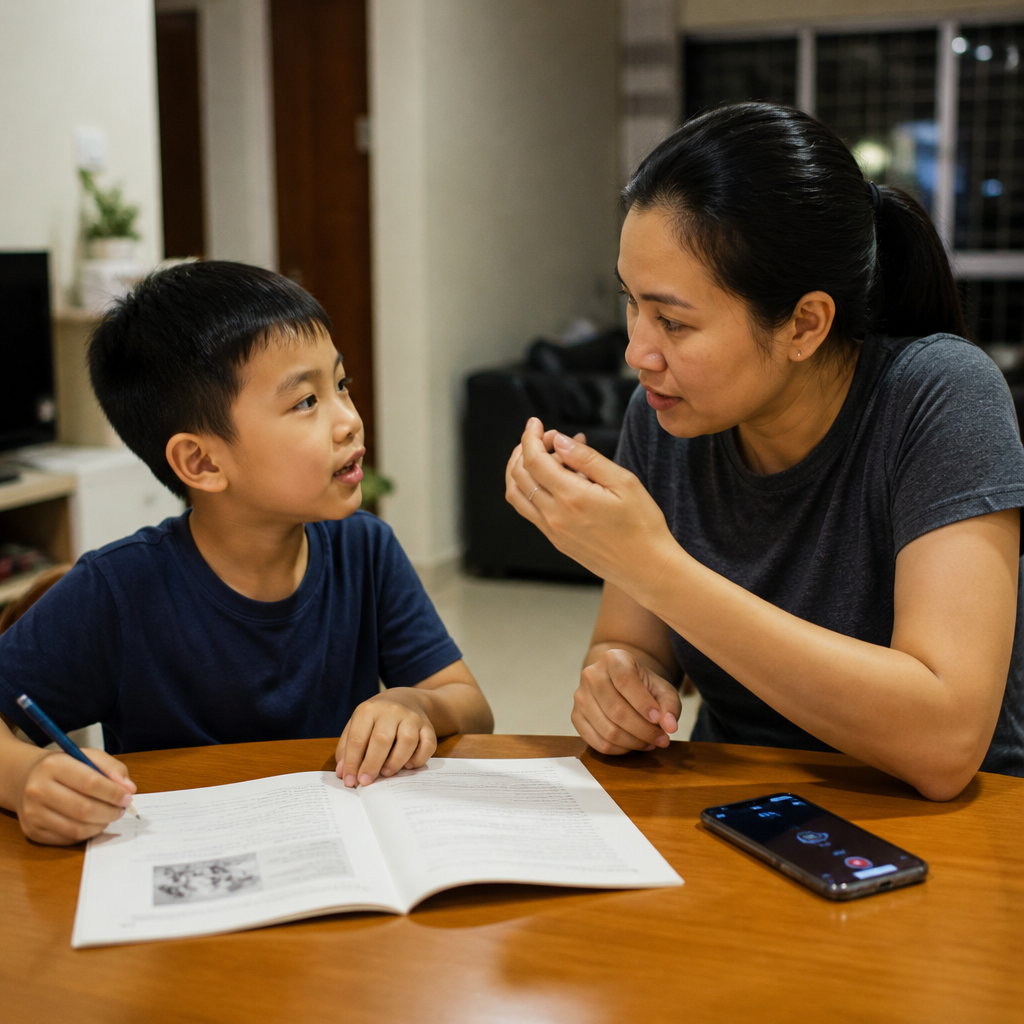
The good news is that English Oral is a skill that can improve with focused practice. In Singapore schools, oral assessment commonly includes two main areas: reading aloud and stimulus-based conversation. Examiners usually listen for clarity, pronunciation, fluency, expression, relevance, and whether the student can develop ideas with examples. The exact format may change over time, so it is wise to check the latest school instructions and official updates from MOE and SEAB.
Key Takeaways
- Oral is not just about speaking more. Examiners usually listen for clear pronunciation, steady fluency, suitable expression, and answers that are relevant and developed. A long answer without structure does not automatically score well.
- Reading aloud and conversation need different preparation. A child who reads smoothly may still struggle to elaborate in discussion, while a talkative child may lose marks through unclear reading. Both components need separate practice.
- Short answers are one of the biggest score blockers. A simple opinion is rarely enough. Students usually do better when they add a reason, an example, and a small personal reflection.
- Monotone reading can improve quite quickly. Many students do not need a “perfect accent”. They need better phrasing, punctuation awareness, and confidence in stressing key words naturally.
- Home practice works best when it feels calm and regular. Ten focused minutes of reading, recording, or discussing a photo after dinner is often more effective than one tense weekend session.
- Primary and Secondary students face slightly different challenges. Primary pupils often need help with confidence and basic elaboration, while Secondary students usually need sharper opinions, wider vocabulary, and more mature examples.
- Last-minute cramming rarely fixes oral weaknesses. Consistent exposure to spoken English, current topics, and feedback makes a bigger difference than memorising model answers the night before.
What Examiners Are Really Listening For
Many students do practise, but they still feel stuck because they are not fully clear on what English Oral is testing. Once that becomes clearer, practice starts to feel more purposeful.
Reading aloud is about clear, meaningful delivery
In reading aloud, examiners are not expecting a dramatic performance. They are usually listening for whether the student can read clearly, pronounce words accurately, pause at suitable points, and sound like they understand the passage.
A common mistake is reading every line at the same speed and volume. Another is rushing because of nerves, especially when the student sees a difficult word and just wants to get through it.
A child may know every word in the passage but still lose marks if the reading sounds robotic. That is why some of the most effective ways to improve reading aloud are also the simplest. Slow down slightly, notice punctuation, and stress important words naturally.
Stimulus-based conversation is about ideas, relevance, and support
This is the part where many students panic. They answer the first question, then suddenly run out of things to say.
In Singapore school oral exams, the conversation often begins with a visual stimulus and moves into personal response, opinion, or wider reflection. Examiners are usually listening for whether the student answers the question directly, explains the answer, and supports it with examples.
Students often ask how to answer stimulus-based conversation questions without sounding memorised. The answer is not to memorise full scripts. It is to build the habit of giving complete responses.
Weak answer: “Yes, because it is healthy.”
Stronger answer: “Yes, I think outdoor activities are important because they keep us active and reduce stress. For example, after a long school day, playing basketball or even walking in the park helps students feel refreshed.”
That difference matters. The stronger answer does not sound fancy, it simply sounds more complete.
Improve Your Reading Aloud Score
For many children, reading aloud feels safer than conversation because the words are already there. Even so, this section still causes plenty of lost marks.
Mark the passage quickly and wisely
During preparation time, students should not try to overanalyse every sentence. That often creates more panic. A more practical approach is to scan for punctuation, underline difficult words, and note where the voice should rise or fall slightly.
If the passage says, “To everyone’s surprise, the timid boy volunteered first,” the student should notice that “to everyone’s surprise” and “volunteered first” carry meaning and should not be read flatly.
This matters for both Primary and Secondary students, although the expectations are not exactly the same.
Fix the habits that make reading sound weak
Tutors often notice the same patterns. Some students swallow the last word of each sentence. Others pause in the middle of a phrase because they are reading word by word instead of in chunks. There are also students who sound fine until they hit one unfamiliar word, then the whole rhythm falls apart.
Try these practical adjustments:
- Read in thought groups, not one word at a time. For example, “After the heavy rain, the school field became muddy” should flow in meaningful chunks.
- Match punctuation with breathing. A full stop is a proper pause. A comma is a lighter pause.
- Use expression where meaning changes. Surprise, concern, excitement, and contrast should be heard gently, not acted out.
These are practical English Oral tips parents in Singapore can use at home too. A short nightly reading drill, with one round for accuracy and one round for expression, is often enough.
One useful method is echo reading. The parent, tutor, or older sibling reads one sentence first with natural pacing, and the student repeats it. This helps children hear what “smooth” reading sounds like. Another simple method is to record one short passage and replay it immediately. Students often notice on their own that they are rushing, mumbling, or pausing oddly. That kind of self-awareness can improve reading faster than repeated nagging.
Get Better At Stimulus-Based Conversation
This section often reveals whether a student sounds prepared or unsure. It is also where nervous students shrink into one-line responses.
Stop aiming for the “correct” answer
A common misconception is that oral examiners want one fixed answer. Usually, they want a relevant, clear, and supported answer.
A child who keeps trying to guess the “best” answer often becomes stiff and unnatural. It is far better to give a real opinion and explain it clearly.
Imagine a visual about students using phones in public. If asked whether phones are helpful or distracting, there is no need to force a perfectly balanced essay-style answer. A student can simply say that phones are helpful if used responsibly, but distracting when students keep checking games or messages. That sounds more believable than something memorised.
Learn to elaborate without rambling
Many students know the topic but do not know how to continue speaking. The easiest fix is to build answers using a few simple parts.
A common pattern among students is this. They think they need advanced vocabulary first. Usually, they do not. They need fuller thinking.
If asked, “Would you enjoy taking part in a community event?”, a weak answer is simply, “Yes, because it is fun.” A fuller answer explains why, then adds an example from school or daily life.
A helpful structure is point, reason, example, reflection. For instance: “Yes, I would enjoy it because community events help people feel more connected. For example, if residents clean a park together or organise a food drive, they get to help others while working as a team. I think this is meaningful because young people should learn to contribute, not just focus on themselves.” This is not long, but it shows maturity.
Know the difference between Primary and Secondary expectations
Primary students often need support with basic confidence and complete sentences. Secondary students are usually expected to handle broader questions with more maturity.
That means older students should get used to discussing everyday Singapore topics such as school rules, group projects, screen time, public behaviour, CCA commitment, and balancing rest with achievement.
Practise At Home Without Turning It Into A Battle
This is where many parents feel stuck. You want to help, but you do not want every oral practice session to end badly. Sometimes the child is already tired after school, homework, and CCA. The moment oral practice starts, the tension rises.
Keep practice short, specific, and repeatable
The best English Oral practice at home is often simple. Ten to fifteen minutes is enough if the routine is clear.
Try rotating these:
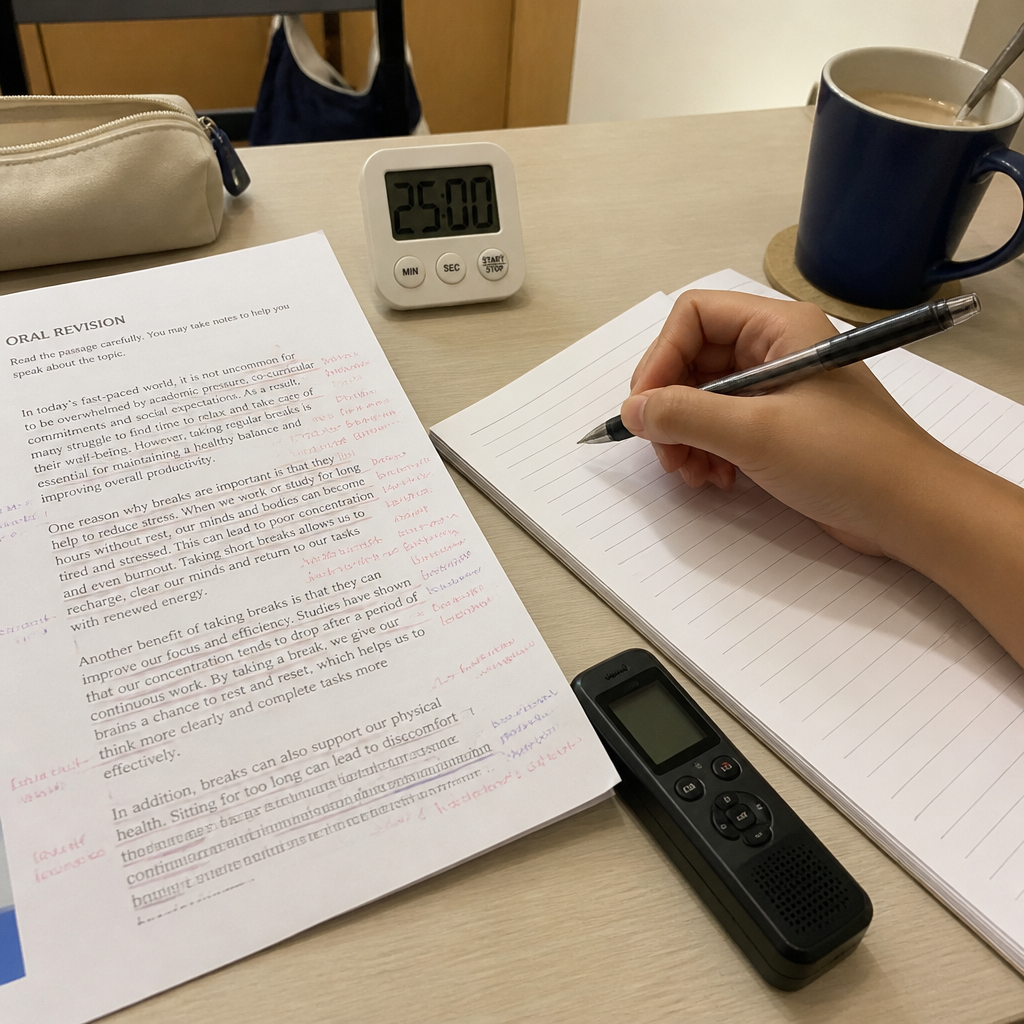
- Timed reading aloud. Use one short passage, one minute of silent preparation, and one reading.
- Record and replay one conversation answer. Many students are surprised by how soft, rushed, or repetitive they sound.
- Discuss one everyday topic at dinner. This makes oral feel more like communication and less like interrogation.
Avoid the habits that backfire
Some well-meant habits make things worse. Overcorrecting every pronunciation mistake can make a child more self-conscious. Forcing model answers can lead to unnatural speech. Comparing siblings or classmates usually damages confidence very quickly.
A calmer approach works better. Correct one or two things each session. For example, focus only on speaking louder and giving one example. That feels manageable.

It also helps to vary the role of the adult. Sometimes be the examiner and ask a direct question. At other times, be a listener and simply respond with, “Why do you think so?” or “Can you give me an example?” This feels less intimidating and trains the child to extend answers naturally.
If your child needs more structured support, especially if school oral results stay weak despite practice, it may help to get targeted guidance from an experienced English tutor who can work on reading aloud, idea development, and confidence in a more neutral setting. You can learn more here: private home tuition support.
Fix Common Oral Problems Fast
Sometimes the exam is close and students need practical fixes they can use this week, not broad advice.
Another common issue is repetition. Some students keep saying “because” or repeat the same point in different words. A quick fix is to prepare a few linking phrases such as “for example,” “in addition,” “on the other hand,” and “as a result.” These do not need to sound advanced. They simply help the answer move forward more smoothly.
Use The Right Checklist Before The Exam
Preparation should match the child’s level. What helps a Primary 4 student is not always enough for a Secondary 3 student.
For Primary students
For younger students, focus on basics done well:
- Read clearly and not too fast.
- Pronounce common words carefully.
- Look at punctuation.
- Answer in complete sentences.
- Add one simple reason or example.
A Primary 6 pupil preparing for school oral or national exam components does not need to sound sophisticated. Clear, steady, and relevant usually beats fancy but memorised.
For Secondary students
Older students need stronger thinking as well as better delivery:
- Read with natural phrasing and control.
- Avoid repetitive words like “very nice” or “very fun”.
- Give opinions that are thoughtful where suitable.
- Support points with examples from school, society, or personal experience.
- Handle follow-up questions without freezing.
Secondary students often know more than they show. The problem is that stress compresses their answers. Practising follow-up questions makes a real difference.
The night before and the morning of the exam
Do not cram ten topics at once. Read one or two passages aloud. Practise two conversation questions. Sleep on time.
On the morning itself, warm up the voice gently by reading a paragraph softly. A tired child after late-night revision rarely performs well in oral.
Frequently Asked Questions
How can my child improve English Oral quickly before a school exam?
Focus on the highest-impact areas first, reading pace, clear pronunciation, and fuller answers in conversation. In a short period, one reading passage a day and two oral questions with follow-up examples can improve performance more than memorising long scripts.
What if my child has good English marks but weak Oral marks?
This is very common, and it can be frustrating for parents because the gap feels confusing. Some students write well but speak cautiously, too softly, or with little expression. Oral requires live delivery and quick thinking, so targeted speaking practice is still needed even if written English is strong.
Are model answers useful for oral preparation?
They can help students see what a developed answer sounds like, but overusing them can make speech stiff and unnatural. A better approach is to study how model answers add reasons and examples, then build personal responses instead of reciting.
How often should we do English Oral practice at home without making my child dread it?
Short and regular usually works best. Three to five sessions a week, even just ten minutes each, is often more effective than one long Sunday session that ends in frustration. The key is keeping practice calm enough that your child can stay responsive.
Where can I check the latest English Oral exam format in Singapore?
Since school-based and national assessment details can change, check the latest guidance from your child’s school and official sources such as MOE and SEAB.
Conclusion
Learning how to do well for English Oral is not about sounding perfect. It is about sounding clear, confident, and thoughtful.
For reading aloud, students need calm pacing, accurate pronunciation, and expression that shows understanding. For stimulus-based conversation, they need the habit of answering directly, then adding reasons, examples, and personal insight.
Parents do not need to turn the home into an exam hall. A steady routine of short reading practice, recorded responses, and everyday discussion often works better than pressure and repeated correction. For Primary students, confidence and complete answers matter a lot. For Secondary students, stronger elaboration and more mature examples become increasingly important.
If your child would benefit from extra support with oral practice, reading aloud, and building confidence for school assessments and exams, you can learn more about our English tutors here: private home tuition. For broader language support, you may also wish to explore our English tuition options.