


Introduction
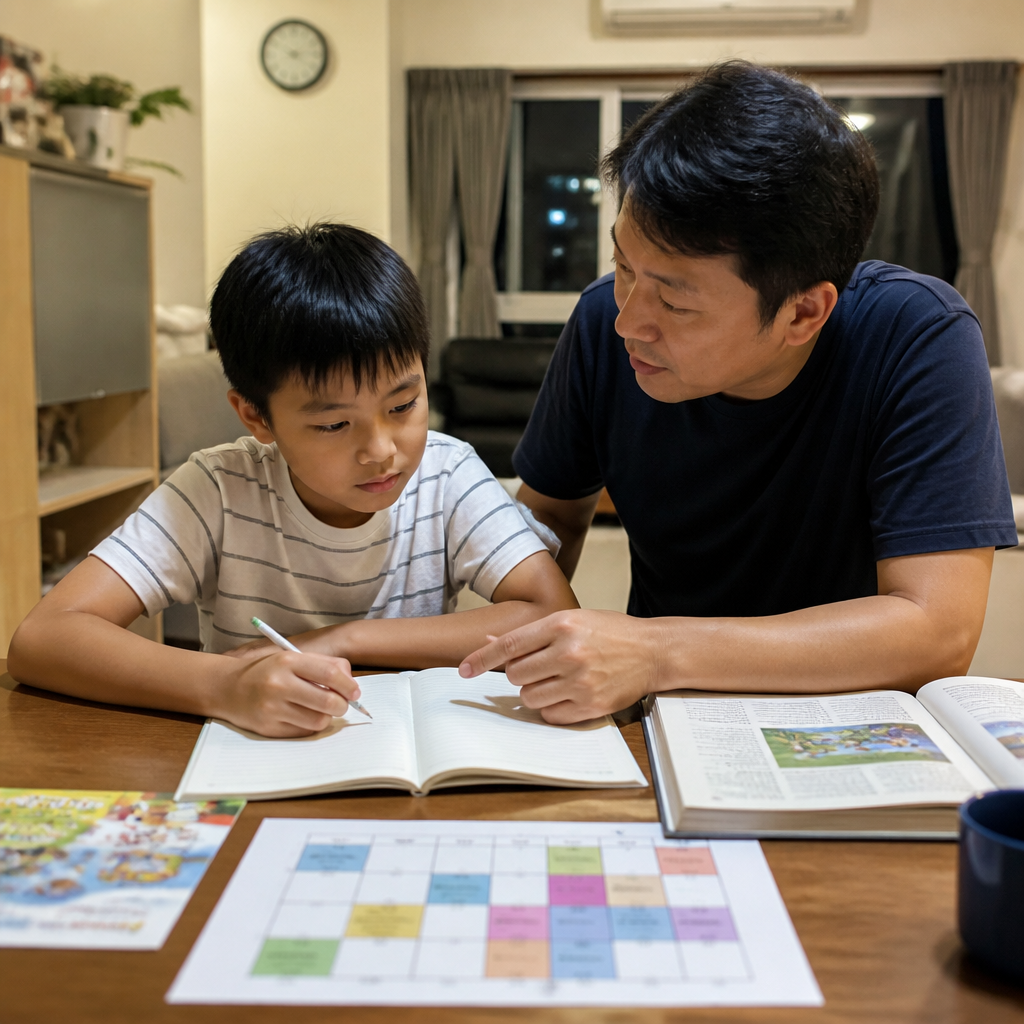
You are probably familiar with this moment. Your child sits at the table, pencil in hand, staring at a blank page. After a long pause, they write a few lifeless lines about “a sunny day” and then look up with that defeated expression, “I don’t know what else to write.”
It is frustrating, especially when this same child can talk non-stop in the car, complain in great detail about school, and tell funny stories about what happened during recess. On paper, though, everything suddenly goes flat.
The reassuring part is this, creative writing is not a gift that only a few children are born with. It can be built over time through observation, reading, conversation, and better writing habits. For Singapore parents, the challenge is often practical. Between school demands, tuition, CCAs, and tired evenings, it is hard to know how to help without turning writing into another stressful task. This guide focuses on simple, realistic ways to strengthen creative writing skills so your child can develop better ideas, stronger storytelling, and more confidence, instead of relying only on memorised model compositions.
Key Takeaways
- Creative writing improves through daily noticing, not only formal practice. A child who learns to observe MRT passengers, hawker centre sounds, or a rainy school dismissal often has more to write about than a child who only memorises sample essays. Real-life observation gives them scenes, emotions, and details they can reuse naturally in composition writing.
- Strong storytelling matters more than fancy words alone. Many children try to impress with difficult vocabulary, but stories become memorable when the character, problem, and emotions feel believable. A simple sentence with clear feeling often works better than an overdecorated paragraph that sounds copied.
- Home support works best when it feels low-pressure. Short conversations, journaling, and playful rewriting tasks often work better than turning every writing session into a mini-exam. Children usually write more freely when they do not feel judged from the first line.
- Reading widely builds writing naturally. Exposure to different sentence styles, character voices, and story structures gives children a bigger mental library to draw from when they write. This helps with both English composition and overall language development.
- Singapore settings can spark better ideas. School corridors, HDB void decks, tuition days, CCAs, hawker centres, and thunderstorms are familiar scenes that make writing richer and more authentic. Local details also help children sound more grounded and less generic.
- Some children need structured feedback, not just more practice. If your child keeps writing flat storylines or repeating the same mistakes, a suitable creative writing tutor in Singapore may help build stronger habits over time. Good support should develop ideas and storytelling, not just correct grammar.
Why Children Struggle With Creative Writing, Even When They Are “Good In English”
This catches many parents off guard. A child may do reasonably well in grammar or comprehension, yet still struggle badly with composition. That does not always mean carelessness or laziness. Quite often, the difficulty lies in idea generation, confidence, and storytelling, not just language accuracy.
They have words, but not enough ideas
Some children know plenty of vocabulary, but they do not know how to build a scene. Ask them to write about “an unforgettable journey”, and they produce something like this: “I went on the MRT. It was crowded. Then I reached my destination.” Nothing is exactly wrong, but nothing is alive either.
A common pattern among students is that they have been trained to look for the “correct” answer. Creative writing feels uncomfortable because there is no single safe sentence to copy. They may know English, but they do not yet know how to turn an experience into a story.
They rely too much on memorised model compositions
This is especially familiar in Singapore. A child memorises dramatic openings and stock phrases, then tries to squeeze them into every topic. At first, it may sound polished. After a while, the writing starts to feel forced and repetitive.
The real problem is not just that the phrases sound unnatural. It is that children stop trusting their own ideas. The moment the topic does not fit what they memorised, they freeze.
They are mentally tired
By the end of the day, many children are simply drained. After homework, spelling, tuition, and CCA, there may be very little creative energy left. At 9.30pm, even a capable child may give short, mechanical answers.
If your child resists writing, it is worth asking whether the issue is unwillingness or exhaustion. Sometimes parents push harder, thinking more discipline is needed. In reality, a tired child often needs a lighter, smarter approach.
Build Observation Before You Push Harder Writing Practice
When parents ask how to improve creative writing skills, the answer often starts before the writing itself. Children need material to work with. Imagination is not only about making things up, it is also about noticing real life more closely.
Turn ordinary Singapore moments into story material
Many useful creative writing exercises for kids begin with everyday scenes. On the MRT, ask, “Who looks the most interesting here?” At a hawker centre, ask, “What do you hear? What do you smell? Who seems to be in a hurry?”
These small conversations train children to collect details. Later, when they write, they are not creating from nothing. They are drawing from memory, and that often makes composition writing feel more vivid and believable.
Use “what might have happened?” questions
Observation becomes storytelling when possibility enters the picture. A simple real-life scene can become a strong prompt.
This works well because it feels natural. You are not demanding a full composition. You are helping your child think like a storyteller.
Keep a small idea bank
Not every child likes journaling, and that is fine. A small notebook or phone note with quick observations can still help. A line like “old uncle feeding mynah birds under void deck” may later become a character or opening scene.

Five short notes a week can sometimes do more than one forced two-hour composition session. Tutors often notice that children write better when they already have a bank of scenes and details to draw from.
Improve Creative Writing At home Without Making It Feel Like Punishment
Many parents searching for ways to improve primary school creative writing at home worry that they are either doing too little or doing it wrongly. That anxiety is understandable. Still, home does not need to feel like a second classroom.
Rewrite boring sentences together
A simple exercise can go a long way. Start with a flat sentence like, “The boy was scared.” Then ask, “What did his body do? What did he notice? What made the fear worse?”
“The boy was scared.”
“His fingers tightened around the bag strap as thunder cracked above the parade square.”
The improvement is not about showing off difficult words. It is about making the moment visible.
Talk before writing
Some children can tell lively stories out loud but freeze when asked to write. If that sounds familiar, use speaking as the bridge. Ask what happened, who was there, what went wrong, and what the funniest or most dramatic part was.
Once the story feels real in conversation, writing becomes less intimidating. This is especially helpful for lower primary children who still need support turning spoken ideas into written sentences.
Keep practice short and consistent
Long writing sessions often sound productive, but they can backfire. A tired child forced to sit through a long session may end up hating composition and producing weaker work anyway.
A more realistic rhythm often looks like this:
Twenty minutes, two or three times a week, is often enough to build consistency without constant battles.
Build Imagination Through Reading, Talking, And Play
When a child says, “I have no ideas,” the issue is often not ability. It is input. Children need stories, voices, and situations in their heads before they can create their own.
Read beyond school assessment books
Children who only read comprehension passages and model essays often write in a stiff, predictable way. To build imagination, they need exposure to stories with humour, tension, character, and voice.
This does not mean only thick novels. The key is variety. As they read, they start to absorb how stories move and how characters react. For syllabus context, parents can refer to MOE’s primary English curriculum, but creative growth usually comes from reading more widely than basic curriculum expectations.
Create characters together
Character work is one of the most underrated creative writing exercises for primary students. Ask your child to invent someone with a clear fear, habit, or secret. Once a child knows what a character wants or worries about, the story becomes easier to write.
Flat compositions often happen because “the boy” or “the girl” feels like nobody in particular. A more believable character naturally leads to stronger actions and reactions.
Let play feed writing
Play is often dismissed because it does not look academic. But storytelling grows there too. Comic drawing, pretend play, board games, and made-up backstories all build creative thinking.
If your child narrates a football match dramatically or invents personalities for toy figures, that is not wasted time. Those are early storytelling habits in action.
Creative Writing Exercises That Actually Work For Singapore Students
Not all writing practice helps equally. Some tasks are so broad that children shut down before they begin. Better activities give enough structure to spark ideas while still leaving room for creativity.
Use local story prompts
Prompts rooted in familiar Singapore settings often work better because children can picture them clearly.
- Write about a student who misses a stop on the MRT and discovers something unexpected.
- Describe a rainy dismissal where one wrong umbrella causes a huge misunderstanding.
- Tell a story set during CCA when someone notices a classmate behaving strangely.
- Write about a hawker centre errand that turns into a surprising encounter.
These prompts feel less abstract and more usable because the setting is already real in the child’s mind.
Build scenes from the five senses
Choose a place such as the school canteen, a pasar malam, or a void deck after rain. Ask your child what they see, hear, smell, and feel, and what detail most people would miss.
This helps them move away from vague description and towards specific, memorable detail.
Practise dialogue with purpose
Dialogue should do something. It should reveal character, show tension, or move the story forward. Many children enjoy dialogue because it feels lively and immediate.
A common mistake among students is writing dialogue that fills space but adds nothing. The stronger version usually carries emotion, urgency, or conflict.
Support Your Child Without Overcorrecting Every Line
Many parents mean well but accidentally make writing feel heavier than it needs to be. The child shares a story, and the first response is about tense errors or inaccurate phrasing. Correction matters, but timing matters too.
Respond first as a reader, not an examiner
Before fixing mistakes, react to the story itself. Say what you could picture, what felt funny, or which part made you curious.
That shift matters because it teaches children that writing is about communication, not just error avoidance. Once they feel heard, they are usually more open to revision.
Focus on one or two improvements at a time
If every line gets corrected, many children stop taking creative risks. A gentler and often more effective approach is to choose one writing goal for that session, such as stronger description, clearer feelings, or a better ending.
This keeps revision manageable and protects confidence.
Know when outside help may be useful
Sometimes the issue is no longer the writing itself. It is the tension around it. If every composition session turns into an argument, outside support may help break that pattern.
If your child often lacks ideas, repeats the same flat plots, or needs regular guidance, you can explore our tutors or view available English tuition in Singapore. A suitable creative writing tutor should do more than correct grammar. They should help your child generate ideas, develop scenes, and revise with purpose.
Help Older Students Move Beyond Mechanical Writing
By upper primary or secondary school, some students can produce long compositions that still feel lifeless. They know the format. They know the “good phrases”. But the writing feels assembled rather than genuine.
Watch for overpolished but empty writing
Experienced tutors often notice this pattern. The vocabulary sounds advanced, but the plot is thin, the emotions feel unrealistic, and every story sounds strangely similar.
This usually happens when students chase impressive language before they understand storytelling. Strong writing starts with believable people, meaningful moments, and clear emotional movement.
Encourage revision, not just completion
Many children think writing ends once the last sentence is done. In reality, some of the biggest improvements happen during revision.
Ask your child which sentence is the strongest, which part feels rushed, and where more detail is needed. That habit is useful not only for school compositions but for writing more thoughtfully in general. Parents who want to understand formal assessment context can also refer to SEAB.
Connect writing to real expression
Older students often write better when the topic feels emotionally real. When they care about the situation, the writing usually sounds less mechanical.
Even in school-based composition practice, emotional truth matters. A story feels stronger when the reactions feel believable, not pasted in for effect.
Frequently Asked Questions
My child hates composition. Can creative writing still improve?
Yes. Many children improve once writing stops feeling like constant correction. Start with spoken storytelling, comics, short journals, or sentence-rewriting games. A child who resists full compositions may still enjoy creating characters or describing a dramatic MRT scene, and that can become a bridge to better writing.
How often should my child practise creative writing at home?
For most children, two to three short sessions a week is enough. Consistency matters more than intensity. A calm 20-minute session where your child thinks, talks, and revises is usually more useful than a long, exhausted weekend battle.
What if my child reads a lot but still writes poorly?
Reading helps, but it is not automatic. Some children read passively and do not notice how stories are built. Talk about what they read. Ask why a scene was exciting, why a character felt believable, or how the author created suspense. That conversation helps transfer reading into writing.
Are model compositions bad?
Not necessarily. They can expose children to better vocabulary and structure. The problem comes when children copy them blindly or depend too heavily on memorisation. Model compositions should be used as examples to study, not scripts to recycle.
When should I consider tuition for creative writing?
If your child regularly says they have no ideas, writes very flat narratives, avoids writing, or does not improve despite regular practice, tuition may help. The right support gives personalised feedback, fresh prompts, and writing routines that many busy families find hard to maintain consistently at home.
Conclusion
Helping a child improve creative writing skills in Singapore is rarely about forcing perfect compositions. More often, it is about helping them notice, imagine, express, and revise.
The strongest young writers are not always the ones with the fanciest vocabulary. Very often, they are the ones who notice a rainy afternoon properly, sense tension between classmates, turn a hawker centre errand into a story, and feel confident enough to write in their own voice.

If you want to help your child move beyond memorised phrases and predictable plots, start small. Talk more. Read more widely. Use real Singapore settings. Rewrite dull sentences together. Let stories begin in everyday life. And if your child needs more structured support with idea generation, feedback, and writing habits, you can learn more about our tutors to find guidance that fits your child’s needs.