


Introduction
Some weeks just feel like a blur. You get home after school, there is CCA on two days, tuition on another, and somehow homework, spelling, 听写, project work, and test revision are all still waiting. Then Saturday gets eaten up, and Sunday night turns into a stressful catch-up session.
If you have been wondering how to manage your time as a student, the answer is usually not to squeeze every hour tighter. More often, it comes down to planning your week in a way that actually matches real life. Good time management for students is less about being super disciplined and more about knowing what must be done, what can wait, and how to protect your energy so you do not keep falling behind.
This guide is for students in Singapore trying to juggle school, homework, tuition, CCA, family time, and rest across a normal school week. The goal is not a perfect routine. It is a workable routine that helps you stay steady, lower stress, and study more effectively.
Key Takeaways
- Plan your week before it gets busy. A simple weekly view helps you see school, CCA, tuition, homework, and rest in one place before everything starts clashing.
- Prioritise by urgency and weight, not by mood. The easiest task is not always the one that matters most.
- Estimate your work honestly. Homework, travel, and settling down after school often take longer than expected.
- Tuition should support your routine, not overload it. Extra lessons only help when they fit into a sustainable week.
- Small weekday study blocks matter. Even 20 to 30 focused minutes can stop work from piling up.
- Sleep is part of time management. A tired brain works slower, forgets more, and procrastinates more easily.
- Consistency beats panic catch-up. A steady routine usually works better than relying on Sunday night revision.
See The Whole Week Before It Starts
A lot of students try to manage school life one day at a time. It sounds sensible, but this is often where the stress starts. Monday feels manageable, Tuesday still seems okay, and then by Thursday, everything lands at once.
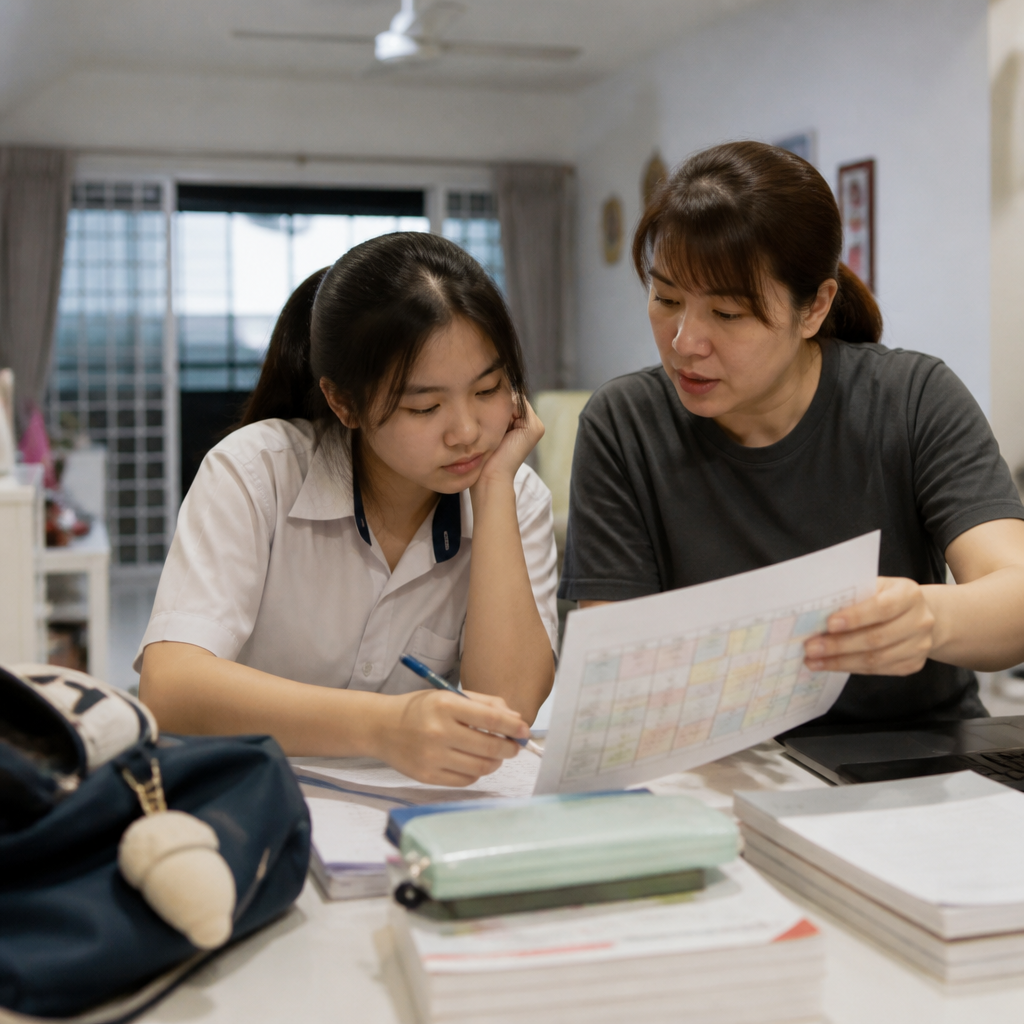
One worksheet becomes three. One tuition task gets forgotten. One group project chat suddenly becomes urgent. That is why the first useful shift is simple, look at the whole week before it starts.
Use a weekly planner, not just a to-do list
A to-do list tells you what needs doing. It does not tell you whether you actually have time to do it. A weekly planner works better because it shows where your time is already taken up.
For example, a Secondary 3 student might block out:
- School from 7.30am to 2.30pm
- CCA on Tuesday and Thursday until 6pm
- Math tuition on Wednesday night
- Family dinner on Friday
- Chinese 听写 preparation on Sunday afternoon
Once these fixed commitments are visible, it becomes easier to fit homework into the remaining spaces.

If you are trying to create a study schedule for secondary school, start with the fixed items first. School, travel, meals, tuition, CCA, and sleep come before revision blocks. A common pattern among students is planning the ideal version of the week first, then feeling bad when real life gets in the way.
Include travel, shower, and winding-down time
This is where many schedules quietly fail. Students often plan only the main activity and forget everything around it. But a 4pm tuition class is rarely just one hour. There is travel, a quick snack, unpacking, maybe a shower, and then trying to settle down again after getting home.
What looks like one hour can easily become two and a half.
This matters even more for JC students with long school days and heavier content loads. Some of the most practical time management tips for JC students in Singapore are not complicated at all. Block transition time. Stop assuming every evening is fully available. Be realistic about how much energy is left after a long day.
Decide What Matters Most When Everything Feels Urgent
When every teacher says “submit tomorrow”, it is easy to freeze. Some students then do nothing for a while, scroll on their phone, and feel even worse after that.
That is not always laziness. Often, it is just overload.
Sort tasks into must-do, should-do, and can-wait
Instead of staring at one long intimidating list, split your tasks into three groups.
If you have English composition homework due tomorrow, Science MCQ due next week, and Geography notes to tidy up, the composition comes first, even if Geography feels easier and more satisfying.
Tutors often notice the same pattern. A student spends 45 minutes making notes neat, rewriting headings, or organising files, but avoids the one difficult Math task that is actually causing stress. Busy does not always mean productive.
Pay attention to academic weight
Not all tasks matter equally. A spelling list, a class worksheet, and a weighted assessment may all take time, but they do not carry the same consequences.
In Singapore schools, this matters because many small pieces of work can feel equally urgent. It helps to ask:
- Is this graded or just practice?
- Is this due tomorrow or next week?
- Will this become much harder if I delay it?
That last question matters more than many students realise. If Chemistry is already a weak subject, delaying a Chemistry task usually makes it feel heavier, not easier.
Balance School, Homework, And Tuition Without Burning Out
Many students are not just balancing school. They are balancing school, homework, tuition classes, CCA, and home expectations all at the same time. That is why balancing school homework and tuition classes is one of the biggest weekly struggles for families in Singapore.
Make sure tuition fits your routine
Tuition can help, but only if it supports your school routine instead of crowding it out. If your week already has school until 3pm, CCA until 6pm twice a week, and tuition on multiple evenings plus Sunday, there may be very little room left for school homework, proper review, and rest.
This is where students get stuck. They attend tuition consistently but still feel behind in school. The problem is not always effort. Sometimes the timetable is simply too packed.
If your current schedule keeps leaving you breathless, it may be time to review whether your tuition load is realistic.
A suitable arrangement should strengthen learning, not create constant exhaustion. If you need help finding support that fits your actual week, you can learn more about our tutors.
Match harder tasks to better energy periods
Not every hour of the day is equally useful. After a long school day and CCA, your brain may not be ready for essay planning or difficult Algebra. On those evenings, lighter tasks may be more realistic, such as filing notes, reviewing vocabulary, or finishing a shorter worksheet.
Then on a calmer evening, when school ends earlier, you can place deeper work there.
This often works better than forcing the same routine every day. Flexibility is not laziness. It is realistic planning, and it is one of the most practical student time management strategies.
Build A Study Schedule You Can Actually Follow
A good study schedule should feel possible on a normal tired school week, not just on a perfect day when everything goes according to plan.
Keep weekday study blocks short and specific
Many students plan giant weekday sessions like “study Science for 2 hours”. Then dinner runs late, someone needs the table, or they are simply too drained to begin. The whole plan falls apart.
A better version looks like this:
- 7.45pm to 8.15pm: finish Math worksheet
- 8.20pm to 8.40pm: revise Science chapter summary
- 8.45pm to 9pm: pack bag and check tomorrow’s tasks
Short, clear blocks are easier to start. And for many students, starting is the hardest part.
Build in catch-up space
If every slot is packed, one small delay can ruin the whole plan. Maybe school ends later than expected. Maybe your group member replies late. Maybe you are just more tired than usual.
Leave at least one lighter catch-up slot in the week, often Friday night or part of Sunday afternoon. That space can absorb unfinished work without turning every delay into a crisis.
Students who cope better are not always the most disciplined. Very often, they have simply left more breathing room in the schedule.
Manage Procrastination During Busy Weeks
Procrastination is often talked about as if it is just bad attitude. In reality, students usually procrastinate for more specific reasons. The task feels too big, too confusing, too tiring, or too unpleasant.
Make the task smaller than your resistance
“Revise History” is too vague. “Read pages 12 to 15 and list 3 key events” is much easier to begin.
That is one practical way of learning how to stop procrastinating and manage study time better. The goal is not to become a different person overnight. It is to make starting feel less heavy.
If Chinese 听写 is on Friday, do not wait for one long revision session on Thursday night. Review ten words on Tuesday, ten on Wednesday, and test yourself briefly on Thursday. Smaller steps usually feel less dreadful and easier to sustain.
Remove the usual time-wasters before you begin
A lot of wasted study time does not look dramatic. It looks harmless at first.
> You sit down with your notebook, check Telegram for a while, reply one message, watch two short videos, and suddenly 25 minutes are gone.
Try simple friction instead:
- Put your phone out of reach for one work block
- Open only the tabs needed for the task
- Set one visible mini-goal before starting
You do not need complicated productivity tricks. During busy school terms, fewer interruptions often matter more than fancy systems.
Prepare For Exams Without Living In Exam Mode All Year
Even if this article is about normal school weeks, some students are already moving toward PSLE, O-Levels, or A-Levels. During those periods, your routine may need more structure. Still, it should remain livable.
Keep your school-week routine stable
A sensible daily routine for students preparing for major exams in Singapore does not mean studying every spare minute. That sounds hardworking, but it often backfires. If every day feels like an endless revision camp, students either burn out or stop following the plan.
A more sustainable routine may look like this: after school, rest and eat, finish urgent homework first, do one focused revision block for a weaker subject, then pack up and sleep on time.
It still looks like a normal student routine. It is just more intentional.
Protect sleep before long school days
Many students tell themselves they can catch up by sleeping later. But the next day becomes slower, homework takes longer, and focus in class drops. Then even more work piles up.
For upper secondary and JC students, sleep is often the first thing sacrificed and the first thing that needs fixing. Some of the best time management tips for JC students are very plain. Sleep earlier. Plan the next day before bed. Do not leave every difficult subject to midnight.
For official updates on national exams and school matters, check MOE and SEAB.
Make Weekends Work For You
A badly planned weekend can make Monday feel worse. A better planned one can help you reset.
Use weekends for review, not endless catch-up
If Saturday becomes six hours of backlogged homework every single week, something is off in the weekday routine. Weekend study can include catch-up, but it should not always feel like emergency recovery.
A healthier pattern is:
- One block for unfinished school work
- One block for revision or preview
- One block left free for family, errands, or rest
This matters in Singapore households where weekends may also include enrichment, religious classes, family visits, or grocery runs. If your planner ignores these, it is not a realistic planner.
Rest on purpose, not by accident
There is a difference between planned rest and drifting for four hours while feeling guilty the whole time. Planned rest could mean watching one episode, having dinner out, playing basketball, or simply taking an evening off after a heavy week.
Students often work better when rest is deliberate. Without it, the whole week starts to feel like one long unfinished task.
For broader support on building a sustainable school routine, you can also explore resources at Singapore Tuition Teachers.
Frequently Asked Questions
How many hours should I study after school in Singapore?
There is no single ideal number, and this is where many students get unnecessarily stressed. A primary school student may only need a short review block, while a secondary or JC student with CCA and tuition may only manage one focused hour on some weekdays. What matters more is whether the routine is sustainable and whether urgent work is getting done on time.
What if my tuition homework leaves no time for school homework?
That is usually a sign that something in the schedule is not working. Tuition is meant to support school learning, not compete with it. If you constantly have to choose between tuition work and school deadlines, the load or arrangement may need adjustment.
How do I manage time if I have CCA twice a week?
Treat CCA days differently from non-CCA days. This is often where students go wrong: they expect the same output from every evening. On CCA days, lighter tasks such as short homework, flashcard review, or packing for the next day may be more realistic. Place heavier work on days when you return home earlier.
Is it okay to leave revision to the weekend?
Some weekend revision is normal. The problem starts when the weekend becomes the only time you revise. A few short weekday review sessions can stop work from piling up and make weekend study feel much more manageable.
Why do I still feel behind even when I am always busy?
Because being busy and using time well are not the same thing. You may be underestimating travel time, switching tasks too often, or spending too much energy on lower-priority work. A clearer weekly plan usually shows where your time is actually going.
Conclusion
Learning how to manage your time as a student in Singapore is not about turning yourself into a machine. It is about building a week that matches real life: school hours, homework, tuition, CCA, family commitments, and proper rest.
Start with a weekly view. Prioritise what actually matters. Keep weekday study blocks short and specific. Be honest about how long tasks take. If tuition is making your week harder instead of helping, review whether the arrangement still makes sense. Most importantly, protect your sleep and leave some breathing room in your schedule.
A routine does not need to be perfect to work. It just needs to be realistic enough that you can follow it consistently. If you are looking for tuition support that fits into a sensible weekly routine instead of overloading it, you can learn more about our tutors.