


Introduction
If you are wondering how to study for PSLE Science, you are not alone. Many Singapore parents only feel how wide the subject is when Primary 6 suddenly gets busy, worksheets start piling up, and their child says, “I studied already, but the question still looked different.” That moment is frustrating, and very common.
Usually, the problem is not laziness. It is revision that has become too passive, too rushed, or too focused on memorising without real understanding.
PSLE Science tests more than facts. It checks whether a child understands concepts, applies them to unfamiliar situations, and reviews mistakes properly. So if you are figuring out how to prepare for PSLE Science, the goal is not just to study harder. It is to follow a realistic revision plan that covers topics, practice, review, and correction properly.

This guide shows you how to revise PSLE Science effectively at home, which topics to focus on, how to organise practice, and how parents can support revision without turning every evening into a battle.
Key Takeaways
- Build concepts before chasing papers. A child who keeps doing practice papers without fixing weak understanding often repeats the same mistakes. PSLE Science rewards application, not just exposure, so concept clarity must come first.
- Revise by topic and by question type. Mixing both approaches works best. Topic revision strengthens understanding, while mixed practice trains the child to switch between ideas under exam conditions and handle unfamiliar contexts.
- Track mistakes in a simple way. A mistake log by topic, question type, and reason helps children see patterns. Some lose marks from careless reading, while others struggle more with experiments, data interpretation, or key concepts.
- Use MCQ and open-ended practice differently. MCQs help check concept clarity and expose misconceptions quickly. Open-ended questions reveal whether the child can explain ideas clearly, use evidence, and apply knowledge to new scenarios.
- Adjust the revision plan to the timeline. A child starting in Primary 5 or early Primary 6 needs a different plan from one rushing after prelims. Both can still improve, but the strategy must match the time available.
- Parents should support without overcorrecting. Sitting beside a child for every worksheet can create tension and dependence. A better approach is to guide revision structure, review errors calmly, and step in more only when patterns keep repeating.
What PSLE Science Really Tests
Many children assume Science is a memory subject. They highlight notes, memorise model answers, and feel prepared, until the paper gives a slightly unfamiliar context. Then they freeze. That is why understanding the exam matters before planning revision.
At PSLE level, Science usually includes multiple-choice and open-ended questions. Parents can refer to the official exam information on SEAB and syllabus details on MOE. In simple terms, the paper tests knowledge, application, interpretation of information, and process skills. A good revision plan should therefore include both topic review and practice with different question types.
Content knowledge is only one part
A child may know that plants need sunlight, water, and air. But if a question shows two setups with different variables, the child must identify what changed, what stayed the same, and what conclusion can or cannot be made. This is where many marks disappear.
This also explains why some hardworking students still score poorly. They revised content, but not the thinking process behind the questions. In PSLE Science, knowing the chapter is not enough if the child cannot use that knowledge in a new situation.
Process skills are built through practice
Upper primary Science includes experiments, fair tests, graphs, food chains, life cycles, forces, systems, and interactions. But the exam often blends these with process skills. A child may be asked to interpret results, compare observations, or explain why an experiment is not fair.
Tutors often notice the same pattern. Students can recite facts from notes, but struggle once the question appears in a new diagram or real-life scenario. If your child says, “I know the topic, but I don’t know what the question wants,” the problem is usually application, not effort.
Why this matters for revision planning
Once families understand what the paper is really testing, revision becomes more focused. Instead of asking, “Did you study Science today?”, a better question is, “Did you revise a topic, test your understanding, and review mistakes properly?” That small shift can make home revision much more productive.
Build A Realistic PSLE Science Revision Plan
A good PSLE Science revision plan is not a long timetable filled with impossible promises. It has to fit real life, school homework, CCA, other subjects, and a child’s energy levels. If every weekday plan assumes two hours of perfect concentration, it usually falls apart halfway through the week.
If your child is starting early
If your child is in Primary 5 or early Primary 6, start with one or two Science sessions a week focused on topic mastery.
- One weekday session can be used for concept revision on a topic such as Systems or Cycles, followed by 10 to 15 questions.
- One weekend session can be used for mixed practice and correction.
This slower pace works because there is time to identify weak topics without panic. A child who keeps confusing heat and temperature, or inherited and non-inherited traits, usually improves more through steady correction than through rushing ahead.
If your child is starting late
If revision is only becoming serious near prelims or after prelims, the plan has to be tighter. Trying to relearn everything at once usually creates stress without much progress. It is better to focus on three layers:
- High-frequency weak topics, so time goes where marks are often lost.
- Error review from school papers, because those mistakes already show what needs fixing.
- Timed practice under exam conditions, so the child learns to think clearly under pressure.
For example, if your child’s prelim script shows repeated mistakes in interactions, energy, and experimental questions, start there. A common trap is spending hours rewriting chapters they already know because that feels safer than facing weaker areas.
To make the difference clearer, here is how the approach changes depending on the timeline.
A weekly rhythm that works
A practical revision routine might look like this:
- Monday: topic review with short notes and quick recall
- Wednesday: MCQ practice on that topic with correction
- Friday: open-ended practice on the same topic
- Sunday: mistake review plus one mixed mini paper
That is often far more effective than doing one full paper, feeling discouraged, and then avoiding Science for the next four days. For busy families, consistency beats intensity.
If your child needs more structured support because concepts remain shaky or unfamiliar questions keep causing problems, it may help to get targeted guidance from a tutor. You can learn more about PSLE tutors.
Revise PSLE Science Topics Without Feeling Overwhelmed
When parents ask how to revise PSLE Science, the first issue is often not effort but organisation. The child has files, worksheets, assessment books, school notes, topical papers, and corrections everywhere. Revision looks busy, but it is not always focused.
Group topics into manageable clusters
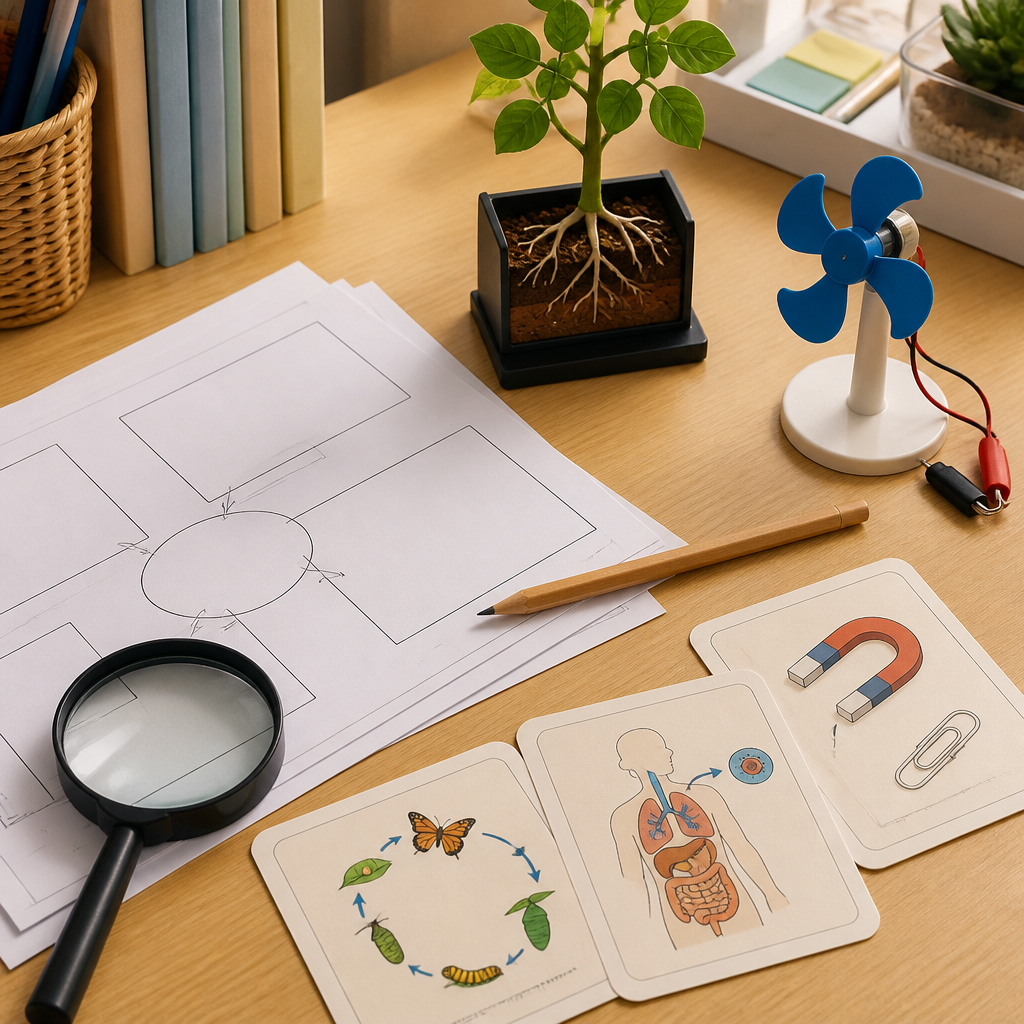
Instead of treating every chapter separately, revise in broader clusters such as:
- Diversity and interactions
- Systems in plants, humans, and cells
- Cycles and reproduction
- Energy, forces, and matter
- Environmental and experimental applications
This helps children connect ideas instead of seeing every chapter as isolated. A common pattern among students is that they revise one small chapter at a time, but then struggle when PSLE questions combine structure, function, and environment in a single question.
Create short notes that force thinking
Avoid copying the textbook line by line. Better revision notes include:
- Key concepts in simple language
- Common confusion points that often lead to mistakes
- One example question to show how the idea may be tested
- One personal mistake the child keeps making
For instance, under food chains, a child might write: “Arrow means direction of energy transfer, not who is bigger.” That small note can prevent a very common error.
Review experiments and practical thinking
Even though PSLE Science is a written paper, practical thinking still matters. Children need to know variables, fair tests, observations, conclusions, and why a method may be unreliable.
One recurring issue is that students memorise experiment answers from school notes but cannot transfer the idea. They recognise the exact worksheet question, but not the concept behind it. So during revision, ask simple variations and let them think through the change. That is often what builds flexible understanding.
A useful way to do this at home is to ask three short questions after any experiment-based worksheet: What was changed? What was measured? What should be kept the same? If a child can answer those clearly, they are usually thinking more scientifically and not just copying a model answer.
Use Practice The Right Way At Home
Home revision often goes wrong in two ways. Some children do too little practice. Others do too much practice without checking why answers were wrong. Both lead to slow improvement.
Use MCQs to expose misconceptions quickly
MCQs are useful for checking whether concepts are stable. They also reveal careless reading very quickly. A child may know that magnets attract some metals, but miss the word “best” or “most likely” and choose the wrong option.
A helpful home routine is simple. After every 10 MCQs, review not only the wrong answers, but also guessed correct answers. If your child got a question right by luck, that is not true mastery.
Use open-ended questions to test application
This is where many children realise they understand less than they thought. Open-ended questions require them to connect concept, evidence, and context.
If a child keeps writing vague answers like “because it helps the plant grow,” that usually points to weak conceptual revision. The answer is not just better phrasing drills. Quite often, the child needs to revisit what the stem, roots, or leaves actually do, and how each part supports the plant.
Use school papers and past-year papers strategically
Past-year and school prelim papers can be excellent, but only when used at the right stage. Stronger schools often set very demanding questions, and weaker students may feel crushed if they start there too early.
A better sequence looks like this:
Harder papers are not always better. Timing matters just as much as difficulty.
Keep a simple mistake log
One small habit can make practice much more useful: keep a one-page mistake log. It does not need to be fancy. A notebook or spreadsheet is enough. Record the topic, the question type, what went wrong, and the corrected idea.
For example, instead of writing “got wrong,” write “mixed up independent and dependent variable” or “did not use data from graph.” After a few weeks, patterns become obvious. That makes the next revision session much more targeted than simply doing another random paper.
Include Answering Practice In The Revision Plan
A PSLE Science revision plan should include some answering practice because many children lose marks through poor question handling, not just weak content.
Read for the task, not just the topic
Many Primary 6 students scan the diagram, spot a familiar topic, and rush to answer. Then they miss what the question is actually asking. Is it asking for an observation, an explanation, a comparison, or a conclusion?
One common mistake is giving a fact when the question wants a reason. Another is writing more than necessary and accidentally talking themselves into errors.
Review common question instructions
Words such as “based on the graph,” “state,” “suggest,” “only,” and “best” matter a lot. If a question says “based on the graph,” a child cannot bring in outside information that is not shown there.
At home, a simple fix is to circle task words before answering. It sounds basic, but it helps children slow down enough to avoid unnecessary mistakes.
Check the answer against the question
After answering, ask, “Did I answer exactly what was asked?” This matters especially for students who write confidently but loosely. They may produce a scientifically related answer that still does not match the question.
If your child has repeated issues with applying knowledge, misunderstanding question intent, or carrying the same misconceptions from one paper to another, extra support may help. You can find out more about PSLE Science support.
Common PSLE Science Mistakes To Avoid At Home
Some of the most damaging revision habits happen quietly at home. No one notices at first because the child appears busy.
Rereading without retrieval
A child reads the chapter, nods, and feels familiar with it. But when asked to explain it without looking, they cannot. Familiarity is not the same as understanding.
A better method is to close the book and say the concept out loud, draw it, or answer a short question from memory. Retrieval practice is often much more effective than passive rereading.
Over-helping as a parent
This is very understandable. Your child is tired, it is late, Math homework is unfinished, and Science corrections are still waiting. In that moment, feeding your child the answer can feel like the fastest way to survive the evening. But over time, it creates dependency.
Try prompting instead. Ask, “What topic is this?” “Which part of the experiment changed?” or “What does the graph show first?” This keeps the thinking with the child while still giving support.
Ignoring repeated error patterns
Many families keep every paper, but do not really analyse them. Yet the pattern matters more than the pile. Is your child repeatedly losing marks in experimental setup questions? Do they keep mixing up cause and observation? Are they rushing through MCQs but slowing down too much in open-ended sections?
These patterns usually do not disappear on their own. Spotting them early helps you decide whether the child needs more concept revision, more timed practice, or more careful review.
Frequently Asked Questions
When should my child start PSLE Science revision seriously?
If possible, start steady revision in Primary 5 and increase intensity in Primary 6. But if your child is already near prelims, do not panic. Focus on weak topics, school paper corrections, and regular mixed practice instead of trying to cover everything equally.
How much time should a Primary 6 student spend on Science each week?
This depends on the child’s current standard and schedule. A student with stable concepts may only need two to three focused sessions weekly. A child with repeated weak topics may need more frequent but shorter sessions, especially if weekdays are already packed with CCA and tuition.
How do I know whether my child’s problem is content or answering skill?
Look at the errors closely. If your child cannot explain basic concepts even after revision, the problem is likely content understanding. If the concept is known but marks are lost through misreading, vague responses, or wrong interpretation of data, then question handling is part of the issue.
Should my child keep doing more assessment books?
Not automatically. More books do not always mean better revision. If your child is not reviewing mistakes, another assessment book often just creates more unfinished work. It is better to complete fewer practices well and learn from them properly.
Is tuition necessary for PSLE Science?
Not always. Some children do well with consistent home revision and school support. But if your child has weak concepts, repeated misconceptions, or difficulty applying knowledge to unfamiliar questions, extra help may make revision more efficient and less stressful.
Conclusion
Learning how to study for PSLE Science well is really about doing the right things in the right order. Build concepts first. Revise topics in manageable clusters. Practise both MCQs and open-ended questions. Use school papers and past-year papers purposefully, not blindly. Most importantly, track mistakes by topic and by cause, because that is where real improvement happens.
For worried parents, the goal is not to turn home into a second classroom. It is to create enough structure for your child to revise consistently, think more clearly, and feel less overwhelmed as PSLE gets closer. In most cases, a calm, focused plan works better than last-minute pressure.
If your child needs extra support with PSLE Science revision, answering techniques, or building confidence before the exam, learn more about our PSLE tutors.