


Introduction
If you are staring at a blank document, deleting the same opening line again and again, you are not alone. For many students in Singapore, the hard part is not the grades, activities, or internship experiences. It is figuring out how to turn all of that into a personal statement that sounds real, not forced. Add in deadlines, friends comparing drafts, and parents asking how things are going, and it is easy to feel stuck.

The good news is that learning how to write a personal statement for university is not about sounding impressive for the sake of it. It is about showing clear course fit, honest motivation, and thoughtful reflection. Whether you are applying to NUS, NTU, SMU, SUTD, SIT, SUSS, or overseas universities, the strongest university personal statements usually feel grounded, specific, and self-aware. This guide will walk you through what to include, how to structure your statement, and what to avoid if you do not want your application to blend into the pile.
Key Takeaways
- Focus on course fit first. A strong personal statement is not your full life story. It should make a clear case for why you and the course match.
- Use specific experiences, not generic claims. Concrete examples are far more convincing than broad statements about passion or ambition.
- Reflect, do not just list. Your achievements may already appear elsewhere in the application. What matters here is what they taught you and why they matter.
- Different profiles can still write strong statements. JC students, polytechnic applicants, IB students, and adult learners can all stand out when they play to their real strengths.
- Avoid sounding copied or exaggerated. Honest, well-explained examples usually read better than polished but vague claims.
- Check each university’s latest requirements. Prompts, word counts, and admissions criteria can differ. Always verify details on official pages such as MOE admissions guidance and the NUS Office of Admissions.
Start With What Admissions Officers Actually Want
A lot of students make this harder than it needs to be. They imagine admissions officers want a dramatic backstory or a perfect profile. Usually, what they want is much more practical. They want to see whether you understand the course, whether your interest is genuine, and whether your experiences connect sensibly to your application.
What your personal statement is really doing
Your statement is not just there to introduce you. It is there to show why you are a suitable applicant for that course at this point in your life.
That means your examples should build one clear message. If every paragraph points in a different direction, the reader is left doing the work of joining the dots. A strong statement makes that easy.
For example, if you are applying for Business, saying you “love entrepreneurship” is too broad on its own. A stronger angle is showing how planning finances for a school event sparked your interest in decision-making, and how an internship exposed you to customer behaviour or marketing strategy. That makes your interest feel tested, not imagined.
This is what a strong university application essay does well. It helps the admissions team see a pattern in your choices, not just a collection of achievements.
What to include in a strong university personal statement
If you are unsure what belongs in the statement, these are the areas to think about:
You do not need to force these into separate blocks. What matters is that, by the end, the reader can clearly answer this question: Why this applicant, for this course?
In Singapore, this matters even more for aptitude-based admissions and courses that look beyond grades. If a university is giving you room to show more than scores, vague writing wastes that chance.
Use A Structure That Keeps Your Writing Clear
When students ask how to write a university personal statement that feels natural, the biggest problem is often not lack of content. It is lack of structure. They have plenty to say, but everything comes out as one long stream of achievements.
A practical structure helps your writing stay focused without sounding robotic.
Open with a real and relevant starting point
Your first few lines should create direction, not drama. Forced openings often weaken a statement before it has even started.
“Ever since I was young, I have always dreamed of changing the world through science.”
This kind of line sounds grand, but it rarely tells the reader anything specific or believable.
A stronger opening starts with a specific moment, question, or pattern that connects naturally to your course interest. The moment does not need to be extraordinary. It just needs to feel real.
Tutors often notice that students worry too much about finding a “perfect” hook. In reality, a believable opening is far more effective than an overly dramatic one.
Show academic interest beyond the classroom
This is where you explain what genuinely draws you to the subject. That could come from lessons, readings, projects, competitions, research exposure, or real-world issues that kept pulling your attention back.
Different students will naturally have different evidence:
A common pattern among students is assuming they need the same style of statement as everyone else. They do not. The strongest draft usually comes from using the evidence that genuinely fits your pathway.
Use experiences, then reflect on them
This is where many statements fall flat. Students list what they did, but they stop there. Reflection is what turns an activity into evidence.
Saying “I was in student council and volunteered regularly” does not tell the reader much. Explaining what those experiences taught you, what you noticed, and how they shaped your thinking is what gives the statement weight.
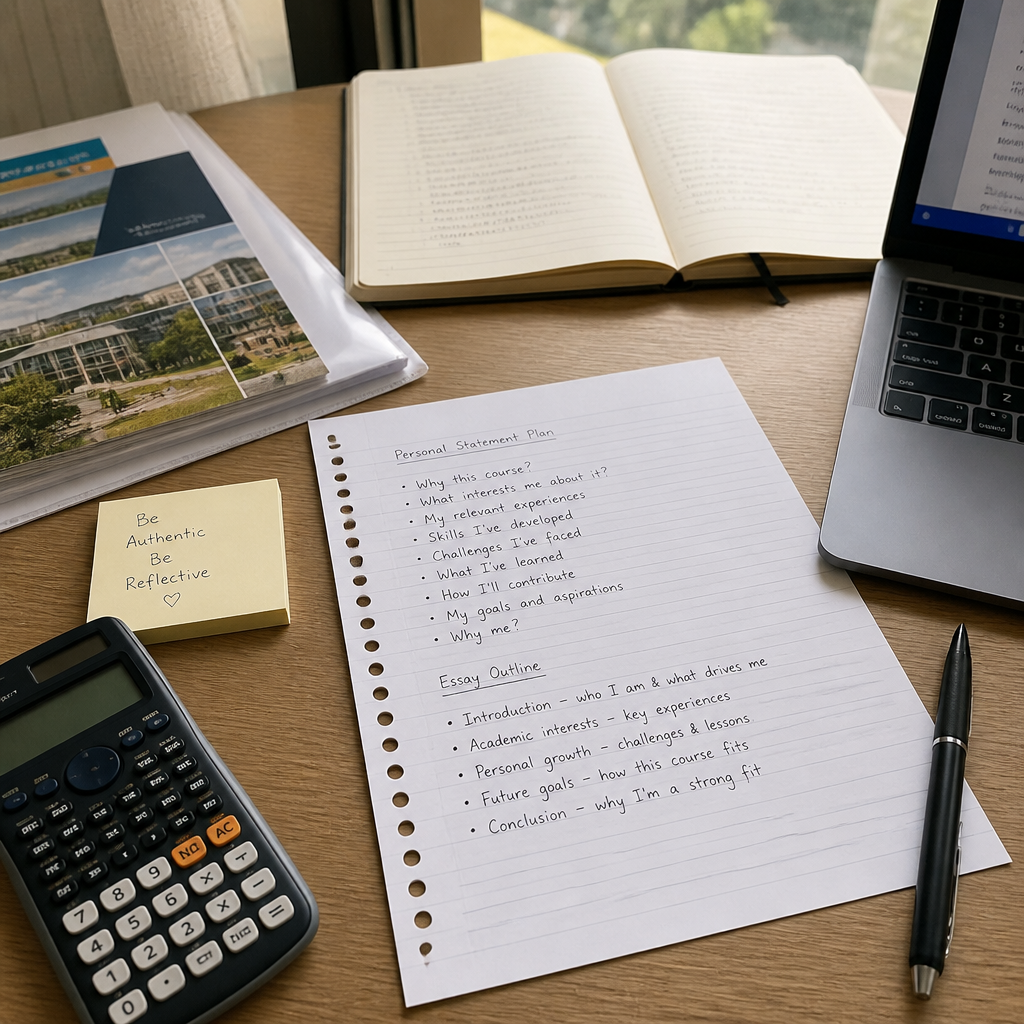
A good personal statement for university admission does not just tell the reader what happened. It shows how your understanding changed because of it.
Keep your paragraphs focused
One simple way to improve a draft is to make sure each paragraph has one main job. One paragraph might explain where your interest began. Another might show how a project deepened it. Another might show what challenge taught you about the course. When a paragraph tries to cover five different ideas, the writing usually becomes rushed and vague.
This also makes editing easier. If a paragraph does not support your main case for course fit, it probably does not need to stay.
What Strong Personal Statements Sound Like
Many students look for personal statement examples for university applications because they want a model to follow. That makes sense, but there is a catch. The more you copy the tone of someone else’s statement, the easier it is to lose your own voice.
A better approach is to study strong angles, not copyable paragraphs.
Example angle for a JC applicant
A JC student applying for Law might centre the statement on debate, GP, and community outreach. The weaker version would simply mention public speaking, leadership, and justice.
The stronger version would explain how exposure to conflicting viewpoints trained the student to examine arguments carefully, and how volunteering highlighted the gap between policy language and lived realities. That creates a clear line of thought.
Example angle for a polytechnic applicant
A poly student applying for Engineering often has a strong base to work from because applied experience is already built into the pathway.
Instead of saying an internship strengthened your interest, explain what happened during that internship. If you had to troubleshoot a recurring issue, track data, or work with technicians, say so. That shows how you think and how you work, which is often more persuasive than a broad declaration of interest.
Example angle for IB students and adult learners
IB applicants often have rich material, but the risk is sounding too abstract. If you discuss broad ideas or global issues, ground them in a project, paper, or initiative.
Adult learners have a different advantage. Maturity and clarity can be very compelling. If you are returning to study after working, explain why this step makes sense now and what your work experience revealed about your next direction.
Practical Tips That Make A Personal Statement Stronger
The best personal statement tips are often the least flashy. They are the things that consistently improve real drafts.
Be specific enough to sound true
Generic lines are easy to write, but they are also easy to forget. A statement becomes stronger when the reader can picture what you are talking about.
Specific writing builds trust. It also helps you stand out without sounding like you are trying too hard.
Match your tone to the course
A Medicine statement should not read exactly like a Business or Design statement. Each field carries different expectations, and your writing should show that you understand what the course involves.
Students sometimes lean too heavily on emotional storytelling and forget to show actual subject engagement. That trade-off matters. A warm, personal tone is good, but it should not replace clear evidence that you understand the field you are applying to.
Show growth, not perfection
Admissions readers do not need a flawless version of you. In fact, statements that only show success can feel thin.
It is often more convincing to explain what a challenge taught you. If an internship was difficult at first but helped you learn how to ask better questions or take initiative, that can show more maturity than pretending everything came naturally.
Edit for clarity, not just grammar
Many students think editing means fixing spelling and punctuation at the end. That matters, but strong editing goes further. Ask whether each sentence is doing useful work. If a line sounds nice but adds nothing, cut it. If a paragraph repeats a point you already made, tighten it.
A clear statement is usually more persuasive than a fancy one. Admissions officers read many applications, so writing that gets to the point without sounding abrupt is a real advantage.
If your application season feels overwhelming and your school workload is already heavy, getting outside support can help you manage both content knowledge and academic stress. If you need extra academic support while preparing for university applications, learn more about our university tutors who can help you strengthen subject understanding and manage your workload with confidence.
Common Mistakes That Weaken A University Application Essay
Some mistakes are obvious. Others show up even in strong students’ drafts.
Being too generic
This is the biggest problem. Statements become forgettable when they rely on broad ideas without personal evidence.
“I want to make a difference” is not wrong. It is just incomplete. Make it concrete. Through what subject, in what setting, and based on which experiences?
Repeating your resume
Your application already lists your CCA roles, awards, and service. The statement should do something different. It should interpret those experiences.
A tutor often sees this pattern. Students assume that more achievements will automatically create a better essay, so they keep squeezing in extra details. The result is usually the opposite. Nothing gets explored properly, and the draft starts to feel crowded.
Overusing clichés and big claims
Phrases like “since young,” “dream university,” “born to,” or “change the world” can sound empty if they are not supported.
Big claims are especially risky. If the statement feels inflated, trust drops quickly. Honest examples, clearly explained, usually land much better.
Ignoring university-specific requirements
Requirements vary, sometimes more than students expect. Some universities ask broad questions. Others want stronger course-based motivation, portfolio support, or a different writing style altogether.
Always check the latest information at MOE admissions guidance and the NUS Office of Admissions, and read each university page carefully before you finalise your draft.
Adapt Your Statement To Your Background And Course
Not every applicant should write the same kind of statement. A good draft fits both your background and the course you are applying for.
Different applicants should write from different strengths
JC applicants often need to work harder to show applied exposure, so reading, competitions, internships, research, or service experiences matter. Polytechnic students often have direct course evidence, but need reflection so the statement does not become a module summary. IB students can draw on interdisciplinary thinking, but should stay concrete. Adult learners should lean into practical maturity and purpose.
This is why broad advice on writing a personal statement can sometimes feel frustrating. The right strategy depends on the evidence you actually have.
Course fit matters more than sounding impressive
A student applying for Architecture may benefit from discussing observation, design thinking, and portfolio development. A Nursing applicant should show realistic understanding of care, resilience, and people-facing work. A Computing applicant may be better served by explaining how they build, test, and refine solutions.
Trying to sound generally outstanding often backfires. Showing that you understand the demands of the course is usually far more persuasive.
Tailor the final version before submission
Even if you start from one master draft, your final statement should be adjusted for the course and university. That does not mean rewriting everything from scratch. It means checking whether your examples match what that programme values most.
For example, one course may care more about research potential, while another may place more weight on practical exposure or service orientation. Small changes in emphasis can make your application feel much more intentional.
Final Checklist Before You Submit
Before you send your application, pause and read your statement with these questions in mind.
Does it clearly explain why this course suits you?
If someone finishes reading and still cannot tell why you want this course specifically, the statement needs tightening. Your motivation should run through the draft, not appear only in the last line.
Does each paragraph add something new?
Cut repeated points. If two examples prove the same thing, keep the stronger one and develop it properly. Depth usually works better than coverage.
Does it sound like you?
A polished statement is good. A borrowed-sounding one is not. Read it aloud. If you would never say those words in real life, revise the tone until it feels more natural.
Have you checked official admissions requirements?
This step is easy to rush, especially when students are juggling exams, NS plans, portfolio work, or multiple applications. But prompts, deadlines, and formats can change. Always confirm the latest details on official university admissions pages before you submit.
Have you left enough time for one final review?
Last-minute submissions often lead to avoidable mistakes. Try to finish your draft early enough to step away from it for a day, then return with fresh eyes. You will usually spot unclear phrasing, repeated ideas, or missing links in your argument much faster after a short break.
Frequently Asked Questions
How long should a personal statement for university be?
Follow the exact word count or character limit given by the university. If no fixed limit is stated, keep it focused and concise rather than stretching it for the sake of length. A shorter, sharper statement usually reads better because your main points stay clear.
Can I use the same personal statement for every university?
You can reuse your core ideas, but sending the exact same version everywhere is risky. Different universities and courses may want different emphasis, such as aptitude, academic fit, portfolio, or career direction. Even small adjustments can make your application feel more thoughtful and better targeted.
Do I need to mention achievements if they are already in my application form?
Yes, but only when they support your story. The point is not to repeat the achievement itself. It is to explain what it reveals about your interests, values, or readiness for the course. One strong example with reflection is usually more effective than several awards dropped in without context.
What if I do not have many big achievements?
That is more common than many students think. A strong personal statement does not depend on prestigious awards. Thoughtful reflection on ordinary but meaningful experiences, such as a part-time job, family responsibility, internship task, or school project, can still be powerful when clearly linked to your course interest and growth.
Should parents help edit the personal statement?
A second pair of eyes can definitely help, especially for clarity and grammar. But too much parental rewriting can make the statement sound unnatural. The final voice should still sound like the student. Parents are often most helpful when they ask questions that help the student explain ideas more clearly, rather than rewriting whole sections.
Conclusion
Learning how to write a personal statement for university is really about turning your experiences into a clear, honest case for course fit. The strongest personal statements do not rely on dramatic language. They show genuine interest, specific examples, thoughtful reflection, and a realistic sense of why that programme is the right next step.
If you remember one thing, let it be this. Do not write to sound perfect. Write to sound credible, engaged, and ready. Whether you are from JC, polytechnic, IB, or returning as an adult learner, your university personal statement will be stronger when it connects your background to your academic direction with clarity.

Requirements can differ across local and overseas universities, so always check the latest official admissions pages before submitting. And if you need extra academic support while preparing for university applications, learn more about our university tutors who can help you strengthen subject understanding and manage your workload with confidence.