


Introduction
At some point in lower secondary, many families hit the same question, usually late at night after homework, CCA, and a quick look at the subject selection form: what is A Math, and does my child need it? If you are feeling unsure, you are not alone. In Singapore secondary school, Additional Mathematics, often called A Math, can sound intimidating before a student has even seen the syllabus.

This guide explains what Additional Mathematics is in Singapore secondary school, how it differs from E Math, and whether it is a good fit for your child or for you as a student. We will also look at common school expectations, future pathways such as JC H2 Math and some poly courses, and the practical reality of coping with A Math alongside school life. The goal is not to push every student into A Math. It is to help families make a calm, informed decision that fits the student’s strengths, workload, and future plans.
Key Takeaways
- A Math is not the same as E Math. E Math covers broad everyday mathematical skills, while A Math goes deeper into algebraic manipulation, functions, and more abstract problem-solving. This is why some students who seem comfortable in regular math still find Additional Mathematics surprisingly demanding.
- Not every secondary student needs A Math. If you are wondering whether A Math is compulsory for O-Level students in Singapore, the short answer is no. It is usually an elective subject, and schools may have their own criteria for offering it.
- A strong E Math score alone is not the full picture. Some students score well because they are careful and hardworking, but still struggle with algebra-heavy thinking. A Math usually suits students who are reasonably secure in algebra and willing to practise consistently over time.
- Subject choice should match future plans and current capacity. A Math can support progression to JC H2 Math and some STEM-related routes, but taking it while already stretched by CCA, tuition, and weak fundamentals may create unnecessary stress.
- Parents should look beyond fear or prestige. Choosing A Math just because “the stronger students all take it” can backfire. The better question is whether the student has the ability, attitude, and time to cope well.
- Schools may differ in availability and prerequisites. Subject combinations, school policies, and internal cut-offs can vary. Always check the latest information from MOE, your child’s school, and exam information from SEAB.
What Is A Math In Singapore Secondary School?
If you are asking what A Math is, the simplest answer is this: A Math is a more advanced secondary school math subject that focuses heavily on algebra, mathematical relationships, and abstract reasoning. In Singapore, it is usually offered at upper secondary level, often from Secondary 3 for students on O-Level pathways, depending on the school’s subject combinations and criteria.
What Additional Mathematics actually means
Additional Mathematics is designed for students who may continue to more advanced math later on. It moves beyond everyday calculations and practical numeracy. Instead, students are expected to manipulate expressions, solve algebraic equations, understand functions, and apply mathematical methods accurately.
This is often where the surprise comes in. A student who is comfortable calculating discounts or reading graphs in E Math may still find A Math challenging, because A Math expects stronger symbolic thinking. Instead of just solving a simple equation, the student may need to simplify a more complicated expression, factorise correctly, and choose the right method without being guided step by step.
Why schools offer A Math
Schools usually offer A Math because it supports students who may be heading towards math-intensive post-secondary options. That does not mean every “good student” should take it. It simply means the subject can be useful for students who are mathematically inclined, interested in science or engineering-related routes, or likely to need stronger math foundations later.
In many schools, teachers look closely at lower secondary performance, especially in Math, before recommending A Math. Some schools may have minimum grade requirements, while others may consider teacher recommendations and overall workload as well. Subject-Based Banding and school-based offerings can change, so it is worth checking the latest school and MOE information on secondary subject options.
How A Math Is Different From E Math
A lot of confusion comes from the names. Families often assume A Math is just “harder E Math”. That is only partly true. The difference between E Math and A Math is not just about difficulty, but also about the kind of thinking the subject demands.
E Math feels broader, A Math feels deeper
E Math, or Elementary Mathematics, usually includes practical topics such as percentages, statistics, geometry, and basic algebra. It is broader and often feels more connected to everyday applications.
A Math goes narrower but deeper. It places much more weight on algebraic fluency, functions, graphs, trigonometric identities, logarithms, and calculus at an introductory level. Students need to stay comfortable working with symbols and abstract steps for several lines without losing track.
Tutors often notice the same pattern. Some students do fine in E Math because they are neat, careful, and methodical. Then they meet A Math and suddenly feel lost because the questions are less straightforward. The problem is not always laziness or lack of effort. Quite often, the algebra foundation was never as secure as it looked.
Why students say A Math feels harder
Many students say A Math feels “more confusing” than E Math because there are fewer obvious entry points to a question. In E Math, the topic may be visible right away. In A Math, the student may first need to recognise the structure of the problem before deciding what to do.
For instance, a student might know factorisation as a chapter skill in lower sec. But in A Math, factorisation may appear inside another topic, and the student has to spot that independently. That is why A Math often rewards pattern recognition, flexible thinking, and repeated practice.
Why doing well in E Math does not guarantee A Math success
This is where many families get caught off guard. A student who gets B3 or even A2 in lower sec math may still struggle if that grade came mainly from strong arithmetic and careful working rather than real algebra confidence.
On the other hand, a student who genuinely enjoys algebra puzzles may do well in A Math even if earlier scores were not perfect. That is why schools and tutors often look beyond the report book. The more useful question is whether the student can handle algebraic manipulation, recover from mistakes, and stay steady through multi-step questions.
To make the difference easier to scan, here is a simple comparison.
What A Math Covers And How It Is Assessed
Understanding the content often helps reduce fear. A Math is challenging, but it is not mysterious. There are clear topics, clear methods, and clear tested skills.
Common A Math topics in secondary school
Depending on the syllabus and school sequence, students may learn topics such as:
- Algebraic manipulation, including factorisation, surds, polynomials, and partial fractions. These topics test whether a student can work accurately through multiple algebra steps without careless slips. A weak foundation here tends to affect almost every later chapter.
- Quadratic and simultaneous equations, where students need to choose the right solving method. A common struggle is knowing the method in theory, but freezing when the form looks unfamiliar or when the question combines several concepts at once.
- Functions and graphs, which require students to understand relationships, not just plot points. Many students memorise procedures but cannot explain what the graph is showing or how one form of an equation affects the shape of the graph.
- Trigonometry, including identities and equations. This often becomes a pain point when students rely on memory without understanding when each identity applies and how to transform one expression into another.
- Logarithms and indices, which can feel abstract at first. Students who are weak in algebra often make small rule-based errors here, and those mistakes can snowball quickly under exam conditions.
- Differentiation and integration, usually introduced in a basic form. These ideas are often new and exciting, but they also expose weak algebra very quickly because students must simplify accurately before applying calculus methods.
A common pattern among students is this: the later topics do not just test new content. They also test whether earlier algebra skills were properly built. That is why some children feel fine at the start of Secondary 3, then suddenly lose confidence later on.
How A Math is usually assessed at O-Level
At O-Level, A Math is assessed through written papers focused on problem-solving, algebraic methods, and accurate presentation. Parents do not need to memorise the full exam structure, but it helps to know that A Math is not about vague class participation or project work. Performance depends heavily on applying the right methods under timed conditions.
This explains why some students seem to understand the chapter at home, but underperform in school exams. Timing pressure, step accuracy, and careless sign errors matter a lot. It also explains why regular correction matters so much. One repeated mistake with negative signs or algebra expansion can keep costing marks across different topics.
For updated syllabus and assessment information, check SEAB.
Is A Math Compulsory For O-Level Students In Singapore?
This is one of the most common worries, especially when everyone around you seems to talk about A Math as if it is mandatory. The short answer is no, A Math is generally not compulsory for all O-Level students in Singapore.
Why the confusion happens
In some schools, many academically stronger students are offered A Math, so it starts to feel like the standard route. In other schools, only certain classes take it. Some parents also hear that A Math is useful for JC, then assume skipping it will shut every door. That is not accurate.
A Math is an elective subject in many school combinations. Whether a student can take it depends on school offerings, internal criteria, and sometimes timetable constraints. N-Level and O-Level pathways may also differ in how subject combinations are offered.
When A Math matters more
A Math can be especially helpful for students considering JC courses that lead to H2 Math, or future STEM-related directions where stronger math foundations are useful. Some polytechnic diplomas may also prefer or benefit from stronger mathematical preparation, though requirements vary by course.
Still, “helpful” is not the same as “compulsory”. A student should not take A Math purely out of panic. If the current math foundation is shaky and the student is already struggling with school pace, adding A Math may end up weakening confidence across multiple subjects.
This is where realistic planning matters more than prestige. A subject combination should support the student’s next step, not just look impressive on paper.
Who Should Consider Taking A Math?
The better question is not whether A Math is “good”, but who it is suitable for. Fit matters more than labels.
Signs a student may be suited for A Math
A student may be a good fit if they:
- Handle algebra reasonably well, not just calculations. If they can rearrange equations and factorise without panicking, that is a stronger sign than simply being fast at arithmetic. A Math leans heavily on this kind of confidence.
- Can tolerate multi-step problem-solving. A Math often involves staying calm through several lines of working. Students who give up the moment they cannot see the full answer may find it stressful unless they are willing to build more resilience.
- Are willing to practise regularly. This subject punishes long gaps in revision. A student who can do a few questions weekly is often better placed than one who only mugs before tests, because fluency in A Math comes from repetition.
- May need stronger math for future pathways. If JC H2 Math, sciences, engineering, computing, or certain poly diplomas are possible goals, A Math can be useful preparation and may make later transitions smoother.
When A Math may be too stressful
Sometimes the student is bright, but overloaded. Picture a Secondary 2 student already getting home late after CCA, still juggling tuition, homework, and school projects. In that situation, even a capable child may not have enough breathing space to cope with A Math well.
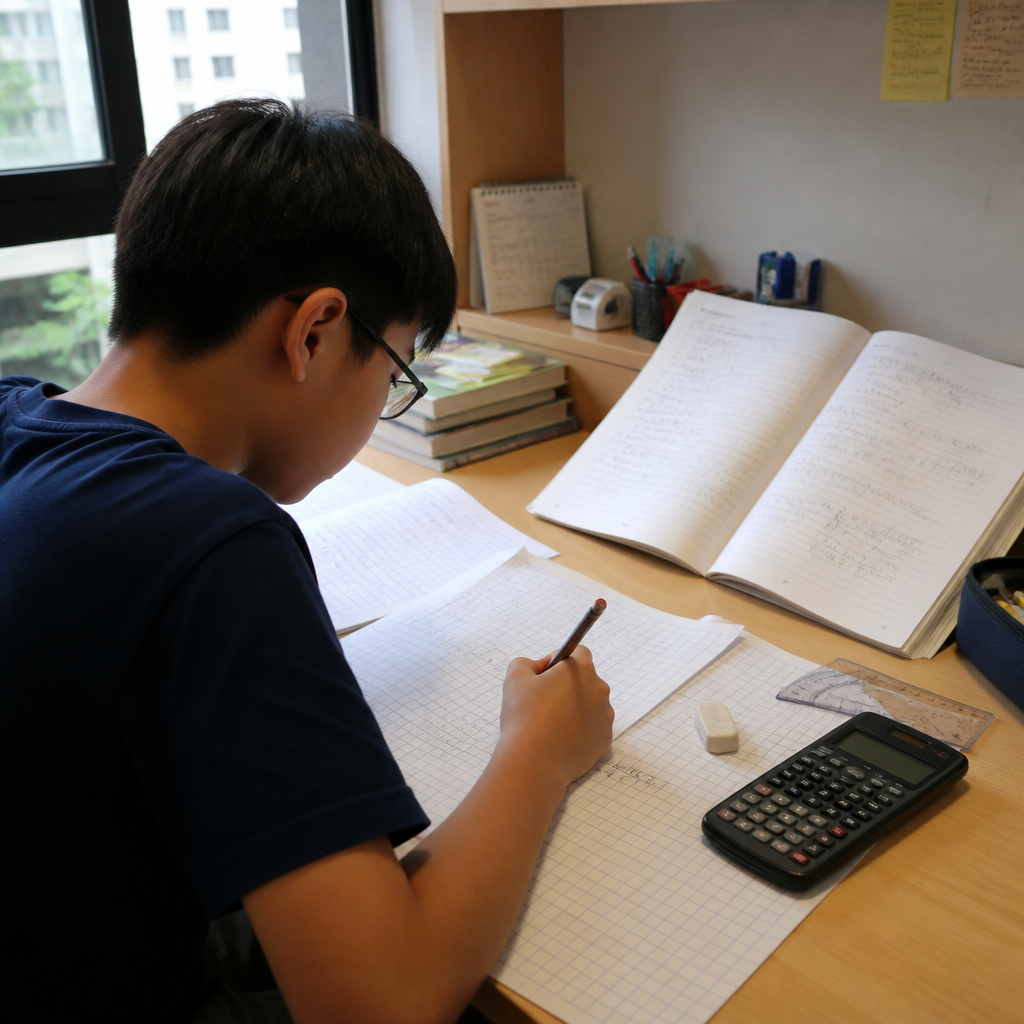
Warning signs include weak algebra basics, severe math anxiety, a tendency to shut down after mistakes, or a schedule so packed that consistent practice is unrealistic. A Math is difficult enough when taken calmly. Taken under constant exhaustion, it can become a source of repeated discouragement.
The contrast below can help families think more clearly.
A practical note on support and study habits
Even for students who are suitable for A Math, the subject usually goes better when routines are built early. A simple weekly habit, such as reviewing one chapter summary and doing a short set of practice questions, can prevent topics from piling up. Many students struggle not because they lack ability, but because they leave corrections undone and keep repeating the same errors.
Parents do not need to reteach the subject at home. Often, the more useful role is to help the student keep a realistic schedule, notice patterns of careless mistakes, and seek help early if confidence starts dropping. Small interventions in Secondary 3 are usually easier than trying to rescue everything just before O-Levels.
If your child needs steady support with E Math or A Math, subject selection confidence, or stronger problem-solving foundations, you can learn more about our private home tuition options or explore our Maths tuition page.
How To Decide If Your Child Should Take A Math
For many parents, this is the hardest part. You do not want to limit your child too early. At the same time, you do not want to sign them up for two years of stress just because other families are doing it.

Questions to ask before choosing
Start with practical questions, not status-based ones.
- How strong is the student’s algebra foundation right now? Look at actual work, not just overall grades. Does your child make frequent sign mistakes, struggle with factorisation, or need help rearranging equations? These are often more telling than a single exam score.
- How independent is the student with math practice? A child who only studies when pushed may find A Math especially draining because it needs regular revision. The subject is much kinder to students who can revise steadily without waiting for a crisis.
- What is the current workload like? A student doing double science, leadership duties, and intensive CCA may need a more balanced combination. Even a strong student can burn out if every subject demands heavy weekly effort.
- What pathways are they considering? Not every 14-year-old knows for sure, and that is okay. But if your child is already leaning strongly towards math-heavy routes, A Math is worth serious consideration because it can keep more options open later.
What parents often misread
Some parents see reluctance and assume the child is lazy. Sometimes that is not true. Quite a few students are scared because they know their algebra is weak and do not know how to say it. Others say yes to A Math because they do not want to look “less capable” than friends.
A useful conversation sounds less like this:
“You must take this if you want to keep your options open.”
And more like this:
“Let’s look honestly at your strengths, your stress level, and what support you may need.”
That shift in tone often leads to a better decision. It also helps the child feel that this is a planning decision, not a judgment of their ability.
Frequently Asked Questions
Can a student take A Math if E Math is only average?
Yes, sometimes. “Average” can mean different things. If the student’s issue is carelessness or uneven test performance, but algebra understanding is decent, A Math may still be possible. If the average result comes from deep confusion in basic algebra, then the jump may be hard. Looking at classwork and problem-solving habits usually gives a clearer answer than looking at the grade alone.
Will not taking A Math close off JC or poly options?
Not always, but it can affect some pathways more than others. A Math is useful preparation for JC H2 Math and certain STEM-related directions. Still, requirements differ by institution and course, so check the latest official information from MOE, relevant schools, and course providers before making assumptions.
Is A Math only for top students?
No. It is more accurate to say A Math suits students with the right math profile, especially algebra readiness, persistence, and capacity to practise consistently. A student does not need to be top in class, but they do need a solid enough foundation to cope with the pace and abstraction.
What if my child starts A Math and struggles badly?
That happens more often than many families expect. Early struggle does not automatically mean the subject is impossible. Sometimes the real issue is weak prior algebra, poor study habits, or fear of making mistakes. But if the subject is causing sustained distress and pulling down everything else, it may be time to speak with school teachers about realistic options and support.
Conclusion
If you came here asking what A Math is, the clearest answer is this: A Math is a more advanced upper secondary math subject in Singapore that suits students who are ready for stronger algebra, abstract reasoning, and more demanding problem-solving. It is not compulsory for all O-Level students, and it is not automatically the best choice for every capable child.
The real decision lies in the fit between the student’s foundation, workload, confidence, and future plans. The difference between E Math and A Math is significant enough that families should not choose based on school culture or peer pressure alone. A calm, informed decision now can prevent a lot of frustration later.
Because subject offerings, prerequisites, and school policies may vary, do check the latest details with your child’s school, MOE, and SEAB. If your child needs steady support with E Math or A Math, subject selection confidence, or stronger problem-solving foundations, learn more about our maths tutors.