


Introduction
If you have ever sat at the dining table hearing your child say, “Math is Math what, why got EMath and AMath?”, you are definitely not alone. Many parents in Singapore only start sorting out these terms when Sec 2 subject selection appears, and suddenly what sounded simple becomes stressful very quickly.

If you have been asking what is EMath, that confusion is completely normal. Many Sec 1 to Sec 4 students, and plenty of parents too, hear terms like EMath, AMath, Express Math, O-Level Math, and assume they all mean roughly the same thing. Then schools start talking about Additional Mathematics, and the pressure goes up.
In plain English, EMath refers to Elementary Mathematics, the mainstream secondary school Math subject in Singapore. It is the Math subject most students take, and it builds the practical and core mathematical skills needed for school exams, everyday problem-solving, and O-Level preparation. When parents ask what Elementary Mathematics means in Singapore secondary school, they are usually trying to understand three things, what their child will learn, whether it is compulsory, and how it affects future subject choices.
This guide explains all of that clearly, with a Singapore-specific view of what EMath involves, how it differs from AMath, and how students can improve if they are struggling.
Key Takeaways
- EMath is the core secondary school Math subject. In Singapore schools, Elementary Mathematics covers the foundational topics most students need for lower and upper secondary learning, including number work, algebra, geometry, and statistics. It is the subject that builds everyday numeracy as well as exam readiness.
- It is different from AMath in purpose and depth. EMath focuses on broad, practical mathematical understanding, while AMath goes deeper into algebraic manipulation and more abstract methods. Students who cope in EMath may still find AMath challenging if their algebra is not strong.
- Many students take EMath even if they do not take AMath. That is why it matters for overall academic progress, O-Level preparation, and future subject pathways, especially in courses that still require basic mathematical competence.
- Sec 2 subject choice is where confusion often starts. The difference between EMath and AMath is not just about difficulty. It is also about suitability, confidence, pace, and future plans such as science-related courses or polytechnic options.
- Doing badly in EMath does not always mean a child is weak in Math. Quite often, the issue is inconsistent basics, careless working, poor question interpretation, or panic during tests rather than complete inability.
- O-Level EMath rewards method and habits, not just intelligence. Students usually improve through topic mastery, steady practice, proper corrections, and better exam technique rather than last-minute mugging.
- Extra support can help when school pace is too fast. If your child keeps losing confidence, a suitable tutor can help rebuild understanding step by step. The right fit matters more than chasing the most heavily advertised tuition option.
What Is EMath In Singapore Secondary School?
When people search for EMath, they are usually referring to the subject officially known as Elementary Mathematics in Singapore secondary school. It is the standard Math subject taught to most students in the secondary system, especially in lower secondary and in upper secondary pathways leading to national exams.
What EMath actually covers
EMath is not just “simple Math.” That is one of the biggest misunderstandings parents and students have at the start. It includes a wide range of topics such as numbers, ratios, percentages, algebra, linear equations, graphs, geometry, mensuration, probability, and statistics. Over time, students are expected to apply these ideas across different question types, not just memorise formulas and repeat steps.
A worksheet may look harmless at first glance. A parent sees percentages and thinks, “This was already taught before.” But secondary school percentages can show up in layered problem sums, reverse percentage questions, financial contexts, or comparison scenarios. The arithmetic may not be hard on its own, but the thinking can be.
That is why some students seem okay during normal homework, then stumble badly in weighted assessments. The issue is often not the topic name. It is the way the topic is tested.
Why EMath matters beyond exams
EMath forms the mathematical base for many later options. Even if a student does not take AMath, EMath still supports subjects like Combined Science, data handling in Geography, Principles of Accounts, and future polytechnic or ITE pathways that require numeracy.
This is also why schools and parents take it seriously. It is not just another subject to clear. It often affects confidence across the whole timetable. A common pattern among students is that once Math starts going badly, they begin avoiding corrections, dragging their feet at homework time, or saying “I studied already” when they are actually stuck and embarrassed.
For the latest syllabus intent and curriculum direction, families can refer to MOE’s Mathematics curriculum overview.
What Students Learn In Elementary Mathematics
To understand Elementary Mathematics in Singapore secondary school, it helps to look at both content and skills. EMath is not only about getting the final answer right. Students are expected to read mathematical information carefully, choose the correct method, show working clearly, and avoid careless interpretation.
Common EMath topics students will see
Across secondary levels, common topics include:
- Numbers and arithmetic, such as fractions, decimals, percentages, ratio, and rate. A student may know how to calculate 20 percent of a value, but freeze when the question asks for the original amount after a discount or compares two changing quantities.
- Algebra, including expressions, formulas, equations, and graphs. Many students lose marks here because they can copy worked examples but do not really understand why terms can or cannot be combined, or when a formula needs to be rearranged first.
- Geometry and mensuration, such as angles, area, volume, and circles. Questions often test whether students know when to use a formula, whether units must be converted first, and how carefully they read diagrams.
- Statistics and probability, where students interpret tables, charts, averages, or likelihood. This can look easier on paper than it feels in an exam hall, especially when the wording is unfamiliar or the data has to be compared across several steps.
Why students commonly struggle
Some students look hardworking but still hover around 45 to 55 marks. That can be frustrating for everyone at home. Tutors often notice that these students are not always weak in effort. More often, their basics are patchy, they skip steps mentally, and they do not review mistakes properly.
Others panic the moment a question looks different from the school worksheet. They memorise methods, but EMath often tests whether they can adapt those methods to new contexts.
This is why “just do more papers” does not always solve the problem. If a student keeps practising on top of a weak foundation, they may only repeat the same errors faster. Sometimes the real need is not more volume, but better correction habits and clearer understanding.
Skills that matter as much as content
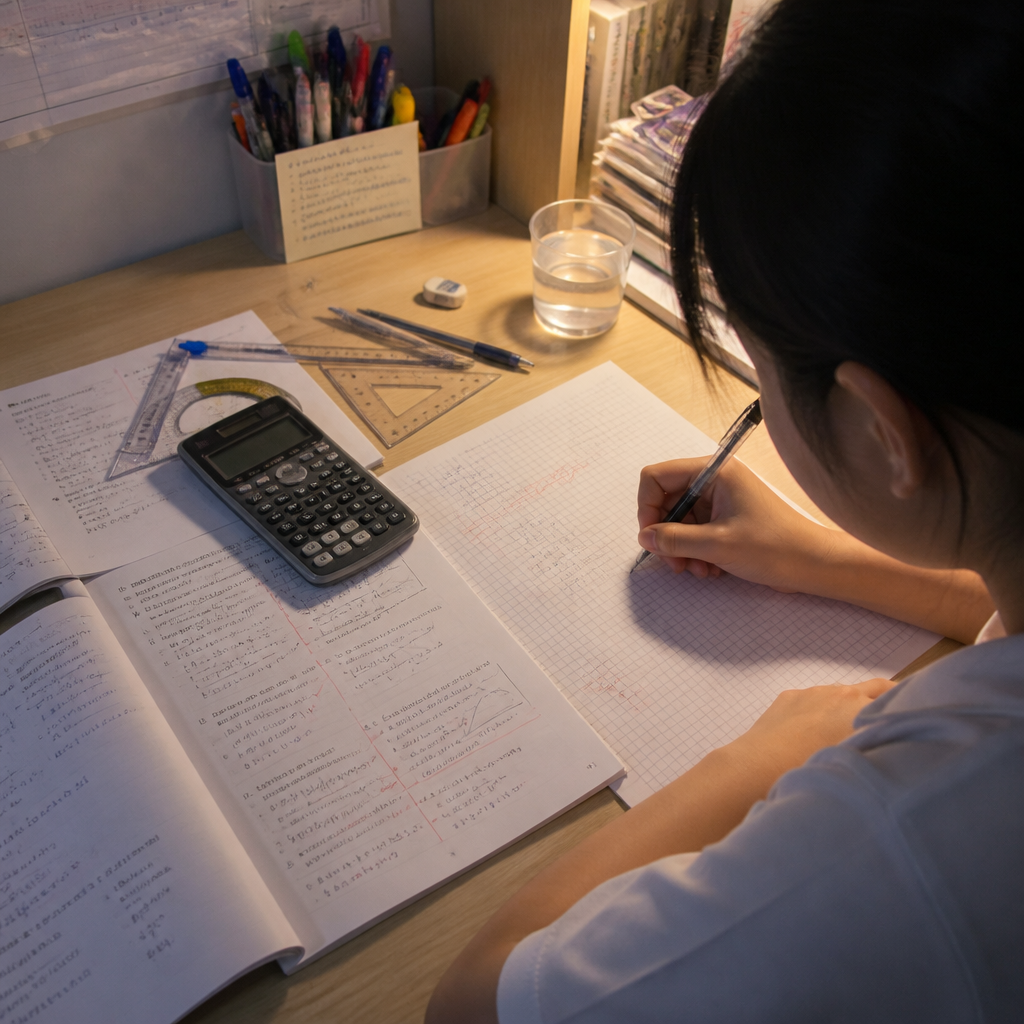
Another point parents sometimes miss is that EMath is also a subject of habits. Two students may know the same formula, but the one who labels units, writes steps neatly, and checks whether the answer is reasonable will usually score better. In other words, performance is not only about intelligence. It is also about process.
This is especially true in upper secondary, where one careless line can affect several later parts of a question. A student who learns to slow down, organise working, and check final answers often improves even before mastering every topic perfectly.
How EMath Differs From AMath
For many families, this is where the real stress begins. The question is not only what EMath is, but whether a child should also take AMath, and what that difference actually means during Sec 2 subject selection.
The main difference between EMath and AMath
EMath is broader and more practical in scope. AMath is narrower in some ways, but much more demanding in algebraic depth and abstract manipulation. AMath usually includes topics such as quadratic functions, polynomials, surds, logarithms, and trigonometric identities, depending on the syllabus and school offering.
A child who is doing reasonably in EMath may still struggle in AMath if algebra is weak. This catches many families off guard. The student says, “I can do Math,” but what they often mean is that they can manage routine EMath calculations. AMath asks for stronger symbolic fluency, cleaner algebra, and more stamina.
Here is the difference in a clearer format:
How Sec 2 students and parents should decide
At Sec 2, subject selection is often when families first compare EMath and AMath seriously. For the EMath article, the key point is simple: EMath remains the core Math subject, while AMath is an additional subject with deeper algebraic demands. Students should check school advice and subject requirements before deciding whether AMath is suitable.
Because subject offerings and criteria can vary, it is worth checking your school’s advice and the latest MOE guidance.
Is EMath Compulsory For O-Level Students In Singapore?
Another common question from parents is whether EMath is compulsory for O-Level students in Singapore. The practical answer is that EMath is very commonly taken, but exact subject combinations and requirements can differ by school, course, and pathway.

What usually happens in school
In many mainstream secondary school pathways leading to the O-Levels, EMath is a standard subject taken by students. It is the default Math subject for most, while AMath is an additional option for selected students based on school policy and suitability.
This matters because some parents assume that if their child is not taking AMath, their Math load is somehow lighter or less important. In reality, EMath is still a major exam subject, and often one that affects progression, confidence, and post-secondary options.
Why parents should verify the latest information
Schools may differ in subject combinations, internal criteria, and whether certain students take particular syllabuses or exam routes. If your child is in a different stream, on a customised school pathway, or facing subject combination decisions, it is safest to check directly with the school and official exam information.
You can refer to SEAB for exam-related information and continue checking updates from MOE.
The key point is simple. Even when details vary across schools, EMath remains one of the most important secondary Math subjects in Singapore.
What O-Level EMath Really Tests
Once students reach upper secondary, the question becomes less about naming and more about performance. What exactly is O-Level EMath testing, and how do students improve their scores?
What examiners are really looking for
O-Level EMath is not only testing whether students know formulas. It checks whether they can:
- Understand the question properly. Many marks are lost before the calculation even starts because the student misreads what is being asked or misses a condition.
- Choose the right method. Knowing several formulas is not enough if the student cannot tell which one fits the problem.
- Present working in a logical way. Clear steps help students earn method marks and reduce self-inflicted mistakes.
- Apply Math to unfamiliar contexts. Questions may use everyday situations, graphs, data, or multi-step scenarios that look different from textbook examples.
- Avoid careless mistakes under time pressure. This includes copying signs wrongly, rounding too early, using the wrong unit, or keying numbers incorrectly into the calculator.
That last point matters more than many students realise. A child may know the topic during tuition or home revision, then lose a painful chunk of marks in school simply because they copied a negative sign wrongly or answered in centimetres when the question wanted metres.
What actually improves scores
There is no magic trick, but there are patterns that work. The improvement usually comes from habits, not last-minute panic.
A useful mindset for students is to treat every test paper as feedback, not just a score. If the same mistake keeps appearing, that pattern matters more than one bad mark. For example, a student who repeatedly loses marks in graphs may not have a “graph problem” only. The real issue may be weak algebra, poor scale reading, or rushing through instructions.
If your child keeps getting stuck despite effort, extra support can make a real difference. You can learn more about our maths tutors and find support that fits their school level and pace, or contact us here.
When EMath Results Drop, What It Usually Means
A low EMath score can trigger a lot of emotion at home. Some parents become stricter. Some back off because every revision session ends in tension. Some students stop asking questions because they are tired of hearing, “You just need to practise more.”
Common reasons students underperform in EMath
In many cases, the issue is not laziness. It may be:
- Weak lower secondary fundamentals. If a student never became secure in fractions, algebra basics, or ratio, upper secondary topics start to feel much harder than they should.
- Careless line-by-line working. Some children understand the concept but lose marks because their written steps are messy, incomplete, or inconsistent.
- Poor language interpretation in problem sums. EMath is still a language-heavy subject in many ways. Students need to decode what the question is really asking before they can solve it.
- Inconsistent revision because of CCA and packed weekdays. In many Singapore homes, revision gets pushed later and later until the child is too tired to think clearly.
- Fear of Math after repeated bad test results. Once confidence drops, even manageable questions can feel threatening. The student starts second-guessing every step.
A familiar scene in many homes is this. It is already 9.45pm, there are still Science corrections to finish, and EMath revision gets pushed to “tomorrow.” After a few weeks, tomorrow never comes.
Practical ways to improve without burning out
Start smaller than you think. When everything feels bad, trying to fix everything at once usually creates more resistance.
- Review one weak area at a time. If everything feels bad, begin with one topic like algebraic manipulation or percentage problem sums. A student who regains control in one chapter often becomes more willing to tackle others.
- Keep an error notebook. Not a neat summary book, but a personal list of repeated mistakes. This makes revision more targeted and less vague.
- Use worked examples actively. Cover the steps and try them yourself. Passive reading creates false confidence because the method feels familiar without being secure.
- Set realistic weekday goals. On heavy school days, 25 focused minutes can be more useful than an exhausted two-hour argument at the dining table. Consistency matters more than dramatic study sessions.
- Build in short review cycles. A topic understood today can be forgotten two weeks later. Brief review sessions help students retain methods and reduce the feeling of always starting from zero.
When progress is slow, it does not always mean the child is not trying. Sometimes they simply need concepts retaught in a clearer way, at a pace that matches how they learn.
Frequently Asked Questions
What is EMath in the simplest way to explain to a Sec 1 student?
EMath means Elementary Mathematics. It is the standard secondary school Math subject in Singapore. It covers the core topics most students learn, such as algebra, geometry, percentages, graphs, and statistics.
Is EMath easier than AMath?
Generally, yes, but “easier” can be misleading. EMath is less abstract than AMath, yet many students still struggle because the paper tests accuracy, interpretation, and application. A child can still find EMath difficult if their basics are weak or they become careless under pressure.
If my child does not take AMath, is EMath still important?
Very much so. Not taking AMath does not make EMath less important. EMath is still a major subject for school exams and O-Levels, and it supports future study options that require numeracy.
How do I know if my Sec 2 child should take AMath?
Look beyond one exam result. Stronger signs include confidence in algebra, consistent effort, comfort with abstract working, and readiness for a heavier workload. It is also wise to check your child’s school criteria and subject advice before deciding.
How should families choose EMath tuition in Singapore?
Instead of chasing the most advertised option, look for fit. A good EMath tutor should explain clearly, spot recurring mistakes, and teach at the student’s pace. For one child, that may mean firm structure. For another, it may mean rebuilding confidence first.
Conclusion
So, what is EMath? In Singapore, it is the core secondary school Math subject that builds essential mathematical understanding for school, exams, and future study pathways. It is broader and more practical than AMath, but still demanding enough that many students need time, support, and proper habits to do well.
For parents, the confusion is understandable. Terms change, school advice can feel brief, and Sec 2 decisions often come with pressure. For students, EMath can feel manageable one month and overwhelming the next, especially when topics pile up and confidence drops. The good news is that Elementary Mathematics is usually very teachable when the gaps are identified early and worked on steadily.
If your child needs extra help building confidence in secondary school Math, explore our maths tuition support or get in touch here.