


Introduction
If you are asking what Knowledge and Inquiry in JC is, chances are this question came up at a very familiar moment. Maybe your child is choosing a JC subject combination and suddenly this subject appears on the list. Maybe you are looking at the name and thinking, “What exactly is this, and is it going to make life harder?”
That uncertainty is completely normal. Knowledge and Inquiry, often called KI, is not as instantly recognisable as H2 Math or Chemistry. It sounds abstract, and for many families, that alone can make it feel intimidating.
In the Singapore JC context, though, KI is a real A-Level subject with a clear purpose. It goes beyond content memorisation and asks students to think about how knowledge is built, challenged, justified, and communicated.

So what is Knowledge and Inquiry in JC really about? In simple terms, it is a subject for students who are willing to read deeply, question assumptions, build arguments carefully, and reflect on how we know what we claim to know. Because subject offerings and requirements may vary by school and year, do check the latest information from MOE and SEAB.
Key Takeaways
- KI is a thinking-heavy A-Level subject. It focuses on argument, knowledge, evidence, and inquiry rather than straightforward content recall. Students need curiosity, patience, and discipline, not just strong grades.
- It is not simply a harder version of GP. While there is overlap in essay writing and critical reading, KI goes further into epistemology, independent thinking, and reflection on how knowledge itself is formed and tested.
- Not every strong student will enjoy KI. A student can be academically capable yet still struggle if they dislike reading, ambiguity, or open-ended discussion without fixed answers.
- School availability and selection rules vary. Families should check each JC’s latest subject combination information instead of assuming every school offers KI in the same way or has the same entry expectations.
- Doing well depends on habits, not last-minute mugging. Regular reading, argument practice, and discussion matter far more than memorising model essays or polished phrases.
- Tuition can help, but only in the right way. Useful support builds critical reading, essay planning, and intellectual confidence. It should not reduce KI to spoon-fed notes and fixed answers.
- KI suits a certain learner profile. Students who enjoy asking “why”, comparing viewpoints, and working through uncertainty usually cope better than those who prefer highly predictable, formula-based tasks.
What Knowledge And Inquiry Covers In JC
When families ask what the Knowledge and Inquiry subject in junior college Singapore involves, the shortest answer is this: KI is an A-Level subject that examines the nature of knowledge and how people inquire into truth, evidence, and meaning across different fields.
What students actually study
KI is not just “thinking deeply” in a vague way. In practice, students explore questions such as:
- What counts as knowledge? This pushes students to distinguish between opinion, belief, evidence, and justified claims rather than treating them as the same thing.
- How do we judge whether evidence is reliable? Students learn to question sources, methods, assumptions, and the limits of proof.
- Do the sciences, arts, history, and mathematics produce knowledge in the same way? This comparison helps students see that different disciplines use different standards and methods.
- How do language, culture, bias, and interpretation affect what we believe? This is where KI becomes especially relevant to real life, because it connects classroom ideas to media, public debate, and everyday judgment.
This means the subject is both philosophical and practical. A student may discuss scientific evidence in one lesson, then examine historical interpretation or ethical reasoning in another.
Tutors often notice that this is the point where students either get energised or overwhelmed. KI classes often involve dense readings, competing viewpoints, and essays that depend on careful distinctions rather than broad opinions.
Why KI feels unfamiliar to many parents
Many parents are used to school subjects having a more obvious content outline. Biology has topics. Economics has market failure and macroeconomics. KI can feel less concrete at first glance.

That does not mean it is vague. It simply means the subject is built more around intellectual habits, analysis, and inquiry than fixed factual chapters alone.
In many JCs, KI is taken by students with strong language ability and a real tolerance for uncertainty. If your child likes asking difficult questions at the dinner table and is not easily satisfied by “because that’s the answer”, KI may genuinely suit them.
Who Usually Takes KI And What Families Should Check
Not every JC offers KI in exactly the same way, and not every student can simply choose it freely. This is where Knowledge and Inquiry subject requirements in Singapore become important.
Subject combination and school-level differences
Some schools may have entry expectations based on O-Level or IP performance, especially in language-heavy subjects. Others may consider overall academic profile, teacher recommendations, or internal criteria. Availability can also change from year to year depending on staffing and school policy.
That is why families should be careful about relying too much on hearsay. A senior may say, “KI is for the top students,” but the actual selection criteria and timetable constraints differ across schools. Always check the latest subject combination details directly with the JC and through MOE.
Which students usually consider KI
The students who usually look seriously at KI often share a few common traits.
A student who scored well in English or Literature may be interested, but good grades alone do not guarantee a good fit. Some students are excellent at exam-smart writing yet struggle when they cannot rely on memorised structures. Others who are naturally curious may thrive even if they are not the flashiest scorers at the start.
Parents often worry here. They may wonder whether choosing KI is too risky compared with a more familiar path. That concern is understandable. The more useful question is not “Is KI prestigious?” but “Does my child have the habits and temperament for this subject?”
What Students Learn And How KI Is Assessed
To understand what Knowledge and Inquiry in JC involves, it helps to look at what the subject expects over two years, not just what appears in a brochure.
Core learning demands
KI asks students to read, interpret, question, and build arguments. On paper, that can sound manageable. In reality, many students find the workload mentally tiring because the subject does not reward superficial understanding.
A common pattern among students is this: they read the assigned material, highlight many lines, feel productive, but still cannot explain the author’s argument clearly. That is a classic KI struggle. Passive reading is not enough.
Students need to identify claims, assumptions, counterarguments, and implications.
Assessment in broad terms
Assessment formats may evolve, so families should verify the latest A-Level details through SEAB. Broadly speaking, KI has involved demanding written components and substantial independent work, including argumentative essays and research-based elements.
This means students are judged not just on whether they know content, but on whether they can do the following well:
- Formulate a defensible argument, with a clear position that can be supported and tested.
- Engage with different perspectives, instead of discussing only the view they personally prefer.
- Use examples meaningfully, so examples strengthen reasoning rather than decorate weak analysis.
- Think independently, instead of recycling polished lines that sound impressive but do not hold up.
That last point matters more than many families expect. In some subjects, drilling common question types can produce visible gains quite quickly. KI is less forgiving. If a student memorises clever-sounding phrases without understanding them, the writing may survive for a paragraph or two, then start to fall apart.
One practical implication is that improvement in KI is often slower but deeper. Students may not see dramatic jumps after one weekend of revision, but steady work usually leads to stronger thinking over time. That can be frustrating for students who are used to quick wins, yet it is also what makes the subject valuable.
Is KI Harder Than General Paper?
This is one of the most common questions from both students and parents: is Knowledge and Inquiry harder than General Paper in JC?
Why people compare KI and GP
The comparison happens because both subjects involve reading, writing, and dealing with ideas. On the surface, they seem related. But they are not interchangeable.
GP is compulsory for most JC students and focuses broadly on language use, comprehension, current affairs, argument, and communication. KI is more specialised. It asks students to think not just about issues in society, but about the foundations of knowledge itself.
Why KI often feels harder
For many students, KI feels harder for reasons that are easier to see side by side.
A GP student may write about technology, education, or media in a relatively direct way. A KI student may need to discuss how knowledge claims in science differ from those in ethics, or whether objectivity is possible in historical inquiry. That requires a different level of precision.
Why some students may prefer KI
Interestingly, some students find KI more intellectually satisfying than GP. If they dislike broad topical essays but enjoy conceptual thinking, KI may feel more natural.
A student who constantly asks “What do we mean by truth?” may struggle with formulaic exam writing elsewhere but come alive in KI discussions. So yes, KI is often harder for most students, but difficulty is not only about intelligence, it is also about fit.
What Kind Of Learner Usually Does Well In KI
A good KI student is not simply “very smart”. That label sounds flattering, but it does not tell families much.
Habits that matter more than raw talent
The students who cope best with KI usually show these patterns:
- They read patiently, even when the text feels uncomfortable at first.
- They can tolerate not understanding everything immediately.
- They revise by clarifying ideas, not just copying notes.
- They are willing to question their own first opinion.
In school, one recurring problem is the student who is used to getting quick answers. In KI, that habit can backfire. If every discussion must end with a neat conclusion, frustration builds fast. Strong KI learners can sit with complexity a little longer.
Who may struggle, even if academically strong
Some students struggle with KI not because they lack ability, but because their usual strengths do not transfer as smoothly as expected.
It is also worth being honest about workload. A JC student already juggling CCA, lectures, tutorials, and travel time may find KI emotionally draining if the schedule is packed. The issue is not laziness. By late evening, after training and homework, even capable students may not have much mental energy left for deep reading.
How To Do Well In Knowledge And Inquiry
For those wondering how to score well in Knowledge and Inquiry in JC, the answer is not “read more” in a vague, guilty way. What matters is the kind of reading and thinking students build over time.
Build arguments, not just opinions
Many students mistake confidence for depth. They take a strong stand quickly, then repeat it in different words. KI rewards developed reasoning, not loud conviction.
A better habit is to ask, “Why does this claim hold, and under what limits might it fail?”
If discussing scientific knowledge, a weaker response may simply praise science as objective. A stronger one examines method, bias, replication, and the role of interpretation.
Read actively and comparatively
Useful KI reading is not about collecting fancy quotes. It is about noticing how different writers define truth, evidence, certainty, or interpretation. Even short reading sessions can help if students compare viewpoints rather than just summarise them.
A simple method is to keep a reading notebook with three columns: the author’s main claim, the assumptions behind it, and possible objections. This turns reading into analysis instead of passive exposure.
Practise writing under feedback
Another tutor-like observation: many KI students think for a long time but do not write enough. Then they are surprised when their ideas do not translate into coherent essays. Writing is where thought becomes visible.
Students usually improve faster when they regularly test arguments in paragraphs and receive specific feedback on clarity, structure, and analysis.
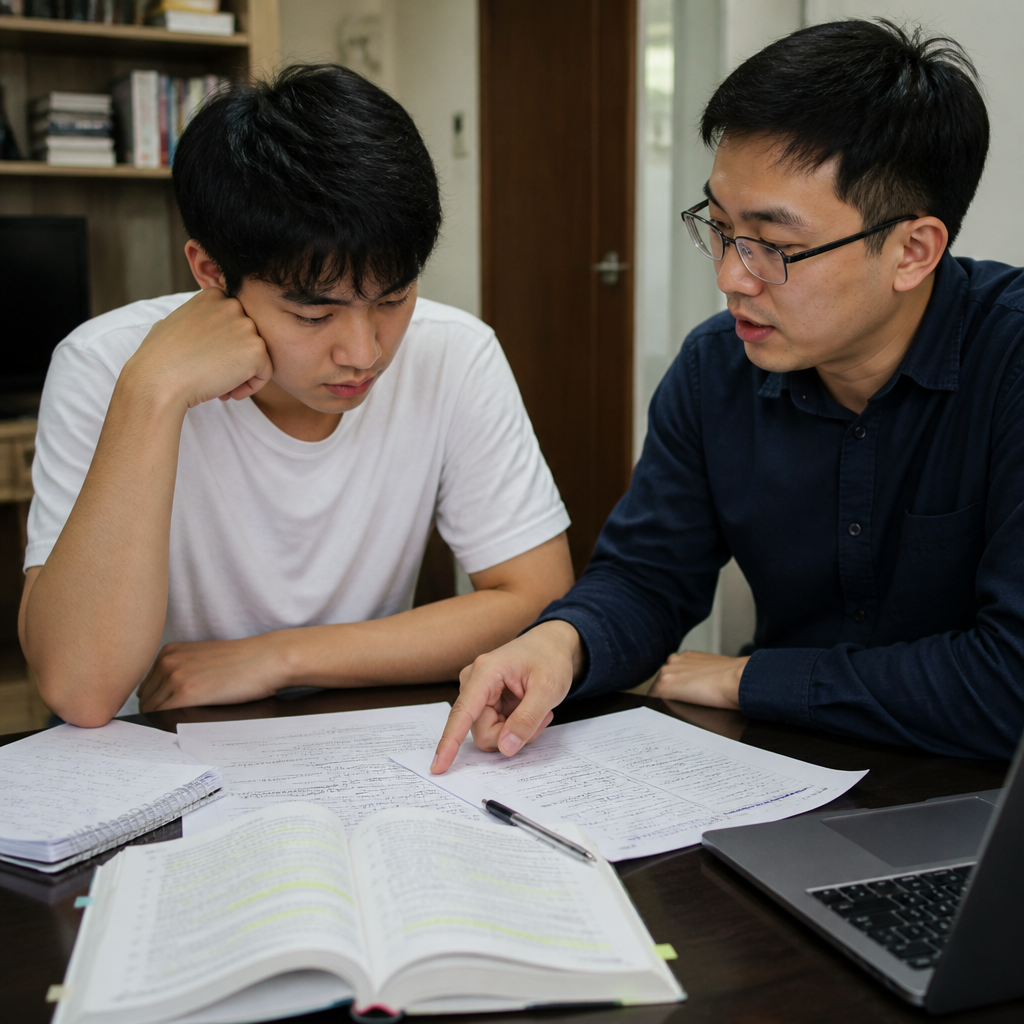
If your child is struggling to organise ideas or keeps receiving comments like “too descriptive” or “insufficient evaluation”, focused support can help. You can learn more about our JC tuition or contact us for private home tuition if they need guidance with critical reading, essay planning, and confidence-building in demanding subjects like KI.
Is Tuition Useful For KI?
When parents hear that KI is abstract and demanding, the next question is often whether tuition is necessary. The fair answer is sometimes yes, but not in the way many people expect.
What useful KI tuition looks like
The best support for KI students does not hand out miracle notes or guaranteed essay templates. Good help usually focuses on:
- Breaking down difficult readings so students can identify the main claim, supporting logic, and hidden assumptions.
- Training students to spot weak reasoning and unsupported assertions.
- Helping them plan essays with clearer progression.
- Giving targeted feedback on argument quality, not just grammar or phrasing.
- Building confidence in discussion and expression.
This is especially useful for students who are hardworking but keep missing what the question is really asking.
When tuition may not be the real solution
Tuition cannot fix everything. If a student fundamentally dislikes reading, refuses to revise consistently, or is overloaded with too many commitments, extra lessons may simply become another stress point.
Parents know this feeling well. You want to support your child, but every added lesson means another evening rush, another late dinner, another tired face on the way home. In those cases, the decision should be practical, not panic-driven. The goal is support, not overscheduling.
Frequently Asked Questions
Is Knowledge and Inquiry only for top students?
Not exactly. KI is often taken by academically stronger students, but the better predictor is suitability. A student who is curious, disciplined, and comfortable with abstract discussion may do better than a higher-scoring peer who dislikes open-ended thinking.
Does KI replace General Paper?
In the Singapore A-Level context, KI is generally taken in place of GP as part of a specific subject arrangement. Families should still confirm the latest details with the school and official sources, because subject arrangements can vary.
My child is good at English, but not sure about philosophy-style questions. Is KI still suitable?
That is a very common situation. Strong English helps, especially for reading and essay expression, but KI needs more than language fluency. If your child enjoys questioning ideas, comparing perspectives, and defending arguments, KI may still be a good fit. If they mainly enjoy narrative writing or straightforward comprehension, KI may feel frustrating.
Can a student start KI without prior background?
Yes. Most students do not begin with formal background in epistemology or philosophy. What matters more is willingness to learn how to read carefully, think critically, and write with precision.
How should families decide whether KI is a good fit?
Look at three things together: interest, reading tolerance, and workload reality. A student may be bright enough for KI but still be unhappy if they are already stretched thin by heavy commitments. It is also important to check school-level availability and expectations, because subject offerings and requirements may vary by JC and year.
Conclusion
So, what is Knowledge and Inquiry in JC? In Singapore, it is a demanding but meaningful A-Level subject for students who want to do more than memorise content. KI asks them to question how knowledge is formed, tested, challenged, and communicated.
For parents, the subject can seem abstract at first, and that concern is understandable. For students, it can feel exciting or intimidating, sometimes both. The key is fit. KI is not automatically better than GP, and it is not the right choice for every strong student. But for the right learner, it can be one of the most intellectually rewarding subjects in JC.
Before deciding, check the latest school and national information through MOE and SEAB, since availability and requirements may change. If your child needs support with critical reading, essay planning, and confidence in demanding subjects like KI, you can also contact us for private home tuition.