


Introduction
Some evenings just feel impossible. Your child gets home late, dinner is pushed back, homework is still waiting, and the idea of travelling again for tuition feels like one more thing nobody has energy for. That is usually when parents start asking, what is online tutoring, and whether it genuinely works or just sounds convenient on paper.
If you have been wondering the same thing, you are not alone. Many parents in Singapore are curious, but also understandably cautious. A screen can feel less personal than a tutor sitting at your dining table. You may wonder if your child will really focus, ask questions, or improve.
In simple terms, online tutoring is live tuition conducted through video platforms, digital whiteboards, shared worksheets, and messaging tools. The tutor teaches in real time, gives feedback, checks work, and interacts with the student much like in-person tuition, just through a device instead of face to face. In Singapore, online tuition is often aligned to the MOE syllabus and used for Primary, Secondary, and JC students who need academic support without the travel and scheduling strain of traditional tuition.

Key Takeaways
- Online tutoring is live teaching, not just watching videos. A proper online lesson includes explanation, questioning, guided practice, and feedback. It should feel like real tuition, not passive screen time.
- It can work very well for busy Singapore families. Parents often value the time saved from not travelling to a tuition centre, especially on school nights when children come home late from CCA or enrichment.
- Suitability depends on the child, not just the subject. A motivated Secondary student may thrive with online lessons, while a younger Primary child who gets distracted easily may need more structure or face-to-face support.
- Online tuition can help with PSLE, O-Level, and A-Level preparation. It is effective when the tutor is experienced, lessons are interactive, and the student is actively involved rather than just logging in.
- The home setup matters more than many parents expect. A stable internet connection, working microphone, proper writing tools, and a quiet study corner can make lessons much smoother and more productive.
- Online tuition is not automatically better than home tuition or tuition centres. It solves some problems very well, but children with very short attention spans or a strong need for hands-on supervision may still do better in person.
- The tutor matters more than the format. Before signing up, ask how lessons are conducted, how progress is tracked, and whether the tutor can teach according to your child’s level, pace, and exam goals.
What Online Tutoring Looks Like In Singapore
When parents hear the term, some picture a child quietly watching recorded lessons. That is only one form of online learning. In tuition, online tutoring usually means a live lesson between tutor and student through Zoom, Google Meet, or another teaching platform.
The tutor explains concepts, asks questions, watches the student solve problems, marks answers, and adjusts the pace on the spot. In other words, it is still teaching, just delivered differently.
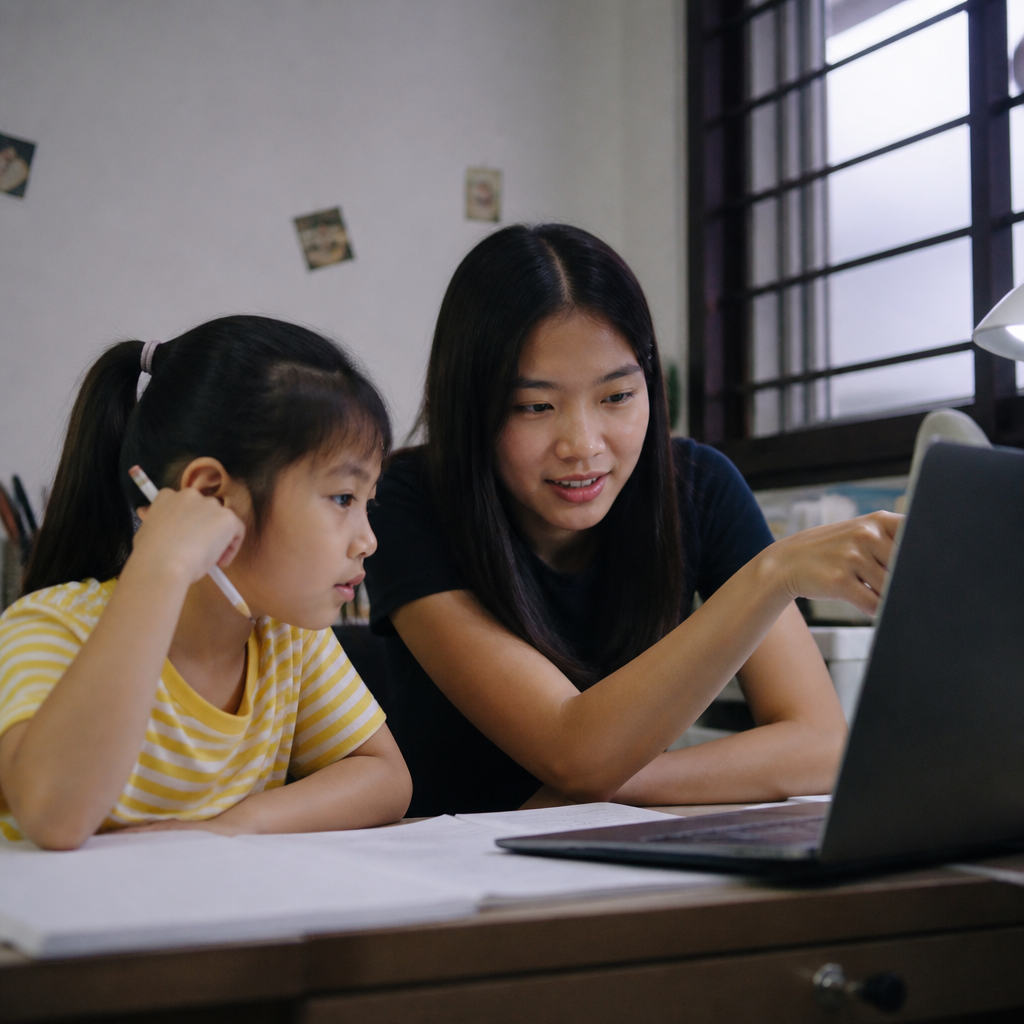
How online tuition works at home
If you are trying to picture how online tuition works in Singapore, think of it as private tuition without the commute. The tutor and student meet at a scheduled time. Worksheets may be sent beforehand by WhatsApp or email. During the lesson, the tutor may use a digital whiteboard, shared screen, online annotations, or a document camera to go through questions together.
A common pattern among students is that they seem to understand while listening, but struggle once they have to apply the concept on their own. That is why a proper online lesson should not be all explanation. It should include active checking, guided practice, and immediate correction.
For example, a Secondary 2 Math student may upload a photo of school homework before the lesson. The tutor reviews common mistakes first, then teaches the weak topic, then gets the student to attempt fresh questions while watching in real time. This is still personalised teaching, not just content delivery.
What parents usually need at home
The setup is often simpler than parents expect.
Families often worry the technology will be complicated. In reality, once the first one or two lessons are settled, most children adapt quite quickly. What matters more is having a routine: ogging in on time, keeping worksheets ready, and treating the lesson like real study time rather than casual screen time.
Why More Singapore Parents Are Considering Online Tuition
Usually, there is a real reason behind the search. It is not just curiosity. Often, parents are looking at a very packed week and thinking, something has to give.
Convenience is sometimes dismissed too quickly, as if it is a lesser reason. But for many families, it is exactly what makes consistent support possible.
Benefits parents notice most
The benefits of online tutoring for Singapore families are often very practical.
- No travel time. A one-hour lesson can easily become much longer once travel and waiting are included. That extra time can go to rest, revision, or simply a calmer evening.
- Easier scheduling. This helps children with irregular CCA days or shifting school commitments. A tutor can often fit an online lesson into a tighter slot without anyone needing to travel across the island.
- Wider tutor choice. You are not limited to who lives nearby. A parent in Punggol can engage a tutor based in Bukit Timah if the teaching fit is strong.
- Continuity during disruptions. Bad weather, minor illness, or exam-season stress does not always have to mean cancelling the lesson. Online sessions can help maintain momentum.
Why some students respond well online
Many older students focus better online than parents expect. Without the transition of travelling out, they come to the lesson less drained. Some are also more willing to ask questions on chat or annotate on screen than speak up in a tuition centre class.
Tutors often notice that students who are quiet in group settings sometimes open up more in a one-to-one online lesson. The screen does not automatically create distance. Poor lesson design does.
That said, convenience alone is not enough. A tired child can still log in and mentally disappear. The format works best when the tutor keeps the lesson active rather than passive.
If you are comparing options now, it may help to learn more about our online and home tuition options to see what suits your child’s learning style, schedule, and subject needs.
When Online Tutoring Works For Primary School Students
For younger children, the question is not only about teaching quality. It is also about attention span, routine, and independence. This is where parents are right to be careful.
When younger learners do well online
Online tuition can work well for Primary students when lessons are short enough, interactive enough, and guided carefully. A Primary 4 English lesson, for example, may involve reading aloud, discussing vocabulary, correcting sentence structure, and doing short writing tasks on screen. A focused child can benefit from this very well.
It also helps when the tutor understands how younger children behave. Many Primary students say “I know already” very quickly. Then when they attempt the question alone, they get stuck. A good online tutor does not just ask “understand?” and move on. The tutor checks learning by making the child explain, answer, and apply.
Another factor is parent support outside the lesson. This does not mean sitting through the whole session. It may simply mean helping the child log in on time, printing or opening worksheets, and making sure the study space is ready. For younger learners, these small routines can make a big difference.
When online lessons may be harder
Some situations make online learning more difficult, even with a capable tutor.
- The child keeps leaving the chair or reaching for toys. In this case, the issue is not the subject but the child’s readiness to learn through a screen.
- The child needs an adult beside them throughout the lesson. If they cannot open files, upload work, or stay on task independently, online tuition may feel more stressful than helpful.
- Foundational habits are still weak. If handwriting, pencil grip, or basic learning routines need close physical observation, face-to-face tuition may be more suitable.
This is why online tutoring is not automatically the best option just because it is convenient. Some Primary 1 or Primary 2 children still do better with in-person support, especially if they are very playful or not yet independent.
How Online Tuition Supports Secondary And JC Students
By Secondary school, online tuition often becomes more workable. Many teenagers already manage school portals, online notes, and digital submissions. The bigger issue is not whether they can use the platform. It is whether the tutor can challenge them properly, and whether the student will stay honest about effort.
Why it often suits Secondary students
When parents look for online tuition for Secondary students in Singapore, they are usually looking for a balance of flexibility, accountability, and strong subject teaching. Secondary students often benefit because subjects become more content-heavy and mistake analysis matters more.
Take a Secondary 3 Chemistry student. Online tutoring can be excellent when the tutor uses diagrams, works through structured questions step by step, and immediately points out recurring errors like careless keyword use or weak answering technique. The screen is not the problem. Weak lesson design is.
Secondary students also tend to appreciate the privacy of one-to-one online sessions more than crowded tuition centres, especially if they are embarrassed by weak basics.
What about JC students?
For JC students, online tuition can be especially effective because the lessons are often discussion-heavy. Whether it is GP essay planning, H2 Math problem solving, or Chemistry explanation, older students are more able to engage through screen-sharing, timed practice, and annotated corrections.
Still, fatigue is real. A JC student who already spends all day in lectures and tutorials may feel mentally drained by another screen session at night. In such cases, shorter but sharper lessons often work better than long blocks.
For older students, online tutoring also makes last-minute academic support easier. A tutor can review a difficult tutorial, go through a failed test paper, or prepare for an upcoming common test without the delay of arranging travel. That speed can be especially useful during heavy exam periods.
Can Online Tutoring Help With PSLE, O-Level, And A-Level Preparation?
Many parents ask this very directly, especially when exam pressure starts building. The honest answer is yes, online tutoring can be effective for PSLE, O-Level, and A-Level preparation, but not simply because a child is attending lessons.
Online tuition does not guarantee results. It supports exam preparation well when the tutor is experienced, the lessons are aligned to the syllabus, and the child is willing to participate actively.
How online lessons support exam goals
For major Singapore exams, online tutoring can help with:
- Targeted revision. A tutor can focus on exact weak areas, such as fractions in Primary Math or answering techniques in Secondary Science, instead of following a generic class pace.
- Timed practice. The tutor can monitor how the student handles pressure and show where rushed work starts to fall apart.
- Error analysis. This is often where improvement happens. Many children keep redoing papers without understanding their patterns of mistakes.
- Consistency. During heavy revision periods, online lessons can reduce the friction of travel and make it easier to keep a regular study rhythm.
What parents should keep in mind
For PSLE, O-Level, and A-Level preparation, exam knowledge matters. Tutors should understand the relevant syllabus and exam expectations. Parents can refer to official education information at MOE and exam-related information at SEAB.
A common mistake is assuming that if a child attends tuition regularly, progress will naturally follow. In practice, some students attend every session but remain passive. They copy corrections, nod along, and then repeat the same mistake in school tests. Effective online tutoring needs interaction, not just attendance.
It also helps when parents and tutors are realistic about timelines. If a student has major content gaps, improvement may come in stages: first understanding, then accuracy, then speed, then exam confidence. Online tuition can support that process well, but it still takes steady work.
Online Tutoring vs Home Tuition vs Tuition Centres
Choosing tuition is rarely just about academics. Budget, personality, family rhythm, and child temperament all matter. That is why comparing formats honestly is more useful than chasing whichever option sounds modern.
Here is a clearer way to look at the differences.
The right question is not “Which is best?” It is “Which suits my child now?” That answer can change over time. Some families even switch formats across different stages. A child may do well with home tuition in lower primary, move to online tutoring in secondary school, and join a tuition centre for revision classes closer to major exams.
What Parents Should Ask Before Choosing An Online Tutor
This is where cautious parents are absolutely right to slow down. Not all online tuition is equal. Some tutors are warm but weak in structure. Others know the subject well but cannot hold a child’s attention through a screen.
Questions worth asking
Before committing, ask:
- How are lessons conducted? Ask for a clear picture. Will the tutor use live explanation, shared worksheets, and active questioning, or mostly just go through answers?
- How is progress tracked? A tutor should be able to explain how weak areas are identified over time. Otherwise, lessons may feel busy but directionless.
- What materials are used? Good tutors usually adapt to school worksheets, exam papers, and MOE-aligned content rather than relying only on generic notes.
- How do you handle a shy or distracted student online? The answer often reveals whether the tutor has real teaching experience or only content knowledge.
- Can the lesson format be adjusted? Some children need shorter lessons, more frequent check-ins, or even a hybrid arrangement.
Red flags to notice
Be careful if the answer to every concern is a promise of quick improvement. Tuition can support learning, but it cannot replace effort, sleep, or long-term habits. Also be cautious if the tutor cannot explain how they manage engagement online.
In many cases, children do not fail online because the format is bad. They struggle because the lesson becomes a one-way lecture. A strong tutor should be able to describe how students participate during the lesson, how homework is reviewed, and how misunderstandings are caught early rather than after an exam.
Frequently Asked Questions
Is online tutoring suitable for a child who gets distracted easily?
It depends on why the child gets distracted. If the issue is travel fatigue and long school days, online tutoring may actually help by reducing transition stress. If the child struggles with self-control, keeps opening other tabs, or cannot sit still without an adult nearby, face-to-face tuition may work better.
Do I need to sit beside my child during online tuition?
Usually not for older Secondary or JC students. For younger Primary children, some light supervision at the start can help, especially in the first few lessons. Over time, the goal should be growing independence, not permanent parent shadowing.
Is online tutoring effective for PSLE preparation?
Yes, it can be effective when the tutor is experienced, lessons are interactive, and revision is targeted. It works especially well for concept explanation, paper review, and correcting repeated mistakes. It is less effective if the child attends passively and does not practise between lessons.
Is online tuition cheaper than home tuition?
Sometimes, but not always. Pricing depends on subject level, tutor experience, and lesson format. The better comparison is overall value, including saved travel time, schedule flexibility, and how well the lessons fit your child.
Can online tutoring follow my child’s school pace and MOE syllabus?
A good tutor should be able to do that. In Singapore, many parents want support that matches school topics, weighted assessments, and exam milestones. Always ask how the tutor adapts to school materials and current syllabus needs.
Conclusion
So, what is online tutoring? For Singapore families, it is live, interactive tuition delivered through a screen, designed to give academic support without the travel and scheduling strain of traditional formats.

It can be a strong option for busy households, older students, and children who are comfortable learning digitally. It can also be less suitable for some younger children who need more hands-on supervision or physical presence.
The key is not to assume online tuition is automatically better or worse. Look at your child’s age, attention span, subject needs, exam goals, and weekday routine. Think about whether convenience will genuinely help learning, or whether your child needs a tutor physically present to stay engaged.
When the tutor match is good and the lesson structure is thoughtful, online tutoring can be practical, flexible, and effective. Still, it is only one part of the bigger learning picture.
If you are still weighing your options, you can learn more about our online and home tuition options to see what suits your child’s learning style, schedule, and subject needs. You can also visit the Singapore Tuition Teachers homepage for more information.