


Introduction
If your child freezes in front of a PSLE Maths problem sum, you are definitely not alone. Many Primary 5 and Primary 6 parents in Singapore know this scene well: it is late, everyone is tired, the question looks manageable at first, and somehow it ends with guessing, frustration, or complete silence. The encouraging part is this: learning how to solve PSLE Maths questions step by step is usually not about being naturally “good at Maths”.
Very often, the real issue is that the child does not yet have a clear thinking process.
For PSLE Maths, children are not only tested on calculation. They also need to understand word problems, choose a suitable method, show their working clearly, and check whether the final answer even makes sense. That is why knowing how to solve PSLE Maths word problems step by step can make such a big difference. This guide walks through a parent-friendly approach to help your child handle PSLE Maths questions more calmly and accurately, especially those tricky multi-step sums that quietly cost marks.
Key Takeaways
- Read before rushing into calculations. Many children lose marks not because they cannot do the Maths, but because they start too quickly and solve the wrong thing.
- Separate givens from the unknown. Help your child identify what the question tells them, what is missing, and what must be found before choosing a method.
- Match the question to a suitable strategy. Different PSLE problem sums call for different approaches, such as model drawing, unit conversion, ratio reasoning, or working backwards.
- Write workings in a clear order. Even capable children can get lost halfway through a multi-step sum when the page becomes messy.
- Always check for reasonableness. A neat answer can still be wrong if the unit, size, or context does not fit the question.
- Parents can guide without spoon-feeding. The most useful support often comes from asking the right prompts, not giving the full solution immediately.
What PSLE Maths Is Really Testing
Before focusing on how to solve PSLE Maths questions, it helps to understand why children struggle even when they seem to know the topic. PSLE Maths is not just about memorising formulas. It also tests whether a child can interpret information, organise it, and choose a sensible route to an answer.
According to the Mathematics curriculum and PSLE information from MOE and SEAB, pupils are expected to handle both routine and non-routine problems. Some questions are straightforward. Others require more than topic knowledge: they require thinking, linking ideas, and deciding what to do first.
Why problem sums feel harder than worksheets
A child may do well on a page of fraction subtraction, then suddenly struggle when fractions appear inside a word problem. Usually, the weakness is not the fraction skill itself. It is the translation step. The child does not really know what the question is asking.
Take this kind of question: “Tom spent 3/5 of his money and had $24 left.” A child who panics may subtract 24 from 3/5 or try random operations just to feel like they are doing something. Quite often, it is an interpretation issue, not a pure content issue.
Common question types
In PSLE Maths, common problem-solving areas include:
- Word problems
- Model drawing
- Fractions and mixed operations
- Ratio and percentage
- Speed and unit conversion
- Multi-step problem sums
- Heuristics such as working backwards or making assumptions
The real tested skill is often not just “can your child do ratio?” It is “can your child recognise that this is a ratio question hidden inside a shopping or travel story?” That is why exam preparation cannot rely on drilling alone. Children need a repeatable way to think.
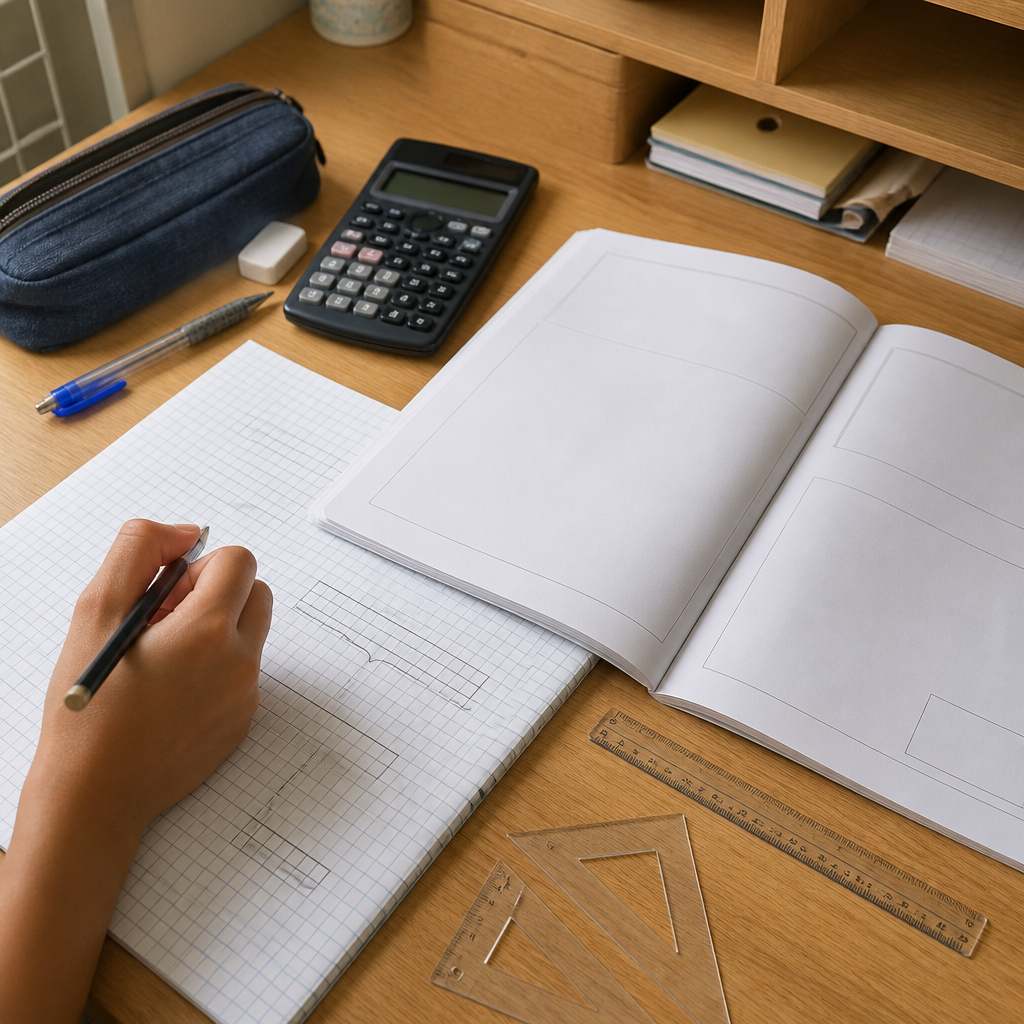
Start By Reading And Interpreting The Question Properly
This first step sounds simple, but it is where many children already go wrong. If you want to teach your child how to solve PSLE Maths questions more confidently, slowing down the reading stage matters a lot.
Read once for the story, twice for the details
On the first read, your child should understand the situation. Is the question about sharing, spending, travelling, comparing, or changing quantities?
On the second read, they should mark the key details. This includes numbers, units, words like “remaining”, “altogether”, “more than”, or “twice”, and the exact question being asked at the end.
For example:
A tank was 3/4 full. After 18 litres of water were poured in, it became full.
Your child needs to notice that 18 litres represents the missing 1/4, not the whole tank.
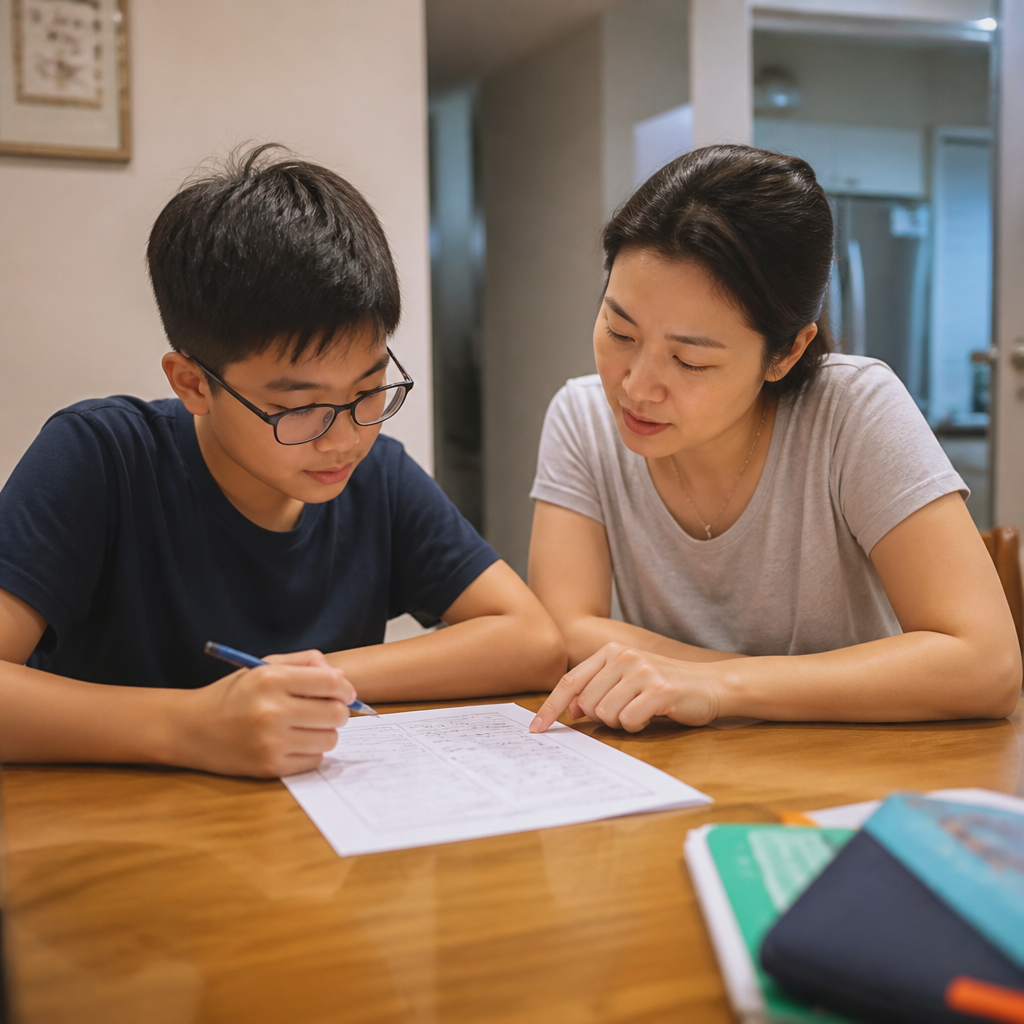
Ask what the question really wants
Children may find the total when the question asks for the difference. Or they may stop after finding one child’s amount when the question asks for both children combined.
A useful home prompt is: “Tell me in one sentence what the question wants.” If your child cannot say it clearly, they are usually not ready to solve it yet.
Watch for hidden traps in wording
Separate The Givens And Unknowns Clearly
Once your child understands the question, the next step is to sort the information. This is often where a messy-looking problem sum starts to feel manageable.
List the givens in plain language
Instead of staring at one big block of text, rewrite the facts simply:
- Total number of apples = 84
- Red : Green = 4 : 3
- 12 green apples were sold
- Find number of red apples left
That short rewrite reduces overload.
Separate before-and-after information
This matters especially in ratio, percentage, and quantity-change questions.
For example:
- Before: boys : girls = 3 : 5
- After 6 girls leave, ratio becomes 3 : 4
A child who mixes up before and after often builds the wrong model or chooses the wrong starting point.
Write the unknown as a proper Maths target
Instead of vaguely thinking “find answer”, get your child to write:
- Find total cost
- Find original number of marbles
- Find distance travelled in 2 hours
This gives the question direction. Without a clear target, children often do random operations just to produce some working.
Choose the Right Method for the Question
Knowing how to solve PSLE Maths word problems step by step also means choosing a method that fits the question. Children may know several topics, but they do not know which one to use.
When model drawing works best
One of the most useful PSLE Maths strategies for primary students is model drawing. Bars help children see part-whole relationships, comparisons, and changes over time.
If Ali has 3 parts and Ben has 5 parts, and the difference is 24, a bar model makes it easier to see that 2 parts = 24, so 1 part = 12.
When direct calculation is better
Not every question needs a model. If the sum is mainly about unit conversion or a straightforward percentage, direct calculation may be cleaner.
Parents sometimes over-push model drawing because schools emphasise it. But if your child already sees the structure mentally, forcing a long model can create unnecessary mistakes instead of preventing them.
If your child needs more guided support in choosing methods, you can learn more about our PSLE tutors who help pupils build problem-solving habits, not just memorise answers.
Set Up The Working Clearly For Multi-Step Sums
Even when the method is correct, marks can still be lost through poor organisation. One of the most practical lessons in solving PSLE Maths questions is this: clear working supports clear thinking.
Break long solutions into small steps
Instead of squeezing everything into one long line, separate each step clearly:
1. find one part
2. find total amount
3. find remaining quantity
4. write final answer with unit
This matters in multi-step questions on ratio, percentage, and speed.
Label units every time they matter
Units are often where marks slip away. Common trouble spots include cm and m, g and kg, minutes and hours, or litres and millilitres.
If a child uses 30 minutes as 30 instead of 0.5 hour, the arithmetic may look fine, but the setup is already wrong.
End with a sentence answer
A final answer line such as “Therefore, the total mass was 2.4 kg” or “Therefore, Sarah had 36 stickers left” helps the child pause and check whether they actually answered the correct question.
Check The Answer And Catch Common Mistakes
The checking stage is often skipped, especially when children are tired or rushing. Yet this is where some of the easiest marks can be saved.
Ask whether the answer makes sense
A child gets an answer saying 1 pencil costs $18, or a girl ran at 600 km/h. The working may be neat, but the answer clearly does not fit the situation.
A simple check can be built around these questions:
- Is the answer too big or too small?
- Is the unit correct?
- Does it fit the story?
- Did we answer what was asked?
Watch for these recurring PSLE Maths mistakes
How Parents Can Help At Home Without Giving Away The Answer
This is often the hardest part. You want to help, but every discussion starts to feel tense.
Ask guiding questions, not leading answers
A better approach is to prompt thinking:
- What is the question asking for?
- What do we already know?
- Is this before or after the change?
- Would a model help here?
- What should we find first?
This keeps ownership with the child. If you jump straight into teaching the full method, your child may copy the steps without learning how to think independently.
Adjust support based on your child’s level
For weaker students, focus first on understanding the story. If they do not understand the situation, method practice will not stick.
For stronger students, it helps to ask them to compare two methods, explain why one is more efficient, and practise speed without losing clarity.
Build a calm routine instead of crisis revision
Last-minute drilling often creates panic, not mastery. A more workable routine might look like this:
- two problem sums on weekdays
- one short review of corrections
- one focused weekend session on weak topics
If your child needs extra support with PSLE Maths problem solving, learn more about our home tuition support. For the latest syllabus and assessment details, refer to official guidance from MOE and SEAB.
Frequently Asked Questions
How can I teach my child to solve PSLE Maths word problems step by step if I am not strong in Maths?
You do not need to be a Maths expert to help well. What matters more is guiding the process. Ask your child to read the question aloud, explain what is known, identify what must be found, and decide whether the situation involves part-whole, comparison, or change.
Should every PSLE problem sum be solved using model drawing?
No. Model drawing is very useful, especially for fractions, ratio, and comparison questions, but it is not always the fastest or clearest option. Some questions are better handled with direct calculation, unit conversion, or working backwards.
Why does my child understand during revision but still get problem sums wrong in exams?
This is extremely common. At home, your child may be relying on hints, familiar question types, or extra time without realising it. In the exam, stress, time pressure, and slightly different wording can throw them off.
How much should parents help with PSLE Maths at home?
Help is useful when it supports thinking, not when it replaces it. A better balance is to guide the first few steps, then let them continue on their own and explain their reasoning back to you.
Conclusion
Learning how to solve PSLE Maths questions step by step is rarely about magic shortcuts. It is about building calm, repeatable habits. Read carefully. Identify the givens and the unknown. Choose the right method. Set up the working clearly. Then check whether the answer makes sense.
For parents, the challenge is often emotional as much as academic. In most cases, steady guidance works better than panic drilling. Small, consistent practice with the right prompts can improve both confidence and accuracy over time.
If your child needs extra support with PSLE Maths problem solving, you can explore our PSLE tuition options to help build revision habits, exam skills, and confidence.