


It can be frustrating to watch your child understand a Maths question at home, then leave questions blank in a timed paper or lose marks over a misplaced decimal point. After school, CCA and homework, another worksheet may seem like the obvious answer. Yet more questions alone can make a child rush harder rather than work better.
Improving PSLE Maths speed without losing accuracy is not about racing through every question. It is about recognising familiar question types, choosing an efficient method, writing enough working to stay organised and knowing when to move on. For Primary 5 and Primary 6 pupils, the aim is to build calm, repeatable exam habits that hold up when time feels tight.
The current syllabus develops mathematical reasoning, problem-solving and communication, not just quick calculation. Check the latest information from MOE and SEAB as your child’s PSLE approaches.
Key Takeaways
- Speed starts with certainty, not rushing. Recognising a percentage, ratio or fraction structure is faster than calculating before understanding the question.
- Build timed practice gradually. Begin with short sets before progressing to full papers.
- Use question triage. Complete accessible questions first and return to time-consuming ones later.
- Keep working neat but economical. Show enough steps to track the method without repeatedly copying information.
- Analyse errors, not just scores. Identify whether an error came from misreading, calculation, units, method choice or time pressure.
- Use a checking routine. Scan for blanks, units and unreasonable answers instead of randomly redoing questions.
Understand Where Time Goes in PSLE Maths
Speed problems are often thinking problems
When a child spends four minutes on one question, parents may assume multiplication facts are the main problem. Sometimes that is true. Often, however, the delay begins earlier: the child reads a word problem twice, circles several numbers and starts an operation without deciding what those numbers represent.
PSLE Mathematics assesses procedural fluency, reasoning and problem-solving. A pupil must calculate accurately, interpret information, choose a strategy and communicate a workable solution. A child may understand fractions yet freeze when fractions appear in a multi-step model-drawing question.
During revision, observe the first minute, not only the final answer. Can your child identify the unknown? Do they know whether a diagram, number sentence or table would clarify the information? This is where meaningful time savings begin.
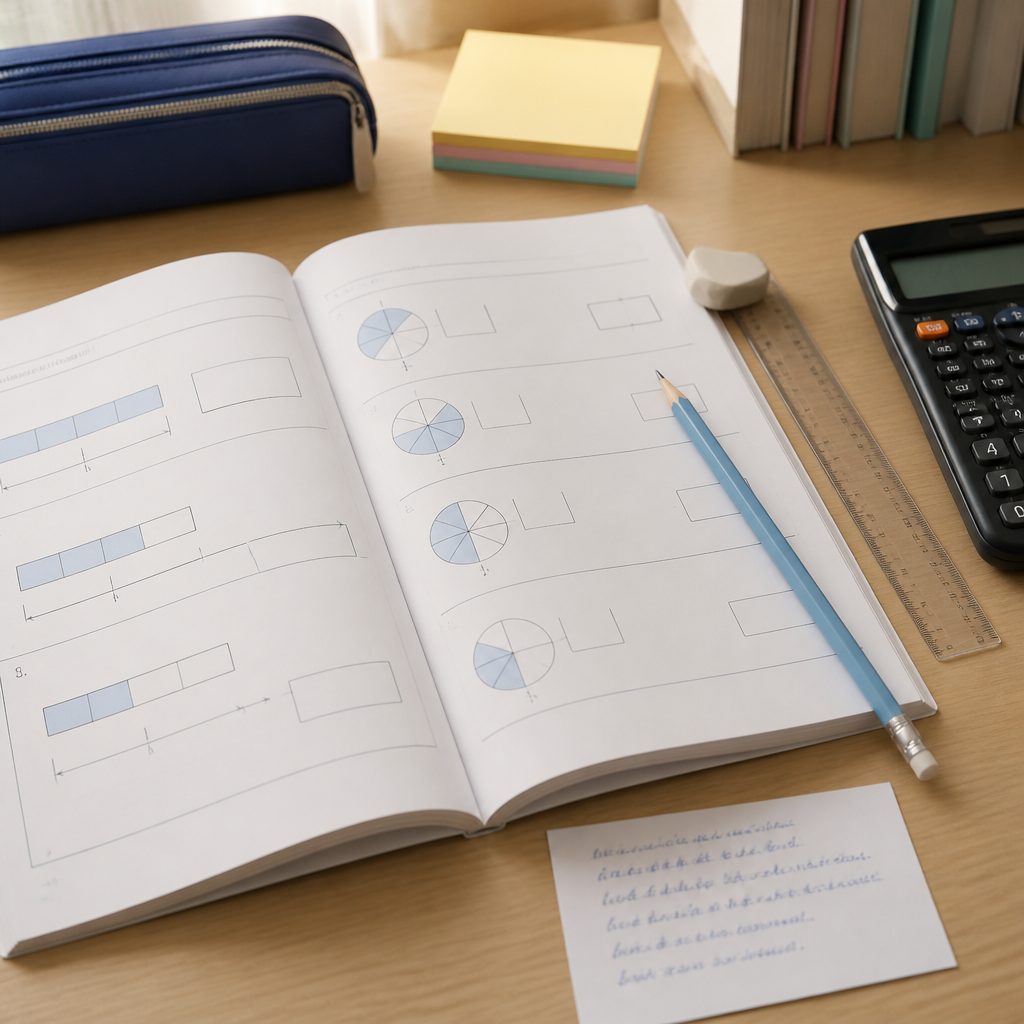
Paper familiarity reduces avoidable panic
Your child should know the current PSLE format and permitted materials, but avoid relying on old assumptions or social-media summaries. Refer to the latest official SEAB PSLE examination formats and the MOE Primary Mathematics syllabus.
A timed paper feels different from an ordinary worksheet. Multiple-choice questions require quick but careful reading, while constructed-response questions need enough working for pupils to follow their own reasoning. Familiarity removes wasted minutes caused by uncertainty about how to approach the paper.
Build Speed Through Timed Practice
Build timing in layers
Jumping straight into full papers can backfire, especially for a Primary 5 child. If every session ends with “You are too slow,” Maths can become associated with a stopwatch and disappointment. Start with a focused set instead.
For example, give your child six fraction questions they can already answer correctly, with a realistic time limit. Afterwards, discuss which question took longest and why. Perhaps they simplified fractions at every line or hesitated over mixed numbers. Repeat a similar set another day, aiming for smoother working rather than a dramatic reduction in time.
Once accuracy remains stable, combine two topics. Later, progress to mixed timed sections and then full papers. This gradual approach develops PSLE Maths time management while revealing which topics become difficult under pressure.
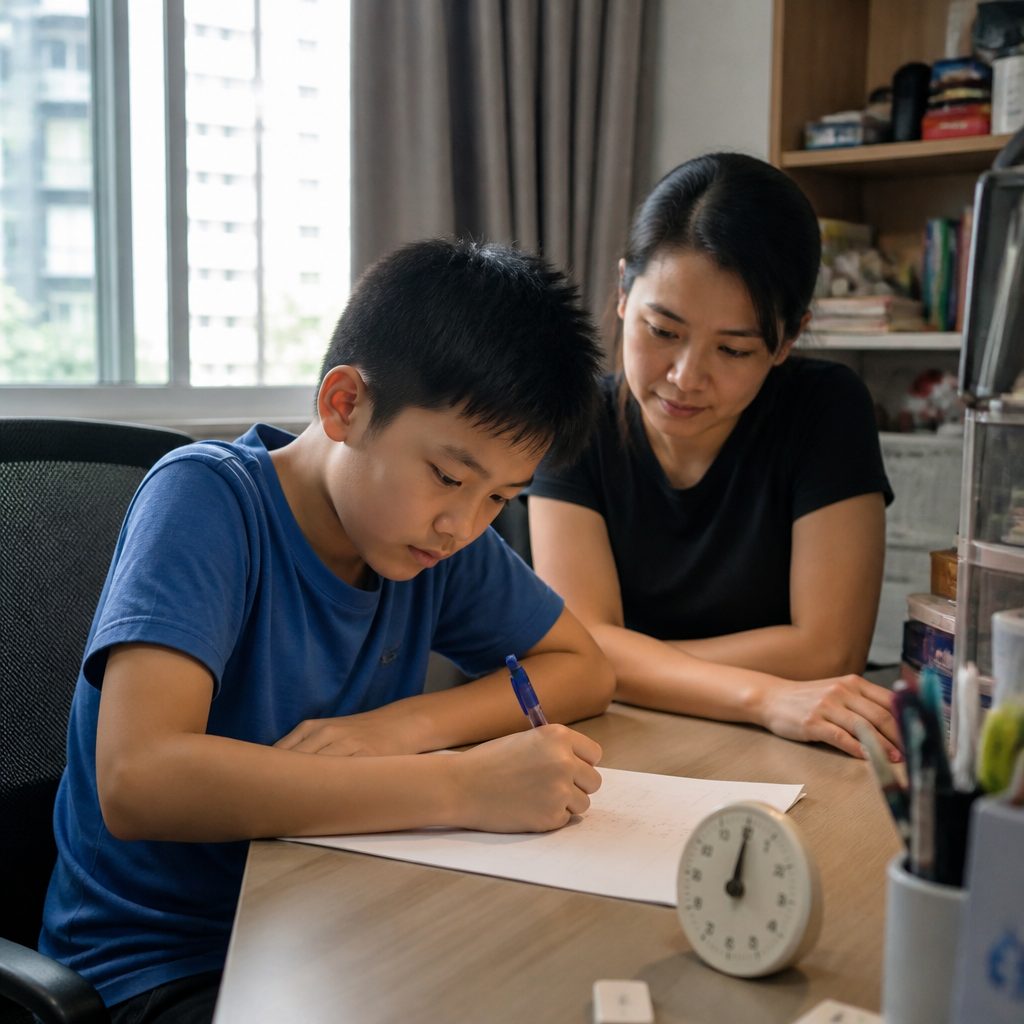
Review after the timer stops
Finishing a worksheet does not automatically make it useful practice. Spend five to ten minutes examining what happened instead of checking only the score.
Pupils often describe every pattern as “careless.” Naming the actual cause gives the next revision session a purpose and shows that improvement is manageable.
Use Question Triage and Efficient Working
Protect accessible marks first
In a timed paper, getting stuck can cost more than one question. A child who spends seven minutes staring at a difficult problem may become anxious and then rush through several questions they could have solved calmly.
Encourage a simple triage habit: answer familiar questions first, place a small mark beside those needing more thought and return later. This is not permission to avoid challenging questions. It is a strategy for using limited time wisely.
Model helpful language at home: “This needs a model, and I cannot see it yet, so I will mark it and secure the next question.” This protects confidence while establishing a deliberate return plan.
Make working shorter, not invisible
Some children record every mental step because they fear mistakes. Others write almost nothing and cannot locate an error. The balance is purposeful working.
For a word problem, a labelled bar model or short equation may be faster and safer than several sentences. For calculations, lining up decimals clearly prevents quick answers from becoming wrong ones. If your child repeatedly copies numbers, teach them to write one clean number sentence before calculating.
Do not insist that every question use the same method. Model drawing is valuable, but forcing it onto a straightforward numerical question may slow a confident child down. Efficiency means choosing the clearest reliable method, not the most elaborate one.
Strengthen Mental Calculation Without New Errors
Build useful number habits
Mental calculation supports speed when it reduces routine workload. A child who knows multiplication facts, common fraction equivalents and simple percentage relationships has more attention available for the problem itself.
Use brief, low-pressure practice. Ask, “If a $20 item has a 25% discount, what is the discount?” If your child answers $5, ask how they saw it. Recognising that 25% is one quarter is more useful than memorising a single answer.
Useful areas include:
- Multiplication and division facts
- Complements to 100 and 1,000
- Fraction-decimal-percentage relationships
- Estimation and number sense
Before dividing 398 by 8, for example, a child can expect an answer near 50. That estimate helps catch an accidental answer of 5 or 500.
Do not turn every calculation into a speed drill
Speed drills have a place, but excessive drilling can make a careful child tense and encourage guessing. If a pupil confuses 6 × 7 and 7 × 8, practise those facts briefly through retrieval and application, then stop. Ten calm, correct responses across several days may be more valuable than a stressful 100-question sheet.
Mental calculation also has limits. When a written method is safer, especially with decimals or multi-step calculations, encourage your child to use it. Fast thinking should reduce errors, not create pressure to do everything mentally.
Create a Reliable Checking Routine
Reserve checking time on purpose
“Check your work” is too vague for a tired Primary 6 pupil. A stronger routine directs attention to places where marks are commonly lost.
Practise this routine with a 20-minute home set. At the 17-minute mark, have your child stop starting difficult questions and begin checking. Afterwards, ask what they reviewed or corrected. Accuracy improves when checking is treated as part of solving, not a bonus for early finishers.
Adapt the Plan for Primary 5 and Primary 6
Primary 5: build dependable foundations
Primary 5 is a good time to remove slow habits without full PSLE pressure. Focus on number sense, topic understanding and clear representations. A child who needs ten minutes to decode a fraction problem may need more exposure to its language, not another full paper.
After a tiring school day, keep practice modest. A 15-minute targeted set followed by error review may be more productive than a long worksheet completed while exhausted. A child who understands why an error happened is more likely to improve than one who completes pages mechanically.
Primary 6: rehearse decisions under exam conditions
Primary 6 pupils need increasing exposure to mixed, timed work, but the schedule should remain sustainable. Use timed practices to rehearse triage, working layout and checking. Between papers, return to the exact topics and error patterns that caused delays.
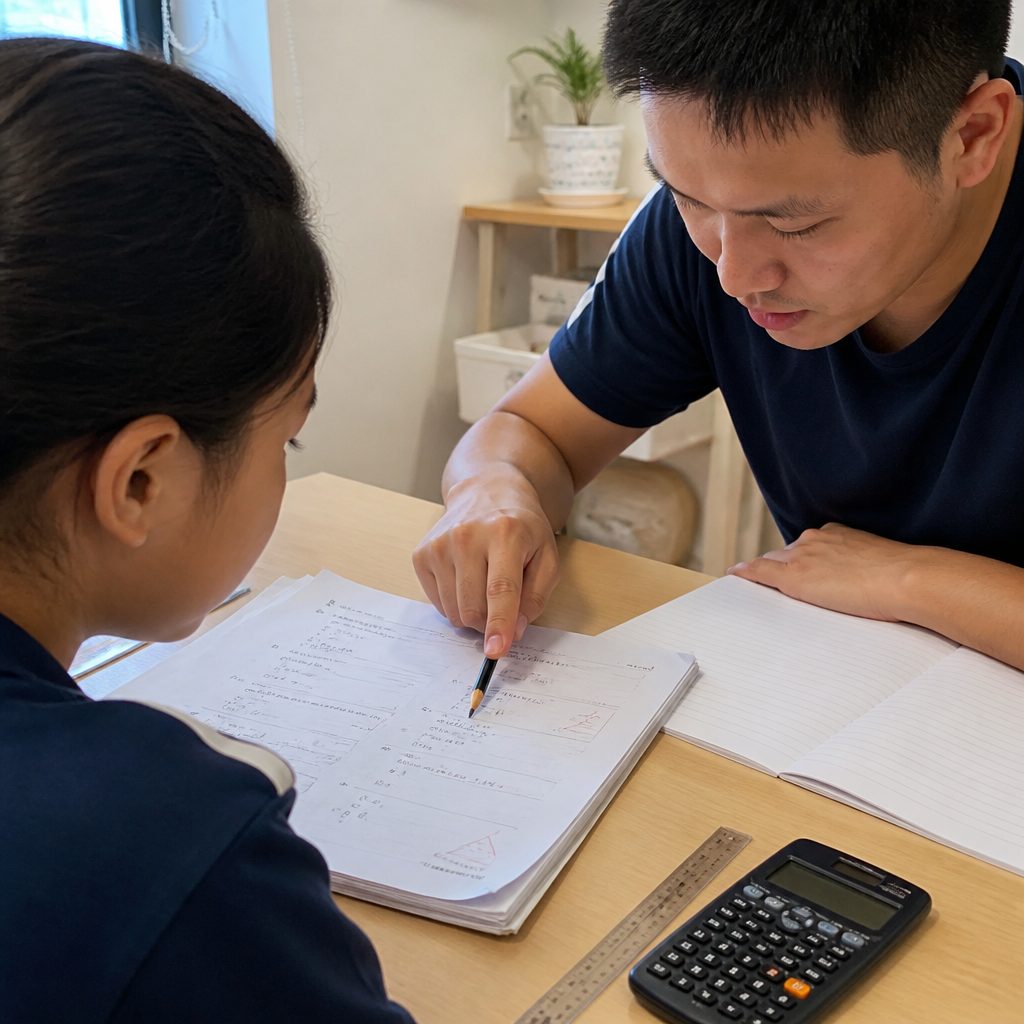
Some pupils understand the concepts but freeze or repeat mistakes under time pressure. Personalised feedback can help identify whether the barrier is method selection, foundational fluency, confidence or exam habits. Learn how a Maths tutor can help your child strengthen exam skills while balancing speed and accuracy. Tuition cannot guarantee results, but suitable guidance may make revision more focused.
Frequently Asked Questions
Should my child do a full Maths paper every week?
Not necessarily. Full papers help practise stamina and time management, but targeted correction may be more valuable if the same topic errors keep recurring.
My child is accurate at home but slow in school tests. What should we do?
Start with short timed sets. Your child may know the method but have limited experience choosing it under pressure. Identify the exact point where they slowed down.
Should I teach my child to skip hard questions?
Teach them to postpone rather than abandon a question. Mark it, complete accessible questions and return with the remaining time.
How can I address careless mistakes without causing arguments?
Ask neutral questions such as, “Which line changed the answer?” or “What did the question ask for?” Avoid labels such as “You are always careless,” which may make a child defensive instead of reflective.
Conclusion
Improving PSLE Maths speed without losing accuracy comes from better decisions, not frantic work. Build fluency in essential number facts, use gradual timed practice, teach question triage, keep working clear and follow a specific checking routine. For Primary 5, strengthen habits before the pressure rises. For Primary 6, rehearse those habits under realistic timed conditions.
The aim is not for your child to race through every question. It is for them to work steadily, recognise when to move on and trust a method that keeps avoidable mistakes under control.