


It is 9.30pm, your child has just finished CCA, homework is still open, and a simple-looking measurement question has somehow turned into a tense parent-child moment. One day, they write that 2 m is 200 cm. The next, 3 kg becomes 3,000 g incorrectly.
Primary Maths unit conversion can look basic, but it draws on number sense, place value, vocabulary and careful reading. In Singapore Primary Maths, children first meet measurement through familiar objects before they are expected to convert units confidently. The aim is not to memorise a string of rules. It is to understand what each unit represents, know whether an answer should become bigger or smaller, and keep the correct unit throughout a calculation.
Key Takeaways
- Start with meaning before memorisation. A child who can picture a 1-litre drink bottle is less likely to confuse litres and millilitres when numbers become larger or appear in word problems.
- Use everyday comparisons first. Measuring a dining table, weighing fruit at the market or reading a bus journey time gives measurement in Primary Maths a purpose beyond a worksheet.
- Ask whether the number should grow or shrink. Converting metres to centimetres creates a larger number because centimetres are smaller units. Converting centimetres to metres groups those smaller units together.
- Build conversion tables only after place value is secure. Tables can be useful visual aids, but they should support understanding rather than become a trick applied blindly.
- Keep units visible in every line of work. Writing “250 cm = 2 m 50 cm” makes it easier to catch errors that appear when children work with bare numbers.
- Treat word problems as reading tasks too. Many mistakes happen because a child converts correctly but answers in the wrong unit, or combines quantities expressed in different units.
Understand What Unit Conversion Is Really Testing
More Than Moving Digits
Unit conversion means expressing the same quantity using different-sized units. For example, 1 m and 100 cm describe exactly the same length. The quantity has not changed, only the number used to describe it.
That is why “just add two zeroes” can backfire. It may work for metres to centimetres, but it does not explain why 2.5 m is 250 cm. It also does not prepare a child for time conversions such as 1 hour 30 minutes.
Tutors often notice that children can recite “times 100” but cannot say whether 500 cm is longer or shorter than 5 m. The rule has stayed with them, but the meaning has slipped away. Understanding must come before speed.
The Main Measurement Units Children Encounter
The exact sequence and depth vary by level and school materials, but primary school measurement commonly includes the following units.
For broad curriculum guidance, refer to the current MOE Primary Mathematics syllabus, while using your child’s school worksheets to confirm the expected level of difficulty.
Build Understanding From Concrete Objects to Numbers
Let Your Child See and Handle the Units
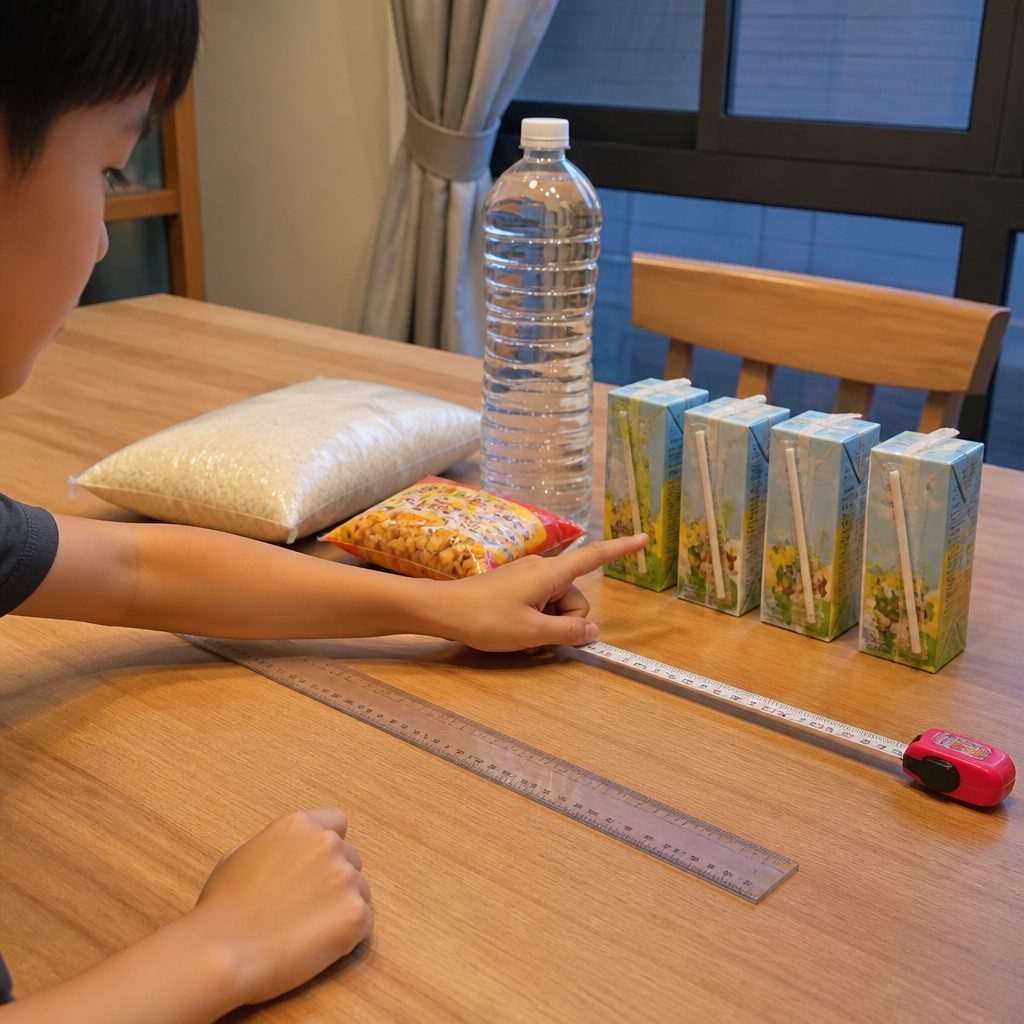
Before opening a worksheet, start with objects at home. Place a 30 cm ruler beside a 1 m measuring tape and ask, “How many ruler lengths roughly make one metre?” Measure the sofa, dining table and school bag strap.
Estimation matters here. If your child says the sofa is 4 cm long, pause gently. Ask whether 4 cm is closer to the width of a finger or the length of a sofa. The goal is not to catch them out. It is to help them reconnect the number to something real.
For mass, compare a 1 kg packet of rice with a lighter snack packet labelled in grams. For volume, line up a 1-litre bottle and a 250 ml drink carton. Four cartons make one litre, giving children a concrete picture before the statement 1 l = 1,000 ml appears.
Draw the Relationship Before Calculating
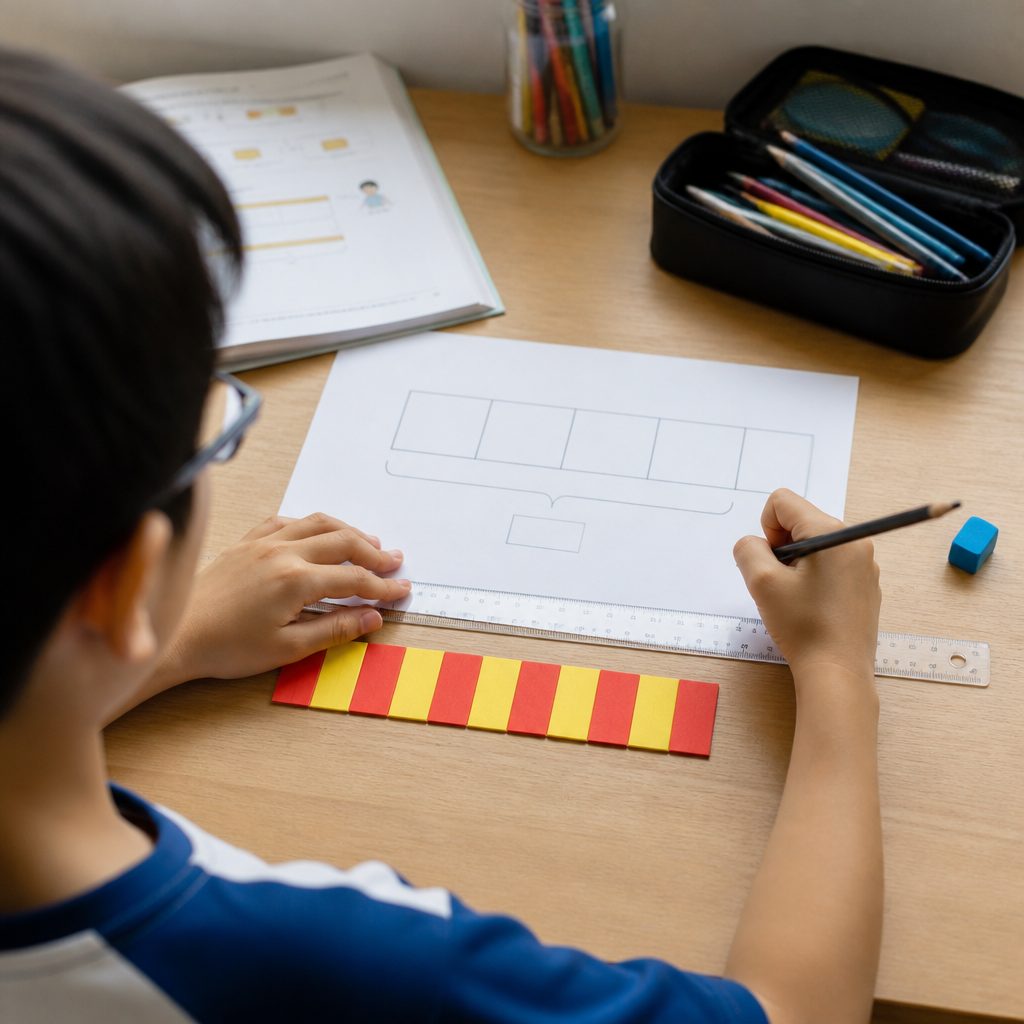
Once the object is familiar, sketch it. Draw a 1 m strip divided into ten equal sections and label each section 10 cm. Then ask where 70 cm would sit.
This makes 70 cm = 0 m 70 cm, or 0.7 m where decimals are appropriate for the child’s level, feel less arbitrary. A common pattern among students is that they become more confident once they can see how the units fit together.
A simple conversion table can then help.
Avoid introducing every table at once. A tired child who has returned from a long school day may copy facts without retaining them. Work on one family of units, such as length, over a few short sessions before moving on to mass or volume.
Teach Unit Conversion Step by Step at Home
First Decide Which Unit Is Smaller
A reliable question is: “Are we describing the same amount using smaller pieces or bigger pieces?”
If 3 m is expressed in centimetres, your child is counting smaller pieces, so the number becomes larger: 3 m = 300 cm. If 450 cm is expressed in metres, they are grouping smaller pieces into larger ones, so the number becomes smaller: 450 cm = 4 m 50 cm or 4.5 m, depending on the question.
This reasoning lasts longer than telling a child to multiply when moving “down” a chart. Directional arrows can be useful later, but they are easy to reverse under assessment pressure.
Say, Show, Write
A calm three-part routine can make teaching unit conversion less stressful for everyone.
For mixed units, use regrouping instead of guessing. With 3 m 45 cm, show three 100 cm groups plus 45 cm. The answer is 345 cm. Conversely, 275 cm means two complete 100 cm groups and 75 cm left, so it is 2 m 75 cm.
Keep Practice Short and Specific
Twenty mixed questions can feel like a test rather than practice. Try five questions with a clear purpose instead. Use the height of a 145 cm cupboard, a 1.5 l water bottle used for training, and $6.80 expressed in cents. Then ask what made each conversion different.
Time needs particular care. 1 hour 20 minutes is 80 minutes, not 1.20 hours. Decimal-looking notation can mislead children because 60 minutes, not 100, make an hour.
Avoid Common Measurement Mistakes
Multiplying When the Answer Should Be Smaller
The most common mistake is multiplying automatically. A child sees “4,000 g to kg” and writes 4,000,000 kg because “kg and g means times 1,000”.
Bring the question back to reality. Would 4,000 g of rice be four kilograms or four million kilograms? Holding a 1 kg packet of rice can settle the doubt faster than another lecture.
Dropping the Units
Some children write correct calculations but omit the final unit. In a question asking for 2 l 300 ml in millilitres, “2300” is incomplete. Encourage one final check: “2300 what?”
This matters even more in multi-step word problems, where centimetres, metres and kilometres may appear together. A number without its unit is not yet a complete answer.
Converting at the Wrong Moment in Word Problems
Consider a ribbon that is 2 m 40 cm long and another that is 85 cm long, where the answer is required in centimetres. A child may add 2 + 40 + 85 and get 127. The issue is not addition. The units were never made consistent.
Teach the habit of circling the requested unit first. Here, convert 2 m 40 cm to 240 cm, then calculate 240 cm + 85 cm = 325 cm. In Singapore Primary Maths, this decision may be tucked inside a familiar context, such as fabric for an art project or distances walked during a school event.
Rushing Into Shortcuts
Conversion ladders, arrows and “shift the decimal point” methods look efficient. They can also make measurement feel like a magic trick. Use them only after your child can explain the relationship in words.
Efficiency matters later, but understanding is what helps when the question looks unfamiliar. If repeated confusion is making homework tense, patient one-to-one support can help uncover whether the real difficulty is place value, language or problem-solving. Learn more about Primary Maths tutors and subject support for measurement and unit conversion concepts.
Make Unit Conversion Part of Ordinary Singapore Routines
Use Moments That Already Happen
At the supermarket, invite your child to compare a 500 g loaf with a 1 kg bag of flour. Ask which is heavier, and how many 500 g loaves would equal 1 kg.
When filling a water bottle before school, ask whether a 600 ml bottle holds more or less than 1 litre, and how much more is needed to make 1 litre. On a family outing, notice distance signs in kilometres and estimate a shorter distance in metres.
At a hawker centre, money conversion can happen naturally too. If a drink costs $1.80, how many cents is that? These moments need not turn into a quiz. One quick question while waiting for food is often enough.
Create a Five-Minute Weekly Check
Choose one category each week instead of revising all units just before a school test.
A 120 cm dining bench can be expressed as 1 m 20 cm, but 120 m clearly does not fit the room. These small reality checks build confidence without making practice feel heavy. The aim is confidence, not speed. Children often improve when they stop feeling that every mistake proves they are “bad at Maths”.
Frequently Asked Questions
What does my child really need to memorise for Primary Maths unit conversion?
They need secure basic relationships, such as 1 m = 100 cm, 1 kg = 1,000 g and 1 l = 1,000 ml, alongside common time and money relationships. Memorisation alone is not enough. Ask your child to explain why the number changes when the unit changes.
My child knows the conversion facts but still gets word problems wrong. Why?
They may be struggling with the question language rather than the conversion itself. Encourage them to identify every quantity, its unit and the unit requested in the answer. A child can know that 1 m equals 100 cm yet still add metres directly to centimetres when they rush.
Should I teach decimals early to make unit conversion easier?
Only if your child is ready and it matches current school learning. Decimals can clarify 1.5 m, but they can confuse a child who has not yet grasped tenths or who mixes up 1.5 hours with 1 hour 50 minutes. Mixed units and concrete diagrams are often the safer starting point.
How can I prepare my child for school assessments without making them more anxious?
Practise varied questions, not just direct conversions. Include comparisons, addition and subtraction with units, and short word problems. Check current assessment information through the school and SEAB, as formats and expectations should always be confirmed against the latest official and school guidance.
Help Your Child Reason, Not Just Remember
Primary Maths unit conversion becomes far less intimidating when children can connect units to real objects, visualise smaller and larger parts, and check whether an answer makes sense. Start with household experiences, move to drawings and labelled working, then practise short numerical questions and word problems.
A wrong answer is useful information. It may show that your child has reversed a relationship, forgotten a unit or rushed past the words asking for centimetres rather than metres. With steady, low-pressure practice, these patterns can change.
If your child needs patient, personalised help with Primary Maths concepts such as measurement and unit conversion, learn more about our tutors and available subject support.