


Paper 1 can look manageable at first glance. The questions are shorter than Paper 2, so it is easy to assume it will be less stressful. Yet many Secondary 4 and 5 students leave the examination frustrated because the marks they lost came from a negative sign, a rushed calculator entry, an omitted unit or insufficient working.
Learning how to score well in O-Level E-Math Paper 1 is less about finding a shortcut and more about building dependable habits before the examination, then applying them calmly under time pressure.
For the 2026 GCE O-Level Mathematics syllabus, Paper 1 is a 2-hour-15-minute paper with about 26 compulsory short-answer questions worth 90 marks. It tests Number and Algebra, Geometry and Measurement, and Statistics and Probability. An approved calculator may be used, but it cannot replace clear mathematical thinking or careful checking. Always confirm the latest format and syllabus details through SEAB’s O-Level syllabus page.
Key Takeaways
- Treat Paper 1 as an accuracy paper. Short questions can still carry several marks, so show enough working to protect method marks when a final answer goes wrong.
- Revise by weakness, not comfort. Repeating easy algebra questions may feel productive, but focused practice on reverse percentages or bearings can be more useful.
- Use a timed first attempt. Move on when stuck, then return with a clearer head instead of sacrificing later questions.
- Estimate before trusting the calculator. A quick sense-check can catch a negative length, impossible probability or unreasonable percentage.
- Check high-risk details. Signs, brackets, degree mode, significant figures, units and labels commonly cause avoidable errors.
- Keep a purposeful error log. Record why each mistake happened and redo a similar question later instead of merely copying the correct answer.
Know What Paper 1 Really Tests
Short questions still require clear reasoning
“Short answer” does not necessarily mean “one-line answer”. The 90 marks are distributed across questions with different demands. One question may test a routine calculation, while another may ask students to choose a formula, interpret a graph or connect ideas from several topics.
A common mistake is assuming that a short question only needs a final number. In reality, students must use standard techniques, solve problems in context and communicate their mathematical reasoning. A calculator display alone may not earn full credit.
In a trigonometry question, write the ratio or rule before substituting numbers. In a percentage question, show the multiplier, such as `1.08` for an 8% increase. If the final calculator entry is mistyped, the earlier line can still demonstrate the correct method.
Working should be concise rather than excessive. There is no need to explain every basic arithmetic step, but another person should be able to follow the route from the information given to the final answer.
Prepare examination tools early
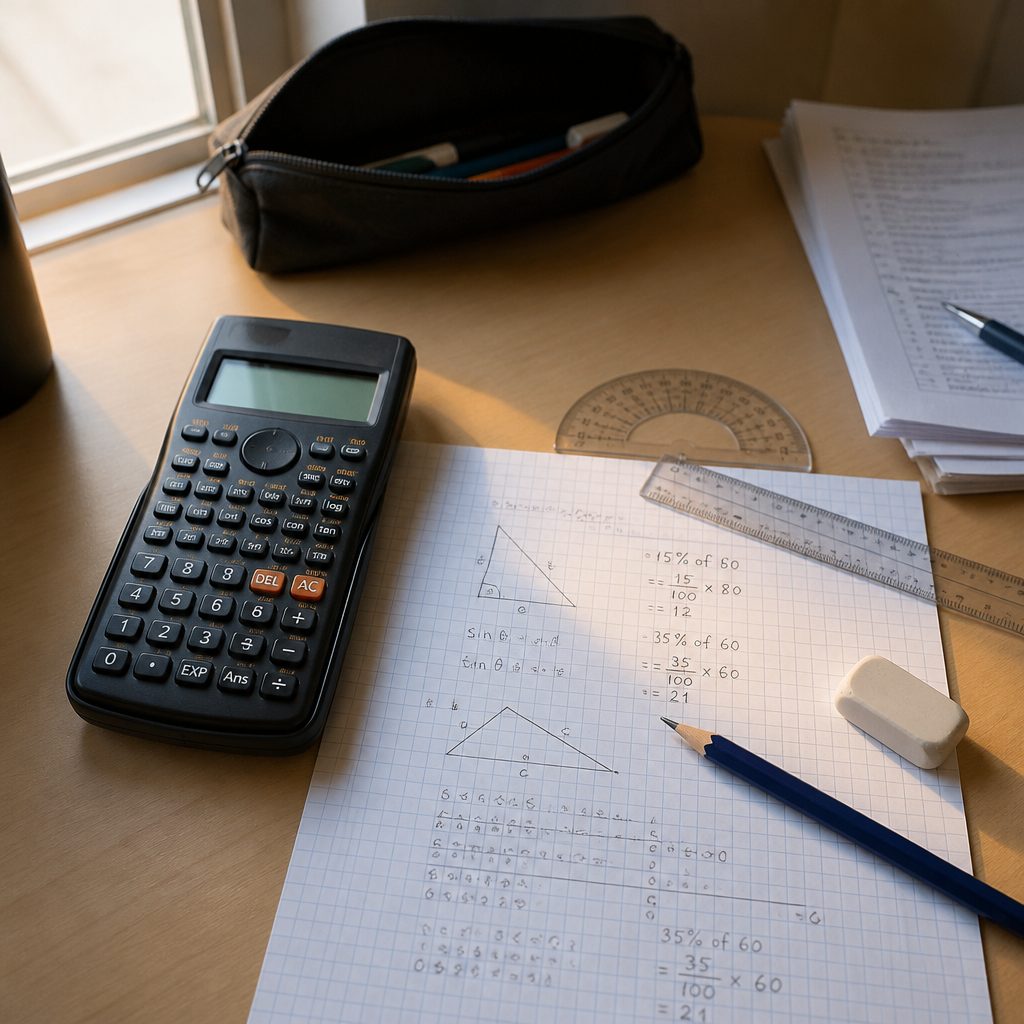
Check the calculator against SEAB’s approved calculator list well before the examination. Replace weak batteries early and practise with the same model that will be used during the paper.
Students should be comfortable using fraction, memory, statistics and trigonometric functions accurately. However, knowing which buttons to press is only part of the skill. They must also recognise whether the result is reasonable.
Practise calculator functions within actual questions. Before accepting a result, estimate its likely size or range. This prevents a calculator entry error from passing unnoticed simply because the screen produced a precise-looking number.
Revise Weak Topics With Purpose
Build practice across the syllabus
Effective Paper 1 revision is not simply completing one past-year paper after another. Start by listing topics under the three syllabus strands, then mark each as secure, shaky or weak. Include algebraic manipulation, equations and graphs; angles, similarity, trigonometry, mensuration, coordinate geometry and vectors; and data handling and probability.
Avoid broad labels such as “bad at geometry”. A student who repeatedly confuses area scale factor with length scale factor has a specific gap. That gap can be addressed with a short explanation followed by several targeted questions.
Practise five to eight questions on one weakness, review the method and revisit the same question type a few days later. Delayed practice checks whether the method has actually been retained. It is usually more effective than completing a long topical worksheet while skipping every uncomfortable question.
Short, regular sessions are also easier to sustain. After a tiring school or CCA day, a focused 25-minute set on indices or cumulative frequency can be more productive than an unrealistic three-hour revision plan.
Turn mistakes into an error log
Keep a notebook section for recurring errors. For each mistake, record the topic, the exact error and the action needed. “Careless” is too vague to correct. “Expanded `-(2x – 5)` as `-2x – 5`” identifies what must be checked next time.
If a student knows the trigonometry method but uses radians instead of degrees, add “check DEG” to the routine. If the student calculates total cost when the question asks for change, underline the requested quantity before starting.
The log only becomes useful when students act on it. Reattempt the original question without looking at the solution, then complete a similar question to confirm that the correction can be applied independently.
Manage Time Calmly During the Paper
Make a confident first pass
With 135 minutes for around 26 questions, it is unhelpful to treat every question as equally urgent. Begin with questions that can be set up confidently and keep the working orderly. The aim is to collect marks across the paper, not to perfect one difficult question while later pages remain untouched.
If a question has stopped progress for roughly two or three minutes and no workable first step has emerged, leave space, mark it lightly and move on. Do not erase useful observations. Identified sides, diagram labels or a relevant formula may help when returning later.
Unfamiliar wording does not always mean unfamiliar Mathematics. A phone-plan problem may involve simultaneous equations, while a map question may require scale and Pythagoras’ theorem. Circle the important information, identify the requested quantity and connect the context to a familiar topic.
Reserve time for checking
Aim to finish the first pass with at least 15 to 20 minutes remaining. Use this time to return to incomplete methods and check high-risk details.
Do not restart a whole solution merely because its answer looks unfamiliar. Compare it with an estimate first. A probability greater than one or a very small area for a large object is a stronger warning than a vague feeling of uncertainty.
Protect Marks With Working and Final Checks
Show the mathematical route
Omitting essential working can lead to lost marks. Write in a sequence another person can follow. For a speed question, show the unit conversion before dividing. For a quadratic, show the factorisation or formula substitution. For statistics, label frequency and midpoint columns clearly.
Neat working is not about creating a perfect page. It prevents a correct first line from being lost among calculations in a crowded margin. If an answer changes, cancel the original clearly and place the replacement nearby.
Unless a question states otherwise, numerical answers are generally given to 3 significant figures, while angles in degrees are given to 1 decimal place. Keep more digits in the calculator until the final line. Rounding during an intermediate step may distort the final answer.
Use mathematical common sense
Before accepting an answer, apply a quick check suited to the topic.
These checks are brief, but they interrupt rushed, automatic answers before they become lost marks.
Avoid Common Mistakes That Drain Marks
Do not confuse speed with rushing. A student who checks brackets before pressing `=` may finish sooner than one who repeatedly restarts calculations.
Watch for these frequent traps:
- Copying information incorrectly. Point from the question to the working when transferring numbers or expressions.
- Giving only the answer. Show the equation, formula or setup for multi-mark questions.
- Rounding too early. Retain full calculator values and round only the final answer as instructed.
- Ignoring context. Reconsider a negative time, a probability of 1.4 or an answer of 3.2 people.
- Forgetting units. Distinguish between length, square units and cubic units, and convert units before calculating when necessary.
- Overchecking one question. Do not spend ten minutes chasing a one-mark doubt. Flag it and protect the rest of the paper.
Frequently Asked Questions
Is Paper 1 easier than Paper 2?
Paper 1 has shorter questions, but it is not automatically easier. Its pace makes accuracy crucial, and questions can still require application across topics. Treat it as a separate paper that rewards efficient, clearly presented solutions.
How many timed papers should a student complete?
Quality matters more than a fixed number. Begin with targeted topical practice, then attempt timed papers once most topics can be handled independently. Review each paper thoroughly before starting another.
What should a student do after freezing on a question?
Write down relevant information, label the diagram or record a possible formula. If no route appears after a few minutes, move on and return later. A fresh look often reveals the connection.
Can students rely on the calculator for difficult questions?
Use it confidently for computation, but not as a substitute for setup, interpretation or checking. The calculator produces a number; the student must choose the correct expression and present the result accurately.
Conclusion
Scoring well in O-Level E-Math Paper 1 means protecting the marks you are capable of earning. Revise specific weaknesses, practise under realistic timing, show essential working and use estimates, units and sensible checks to catch avoidable errors.
Paper 1 does not require perfection or a last-minute miracle. A steady revision routine, a useful error log and a calm first-pass strategy can turn repeated mistakes into marks saved.