


It is a familiar weeknight scene for many Singapore parents. It is 9.30pm after CCA, your child has one more maths worksheet to finish, and a question about tiles for an HDB bedroom or fencing for a school garden suddenly feels far harder than it should. The formula was memorised on Monday, yet by Friday, nobody is quite sure whether to explain, correct, or simply take a break.
Mastering area and perimeter in primary school is not mainly about racing through formulas. It starts with knowing what each measurement means. Perimeter is the distance around a shape, while area is the space inside it. Once pupils can picture that difference, use the right units, and read maths word problems carefully, these questions become much more manageable.
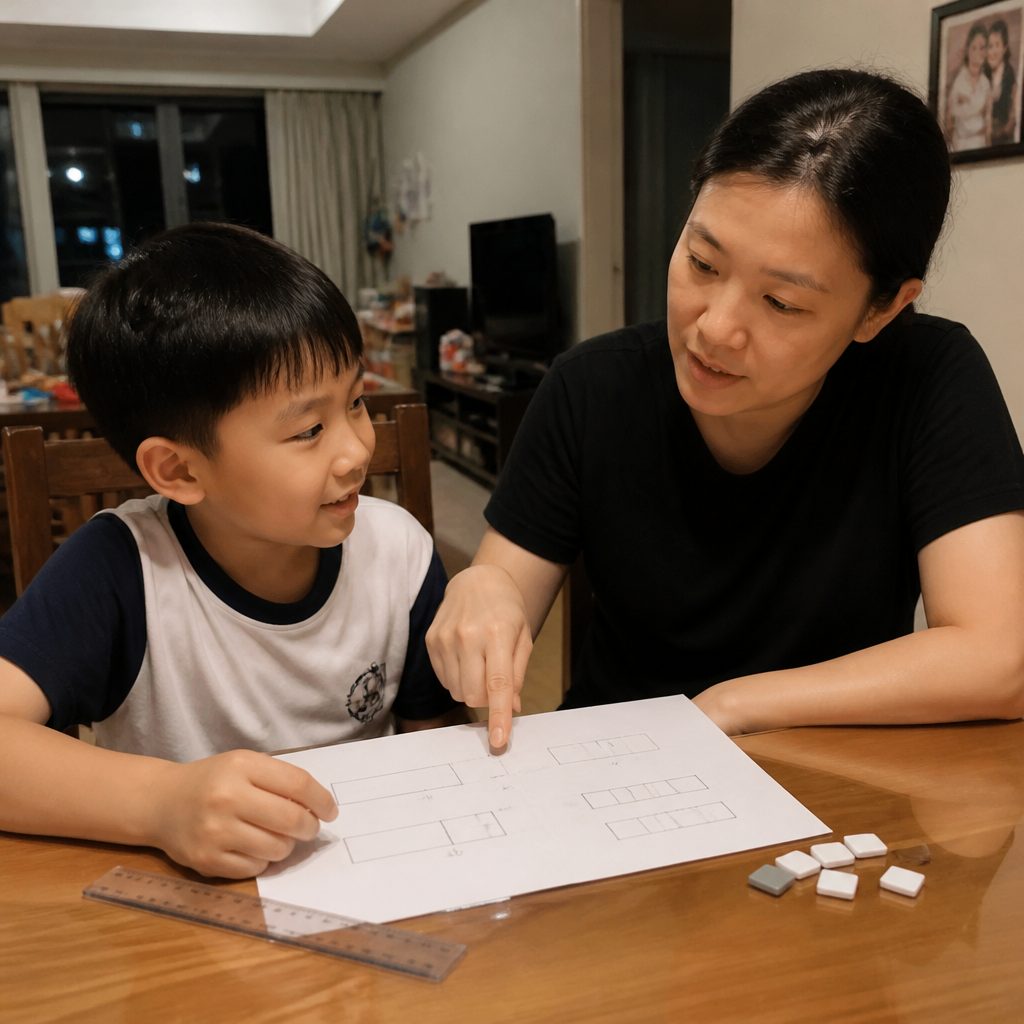
This guide follows the usual learning progression in Singapore primary mathematics, from rectangles and squares to composite figures and missing dimensions.
Key Takeaways
- Area is the space inside a shape. Think of covering a bedroom floor with tiles, because each tile fills part of the surface.
- Perimeter is the distance around a shape. Imagine walking once around the edge of a school garden or putting a border around a noticeboard.
- Units reveal the measurement needed. Perimeter uses units such as cm or m, while area uses square units such as cm² or m².
- A formula works only after the child identifies the shape correctly. A rectangle’s length and width must describe the whole rectangle, not just one part of a composite figure.
- Word problems reward careful reading before calculation. “Fence”, “border”, and “wire” usually point to perimeter, while “cover”, “carpet”, and “tiles” usually point to area.
- Drawing is a useful problem-solving strategy. A labelled sketch can prevent the common mistake of using the right formula for the wrong purpose.
See the Difference Before Reaching for a Formula
Picture the action, not just the numbers
The biggest challenge in primary school area and perimeter questions is often not calculation. It is conceptual confusion. A pupil may know that area involves multiplication, then multiply automatically whenever they see a rectangle, even when the question is asking for the length of wire needed around it.
Use familiar objects to make the difference visible. For an exercise book, run a finger around its outer edge. That is perimeter. Then place small sticky notes across the cover without overlapping. The covered surface represents area.
A useful question at home is: “Are we going around it, or covering it?” Pause there instead of giving the answer immediately. If a school garden needs a fence, they are going around it. If it needs grass turf, they are covering it.
Tutors often notice that children become more confident once the action is clear. The numbers may be the same, but the purpose changes everything.
Let the units guide the answer
Units offer a quick way to check whether the child has understood the question.
A 24 m fence goes around a garden, so metres are appropriate. A 24 m² tiled floor describes a surface being covered.
The small raised 2 in cm² matters. It means “square centimetres”, or the number of 1 cm by 1 cm squares that fit inside a region. Encourage your child to say the unit aloud before writing the answer. A pupil who writes “36 cm” for a floor area may have calculated correctly, but has not yet connected the number to what it represents.
Build Confidence with Rectangles and Squares
Understand why the formulas work
Formulas are useful shortcuts, but they make more sense after a child understands where they come from.
For a rectangle, perimeter adds the two matching lengths and two matching widths around the outside edge. Area counts the unit squares needed to fill the interior. For a square, all four sides are equal, while the same side length describes both the rows and columns of unit squares.
A rectangle measuring 8 cm by 5 cm has sides of 8, 5, 8, and 5 cm. Adding all four sides gives 26 cm. Its area is 40 cm² because five rows of eight unit squares fill the inside.
Parents sometimes encourage repeated formula memorisation before a school test. The intention is understandable, but memorisation alone can make children less flexible. When the rectangle is turned sideways, some pupils suddenly feel that the formula has changed. Drawing a quick grid or tracing the boundary can bring them back to the meaning behind the calculation.
Use familiar Singapore settings
Try this question: “A rectangular HDB study room is 4 m long and 3 m wide. What is its floor area?”
The child should notice that flooring covers the inside, then calculate 4 × 3 = 12 m².
Now change just one sentence: “What length of skirting is needed around the room?” The calculation becomes 4 + 3 + 4 + 3 = 14 m. The dimensions are identical, but the action has changed. That contrast is one of the quickest ways to strengthen a child’s understanding of area and perimeter.
Read Word Problems Like a Detective
Underline what needs to be measured
Area and perimeter word problems can feel difficult because the calculation is hidden inside a story. Children often rush towards the numbers before deciding what the question actually wants.
A simple reading routine can slow things down without making homework feel heavier.
Consider a school garden measuring 12 m by 7 m. If the school wants to spread fertiliser across the garden, find the area: 12 × 7 = 84 m². If the gardener needs netting around it, find the perimeter: 12 + 7 + 12 + 7 = 38 m.
Words can guide pupils, but keywords alone are not enough. “Length” does not automatically mean perimeter, and “rectangle” does not automatically mean area. The full context decides.
Identify information that matters
A question may state that a tiled floor uses 20 cm by 20 cm tiles. Some pupils calculate the floor’s perimeter simply because they see several measurements. Others try to use every number, even when one is not needed for the exact question.
Ask, “Which numbers answer this exact question?” It is gentler and more useful than saying, “You used the wrong formula.” A common pattern among students is trying to make every number fit. Over time, they need to learn that maths problem-solving involves selecting information, not using every number on the page.
Tackle Composite Shapes Step by Step
Split complex figures into simpler parts
Composite figures are shapes made from familiar rectangles or squares joined together. They can unsettle pupils because the formula is no longer written neatly at the top of the page. Yet the same area and perimeter concepts still apply.
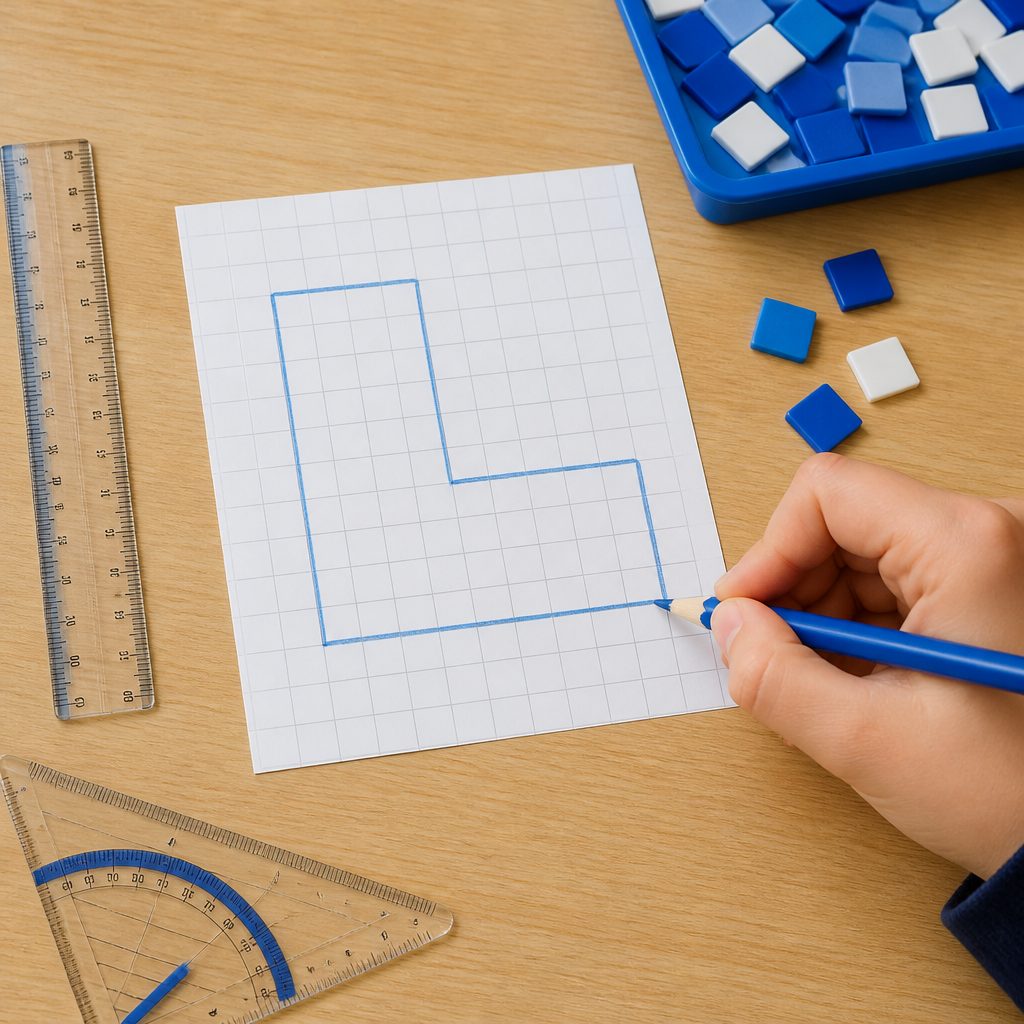
For area, divide an L-shaped floor plan into two rectangles. Calculate each area, then add them. If one section is 6 m by 4 m and an attached section is 2 m by 3 m, the total area is 24 m² + 6 m² = 30 m².
For perimeter, trace only the outside boundary. Internal joining lines must not be counted because they are not part of the outer edge. Tutors often notice this mistake: children add every line they can see, including the line dividing their two rectangles.
Find missing side lengths through reasoning
Missing dimensions test whether children understand matching lengths. In a stepped shape, a long horizontal side may equal the combined lengths of two shorter horizontal sections. Mark matching directions with the same colour or symbol on a sketch.
Suppose the entire top length is 10 cm, while two lower horizontal sections are 6 cm and an unknown length. The missing length is 4 cm. Only after filling in that side should the child calculate perimeter or area.
Rather than rushing to give the missing value, ask, “Which sides travel in the same direction?” and “How far must we move to return to the starting point?” These prompts develop reasoning, which matters more than getting one worksheet question right.
Practise Without Creating a Nightly Argument
Keep revision short and specific
When a child has already had a long school day and CCA, a full page of mixed questions can end in frustration. Ten focused minutes can work better than forty minutes of tired guessing.
For the first activity, ask whether “new carpet” requires area or whether “ribbon around a mat” requires perimeter, then let your child explain why. Estimation also helps wildly unreasonable answers stand out.
Avoid correcting every small presentation issue while your child is still thinking. Constant interruption can make a capable pupil wait for adult approval at every step. Check the reasoning first, then return to neatness and units.
Check whether the answer makes sense
A reliable answer has a story behind it. If a 3 m by 4 m room has an area of 7 m², your child can see that 3 × 4 cannot be 7. If a perimeter answer is smaller than one side of the rectangle, something is clearly wrong.
For composite shapes, have the child trace the outside boundary with a pencil after adding it. For area, lightly shade the regions being included. These simple habits reduce careless errors without creating another formula to memorise.
If your child remains stuck despite regular practice, a tutor can observe whether the difficulty lies in visualising the shape, calculating accurately, or interpreting language. Learn how our tutors can help your child build confidence in primary mathematics and area and perimeter problem-solving.
Frequently Asked Questions
Should my child memorise all area and perimeter formulas?
Yes, but only alongside understanding. When a child knows that area measures covering and perimeter measures edging, they can choose the correct formula even when a question is phrased differently.
Why does my child get area questions right but perimeter questions wrong?
Many pupils automatically multiply when they see a rectangle. Return to familiar contexts, such as carpeting versus fencing, and ask whether the question concerns the inside of the shape or its boundary.
How can I help without giving the answer when my child is stuck?
Ask guiding questions such as, “What is the shape?”, “What does the question want?”, and “Which sides are on the outside?” Let your child do the calculation after explaining their plan.
Are composite figures tested in Singapore primary mathematics?
Composite figures and missing dimensions develop spatial reasoning and application skills within primary mathematics. Check the latest MOE curriculum and subject syllabuses, the Primary Mathematics syllabus, and your child’s school requirements for current expectations.
Conclusion
To help your child master area and perimeter in primary school, begin with meaning before formulas. Help them picture whether they are covering a surface or travelling around an edge, label units carefully, and sketch unfamiliar shapes before calculating.
With short, regular practice using rooms, gardens, and tiled floors, maths word problems can feel less intimidating and more logical. For further support with Singapore primary mathematics, including patient guidance through area, perimeter, and problem-solving questions, explore Singapore Tuition Teachers.