


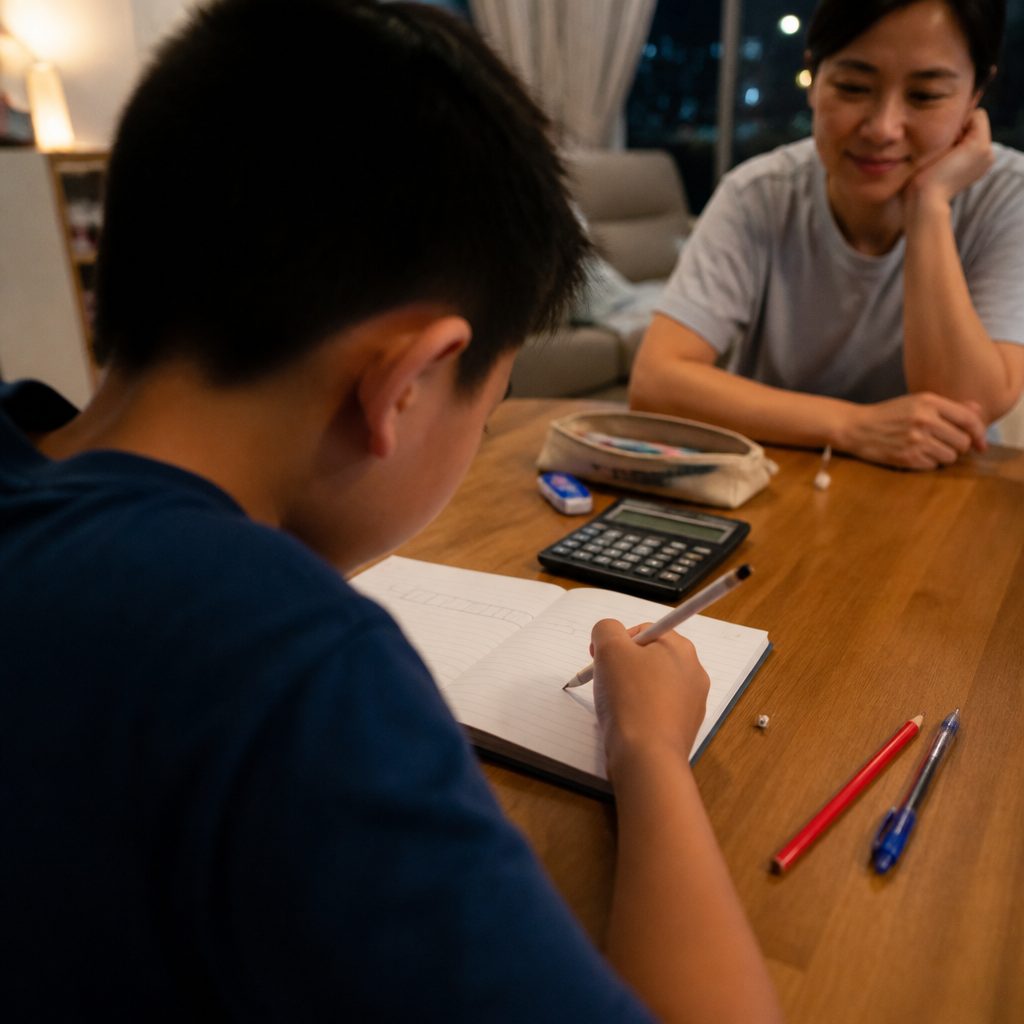
It is a familiar late-night scene for many Singapore parents: your child has had a full day of school, CCA and homework, then suddenly gets stuck on a percentage word problem. They may know that 25% of 80 is 20, but when a question involves discounts, repeated changes or an unknown original amount, the confidence disappears.
Mastering percentage in Primary 6 Maths is less about memorising formulas and more about understanding what each percentage refers to. For PSLE Maths, the key is to identify the correct whole, translate the story into a clear relationship and check whether the answer makes sense. With calm, focused practice, even multi-step percentage questions can feel far less intimidating.
Key Takeaways
- Find the whole before calculating. The most common percentage mistake is treating the wrong quantity as 100%. Encourage your child to state what the percentage is based on before they begin.
- Use simple models for word problems. A bar model or labelled sketch can show whether the question involves a part, remainder, increase, decrease or original amount.
- Read percentage changes carefully. A 20% discount and a 20% increase are not opposites unless both are calculated from the same starting amount.
- Work backwards when the final amount is given. In reverse percentage questions, first identify the percentage that remains before finding the original quantity.
- Check whether the answer is sensible. A discounted price should be lower than the original price, while an increased quantity should be higher.
- Practise regularly without panic. A few well-reviewed percentage questions each week are usually more useful than rushing through a large worksheet before an assessment.
Start by Finding What Represents 100%
Ask, “Percentage of what?”
Every percentage has a base quantity, and that quantity represents 100%. In a simple question such as “30% of 200 pupils wear spectacles”, the 200 pupils are clearly the whole group. In tougher Primary 6 Maths questions, though, the whole is often hidden in the wording.
Consider a shop that gives a 15% discount on a bag priced at $80. The discount is 15% of $80, not 15% of the discounted price. The original price is the base because that is the amount used to calculate the discount.
A helpful habit is to write:
Original price = 100% = $80
This can feel slow at first, especially for children who want to jump straight into multiplication. Yet tutors often notice that pupils who write down the relationship make fewer errors when a question becomes longer or less familiar.
Use the unitary method when numbers feel awkward
Some pupils remember that percentage means “divide by 100 and multiply”. That may work for routine questions, but the unitary method often makes the relationship clearer, especially when the original amount is unknown.
If 25% of a class is 10 pupils, the child can work from the known part back to the whole.
Instead of seeing a string of operations, your child can see the movement from a known part to the complete group. That matters when reverse percentage questions appear in PSLE Maths practice.
Make Multi-Step Word Problems Manageable
Separate each event
PSLE Maths percentage questions often test whether pupils can track a sequence accurately. A question may include a discount followed by GST, pupils leaving a group or several percentage changes. Trying to hold every step in their head can make a manageable question feel confusing.
A bicycle costs $240. It is sold at a 25% discount. The discounted price is then increased by 9% GST. Find the final price.
The important point is that the base changed. The 25% was calculated from $240, while the 9% GST was calculated from $180. A common pattern among students is getting both percentages correct but applying them to the same original amount.
Label every amount
Encourage your child to write labels such as “original price”, “after discount” and “final price”. A bare row of numbers can make it easy to lose track halfway through a question.
This is especially useful after a tiring weekday. A child may understand the method in class or tuition, then make avoidable mistakes at home because they are rushing. Clear labels reduce the memory load and make it easier to spot where an error happened.
Understand Increases, Decreases and Reverse Percentages
Equal percentage changes do not cancel out
A common misconception is that an increase of 20% followed by a decrease of 20% returns an amount to its original value. It does not, because the second calculation uses a different base.
The decrease is calculated from $120, not $100. This is why a child can obtain an unexpected answer even when their multiplication is correct.
Work backwards from the percentage remaining
Reverse percentages are challenging because children often see a final number and instinctively treat it as 100%. Instead, pause and ask what the final amount represents.
After a 20% discount, a shirt costs $48. Find its original price.
After a 20% discount, 80% remains. That means 80% is $48, 1% is $48 ÷ 80 = $0.60, and 100% is $0.60 × 100 = $60.
Many pupils add 20% of $48 and get $57.60. The calculation feels logical, but $48 is not the original 100%. It represents only 80% of the original price. This distinction sits at the heart of many percentage errors in Primary 6 Maths.
Use Bar Models to See the Relationship
Make the whole visible
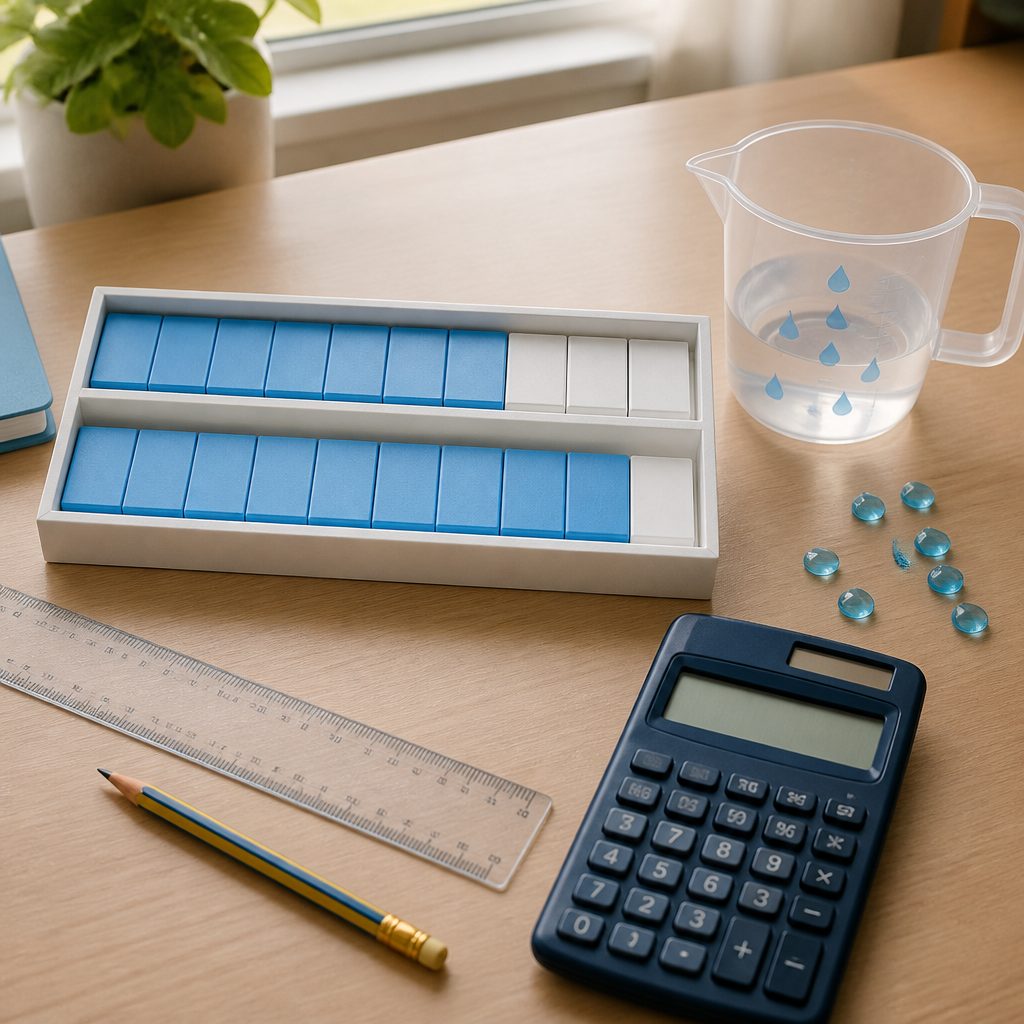
For questions involving an unknown original quantity, a bar model can make the relationship much easier to see. The drawing does not need to be neat. Its job is to show what the percentages mean.
A water tank was 70% full. After 120 litres of water were added, it became 90% full. What was the capacity of the tank?
The difference between 70% and 90% is 20%, and that 20% represents 120 litres. So 1% is 6 litres and 100% is 600 litres.
Without a model, some children try to calculate 70% of 120 or subtract 90 from 120. The bar model directs attention to the percentage change, which is exactly what the 120 litres represent.
Look for a difference when groups are compared
Not every question requires finding a percentage of the whole immediately. If 35% of pupils chose Art and 45% chose Music, while the difference is 20 pupils, the useful comparison is 10%.
Since 45% − 35% = 10%, 10% represents 20 pupils. Therefore, 100% represents 200 pupils. This type of percentage word problem tests reasoning rather than formula recall.
When your child gets stuck, a calm prompt such as “Which percentage does this number represent?” is often more helpful than asking which formula to use.
Avoid Common Percentage Mistakes
Match the operation to the story
A discount requires subtraction after finding the discount amount. An increase requires addition. It sounds obvious, but a tired pupil may calculate 15% correctly and still apply the wrong final operation.
Focus on understanding, not formula memorisation
Formula memorisation can make a child look quick in routine exercises, but it may backfire in unfamiliar problem sums. Some pupils repeatedly use “percentage = part ÷ whole × 100%” even when the question asks them to find a quantity.
For Primary 6 Maths revision, review incorrect questions instead of only marking them wrong. Ask your child what each number represented and where the base quantity changed. If they can explain the method in simple words, they are more likely to remember it in an exam.
Keep support calm and specific
It can be frustrating when your child has practised a topic but keeps making the same error. Repeating, “You have already learnt this,” often raises the pressure without showing them what to fix.
A narrower response works better: “You found 20% correctly. Let us check whether it is based on the original price or the sale price.” This recognises progress while addressing the exact gap. If percentage repeatedly causes tears or confusion, a tutor can help identify whether the difficulty lies in calculation fluency, reading comprehension or problem-solving structure. Learn more about our Primary 6 Maths tutors.
Build a Realistic Percentage Revision Routine
Use short sessions with a clear purpose
Percentage practice does not need to take up an entire evening. Three sessions of 20 to 30 minutes each week can be enough when every session has a clear focus.
For foundation work, include values such as 10%, 15%, 25%, 40% and 50%. When solving word problems, ask your child to explain the model and workings aloud. This reveals whether they understand the relationship or are simply copying a method.
The aim is not to complete the most questions. It is to become more reliable at deciding what each percentage means.
Balance challenge with confidence
A stack of difficult worksheets can make percentage feel impossible, while practising only easy sums can create false confidence. A useful mix is one familiar question, two standard questions and one challenging problem-solving question.
This is kinder during the busy months before PSLE, when school assessments, tuition schedules and CCA commitments can already feel overwhelming. If your child is stuck after a genuine attempt, guide them to draw a model or identify 100% rather than supplying the answer immediately.
For the current Primary Mathematics scope and assessment information, refer to the official MOE syllabus page and SEAB PSLE information. Examination requirements can change, so it is sensible to check the latest official guidance.
Frequently Asked Questions
Are percentage questions important for PSLE Maths?
Yes. Percentage is part of the wider problem-solving skills pupils need in Primary Mathematics. Questions may appear as direct calculations or longer word problems involving money, quantities, rates and comparison. Understanding the method is more useful than trying to predict one exact question type.
Why can my child do simple percentages but freeze during word problems?
Simple questions usually state the whole quantity clearly. Percentage word problems may require a child to infer what 100% represents, identify a remainder or difference and manage several steps. The struggle is often in interpreting the question, not a lack of effort.
Should my child draw bar models for every percentage question?
Not necessarily. For a direct calculation such as finding 10% of $50, a model may be unnecessary. Use a bar model when the whole is unknown, percentages are compared or the wording feels confusing. It is a thinking tool, not extra work to force into every solution.
How can I tell if my child’s percentage answer is reasonable?
Ask whether the final amount should be bigger or smaller than the original, then estimate roughly. A 10% discount on $200 should be about $20, so a final answer near $180 is sensible. An answer of $220 suggests that the operation may have been reversed.
Conclusion
To master percentage in Primary 6 Maths, focus on the meaning behind each number. Identify the 100% base, separate multi-step events, use a quick bar model when the relationship is unclear and check whether the final answer is sensible. These habits make percentage questions more manageable and build confidence for PSLE Maths problem-solving.
Progress does not require hours of pressured drilling. A steady routine, careful review of mistakes and patient guidance can help your child move from guessing methods to understanding why they work. For personalised support with percentage concepts, revision skills and confidence, explore our Primary 6 Maths tuition support.