


A spelling list can seem perfectly manageable on Monday, then somehow become a source of stress by Thursday night. There is homework to finish, a child who is tired after CCA, and a test waiting the next morning. When the same words keep going wrong, it is natural to wonder whether to push harder, while your child may quietly worry that they are “bad at spelling”.
Doing well in primary school spelling tests in Singapore is not about copying each word twenty times or cramming the entire list at the last minute. Strong spelling grows through noticing patterns, hearing sounds, understanding meanings, and revisiting words in short bursts through the week. With a calm routine, Singapore primary school pupils can build spelling confidence that lasts beyond Friday’s test.
Key Takeaways
- Build familiarity across the week. Ten focused minutes over several days is usually more effective than one tense hour before a spelling test because children get repeated chances to recall each word.
- Group words by patterns and meaning. Seeing raincoat, rainbow, and rainfall together teaches a useful pattern instead of making them feel like three separate words to memorise.
- Use more than copying. Look-cover-write-check, syllable clapping, and short dictation show whether a child can truly spell a word without depending on the list.
- Treat errors as clues. If beautiful becomes beutiful, your child may need help spotting the vowel pattern, not another full page of rewriting.
- Match practice to the child’s level. Lower primary pupils benefit from sound awareness and simple routines, while upper primary pupils need vocabulary, word roots, and accurate sentence use.
- Keep practice calm and specific. A short, predictable session after a snack is often more productive than a frustrated quiz at 10pm after a long school day or CCA.
What Spelling Tests Actually Check
A primary school spelling test may look like a simple weekly quiz, but several skills are working together. Your child needs to hear the sounds in a word, remember its letter pattern, tell similar-looking words apart, and sometimes understand the word well enough to use it correctly in a sentence.
In English lessons, spelling supports reading, writing, grammar, and comprehension. The Ministry of Education’s English Language programme focuses on meaningful language use rather than isolated memorisation. Parents can explore the broader approach at MOE’s English Language and Literature programme.
In practical terms, a child who knows that cautious describes someone careful has a stronger memory hook than one who has simply copied the letters. Tutors often notice the same pattern: a pupil may score full marks after intense last-minute drilling, then misspell those very words in composition the following week.
The test score matters, but it should not be the only target. The bigger goal is for spelling to stay available when your child is writing independently.
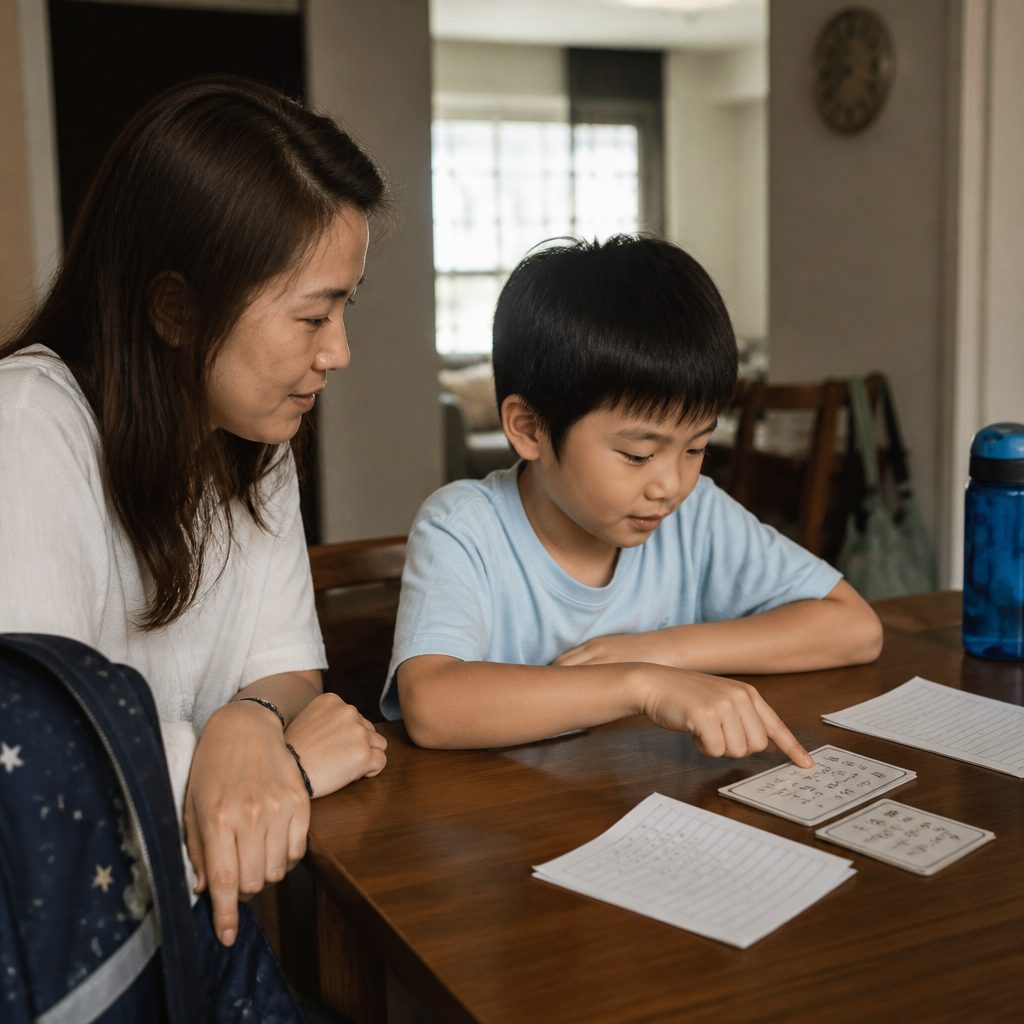
Identify the Type of Mistake
Rather than correcting every worksheet in the same way, keep a small “tricky words” list. A common pattern among students is that repeated mistakes usually fall into a few recognisable types.
This is one of the most useful spelling strategies for children because it turns a “careless” error into a clear next step.
Build a Weekly Spelling Routine That Works
Start the Week by Sorting and Understanding Words
Start when the spelling list comes home. Instead of asking your child to write every word repeatedly, read the list together and group related words. Happiness, carelessness, and kindness can be grouped by the ending -ness. Preview, preheat, and preschool can be grouped by the prefix pre-.
For unfamiliar vocabulary, ask one quick meaning question. “What might you preview before a movie?” A word becomes easier to remember when it has a picture, situation, or sentence attached to it.
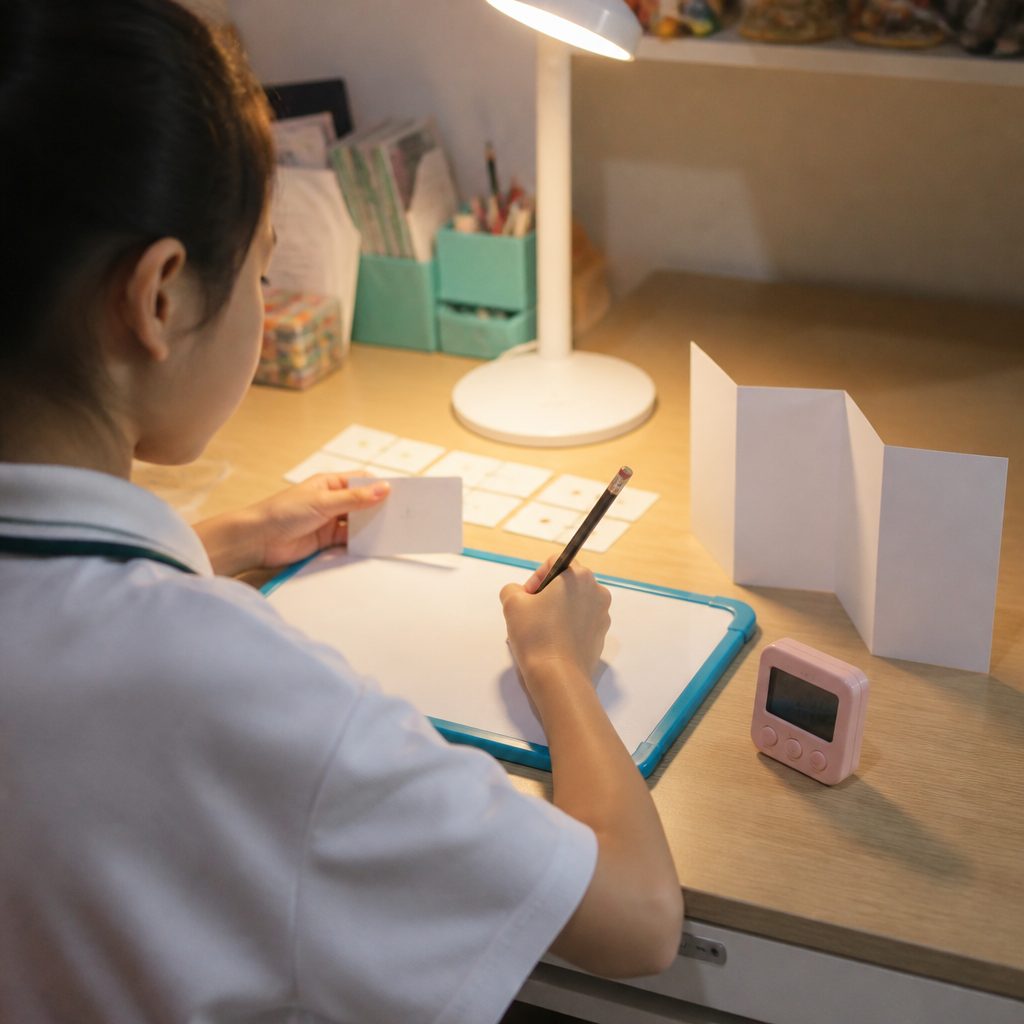
For five to ten minutes, guide your child through look-cover-write-check.
If separate becomes seperate, circle the a in the middle. Use a memory cue only if it genuinely helps your child remember, rather than adding another thing they must memorise.
Use Retrieval Practice in the Middle of the Week
Midweek practice works best as a short recall game. Dictate three to five words in mixed order, then use two in spoken sentences. After your child writes disappear, you might ask, “What might disappear from a table after dinner?”
This connects spelling to meaning and everyday use. Space the revision too. A word recalled on Tuesday should return on Thursday, rather than disappearing from the routine once it has been written correctly once.
If Wednesday is packed with tuition or CCA, practise while travelling home or before dinner. Five words accurately tested are more valuable than fifteen words copied while exhausted.
A calm prompt such as, “Show me the part you are unsure about,” invites thinking. “You revised this already,” can make a child hide uncertainty instead.
Keep Friday Morning Light
Test morning is rarely the right time for a panic session. Review only the tricky words and one example sentence for each pattern. A child who has slept properly and feels steady often recalls more than one who was drilled late into the night.
Use Sounds, Syllables, and Word Patterns
Phonics Still Matters Beyond the Early Years
For lower primary children, phonics can be the missing bridge between hearing a word and writing it. When a child writes choclate for chocolate, slow it down: cho-co-late. The point is not to lecture about every rule. It is to help them hear that each sound part needs a written home.
Some English words are not fully predictable from sound alone. Because, people, and could need visual memory as well as sound awareness. That is normal. “English has patterns, and some words have tricky parts we learn by noticing,” is kinder and more accurate than calling a word easy.
Break Longer Words into Manageable Parts
Upper primary pupils increasingly meet longer vocabulary in reading passages, science topics, and composition work. Environment can be split into en-vi-ron-ment. A pupil may remember developed by noticing develop + ed, instead of treating it as nine unrelated letters.
These spelling tips are especially useful for words from school texts. After reading a passage on conservation, pick out recycle, pollution, and protect. Discuss their meanings, then use each in a sentence. Revision feels more relevant when it reflects how vocabulary appears in class.
Notice Word Families
Word families reduce memory load. Once a pupil knows care, connect it to careful, carefully, and careless. The spelling changes have meaning: -ful means full of, while -less means without.
A child who sees these relationships becomes less dependent on rote memorisation. That is a useful shift, especially when spelling lists become longer and less familiar.
Adjust Practice for Your Child’s Level
Lower Primary: Make the Routine Short and Visible
Primary 1 to Primary 3 pupils often need an adult nearby while learning how sounds map to letters. Use a mini whiteboard, magnetic letters, or folded paper for look-cover-write-check. Keep sessions brief enough that your child still ends feeling successful.
If a Primary 2 child keeps writing friend as freind, avoid demanding ten rewrites. Highlight the unusual vowel order, say the word in a sentence about a classmate, and revisit it on three separate days. Repeated retrieval builds memory without turning practice into punishment.
Upper Primary: Move From Lists to Independent Writing
Primary 4 to Primary 6 pupils need more responsibility, but “go and revise your spelling” is often too vague. Ask them to mark their own tricky letters, create one meaningful sentence, and test themselves after a delay.
At this stage, pupils may memorise model answers for composition yet lose marks through spellings such as definitely, embarrassed, or necessary. Encourage a personal bank of words they genuinely use in writing. Learning ten useful descriptive words well is more valuable than cramming twenty words that never appear again.
If spelling is repeatedly affecting composition confidence, patient one-to-one guidance can help uncover whether the issue is weak phonics, limited vocabulary, or rushed proofreading. Learn more about personalised support from primary English tutors in Singapore.
Avoid Habits That Make Spelling Harder
Last-Minute Cramming Creates False Confidence
A child may copy responsibility flawlessly five times at 9pm, then misspell it the next day because copying lets the eyes do most of the work. Retrieval is harder, but it is the useful kind of hard. Covering the word and writing it from memory shows what your child actually knows.
Do not mistake a full page of handwriting for effective revision. Ask for one closed-book attempt after each short practice block. The result gives both parent and child honest information without shame.
Too Much Correction Can Make Children Freeze
It can be painful to watch your child make what feels like the same error again. Yet correcting every letter immediately can make spelling feel like a trap. Let them finish the word, then ask, “Does any part look unfamiliar?”
This builds self-checking, which they will need during tests. Use neutral language such as, “This word needs another look,” rather than, “You are careless.” Many pupils who appear careless are actually rushing because they are anxious, tired, or unsure where to begin.
Practise Spelling in Real Writing
A weekly list should not live only in a notebook. During a short journal entry or composition plan, challenge your child to use two current spelling words correctly.
A pupil learning whispered and suddenly could write: “Suddenly, the lights went out, and Amir whispered to his friend.” The words now carry a story, not merely a test score.
Frequently Asked Questions
How long should spelling practice take each day when my child is already tired from school or CCA?
For most primary pupils, 10 to 15 focused minutes is enough. A shorter session is often better when your child is tired from schoolwork or CCA. Add a quick review on another day rather than stretching one exhausted session.
My child gets full marks but still misspells words in composition. What should we do?
Include sentence writing and delayed dictation. Test a word again several days later, then ask your child to use it naturally in a short paragraph. This helps move learning from short-term memorisation to usable spelling.
Should I test every word on the list nightly if my child keeps forgetting them?
Not necessarily. Rotate the words and spend more time on the ones your child missed. Testing every word every night can feel repetitive and may leave less time to correct the patterns behind the errors.
Can the Student Learning Space help with English spelling practice?
It can support English learning through school-assigned materials and activities. Use Student Learning Space alongside active spelling practice such as saying, writing, and checking words.
Steady Practice Makes Spelling Less Stressful
Helping a child improve spelling is less about having a perfect memory and more about building a repeatable habit: understand the word, notice its pattern, recall it without looking, and revisit it later. This turns weekly spelling lists from a source of tension into manageable practice.
Keep sessions short, make mistakes useful, and celebrate progress, even if it is simply remembering one previously troublesome word. With patient spelling test practice, Singapore primary school pupils can build the accuracy and confidence they need for tests, compositions, and everyday English.