


It can be frustrating when your child understands a topic during lessons yet loses marks because one item goes into the wrong section, an adjustment is missed, or the final figures do not balance. In POA Financial Statements, small errors can affect several totals. After a full school day, CCA, and homework from other subjects, it is easy to rush the final part of a question.
For Principles of Accounts students in Singapore, these details often separate a nearly correct answer from a high-scoring one. The aim is not to memorise a perfect model answer. It is to understand what each figure represents, present it clearly, and check the work calmly under exam conditions.
Key Takeaways
- Classify before writing. Decide whether an item is income, expense, asset, liability, or equity before placing it in a financial statement. One wrong classification can affect several totals.
- Treat adjustments as two-part entries. An adjustment often affects both the income statement and statement of financial position. Accrued electricity, for example, is an expense for the period and a current liability at year-end.
- Use accurate labels and layout. Clear headings such as “Revenue”, “Cost of sales”, and “Non-current assets” show the examiner what the figures mean.
- Carry figures forward carefully. A correct calculation can still lose marks if the wrong amount is copied into the next section. Mark the final working figure before transferring it.
- Balance with logic, not guesswork. If total assets do not equal total equity and liabilities, trace classifications and adjustments first. Do not change a figure simply to force agreement.
- Leave visible workings. A short calculation beside an adjustment can support method marks and make errors easier to spot.
Set Up Your Answer Before Writing
Many common POA mistakes happen before the first number enters the answer booklet. A question may provide a trial balance, several adjustments, and an instruction to prepare an income statement and statement of financial position. The urge to start immediately is understandable, but a one-minute scan can save several marks.
Know What Each Financial Statement Shows
The income statement shows the business’s performance for a period. Depending on the question, it may include revenue, cost of sales, other income, expenses, and profit or loss for the year.
The statement of financial position shows the business’s position at a particular date. It includes assets, liabilities, and equity. Keeping this distinction clear prevents students from treating the second statement as simply another income statement.
Students may recognise an item but overlook how its wording changes the accounting treatment. Insurance expense belongs in the income statement, while prepaid insurance is a current asset because it represents a future benefit.
Before writing, lightly mark important wording in the question:
- “For the year ended” signals the income statement, so figures must relate to that accounting period.
- “As at” signals the statement of financial position, which records balances at a specific date.
- “Accrued”, “prepaid”, “closing inventory”, and “depreciation” signal adjustments that require careful treatment.
Make a Quick Classification Plan
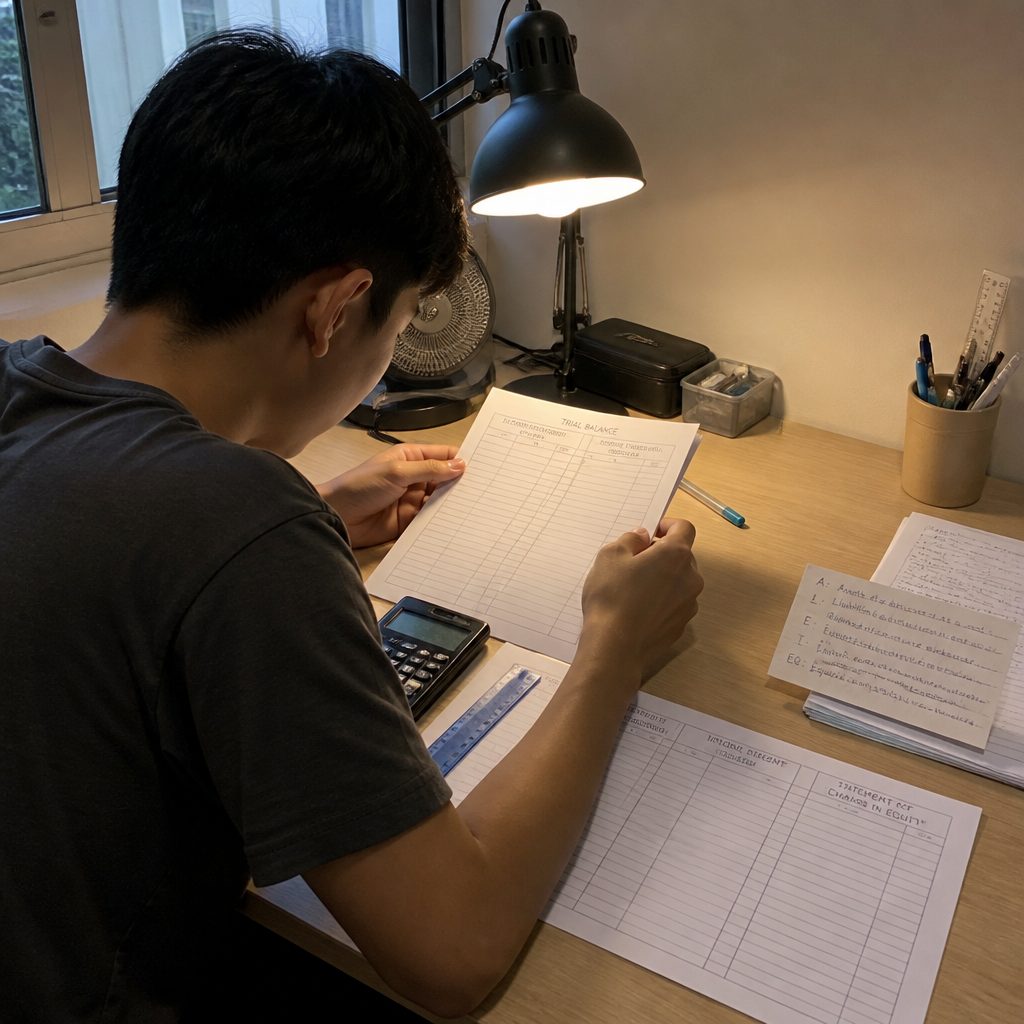
A small margin note is often more reliable than trying to hold every detail in memory. Write A for asset, L for liability, E for expense, I for income, and EQ for equity beside unfamiliar figures.
For instance, a $600 electricity bill owing at year-end is not an asset simply because it has not been paid. It is an accrued expense. The $600 increases electricity expense in the income statement and appears as a current liability in the statement of financial position.
Students who understand the topic can still lose marks because they rush this classification step. Taking a little more care here usually allows them to write faster and with greater confidence later.
Avoid Income Statement Errors
Income statement errors often happen when operating costs, cost-of-sales items, and adjustments become mixed up. A student may correctly recognise that an amount is an expense yet place it under the wrong heading. Presentation matters because it demonstrates the accounting treatment clearly.
Keep Cost of Sales Separate From Expenses
Cost of sales relates directly to goods bought for resale. Opening inventory, net purchases, carriage inwards, and closing inventory are commonly used to calculate it. Rent, salaries, advertising, and electricity are expenses, not part of cost of sales.
Cost of sales is $4,000 + $18,000 + $500 − $3,500 = $19,000.
One frequent error is placing carriage inwards under delivery expenses. Carriage inwards is the cost of bringing goods into the business, so it belongs in the cost-of-sales calculation. Delivery expenses are generally incurred when sending goods to customers and are treated as an expense.
Match Expenses to the Correct Period
Adjustments test whether students can match income and expenses to the correct accounting period. Suppose rent paid is $12,000, but $1,000 relates to the next financial year. The income statement should show rent expense of $11,000, while prepaid rent of $1,000 becomes a current asset.
The reverse applies to accrued expenses. If salaries paid were $24,000 and $800 remains unpaid, salaries expense is $24,800, with accrued salaries shown as a current liability.
Rather than mechanically memorising “add accrued, subtract prepaid”, pause and ask: “What expense belongs to this year?” That question remains useful even when the wording changes.
Get the Statement of Financial Position Right
The statement of financial position is where one incorrect classification can create a chain reaction. It may even look balanced if another accidental error offsets it, so a balanced answer is not proof that every treatment is correct.
Separate Assets, Expenses, and Drawings
Assets bring future economic benefits to the business. Expenses are costs used up during the period. Drawings are resources taken by the owner for personal use and reduce equity.
Missing the $300 inventory adjustment can overstate both profit and assets. Similarly, buying equipment may feel like a large business cost, but its benefit extends beyond the current period. That is why the equipment is treated as a non-current asset.
Record Both Effects of Every Adjustment
Students sometimes complete the income statement adjustment but forget its second effect in the statement of financial position. They may know the rule yet apply only half of it under time pressure.
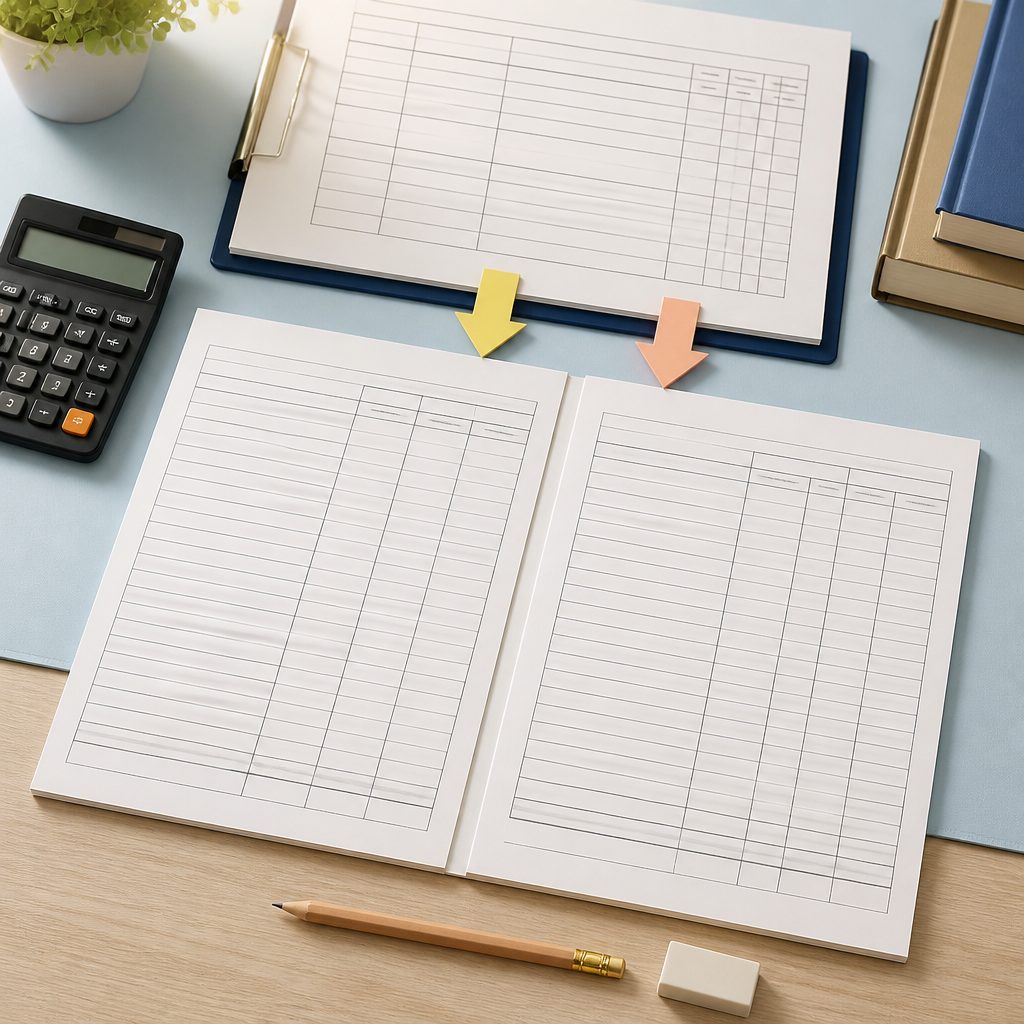
Take depreciation on equipment. If equipment cost is $10,000 and depreciation for the year is $1,000:
- Record depreciation expense of $1,000 in the income statement because the asset has been used during the year.
- Reduce the carrying amount of equipment by $1,000 in the statement of financial position, following the required format.
If a question provides accumulated depreciation, do not subtract it twice. Read carefully whether the figure is for the beginning or end of the year, and show the working. The wording determines whether the amount given is an existing balance or the current year’s depreciation charge.
Stay Accurate Under Exam Conditions
Knowing the accounting rules is only half the task. In a timed paper, capable students can still make errors when they repeatedly erase, copy figures between columns, or begin writing before understanding the adjustments. A practical checking routine keeps the work steady.
Use a Three-Pass Checking Routine
Place a small tick beside each adjustment only after both effects have been recorded. Tick closing inventory, for example, only once it has reduced cost of sales and appeared as a current asset. This prevents an adjustment from being remembered in one statement but forgotten in the other.
Trace Figures Instead of Forcing a Balance
Suppose total assets are $31,200 while equity and liabilities total $30,200. Do not change capital by $1,000 simply to make the totals agree. Start by tracing likely causes:
- Check whether prepaid insurance was included as a current asset after reducing insurance expense.
- Confirm that every accrued expense was added to expenses and recorded as a current liability.
- Ensure the correct net profit or loss was transferred into capital.
- Verify that drawings were deducted from capital.
- Recheck the closing inventory figure and where it was used.
Visible workings are valuable here. A $1,200 depreciation calculation or a $500 prepaid-expense note can reveal the issue much faster than rereading the entire question.
Turn Corrections Into Better Revision
Repeatedly completing full financial-statement questions without reviewing errors can create the illusion of revision. A student may become quicker at writing headings while continuing to confuse assets and expenses. Targeted correction is more effective.
Keep a Small Error Record
After each practice question, write down the exact type of error. “Careless mistake” is too vague to fix. A note such as “forgot prepaid insurance is a current asset” or “placed carriage inwards under expenses” gives the student something specific to revisit.
Before the next practice, read that short list. If a student commonly carries the wrong figure forward, pause after each subtotal and identify the figure that will be transferred. It may feel slow initially, but it builds exam reliability.

Practise What the Question Actually Tests
Financial-statement questions typically test classification, calculations, adjustments, formatting, and accuracy together. That is why memorising a completed answer can backfire. Once one label or adjustment changes, the memorised sequence no longer helps.
Instead, cover the final answer and explain each line aloud: “Closing inventory reduces cost of sales because those goods were not sold.” If the explanation is unclear, revisit that concept before attempting another full question.
Assessment details and syllabus requirements can change, so check the latest Singapore Examinations and Assessment Board information and relevant MOE secondary education information when planning revision.
Frequently Asked Questions
Why do my POA financial statements balance but still lose marks?
A balanced statement only proves that the totals agree mathematically. An item may still be classified wrongly, labelled inaccurately, or adjusted incorrectly in a way that another error offsets. Check the treatment of each item, not just the final totals.
Should I memorise the income statement format for POA exams?
Learn the structure, but understand what belongs in each section. Memorisation helps students set out headings quickly, while understanding prevents carriage inwards, delivery expenses, and adjustments from being placed incorrectly.
What should I do if I cannot find the error during a POA exam?
Do not panic or rewrite everything immediately. Check adjustments first, then transferred subtotals, followed by capital and drawings. These are more likely causes of statement of financial position errors than random arithmetic.
Do I need to show workings for POA adjustments?
Yes, where space and question requirements allow. Clear workings support the final figure, may earn method marks, and make checking easier. For example, show “$12,000 − $1,000 prepaid = $11,000” beside rent expense.
Conclusion
Avoiding common POA financial statement mistakes is less about being naturally fast and more about being systematic. Classify each item before placing it, record both effects of adjustments, use precise labels, and trace differences instead of forcing a balance.
When financial statements become a calm checking exercise rather than a last-minute rush, errors become easier to catch. Practise this routine consistently, review specific mistakes, and build confidence one well-checked question at a time.