


For many Singapore families, Chinese composition practice can become the most stressful part of the week. It is 9.30pm, your child has copied several 好词好句 into a notebook, yet still stares at the paper and says, “妈妈,我不知道要写什么.”
Usually, the issue is not simply vocabulary, effort, or a lack of ideas. A strong Primary Chinese composition comes from turning pictures and familiar situations into one clear, believable story, then expressing it in suitable language.
For 小学华文作文, markers look beyond impressive idioms. They notice whether the story follows the pictures, develops a sensible problem, shows feelings, and avoids careless errors.
Key Takeaways
- Start with the pictures, not fancy phrases. Identify who is involved, where the story happens, what goes wrong, and how the events connect.
- Keep one focused storyline. A simple story about returning a lost wallet can be stronger than several unrelated incidents squeezed into one composition.
- Open with action or a clear setting. Bring readers into a busy school canteen, a rainy HDB void deck, or a rushed morning before class.
- Show feelings through reactions. “我的手心冒汗,心跳得很快” creates a clearer picture than repeatedly writing “我很害怕.”
- Use vocabulary naturally. One accurate idiom, such as “手忙脚乱,” is more effective than several memorised phrases used in the wrong context.
- Leave time to check meaning and errors. Missing characters, incorrect punctuation, and changing a character’s name can weaken an otherwise thoughtful essay.
Understand What Examiners Look For
The composition task is testing more than description
In Singapore Chinese composition writing, pupils commonly work from a set of pictures and create a coherent narrative around them. At upper-primary and PSLE level, the task is not simply to describe each picture in order. Children need to work out what happened before, during, and after the illustrated moments.
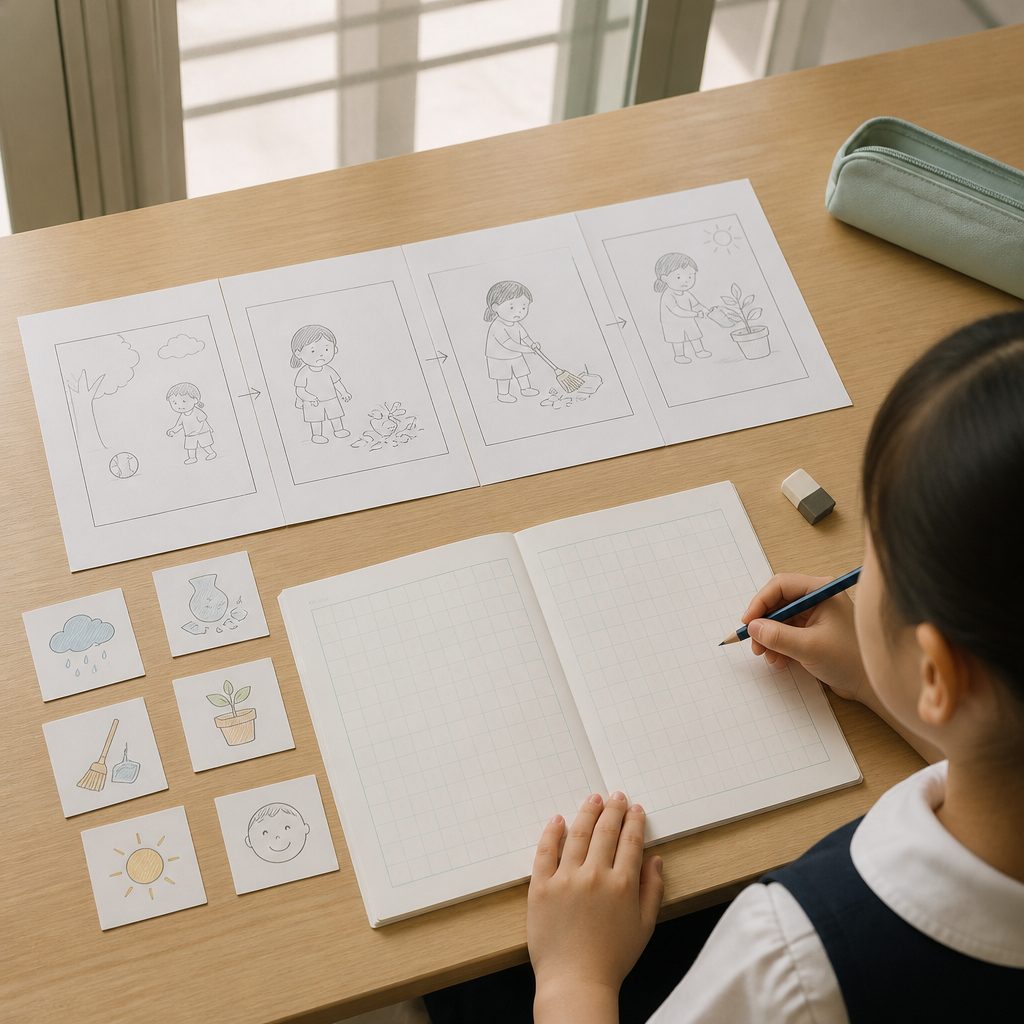
A composition may contain beautiful phrases but still feel weak if the plot does not make sense. Pupils sometimes rush to use vocabulary they have memorised and lose sight of the actual story.
If a child slips near a wet floor, for example, that moment should matter to the plot. A pupil rushing because he is late for CCA may fail to notice a “地上湿滑” sign. This creates a natural connection between the cause, problem, and outcome.
The primary Mother Tongue Languages curriculum emphasises clear, appropriate communication across listening, speaking, reading, and writing. Parents should refer to the latest information from the Ministry of Education and SEAB, as assessment requirements may change.
Why hard-working pupils still struggle
Some pupils have thick vocabulary books but still produce flat stories. Under timed conditions, they may try to recall every “good phrase” first and then force those phrases into the plot.
A simple canteen spill suddenly becomes “惊天动地,” even though the phrase does not suit the situation. Plot comes first, language comes next. A modest story with believable actions and accurate words gives a child firmer ground than a dramatic story they cannot control.
Plan a Clear Story From the Pictures
Prepare the plot before the first sentence
Picture composition planning does not need to take fifteen minutes. A few notes beside the question can prevent a pupil from reaching the final picture without a suitable ending.
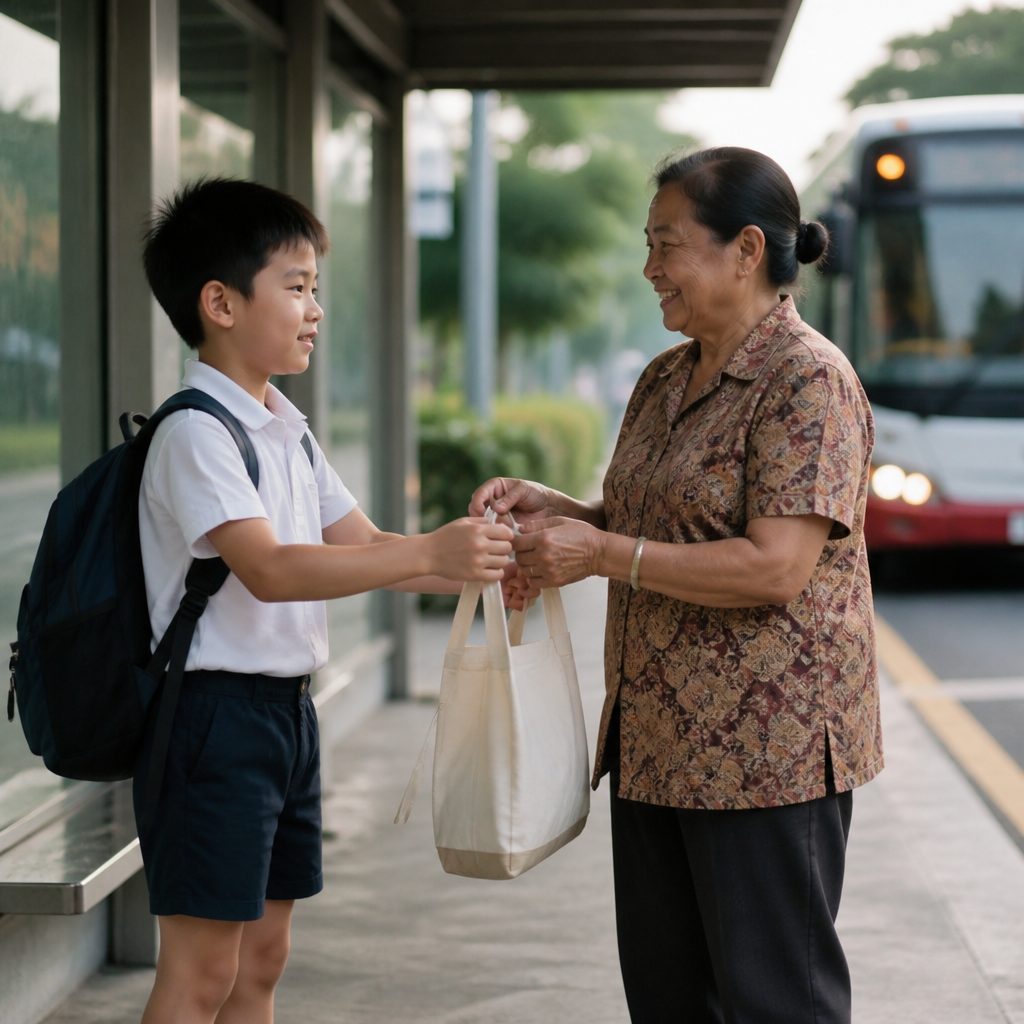
Imagine pictures showing a boy at a bus stop, an elderly person dropping a bag, and the boy returning it. A focused plot could be simple: after school, the boy notices an elderly commuter leave a bag on the bench, runs after her, and returns it before her bus departs.
That is enough. There is no need to add a thunderstorm, police station, and lost dog. Extra events often blur the main point rather than improve the composition.
Add details only when they support the story
Pictures are prompts, not handcuffs. Pupils may add sensible details, but each one should make the main event clearer or more meaningful.
放学后,小明赶着到图书馆还书。他在巴士站等车时,看见一位阿姨匆匆离开,长椅上却留下了一个手提袋。
The library detail explains why Xiaoming is at the bus stop and gives him a reason to notice the bag.
For lower-primary children, ask them to tell the story aloud from the pictures first. For upper-primary pupils, ask, “Which picture is the turning point?” The answer should guide the longest and most detailed scene.
Create an Engaging and Believable Plot
Begin close to the action
Many pupils begin with “今天是星期天,天气晴朗,万里无云.” This is not wrong, but it can use precious time without creating interest. Compare these openings:
一天,小丽去学校。
上课铃快响了,小丽抱着作业本,气喘吁吁地跑向课室。
The second opening makes readers wonder why she is rushing. It also creates a natural path to conflict: perhaps she bumps into someone or notices a classmate’s work scattered across the floor.
Build tension without becoming unrealistic
A high-scoring composition needs tension, but it does not require a huge disaster. Everyday Singapore situations can be effective: a child sees someone being teased during recess, discovers litter after a class gathering, or notices that a younger pupil has lost sight of a parent at a community event.
The key is cause and effect. If a classmate falls, show what happened before the fall, what the narrator does, and what changes afterwards. Dialogue can make the moment more immediate.
“你还好吗?别乱动,我去找老师!”我一边安慰他,一边快步跑向办公室。
Avoid turning every ending into a lecture. “我明白了要乐于助人” becomes more meaningful when the lesson grows naturally from the character’s actions.
End with resolution and reflection
Some children spend too long on the opening and finish with “后来老师来了,事情解决了,我很开心.” A fuller ending shows both the outcome and the character’s response.
看着他安心地笑了,我心里的大石头终于放下了。这件事让我明白,在别人需要帮助时,及时伸出援手并不难。
This reflection works because it is connected directly to the event rather than added as a generic moral.
Use Better Chinese Vocabulary Naturally
Choose words that fit the moment
Limited vocabulary worries many parents, especially when classmates seem to know endless lists of 成语. Yet accurate, familiar language is more useful than ambitious language used incorrectly.
A child writing about a noisy canteen could use “人声鼎沸” if they understand it, but “热闹非凡” may be easier to use accurately. One or two suitable expressions in each key scene are enough.
Overloading every sentence with idioms can make writing stiff and increase the risk of errors. Vocabulary should support the story, not take it over.
Turn feelings into visible scenes
Instead of “我很后悔,” help a child show what regret looked like.
我低下头,不敢望着妈妈失望的眼神,脸颊也热得发烫。
Actions, facial expressions, thoughts, and dialogue reveal emotion more clearly than repeatedly naming it. During practice, asking “What did his hands do when he was scared?” may prompt more useful detail than correcting the entire sentence for the child.
Practise at the Right Level and Edit Carefully
Match practice to your child’s stage
Lower-primary pupils benefit from building complete sentences, sequencing events, and using connectors such as “首先,” “后来,” and “最后.” A clear beginning, middle, and ending matters more than elegant phrases.
Upper-primary pupils need greater control over conflict, thoughts, dialogue, sentence length, and resolution. This matters for PSLE Chinese composition, where rushed writing may produce a complete but emotionally thin story.
Practice should also fit family life. After a long school day, CCA, and homework, forcing a full essay at 10pm can end in frustration. A child could plan one picture set on a weekday, write the key scene on another day, and complete and revise the composition over the weekend.
Use a final proofreading checklist
Before handing in a composition, pupils should pause for a short check.
- Have I included every important picture? Trace the story against the visuals.
- Does my character have one name throughout? A pupil may begin with “阿明” and accidentally switch to “小明.”
- Do my sentences make sense aloud? Reading aloud can reveal errors such as “我把钱包还给他,她很开心.”
- Have I checked commonly confused characters? Focus on words the child often gets wrong, such as “已经” and “应该.”
- Does the ending solve the main problem? If the conflict concerns a lost wallet, show whether it was returned.
Avoid Common Composition Mistakes
Using a model answer that does not match the pictures
Memorised essays may feel safe, but a story about helping an elderly man cross the road will not suit pictures of a broken classroom window. Use model compositions as language banks, not scripts. A child can borrow a flexible phrase such as “我犹豫了一会儿” and apply it to the actual situation.
Adding irrelevant drama
A story loses focus when every paragraph introduces a new event. If a playground-cleaning story includes being late, quarrelling with a sibling, getting caught in rain, and losing a bag, the central event becomes blurred.
Ask, “If I remove this sentence, does the story still make sense?” If it does not develop the character, explain the problem, or move the action forward, it may be unnecessary.
Over-correcting at home
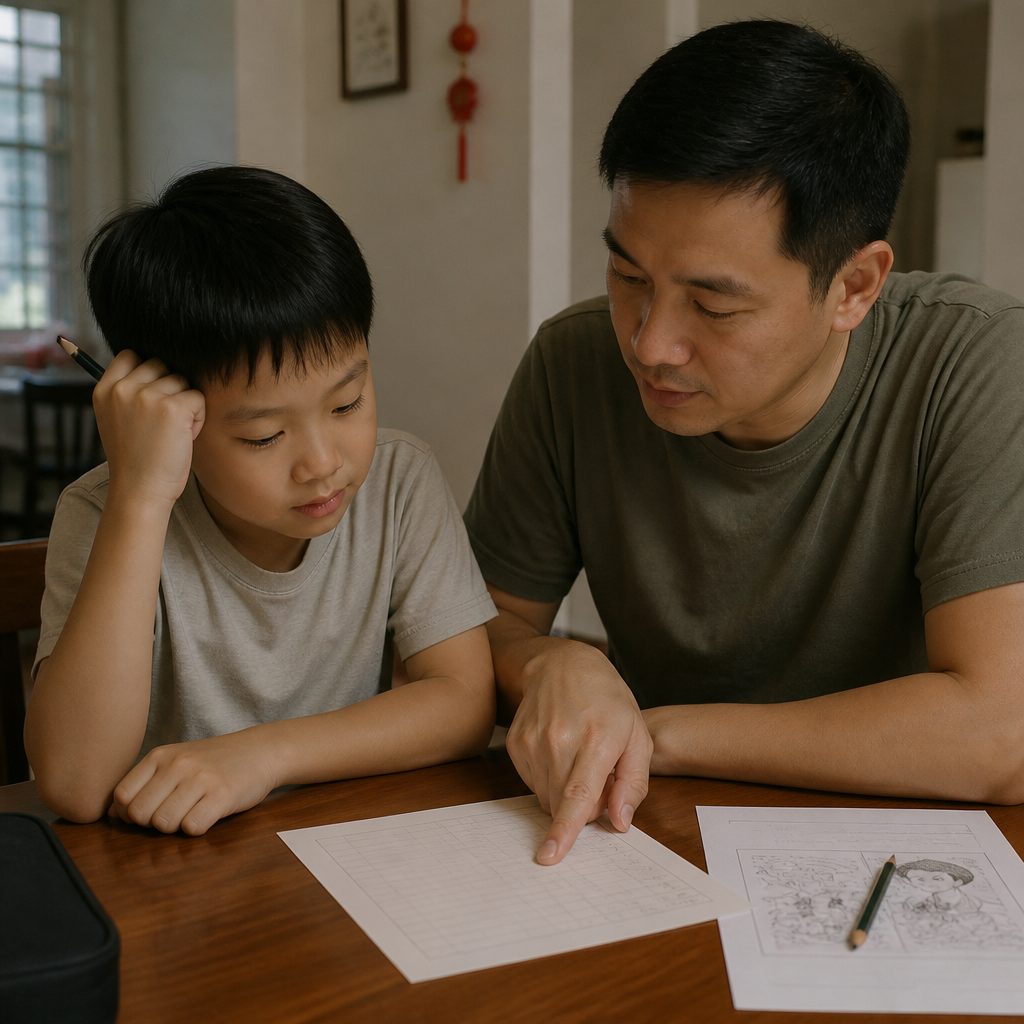
Parents naturally want to help when they see repeated errors. Yet rewriting an entire essay can create a polished practice piece that the child cannot reproduce independently in school.
Choose one focus each time—perhaps a stronger opening today and punctuation next time. Small, repeated improvements are more likely to carry into exam conditions.
Frequently Asked Questions
How many idioms should my child use?
There is no useful target number. A few expressions that fit the scene are better than numerous forced idioms. Your child should understand and be able to explain every phrase used.
What if my child has ideas but cannot express them in Chinese?
Let the child explain the plot orally in simple Chinese first. Then identify the essential words needed for the main event. A short vocabulary list based on the child’s own story is usually easier to remember than a long, unrelated guidebook list.
Should pupils memorise model compositions?
Memorising full essays can backfire when the examination pictures differ. It is more useful to study how a model introduces the setting, develops conflict, uses dialogue, and resolves the problem, then apply those techniques to new picture sets.
How often should a child practise?
Quality matters more than producing many rushed essays. One carefully reviewed composition each week, supported by short planning or vocabulary exercises, can be more useful than several uncorrected pieces.
Build Confidence One Story at a Time
A high-scoring Primary Chinese composition begins with a clear picture-based plan, a focused plot, believable feelings, and careful editing. Fancy vocabulary has its place, but it should strengthen the story rather than control it.
When children learn to identify the key event, describe it vividly, and correct recurring mistakes, 小学华文作文 becomes less of a guessing game. Families seeking personalised help with planning, language errors, and sustainable revision routines can learn more about Primary Chinese tutors.