


It is a familiar weeknight scene for many Singapore parents. Your child has notes open, key terms highlighted and formulas copied out, yet when you ask why ethanol and ethene behave differently, the answer still does not come easily.
Organic chemistry can feel like a wall of names, formulae and reaction conditions, especially when schoolwork, CCA and preliminary-exam pressure are already piling up. The issue is rarely effort. More often, students memorise separate reactions without seeing the links between functional groups, properties, conditions and equations.
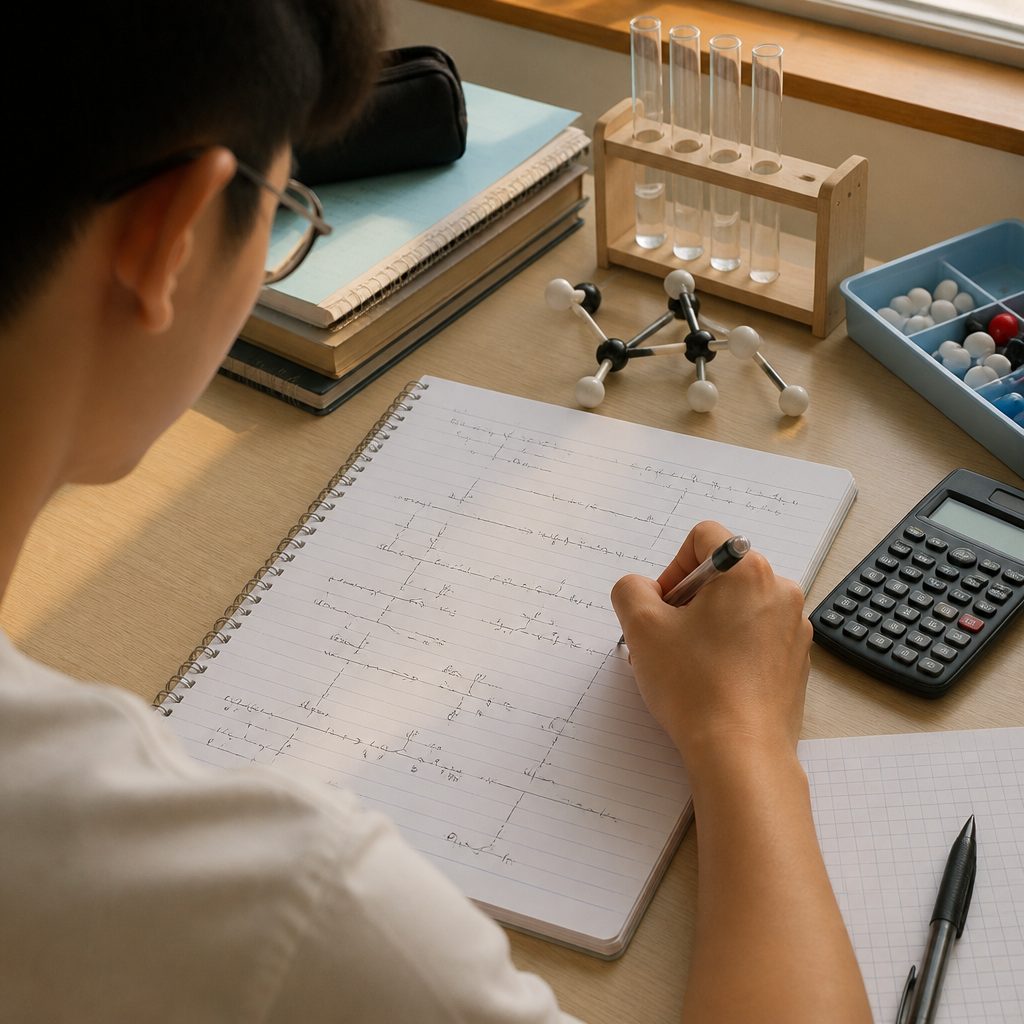
This guide helps students revise O-Level organic chemistry as a connected map rather than a long list to cram. As schools may teach topics in slightly different sequences and the syllabus can be updated, check the latest guidance from SEAB and MOE.
Key Takeaways
- Build connections before memorising reactions. A reaction is easier to understand when a student first recognises the functional group and its usual behaviour. For example, an alkene undergoes addition because of its carbon-carbon double bond.
- Learn each homologous series as a complete profile. Revision should cover the general formula, functional group, naming pattern, physical properties, reactions and relevant tests together, rather than treating them as separate chapters.
- Practise conditions alongside equations. Writing that ethene reacts with steam is incomplete if the student cannot state the conditions, identify the product or write a balanced chemical equation when required.
- Use comparison questions to uncover confusion. Placing alkanes, alkenes, alcohols and carboxylic acids side by side makes differences in bonding, reactions and observations easier to retrieve under exam pressure.
- Revise through short recall sessions rather than repeated rereading. A ten-minute blank-page reaction map after dinner can reveal more than another passive read of highlighted notes.
- Match practice to O-Level Chemistry question demands. Students need to interpret unfamiliar structures, explain observations, write equations and apply concepts, not simply reproduce model answers.
Begin Revision With What the Exam Requires
What students are expected to do
O-Level Chemistry organic chemistry questions usually go beyond naming a familiar compound. A student may need to identify a homologous series, predict products, state reagents and conditions, explain an observation, distinguish compounds using a test, or write a chemical equation.
Practical-style questions can also require careful interpretation of colour changes and experimental steps. That is why a child may appear to “know the chapter” but still lose marks in a paper. Recognising a point in their notes is very different from retrieving it precisely when the question is worded differently.
For example, a student may remember that bromine water tests for unsaturation, yet write only “it changes colour”. In an exam, that wording is too vague. They need to state that orange-brown bromine water is decolourised by an alkene.
A useful checklist before answering
Before answering an organic chemistry question, encourage your child to pause and ask:
1. What functional group is present?
2. Which property or reaction does that functional group suggest?
3. Is the question asking for an observation, a condition, a product or an explanation?
4. Have I used the correct formula and balanced the equation where needed?
This may sound straightforward, but tutors often notice that students rush straight towards a memorised reaction. The answer may be related to the topic, yet still miss what the question actually asks for.
A common pattern among students is knowing the science but losing marks through incomplete exam wording. Current content and assessment expectations should always be checked against school materials and the latest SEAB GCE O-Level information.
Make Functional Groups the Centre of Revision
Use one comparison table repeatedly
Instead of maintaining four disconnected sets of notes, create one comparison page for the main homologous series. The value is not in making the page look neat. It is in using it repeatedly until the differences feel familiar.
Cover the right-hand columns and ask, “Which series decolourises bromine water?” Then reverse the direction: “A compound reacts with sodium carbonate and produces a gas. What functional group might it contain?”
Two-way recall matters because examination questions do not always start with the name of a compound. They may give a displayed formula, a reaction result or an observation, then expect the student to work backwards.
Treat names as structural clues
Names reveal structure. “Ethene” points to two carbon atoms and an alkene. “Propanol” suggests three carbon atoms and an alcohol. “Ethanoic acid” indicates a two-carbon carboxylic acid.
A common mistake is treating prefixes and suffixes as decorative labels. During revision, ask your child to sketch the displayed or structural formula immediately after reading a name. For instance, propanoic acid should lead to CH₃CH₂COOH, not a formula with the –COOH group placed in the middle of the chain.
This small habit makes similar-looking names less confusing. Ethane and ethene differ by one letter, but their bonding, tests and reactions are importantly different.
Learn Reactions as Connected Changes
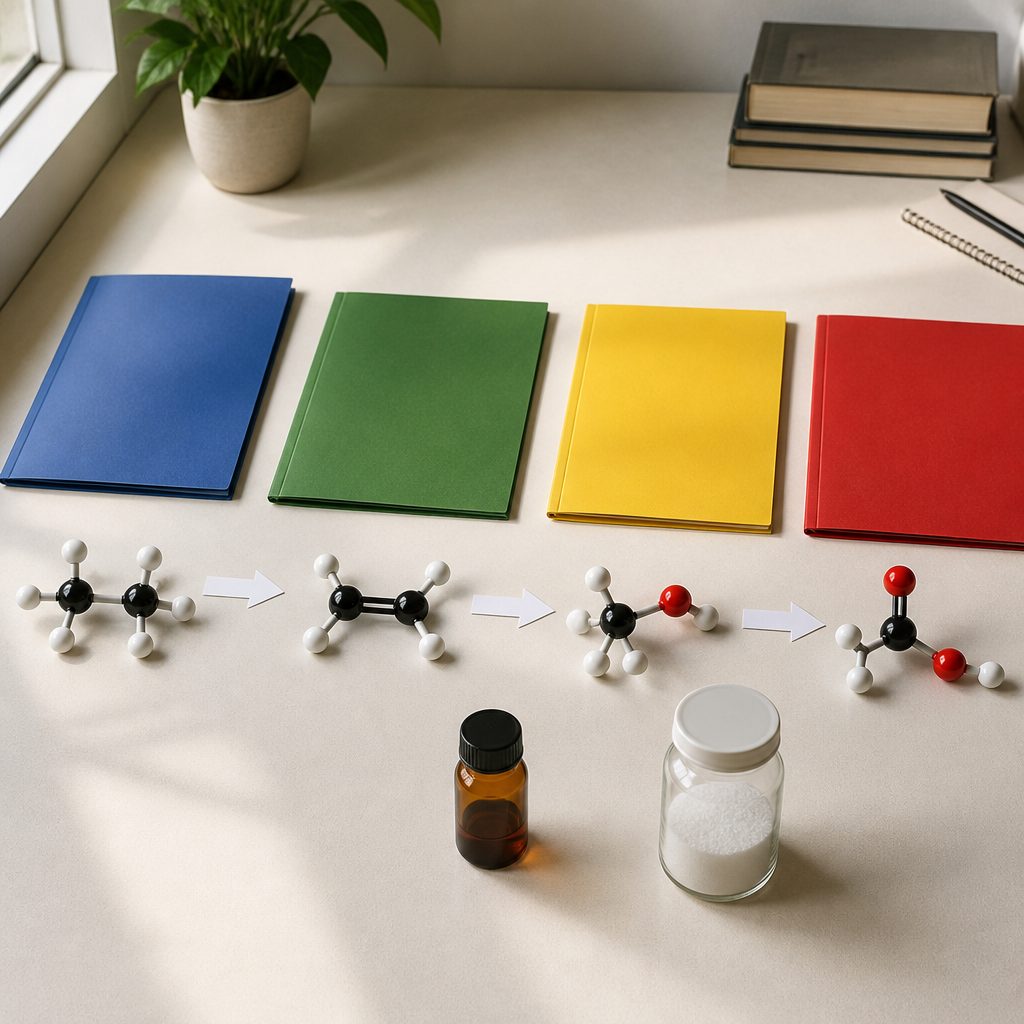
Follow a reaction pathway
Rather than memorising every equation as a separate item, start with a simple carbon compound and trace what can happen next.
Seeing these as related transformations reduces the feeling that every equation is unrelated. It also helps when an exam introduces an unfamiliar compound with a longer carbon chain. The chemistry still depends on the same functional group.
Build complete answers, not partial ones
Consider this question: describe what happens when ethene is shaken with bromine water.
The orange-brown bromine water is decolourised because ethene contains a carbon-carbon double bond and undergoes an addition reaction.
This response includes the observation, the relevant structural feature and the reaction type. A weaker answer such as “Bromine water becomes clear because ethene reacts” may earn limited credit because it does not explain the feature responsible.
For equations, accuracy matters too. A child who knows the reaction but forgets to balance the equation has not demonstrated the full understanding being tested. Keep a small list of reactions and conditions nearby, but avoid turning revision into blind copying. After each equation, ask what condition is needed and why that reactant can react.
Use a Sustainable Weekly Revision Routine
Move from recognition to application
After a long school day, especially one involving CCA, a two-hour organic chemistry session can become unproductive staring at notes. A more manageable plan is four focused sessions.
The final session matters because exam questions combine skills. Revision that stays neatly separated by topic can create false confidence.
Keep an error notebook instead of rewriting notes
When students get stuck, many rewrite the entire chapter. It can feel productive, but it rarely targets the actual weakness. Use one page divided into “structure”, “reaction”, “condition”, “equation” and “wording”.
If your child repeatedly writes “bromine solution turns colourless” without mentioning its original orange-brown colour, record that exact gap and test it again two days later. If substitution and addition get mixed up, write one contrasting example of each.
Parents can help without becoming the examiner. A brief question while dinner is heating, such as “Which compounds react with carbonate?”, can prompt retrieval. Turning every meal into a quiz, however, may make an already anxious student avoid the topic altogether.
Avoid These Common Organic Chemistry Mistakes
Memorising model answers without understanding
Some students can recite that alkenes undergo addition reactions but cannot identify an alkene from a displayed formula. Others remember the oxidation of ethanol but cannot apply the same idea to a different alcohol at their syllabus level.
The correction is to alternate between words, structures and equations. After every statement, ask for an example. If a student says, “Carboxylic acids react with carbonates,” they should be able to name a carboxylic acid, state the expected observation and identify carbon dioxide as the gas formed.
Mixing up tests and observations
Bromine water is associated with unsaturation, while carbonate reactions are associated with acids. Under time pressure, students sometimes choose the right test for the wrong compound, then compound the mistake with an incorrect observation.
Students do not need to memorise every sentence word for word. They do need enough precision to describe what they would see and link it to the relevant compound feature.
Using resources above the required level
The depth of organic chemistry, expected terminology and range of reactions may differ between subject levels and school teaching plans. A parent comparing notes with another child or downloading an advanced resource may accidentally introduce material that confuses rather than strengthens core knowledge.
Begin with the child’s current syllabus, teacher materials and school revision questions. Add extension practice only when the fundamentals are secure. If concepts still feel disconnected after several focused attempts, personalised Chemistry tuition support can give a student space to explain their thinking, correct misconceptions and practise the question types that unsettle them.
Frequently Asked Questions
Does my child need to memorise every organic chemistry equation for O-Levels?
They need to know the equations and conditions required by their syllabus, but memorisation alone is fragile. A student should also identify the functional-group change, such as an alkene changing to an alcohol through addition, so an unfamiliar carbon chain does not cause panic.
Why does my child know the notes but still struggle with organic chemistry questions?
Notes usually present reactions in tidy categories, while exam questions combine naming, structures, observations and explanations. Mixed practice shows whether the student can select the right knowledge independently instead of simply recognising it on a page.
How often should organic chemistry be revised before O-Levels?
Short, recurring retrieval practice is usually more effective than one large weekly session. Two or three focused revision sessions, plus one mixed-question practice, can work well when mistakes are revisited. The exact frequency should fit the student’s workload and weaker topics.
Should parents make their child do more topical papers when organic chemistry marks are poor?
Topical practice is useful when it identifies a specific gap, such as reaction conditions, nomenclature or chemical equations. Repeating many questions without reviewing errors can become discouraging. Once the basics are steadier, mixed papers are necessary because the exam does not announce which reaction to use.
Conclusion
A clear O-Level organic chemistry revision framework starts with functional groups, then connects names, structures, properties, reactions, conditions and exam wording. When students understand those links, equations become easier to retrieve and unfamiliar questions feel less intimidating.
Keep revision short, active and honest about mistakes. If your child would benefit from personalised support with organic chemistry concepts, revision skills and exam confidence, learn more about our Chemistry tutors.