


After homework, dinner and CCA, it is easy to see why a short editing passage can feel like the last thing your child wants to tackle. They spot one obvious mistake, assume the rest is fine, and move on. Then the paper comes back with marks lost on tiny grammar, spelling or punctuation errors that seemed invisible during the test.
Learning how to do well in Primary English editing is not about memorising every grammar rule overnight. It is about building a calm, repeatable way to read, notice what sounds wrong, and check each sentence under time pressure. In Singapore Primary English, editing exercises test whether pupils can apply grammar, vocabulary, spelling and punctuation in meaningful context, rather than simply recite rules.
Formats and expectations can differ by level, school and assessment. Check your child’s current school format and the latest MOE English Language syllabus, together with relevant SEAB syllabus information.
Key Takeaways
- Read for meaning first. Errors are easier to spot when your child understands what the passage is saying, instead of hunting randomly for mistakes.
- Check one error type at a time. Looking separately at tense, nouns, spelling and punctuation keeps pupils from feeling overwhelmed or changing correct words unnecessarily.
- Use clues around the word. Time words, singular or plural nouns, and the sentence subject often reveal the right correction.
- Slow down at common traps. Words such as “has”, “have”, “was”, “were”, “much” and “many” can lead to avoidable lost marks.
- Practise short passages regularly. Ten focused minutes of English editing practice can be more useful than rushing through several worksheets without reviewing mistakes.
- Explain corrections aloud. When a pupil can say why “go” becomes “went”, they are less likely to guess in the next exercise.
Read Before You Start Correcting
Understand the story before hunting for mistakes
Many children start circling words the moment they see the passage. That often backfires because editing is context-based. In the sentence, “Yesterday, Amir walk to school because he missed the bus,” the word “yesterday” tells the pupil that the action happened in the past. “Walk” should become “walked”.
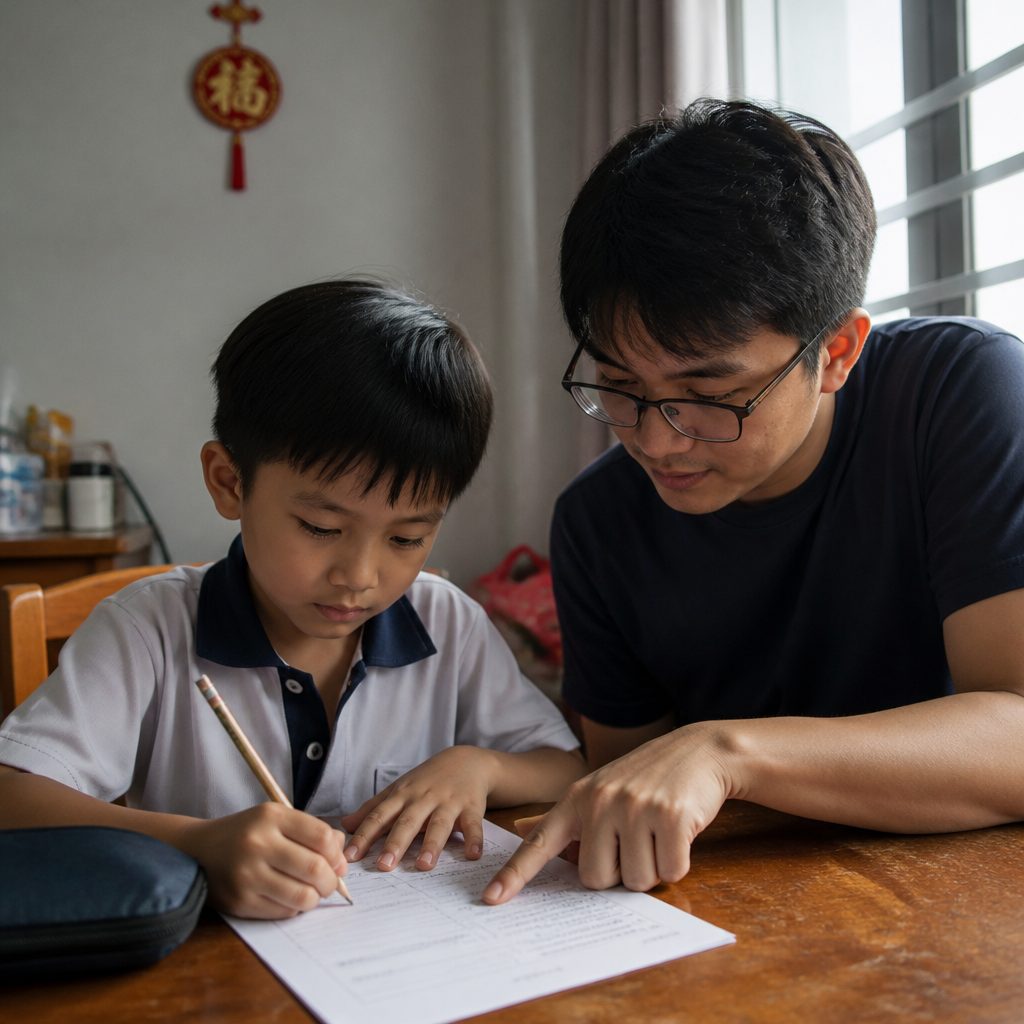
Encourage your child to read the whole passage once without writing anything. Ask simple questions: Who is involved? When did this happen? Is the passage about one child or several children? A pupil who understands the story is more likely to make reliable corrections than one who treats every line as a separate puzzle.
It is understandable to want your child to finish quickly, especially late in the evening. Yet “just find the mistakes” can create a familiar pattern: one error is corrected, several others are missed, and a correct word gets changed because it suddenly looks strange.
Let contextual clues guide the correction
Teach your child to look left and right before changing a word. The clue may appear earlier in the sentence, or even in the sentence before it.
The kittens was hiding under the table because it were frightened.
“Kittens” is plural, so “was” should become “were”. The pronoun “it” refers to several kittens, so it should become “they”. Once that pronoun is corrected, “were frightened” is already right.
This is one of the most useful Primary English editing strategies: do not correct by instinct alone. Match the verb to the subject, and match pronouns to the people or things they refer to.
Build a Repeatable Editing Routine
Check grammar in focused rounds
A good editing routine is not glamorous, but it gives a child something steady to rely on when they feel rushed. Instead of trying to notice everything in one glance, let your child work through the passage in focused rounds.
For instance, in “My brother have two bicycle,” there are two grammar issues. “Brother” is singular, so “have” becomes “has”. “Two” signals a plural noun, so “bicycle” becomes “bicycles”.
Trying to notice every possible error at once overwhelms many pupils, especially those who already feel anxious about English. A focused scan gives the child a manageable job. Lower primary pupils can begin with tense and spelling, while upper primary pupils gradually add agreement, pronouns and word forms.
Do not “improve” words that are already correct
Tutors often notice this during lessons. A child finds one error, feels more confident, then starts rewriting the sentence into the way they would personally say it. Editing is not composition. The goal is to correct the error, not make the sentence sound fancier.
If the sentence reads, “The children were excited to visit the Science Centre,” words such as “excited” or “visit” should not be changed simply because another word also sounds possible.
A useful question is: “What rule proves this word is wrong?” If your child cannot explain the change, leave it and continue. This protects marks and reduces second-guessing.
Spot Errors That Commonly Cost Marks
Watch for recurring grammar traps
A common pattern among students is that errors repeat in small, familiar words. They read them too quickly, especially when they are trying to finish the passage.
Instead of asking your child to memorise a long grammar list, collect mistakes from their own worksheets. A small notebook titled “My Editing Traps” can be more personal and useful than copying rules they rarely use.
Treat spelling as a meaning check
Spelling is not only about whether a word looks familiar. Ask whether it makes sense in the sentence. “The class listened quietly to the principle” may look acceptable to a rushed pupil, but “principal” refers to the school leader. “Principle” means a rule or belief.
Word endings deserve attention too. A child may write “happyness” because they know the word “happy”. Regular reading helps, but targeted review is still needed. During English editing practice, ask your child to underline words they are unsure of, then compare them with a trusted spelling list or corrected worksheet after attempting the passage.
Build Speed Without Creating Panic
Use time limits only after accuracy improves
Parents often worry when a child spends too long on a short editing passage. That concern is real during Primary English exam preparation. Yet timing every practice from the beginning can create a child who scans faster but thinks less carefully.
Start untimed. Let the reading-and-checking routine become familiar first. Once accuracy is steadier, introduce a gentle time limit that matches the school’s expectations. The aim is not to make your child race. It is to ensure there is enough time for a final read.
One short passage twice a week can be a practical weekday routine, perhaps after a brief break from homework. On a night packed with CCA and other revision, a five-minute review of old mistakes is better than forcing a tired child through a full worksheet.
Review mistakes so the next attempt improves
Marking answers is not the end of practice. The more useful conversation is, “Why did this error escape your notice?” A child who changes “were” to “was” may not understand singular and plural subjects. Another may know the rule, but miss the word because they read too quickly.
After correcting “She have a new bag” to “She has a new bag”, try, “My sister has a red bicycle.” This moves the rule from a corrected worksheet into the child’s own language.
If your child continues to guess despite regular revision, personalised support can help identify whether the issue is grammar knowledge, weak reading attention or exam anxiety. Primary English tutors can guide practice at an appropriate pace and help pupils approach editing exercises with greater confidence.
Adapt Practice for Your Child’s Level
Lower primary pupils need visible patterns
For younger pupils, focus on short, concrete patterns: capital letters at the start of sentences, full stops, common spelling, “is” and “are”, and simple past tense. A child who is still learning to read fluently may miss errors because decoding each word takes effort.
Use short passages and read them aloud together. If “The dog are hungry” sounds odd when spoken, the pupil can begin connecting the sound with the rule: one dog means “is”.
Upper primary pupils need precision under pressure
By upper primary, pupils are often expected to manage more complex grammar choices and longer passages. They may know the rules but still lose marks through carelessness, especially after a demanding school day or while juggling PSLE preparation, tuition and CCA.
At this stage, avoid relying only on model answers. Ask your child to justify each correction. A pupil who can explain that “did not went” should be “did not go” understands that “did” already carries the past tense. That understanding is far more dependable than memorising a corrected sentence.
Frequently Asked Questions
How often should my child do English editing practice when mistakes keep repeating?
Two or three short, reviewed practices a week are usually more useful than a large stack completed without feedback. Increase frequency before a school assessment only if your child can still review mistakes calmly and understand the corrections.
Why does my child know grammar rules but still lose editing marks?
Knowledge and noticing are different skills. Your child may know that plural subjects take “were”, but still miss “children” while reading too quickly. Separate checking rounds train attention alongside grammar recall.
Should I correct every English editing error for my child?
Guide rather than immediately tell. Ask, “Who is doing the action?” or “When did this happen?” If frustration is rising, show one example, then let your child attempt the next similar sentence independently.
Are all Primary English editing exercises the same?
No. Schools and levels may use different formats and emphasis. Use school worksheets as the closest guide, and check the latest MOE and SEAB information rather than assuming an older practice book matches current requirements.
Score Better Through Careful, Consistent Editing
Doing well in Primary English editing comes down to careful reading, context clues and a routine your child can repeat even when nervous. Read for meaning first, check one error type at a time, avoid unnecessary changes, and review every missed correction.
Small but regular practice can turn editing from a frustrating guessing game into a familiar task. If your child needs more structured support, learn more about our Primary English tutors for help strengthening revision skills and building confidence with editing exercises.