


Word problems can make an otherwise capable child stare at the page, pencil unmoving, and say, “I don’t know what the question wants.” After a long school day, CCA and homework, it is understandable to feel worried when the calculations are not the real problem. Your child may know their multiplication facts, yet still feel completely stuck once those numbers appear in a paragraph.
This guide offers a calmer, practical way to support your child with Primary Maths word problems. The aim is not to memorise a trick for every question. It is to help them read carefully, identify the mathematical relationship, represent it clearly and explain their working. These habits matter from lower primary through PSLE preparation.
Key Takeaways
- Word problems test understanding, not just calculation. A child may know multiplication facts but still choose addition because they have not understood what the quantities represent.
- Use a repeatable routine. Reading, retelling, identifying key information, drawing a model, calculating and checking gives your child something steady to follow when a question feels intimidating.
- Bar models are useful, but not magic. They work well for comparison, part-whole and ratio-style questions, while a quick table, listing or simple equation may sometimes be clearer.
- Lower primary children need concrete language first. Before expecting a neat model, ask a Primary 1 or 2 child to act out or explain what is happening in the story.
- Upper primary pupils need clearer reasoning. Multi-step Maths questions often assess whether a child can identify hidden information and show a logical sequence, rather than rush to an answer.
- Avoid taking over too quickly. Telling your child the operation may solve tonight’s worksheet, but asking one well-chosen question builds independence for the next test.
Why Word Problems Feel So Difficult
They involve several skills at once
A word problem can look short, but it asks your child to read accurately, understand vocabulary, decide what is relevant, choose an operation and show working. That is why a child can complete a page of sums correctly, then lose confidence the moment numbers appear inside a story.
Take this question: “Amir has 24 stickers. He gives 7 stickers to his sister and buys 15 more. How many stickers does he have now?” It requires subtraction first, then addition. A child who circles all three numbers and adds them may not be careless. They may simply be treating the question as a hunt for numbers rather than a story with events.
Tutors often notice that children look for signal words alone. They see “more” and immediately add, even when “how many more” is asking for a difference. Keywords can offer a clue, but they cannot replace understanding.
Assessments test reasoning as well as answers
In school assessments, word problems can appear in short-answer and longer structured questions. Depending on level, they may cover whole numbers, fractions, measurement, time, money, geometry or data. Upper-primary papers often include questions where an intermediate quantity must be found before the final answer.
The MOE Primary Mathematics syllabus places problem solving alongside mathematical skills and processes. Check the latest syllabus and your child’s school requirements, as question formats and expectations may differ across schools and levels.
Help Your Child Read the Question Carefully
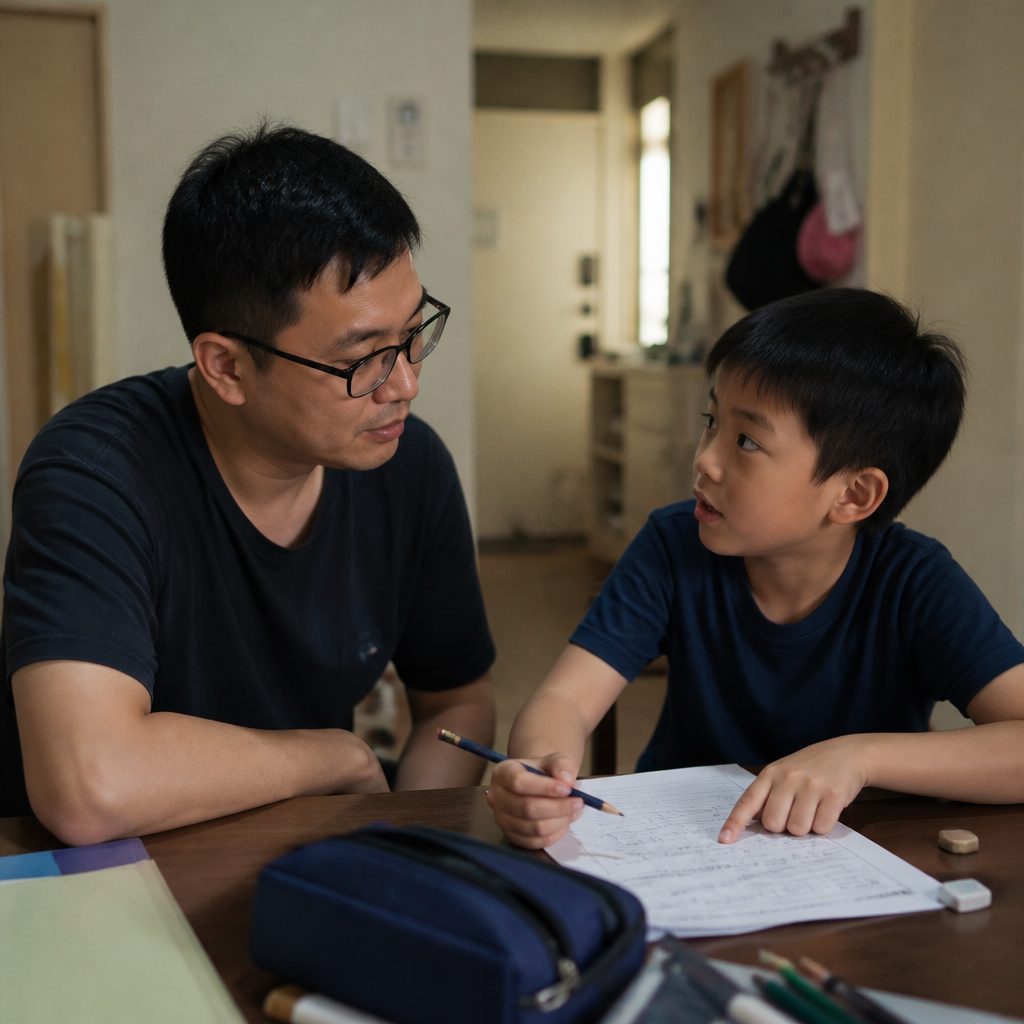
Slow down and retell the story
Before touching the numbers, ask your child: “What happened in this question?” Encourage them to reply in ordinary language.
If the question says, “A class collected 168 cans in Week 1 and 95 fewer cans in Week 2,” your child might say, “Week 2 collected less than Week 1.” That simple sentence matters. It shows whether they understand that 95 is a difference, not the Week 2 total.
For a tired child at 9.30pm, “Read properly” can quickly create more tension. Instead, point to one sentence and say, “Tell me this part as if you are explaining it to me.” It feels less like a correction and more like a conversation.
Identify what the question actually asks
Many mistakes happen because children solve the first thing they notice rather than the final question. Let them underline the question sentence, then say aloud what needs to be found.
- “Are we finding a total, a difference, one part or the number in each group?” For “How many more?”, remind them that the answer compares two amounts rather than combines them.
- “Which information is already known?” In a question involving a total and one part, the missing part may be the target.
- “Do we need every number?” Some upper-primary questions include details needed only for an earlier step, so children need to follow the sequence instead of selecting numbers randomly.
Turn the Words into a Maths Picture
Choose a representation that fits
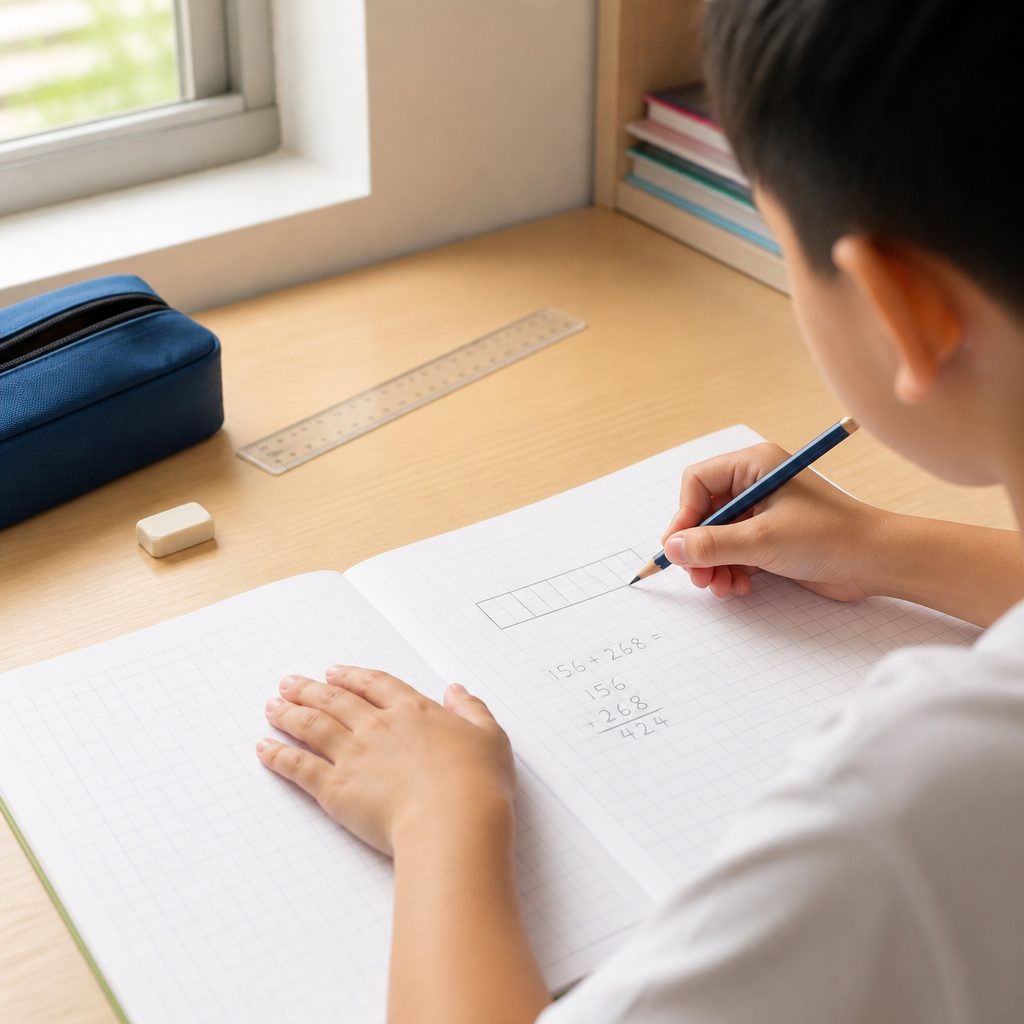
For lower primary, objects and quick sketches can make the story feel real. If Mei has 12 cherries and shares them equally among 3 friends, draw 12 dots and circle them into three equal groups. Only then write `12 ÷ 3 = 4`.
By Primary 3 and beyond, bar models become especially useful for part-whole and comparison questions. Consider this example:
Ben has 36 marbles. He has 12 more marbles than Jia. How many marbles does Jia have?
Draw Ben’s bar as Jia’s unknown amount plus an extra section of 12. The relationship becomes visible:
`Ben: [ Jia’s marbles ][ 12 ] = 36`
Your child can then see that Jia’s amount is `36 − 12 = 24` marbles.
A bar model should clarify, not become another hurdle. Some children spend so long making perfectly straight bars that they lose track of the question. A rough but labelled model is enough. For number patterns, timetables or repeated quantities, a table may be faster and more accurate.
Show the calculation in the story’s order
Working should show thinking, especially in multi-step Maths questions. If a problem asks how many snacks remain after packets are shared, do not write only a final answer. Write the first calculation, state what it represents, then continue.
This makes it easier for your child to spot where the mistake began. It also supports the clear working expected in many school assessments.
Adjust the Method for Your Child’s Level
Lower primary: build meaning before speed
Primary 1 and 2 children commonly struggle with language such as “altogether”, “left”, “each” and “more than”. Use everyday situations. At the supermarket, ask, “We bought 3 packs with 4 yoghurt cups each. How many cups are there?” Let your child arrange counters or draw circles before expecting multiplication notation.
Resist drilling ten similar questions when your child is confused. Repetition without understanding can make them memorise a pattern, then panic when the wording changes. Two questions discussed properly are often more valuable than a full page completed in tears.
Upper primary: uncover the hidden step
By Primary 5 and 6, questions may combine fractions, ratios, percentages, speed or volume with several steps. A common pattern among students is calculating correctly, then stopping too early.
For instance, a question may state that 3/5 of a sum is spent and ask how much remains. Your child first needs to find the amount spent, then subtract from the total. Ask, “Have you answered the exact final question, or only found something useful along the way?”
When PSLE preparation begins, time pressure can encourage guessing. Yet rushing word problems often increases careless errors. Practise a smaller number of questions with full explanation, then add timed practice once the reasoning is secure.
Common Word-Problem Mistakes and Better Responses
When a parent says, “Just subtract 95 from 168,” the homework gets done, but the child learns to wait for the operation. A more helpful prompt is, “Week 2 has 95 fewer than which week?” It nudges them towards the relationship without handing over the solution.
If repeated practice at home is ending in arguments, individual support can be useful. A good tutor can identify whether the issue is reading, number sense, modelling or confidence, then adjust the explanation. Learn more about our Primary Maths tutors and how they can support your child’s problem-solving skills, revision confidence, and understanding of word problems.
Build a Short, Sustainable Practice Routine
Try three questions, not thirty
On a weekday with spelling, Chinese homework and CCA fatigue, aim for three purposeful questions. Choose one familiar question, one that requires a bar model and one with a common trap, such as irrelevant information or a hidden second step.
After each question, ask your child to explain one decision: “Why did you subtract?” or “What does this bar represent?” This reveals far more than simply asking, “Do you understand?”
Keep an error notebook that teaches, not shames
Instead of writing “careless” beside every mistake, record the cause and the next action.
The Singapore Student Learning Space can also provide practice resources where available. Use online practice selectively. Completing many questions without reviewing mistakes can create the impression of revision without strengthening problem-solving habits.
Frequently Asked Questions
Should my child always use bar models for word problems?
No. Bar models are particularly helpful for comparison, part-whole, fractions and ratio relationships. A table may suit repeated patterns, while a simple equation may be clearer for some upper-primary questions. The best representation is the one that makes the relationship understandable.
My child gets the answer but cannot explain the working. Is that a concern?
It can be. A correct answer from guessing, mental calculation or copied steps may not transfer to a different question. Ask for a short explanation, such as “I subtracted because 95 fewer means Week 2 has less.” Keep it conversational rather than turning every question into an oral test.
How often should we practise Primary Maths word problems?
Consistency matters more than long sessions. Three to five short practices each week can work well when each session includes discussion and correction. During exam periods, increase practice gradually instead of suddenly adding a stressful daily hour.
Why does my child understand at home but make mistakes in tests?
Test pressure, time limits and unfamiliar wording can affect performance. Your child may also rely on your prompts at home without realising it. Occasionally let them attempt a question silently, then review their written thinking together.
Conclusion
Primary Maths word problems become less overwhelming when your child has a dependable process: retell the story, identify what is being asked, represent the relationship, calculate in order and check whether the answer makes sense. The aim is not perfect models or instant answers. It is growing confidence in explaining why a method works.
When homework becomes a regular source of tension, step back from chasing the answer. A few patient prompts and carefully chosen examples can reveal far more than another worksheet. For more tailored support, explore how our Primary Maths tutors can help your child build stronger word-problem skills and revision confidence.