


Introduction
If you have ever sat beside your child at 8.30pm, both of you staring at a blank composition page while they sigh, “I don’t know what to write”, you are definitely not alone. For many Singapore parents, composition time is where the stress shows up fast. The child feels stuck, the parent starts prompting, and before long, everyone is frustrated.
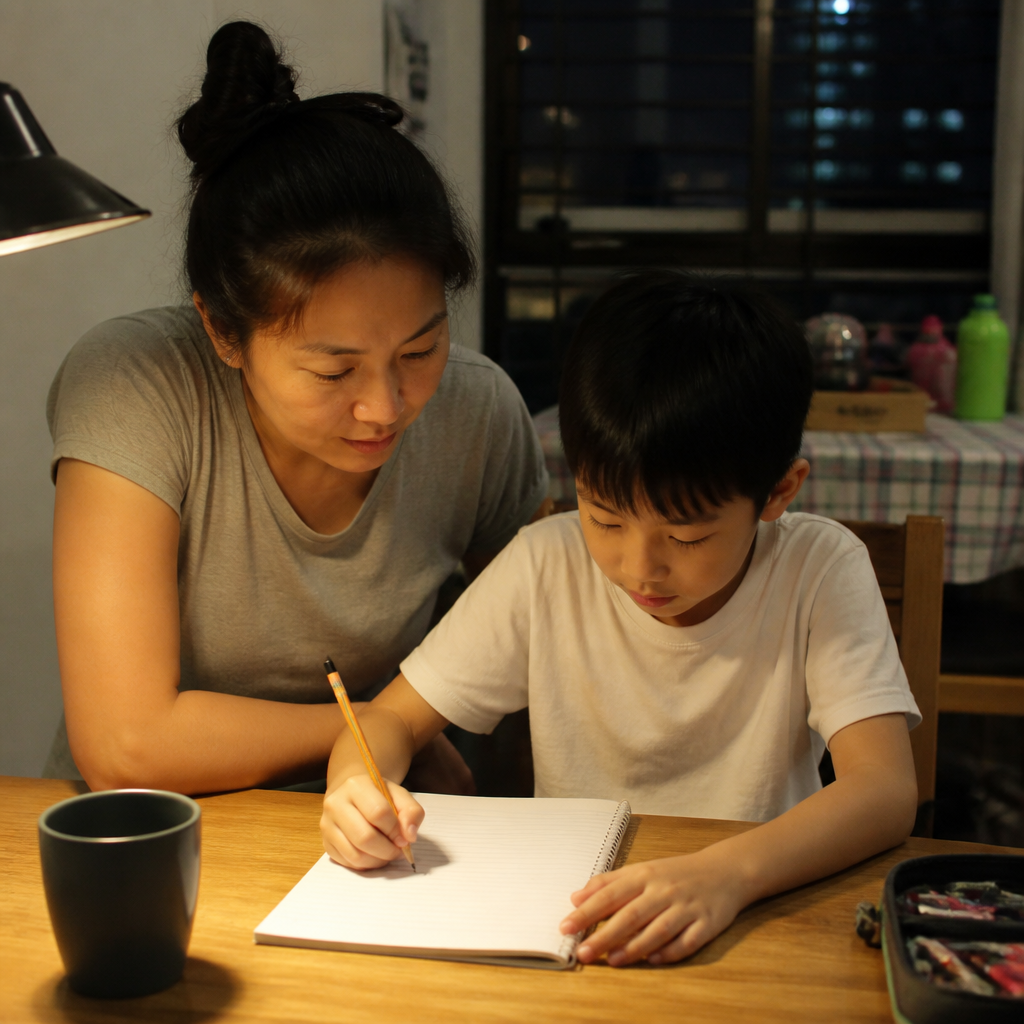
The good news is this. Learning how to write a primary school composition does not have to be complicated. For P3 to P6 students, composition writing is not about sounding impressive. It is about understanding the topic, building a clear story, and writing in complete, organised sentences.
In Singapore primary school English composition, children are often asked to respond to picture prompts or a given topic, then turn that into a story with a beginning, middle, and ending. As students move from P3 composition writing to P6 composition writing, expectations grow, but the foundations stay the same. A child who can plan clearly, describe feelings simply, and end the story properly is already moving in the right direction. This guide breaks primary school composition writing into manageable steps parents can actually use at home.
Key Takeaways
- Start with a simple story structure. A strong primary school composition usually has a clear beginning, problem, action, and ending. Children often write better when they know what happens first, next, and last.
- Teach topic reading before writing. Many weak compositions go off-topic because the child rushes in too quickly. Spending two minutes identifying the main event, setting, and likely problem can prevent bigger mistakes later.
- Use picture prompts and guiding questions. Instead of asking your child to “be more creative”, ask concrete questions like who, where, what happened, and how the character felt. This gives children a structure for thinking and is often one of the best ways to improve English composition at home.
- Keep paragraphing simple and clear. For P3 to P6 students, neat paragraphing is more useful than advanced vocabulary. A reader should be able to follow the story easily from one event to the next.
- Practise planning, not only full writing. Some children improve faster by spending 10 minutes planning stories than by writing long compositions every time. This builds confidence without overwhelming them after school, homework, and CCA.
- Watch for repeated mistakes. Common composition errors often involve tense mistakes, missing punctuation, sudden endings, and stories that do not match the prompt. These can be corrected through focused review rather than constant scolding.
- Get extra support if your child cannot write independently. If your child repeatedly struggles to form complete stories or organise ideas even with help, guided support such as English tuition may be useful.
Understand What Composition Writing Really Tests
Before looking at how to write a composition for primary school, it helps to understand what your child is actually being asked to do. In Singapore, primary school composition writing is not just about grammar. It tests whether a child can understand a topic, choose relevant ideas, organise events clearly, and write in readable English.
For upper primary, composition tasks often involve a few pictures and helping words, or a topic that requires a short narrative. The child must build one sensible story, not simply describe each picture one by one. This is where many children get stuck. They think composition means “write anything”, when really, the task is to create one connected story.
What P3 to P6 students are usually expected to do
In P3 and P4 composition writing, children are still building the basics. Teachers often look for simple sequencing, complete sentences, and clear events. A P3 child does not need a dramatic twist. A sensible story with proper punctuation is already meaningful progress.
By P5 and P6, expectations become higher. The story still needs to be clear, but the child is also expected to show better idea development, smoother paragraphing, and more precise word choice. This supports later PSLE English foundations, even if your immediate goal is simply helping them write with more confidence.
Why some children struggle even when they know vocabulary
Tutors often notice this pattern. Some children memorise good phrases but still produce weak compositions. The issue is not always language. Very often, it is planning.
They may know words like “trembling”, “relieved”, or “furious”, but they do not know what actually happens in the story. Once the plot is shaky, fancy phrases cannot rescue it. That is why a child with simple vocabulary but a clear storyline often does better than a child trying to force in memorised expressions.
For the latest curriculum context, parents can refer to the MOE primary syllabus page and exam information from SEAB.
Follow A Simple Step-By-Step Writing Process
If you are looking for a step-by-step way to teach composition writing to primary students in Singapore, keep it simple. Most children respond better to a repeatable routine than to long lectures about creativity.
A clear writing process is much easier for a tired child to follow after a full school day.
Read the topic and identify the main event
Ask your child, “What is this composition mainly about?” That one question often reveals whether they understand the task at all.
If the prompt is about helping someone, the story should focus on helping someone. It should not drift into a long introduction about the weather or school assembly. A common pattern among students is spending too much time warming up the story, then running out of time for the main event.
Plan the story in four parts
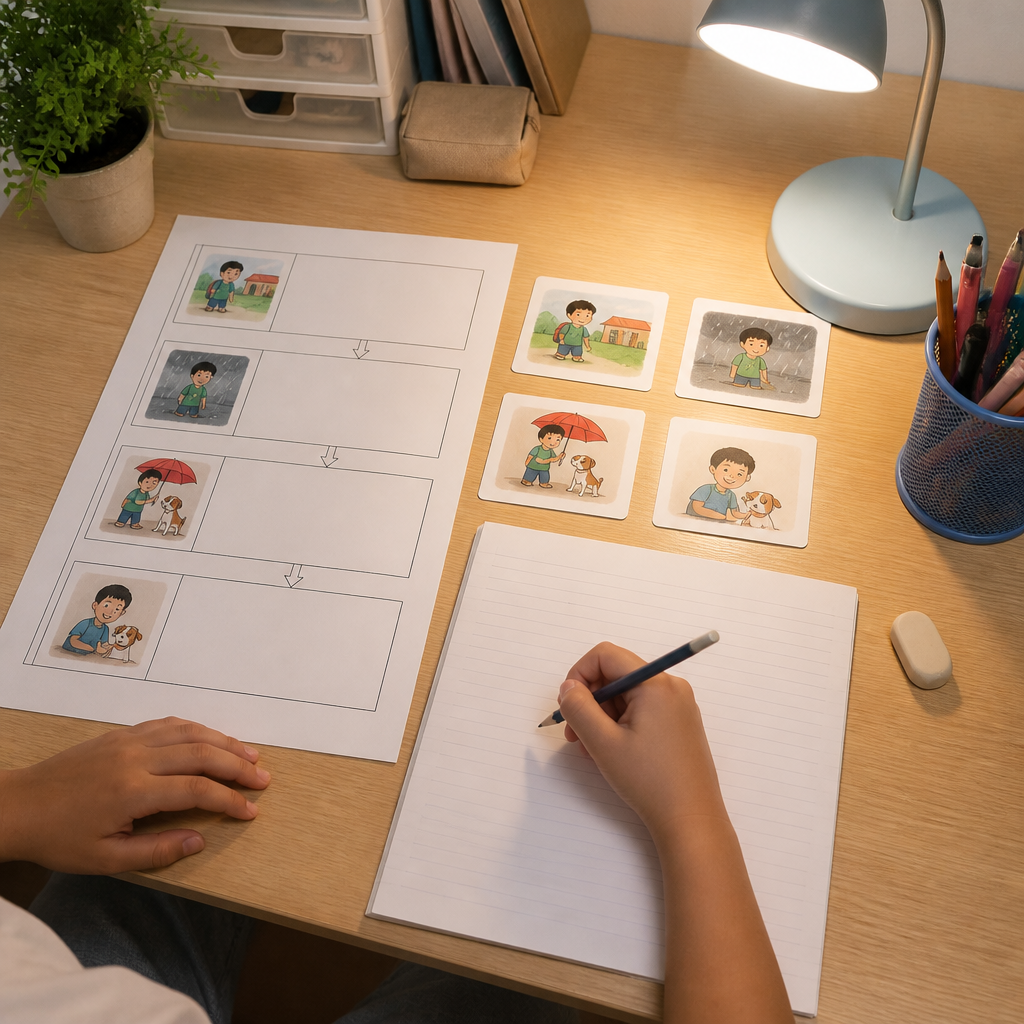
A simple story map works well. Children do not need something complicated.
This is far more useful than telling a child to “just start writing”. When they know the job of each part, the blank page feels less intimidating.
Add feelings and small details
Children often write flat stories because everything comes out like a list. This happened. Then that happened. Then the story ended.
What makes a composition feel complete is usually not big vocabulary, but simple emotional detail. Was the character worried, embarrassed, grateful, or relieved? Even one fitting feeling can make the scene more believable.
Write in clear paragraphs
Teach your child to separate ideas clearly. One paragraph for the start, one for the problem, one for the action, and one for the ending. This alone can improve readability a lot.
Paragraphing also slows children down in a good way. Instead of seeing composition as one long block of writing, they begin to understand that each part of the story has a purpose.
Help Your Child Without Making Composition More Stressful
Parents often mean well but accidentally make composition practice harder than it needs to be. After a long day of school, homework, and maybe CCA, too many corrections at once can quickly lead to resistance.
If you are wondering how to help your child write composition at home in Singapore, a calmer approach often works better than a tougher one.
Use guiding questions instead of interrogation
Instead of saying, “This is too short, write more”, try questions that help your child think.
- Who is in the story? This gives the story a clear focus.
- Where are they? A clear setting makes the scene easier to imagine.
- What problem happened? Every composition needs a central event.
- What did the character do? This moves the story forward.
- How did the story end? Thinking about the ending early can prevent rushed final lines.
That shift matters. Children usually respond better when they feel guided, not judged.
Keep practice short on weekdays
It is not realistic to expect a tired child to produce a full composition every evening. In fact, forcing too much writing can backfire. The child may become more fearful of composition, not better at it.
A better routine is 10 to 15 minutes of focused work. One day can be planning. Another day can be writing only the introduction and problem. Then on the weekend, your child can complete a full short composition. This often builds consistency without burnout.
Correct selectively
Children shut down when every line is marked wrong. If everything becomes a problem, they stop seeing what to improve first.
Pick one or two focus areas each time. Maybe today you correct punctuation and tense only. Another time, focus on endings. Selective correction feels manageable, and manageable practice is what children are more likely to repeat.
Build Better Stories From Picture Prompts And Topics
A lot of composition problems begin before the first sentence is written. Children misread the picture, miss the main action, or describe every object they see without linking the events together.
Teach children to interpret picture prompts properly
When looking at a picture composition, ask, “What is happening here, and what probably happened just before this?” That question helps the child think in story form, not picture description form.
This is an important shift. A weak writer may simply name what they see. A stronger writer starts connecting events. That is usually what makes the composition feel meaningful rather than mechanical.
Show how paragraphs follow the story flow
For many students, especially in P4 and P5, paragraphing becomes easier when they can see the logic clearly.
Teach simple endings, not rushed endings
Many children spend too long on the opening and then end with one flat line. A common example is this:
“I learnt a lesson.”
That sounds unfinished. A better ending includes both result and feeling. It does not need to be advanced. It just needs to feel complete.
Fix The Most Common Composition Mistakes
If you search for common primary school composition mistakes, you will notice the same issues appearing again and again. These are not signs that a child is lazy. More often, they simply have not yet built the right habits.
Going off-topic
Some children see a prompt and immediately pour out a memorised story that does not really fit. Parents are often surprised by how often this happens.
The fix is simple. Ask your child to underline the main clue in the prompt before writing. If the topic is about honesty, the major events should connect back to honesty.
Writing a list instead of a story
Some compositions read like a sequence of actions with no development. Grammatically, the sentences may be acceptable, but the story does not really go anywhere.
The better question to ask is, “What changed?” A story needs a situation, a problem, and a response. Without that, it becomes a list.
Weak character feelings
Another recurring issue is emotional emptiness. Things happen, but nobody seems to react. Yet feelings are what help the reader understand why the event matters.
A small vocabulary bank can help. Words like worried, excited, guilty, nervous, relieved, and proud are often enough. The goal is not to decorate the composition. It is to make the reactions make sense.
Incomplete editing
Some children finish writing and stop immediately. They do not check capital letters, punctuation, or tense shifts.
A short editing routine works better than a vague instruction like “go and check”. Ask them to look for only three things:
- Capital letters at the start of names
- Full stops at the end of sentences
- Consistent tense throughout the story
Simple Home Practices That Improve Composition Writing
When parents ask for the best way to improve primary English composition at home, the answer is usually not “do more papers”. Improvement often comes from small, repeatable habits that do not make the child dread English.
Create a vocabulary bank your child can actually use
Do not overload your child with a long list of fancy phrases. A small word bank built around common themes is usually much more useful.
Words linked to fear, kindness, accidents, school events, and helping others are often easier to remember and apply. A small usable bank is better than a thick notebook of phrases your child never uses correctly.
Practise oral storytelling first
Some children can tell a story aloud much more easily than they can write it. That does not mean they are weak. It often means their ideas are there, but the writing process feels heavy.
Let them talk through the story first. Oral rehearsal can reduce pressure and help them hear whether the plot makes sense before they start writing.
Use one short model, not many memorised compositions
Reading one good age-appropriate model can help a child understand flow and paragraphing. Reading too many model compositions often leads to copying phrases without understanding why they work.
If your child repeatedly cannot organise ideas or write independently even after guided home practice, extra support may help. You can learn more about our tutors.
Frequently Asked Questions
How often should my child practise composition writing?
For most P3 to P6 students, one full composition a week is enough when supported by shorter planning or sentence exercises during the week. In many cases, a child who writes one full piece and does two short planning practices improves more steadily than a child forced to write long essays every night.
My child has good ideas but cannot write them down clearly. What should I do?
This usually means the difficulty lies between thinking and organising. Try oral retelling first, then ask your child to write the story in four parts: beginning, problem, action, and ending. If this gap continues over time, guided support or tuition may help provide more structure.
Should my child memorise good phrases for composition?
A small number of useful phrases can help, but memorising too many often backfires. Children may force unsuitable phrases into simple topics, which makes the writing sound unnatural or off-topic. It is usually better to learn a few useful words and practise using them in the right situations.
Is picture composition or topic composition more important?
Both matter because both build the same foundation: reading the prompt carefully, planning the story, and writing clearly. Picture prompts are often easier for younger children because the situation feels more concrete, while topic-based writing requires more independent idea generation.
When should parents consider English tuition for composition?
Consider it when your child repeatedly struggles to form a complete story, misunderstands prompts, or cannot write independently even with regular home guidance. The goal is not to add pressure, but to provide clearer support and structure.
Conclusion
Learning how to write a primary school composition does not have to feel mysterious or overwhelming. For P3 to P6 students, the most important skills are still the simple ones: understanding the topic, planning a basic storyline, writing in paragraphs, showing feelings clearly, and ending the story properly. These are the foundations of strong English composition writing, and they matter far more than stuffing in difficult vocabulary.
If your child is struggling, try not to panic. Many children need repeated, gentle practice before composition starts to click. Short planning routines, guiding questions, picture prompt discussions, and simple vocabulary banks can go a long way.
And if your child still finds it very hard to organise ideas or write independently, extra support can make home revision feel less tense. You can learn more about our tutors.