


Introduction
One week your child seems fine reading an article at home. The next week, they come back from school frustrated because comprehension went badly again, or their composition lost marks for being “too vague”. For many Singapore parents, this is where Secondary English starts to feel confusing. The effort is there, but the results do not always show it.
If you are wondering how to improve English for secondary students, the good news is this. Progress usually comes fastest when students work on the exact weak areas affecting marks, not by doing more random practice. Under the MOE syllabus, students are tested across a mix of skills, including editing, writing, comprehension, listening, and oral communication. That is why improving secondary school English in Singapore is not just about memorising vocabulary lists. It is about reading better, writing with control, answering what the question really asks, and building exam habits that hold up under pressure.

Key Takeaways
- Focus on the skill, not just the grade. A low English score often comes from one or two weak components, such as comprehension or writing, rather than every area being equally poor. Pinpointing the real issue saves time and reduces frustration.
- Understand the exam components clearly. Editing, situational writing, continuous writing, comprehension, listening, and oral all test different abilities. Improvement becomes more manageable when students prepare for each paper with the right method.
- Use model texts actively. Reading good sample articles, essays, and news reports is one of the best ways to improve vocabulary, sentence structure, and expression. The key is to borrow useful language patterns, not memorise blindly.
- Practise answering the question exactly. Many secondary students know the content but still lose marks because they summarise wrongly, copy without selecting, or miss command words. Better answering technique often lifts scores faster than doing more papers.
- Writing improves with feedback, not guesswork. Teenagers often repeat the same grammar, clarity, and content mistakes because nobody points them out precisely. Marked corrections and rewrites are far more useful than writing many unchecked essays.
- Oral and comprehension need regular spoken and reading practice. Waiting until exam season usually leads to panic, awkward expression, and shallow responses. Short weekly routines work better than last-minute cramming.
- Parents can support without turning every night into a battle. A calmer routine, better question review, and the right level of guidance often help more than constant reminders to study harder.
Understand What Secondary English Actually Tests
Before trying to fix weak English, students need to know what they are being marked on. This sounds simple, but many do not. They keep doing assessment books, hoping the marks will somehow climb.
Lower secondary and upper secondary English are not the same
For Secondary 1 and 2, school papers often focus on building core skills such as grammar control, vocabulary, basic comprehension, and clearer writing structure. By upper secondary, especially for Express, Normal Academic, and O-Level students, the demands become sharper. Examiners expect more precise interpretation, stronger tone control, better elaboration, and more mature language use.
A Sec 1 student may get away with a simple point in composition. A Sec 4 student writing the same way may be marked down for weak development. That is why some students suddenly say, “I used to do okay in lower sec, but now my English dropped.” Often, it is not laziness. The standard has changed, but the student’s method has not caught up.
Know what each paper component is checking
Each component tests something different, and that is where many students get stuck. They revise English as one big subject, when the paper is really testing several separate skills.
Parents who want to understand the syllabus better can refer to MOE’s English Language and Literature overview, while students preparing for national exams can check the latest information at SEAB’s GCE O-Level page.
Build Better Reading Habits That Actually Help In Exams
A lot of weak English comes back to one issue. Students do not read enough, or they read in a way that does not help exams. Scrolling captions and short posts is not the same as learning language deeply.
Read shorter texts well instead of forcing long books
When parents hear “read more”, it can sound like the answer is to hand over a thick novel. In real life, that advice often backfires. A tired Sec 3 student with CCA, homework, and school stress is unlikely to suddenly embrace a long book just because someone said it is good for English.
A better approach is to read short, high-quality English regularly. News features, opinion articles, school-level model essays, and well-written magazine pieces are useful. Ten to fifteen minutes a day is realistic. What matters is not only reading, but noticing how the writing works.
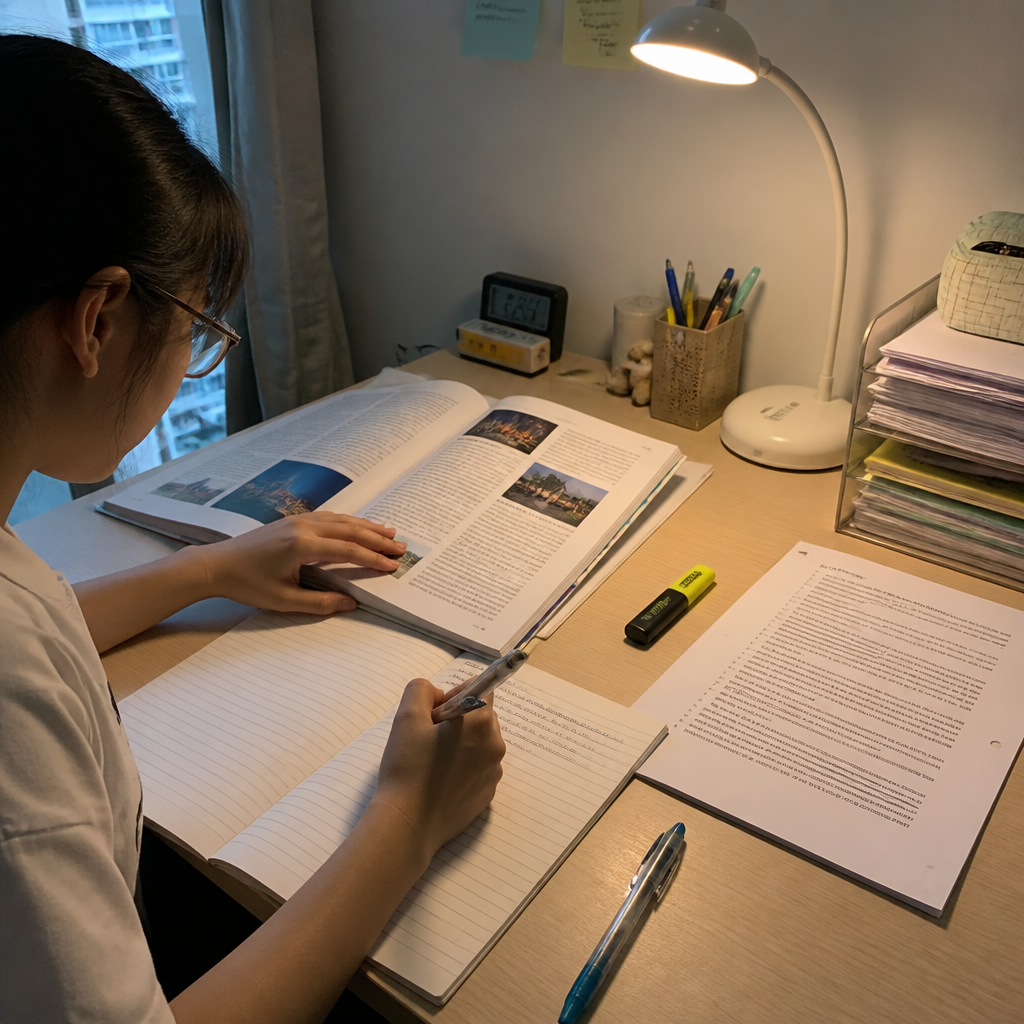
Students should highlight useful phrases, strong sentence openings, transition words, and how examples are used to support ideas. Tutors often notice that students who read actively pick up language patterns much faster than those who simply “finish the article”.
Build vocabulary from context, not random word lists
Many teenagers memorise fancy words they never use properly. Then their composition sounds forced, and parents wonder why all that studying did not help.
A more useful habit is to keep a simple notebook with three parts:
- The word or phrase
- Its meaning in context
- One original sentence
If a student sees “reluctant to speak up”, they can write, “He was reluctant to speak up during class discussion because he was afraid of giving the wrong answer.” This is far more useful than memorising “reluctant = unwilling”. It also helps with comprehension because students start seeing how meaning shifts with context.
Another useful extension is to group vocabulary by theme instead of alphabetically. For example, a student preparing for oral topics on school life, technology, or community issues can collect phrases linked to each theme. This makes it easier to recall suitable language during composition and oral exams, where students need words that fit the topic naturally.
Improve Writing, Editing, And Grammar With Targeted Practice
Writing is where many families feel stuck. The student spends a long time on a composition, gets it back covered in corrections, and still has no clear idea what to do next. That cycle is exhausting, and very common.
Fix repeated writing mistakes before chasing fancy language
In many scripts, the same problems appear again and again. Weak sentence clarity. Tense shifts. Missing explanation. Vague examples. Overuse of simple words like “good” or “bad”. Introductions that sound memorised but do not fit the question.
A common pattern among students is this. They think they need better vocabulary, when the real issue is weak control over expression. A tutor often notices that students are not weak in English overall. They are weak in two or three recurring habits. Once those habits are corrected properly, marks often improve faster.
“The boy was very sad and he cried because the accident was very bad.”
“The boy stood frozen at the roadside, tears spilling down his face as the reality of the accident sank in.”
The improvement here is not just about using harder words. It is about writing with clearer imagery and stronger control.
Use model compositions to learn structure, not to memorise blindly
For parents trying to help teenagers improve English writing skills, model essays can be useful, but only when used properly. Blind memorisation is risky. Examiners can usually tell when a student forces in prepared chunks that do not match the topic.
A better routine is simple. Read one model essay, identify how the writer starts, develops, and concludes, copy three to five useful phrases, then write a fresh paragraph on a different topic using a similar structure. That builds adaptability, which matters far more than memorisation.
Treat editing as a precision skill
Editing is often treated as the easy section. That is exactly why careless students throw marks away.
Instead of relying on what “sounds okay”, train the eye to check one issue at a time:
- Verb tense
- Singular or plural forms
- Pronoun agreement
- Prepositions
- Sentence logic
It may feel slower at first, but this kind of checking builds stronger grammar awareness over time.
A practical way to strengthen grammar is to keep an error log. Every time a student gets back a corrected worksheet or composition, they should record the mistake, the corrected version, and the rule involved. After a few weeks, patterns become obvious. Some students repeatedly confuse past and present tense. Others struggle with subject-verb agreement or sentence fragments. Once the pattern is clear, revision becomes much more efficient.
If your child keeps making the same errors and school feedback is too brief, personalised support can help. Some families explore English tuition when they want closer correction on essays and comprehension responses.
Improve Comprehension By Answering With Precision
Comprehension is one of the biggest pain points in secondary school English. Students often say, “I understand the passage, but I still lose marks.” Usually, the issue is not basic understanding. It is answer technique.
Read the question carefully before hunting for lines
Many weak comprehension students underline random parts of the passage before they have even worked out what the question wants. Is it asking for a factual detail, an inferred reason, the writer’s attitude, a phrase and explanation, or an answer in their own words?
A common mistake is lifting a whole sentence when only one precise point is needed. Another is giving a personal opinion when the answer must come from the text. That is why some students feel they “know the passage” but still underperform.
Learn to explain, not just copy
One major reason students lose marks is weak explanation. They identify the right phrase, but cannot unpack it clearly.
Weak answer: “It means he did not talk.”
Stronger answer: “It suggests he stopped himself from speaking, possibly because he did not want to worsen the situation or reveal his true feelings.”
That extra layer is often what separates a partial answer from a stronger one.
Practise summary and paraphrasing separately
Some of the best ways to improve English comprehension for secondary students involve practising summary skills separately from full papers. Many students include too much detail, go beyond the word limit, or copy too heavily.
A practical exercise is to take one paragraph from a news article and reduce it to two sentences using simpler but accurate wording. This trains selection and paraphrasing, both of which are essential for school exams and O-Levels.
Students should also get used to command words. “Explain” is different from “state”. “How” is different from “why”. “What impression” requires interpretation, not just copying a line. This sounds minor, but many marks are lost because students answer a different question from the one set.
Use Smarter Study Methods For English Exam Preparation

English revision often becomes too passive. Students highlight notes, reread essays, and feel busy. Then the exam comes, and the score does not reflect the effort.
Follow a weekly plan by component
The best study methods for secondary English exam preparation are usually balanced and specific. Instead of “study English on Sunday”, divide revision by component.
This is manageable even during busy school weeks. It also stops weaker components from being ignored until the last minute.
Review corrections properly instead of moving on too fast
A recurring pattern among students is this. They finish a paper, check the answers, then immediately move on. But mistakes that are not analysed properly usually come back again.
A better review method is to label each error clearly:
- Misunderstood question
- Careless reading
- Grammar weakness
- Weak vocabulary
- Poor explanation
- Time pressure
Once patterns appear, revision becomes much more targeted, and much less frustrating.
Rehearse time management before the exam
In school exams and O-Levels, some students know what to do but still run out of time. They spend too long on one composition paragraph or freeze on a comprehension question.
Timed practice matters. Even one timed section a week helps. A student who regularly practises writing introductions within five minutes or planning situational writing points in three minutes usually feels calmer under real exam pressure.
It also helps to decide in advance how long each section should take. Students who walk into the exam with a rough timing plan are less likely to panic. They know when to move on, when to leave a difficult question temporarily, and how much time to reserve for checking.
Support Your Child Without Turning Home Into Another Classroom
English struggles often create tension at home because the subject feels less clear-cut than Math or Science. Parents can check a Math answer quickly. English feels more subjective, and that uncertainty can lead to repeated reminders, frustration, and arguments.
Start with the real problem, not a lecture
It is easy to say, “You just need to read more” or “Why is your composition still so weak?” But many teenagers already know they are behind. What they need first is clarity, not more pressure.
A more helpful question is: “Which part is pulling your marks down most, comprehension, writing, or oral?” That shifts the conversation from blame to problem-solving.
Create low-pressure English routines
Not every form of English practice has to feel like revision. At home, parents can ask the child to summarise a news story in two sentences, discuss one oral topic during dinner, review one corrected paragraph together, or explain why a comprehension answer lost marks.
These are short, realistic routines. That matters, because routines only work when they are sustainable.
Know when extra help may be useful
Some students work hard but still plateau because school feedback is limited or too general. Writing and comprehension often improve faster when someone can go line by line through the student’s answers and explain exactly what is missing.
If that sounds familiar, parents can learn more about private home tuition support.
Adjust The Strategy For Lower Sec And Upper Sec
Not every secondary student needs the same approach. A Sec 1 student building basics and a Sec 4 student preparing for O-Levels should not be revising in exactly the same way.
For lower secondary students, the goal is to prevent weak habits from becoming fixed. For upper secondary students, the goal is sharper exam execution. That difference matters. A student who is still shaky in grammar should not spend all their time memorising impressive phrases, while an O-Level student also needs to practise speed, selection, and precision under timed conditions.
For the latest exam details, students should refer to official updates from SEAB.
Frequently Asked Questions
How long does it take to improve English for a secondary student?
It depends on the weak area. Vocabulary and reading maturity usually take months to build. But comprehension technique, editing accuracy, and writing structure can improve within weeks if practice is focused and corrections are reviewed properly.
My child reads English books but still scores badly. Why?
Reading helps, but exam performance also depends on answering technique. A student may enjoy novels yet still struggle with summary writing, inference questions, or situational writing requirements. Reading is useful, but it has to be paired with exam-specific practice.
What is the fastest way to improve composition marks?
Usually, it is not writing more full essays straight away. Faster improvement often comes from identifying repeated mistakes, studying model paragraphs, and rewriting weaker sections with feedback. Quality correction matters more than quantity alone.
Is tuition necessary for weak secondary English?
Not always. Some students improve with consistent school feedback, home support, and a better revision plan. But if a student keeps repeating the same writing or comprehension mistakes, personalised teaching can help because English often requires detailed explanation, not just more worksheets.
How can parents help if they are not confident in English themselves?
You do not need to teach every grammar rule. You can still help by creating reading routines, asking your child to explain answers, checking whether corrections are reviewed, and encouraging regular oral discussion. Structure and consistency often matter as much as direct teaching.
Conclusion
If you have been wondering how to improve English for secondary students, the most effective approach is usually not doing everything at once. Improvement comes from identifying the weakest components, understanding what secondary school English actually tests, and practising each skill with purpose.
Reading helps, but only when students actively notice language. Writing improves when mistakes are corrected properly. Comprehension marks rise when students learn how to answer the question, not just understand the passage. Oral gets better with regular discussion, not last-minute panic before the exam.
For Singapore students facing school assessments, weighted exams, and O-Levels, steady routines often work better than intense bursts of revision. And for parents, support becomes much more useful when it is calm, specific, and realistic.
If your child needs more personalised help with composition, comprehension, oral, or overall exam preparation, you can learn more about our tutors here.