


Introduction
You visit one preschool and hear about independence. Another talks about creativity. A third reassures you with school readiness, bilingual exposure, and routines. Somewhere between the tour, the brochure, and all the opinions around you, the question starts to feel much bigger than expected, which preschool curriculum is best in Singapore?
For many parents, this decision is not just practical. It feels personal. You are not only choosing a school. You are trying to picture your child in that space, whether they will feel safe, engaged, confident, and ready for what comes next.
The honest answer is simple, even if it does not always feel simple, there is no single best preschool curriculum for every child. A child who loves exploration may respond very differently from one who needs routine and clear guidance. Some families are thinking ahead to Primary 1. Others are more concerned about confidence, language exposure, or whether a full-day childcare setting can really deliver what the school promises.
This guide is for Singapore parents who want clarity, not slogans. We will look at Montessori, Reggio Emilia-inspired, play-based, MOE Kindergarten, and more structured school-readiness approaches, so you can make a better preschool comparison based on real fit, not just attractive labels.
Key Takeaways
- There is no universal winner. The better question is which curriculum fits your child’s temperament, developmental readiness, and your family’s expectations in Singapore.
- Montessori suits some children very well, but not all. It can build independence, concentration, and order, but some children need more social energy, imaginative play, or teacher-led guidance.
- Reggio and play-based approaches are not “just playing”. In strong programmes, children are guided to explore, communicate, and think deeply through meaningful experiences.
- MOE Kindergarten offers a balanced local reference point. For families thinking about Primary 1 transition, bilingual exposure, and familiar classroom rhythms, it can feel reassuring.
- Daily reality matters more than philosophy on paper. A curriculum only works if your child can actually cope well with it across real preschool days.
- Labels can hide big differences in teaching quality. Two schools using the same term may feel completely different in practice.
- Watch the child, not just the brochure. Long-term fit often shows up in your child’s behaviour, mood, and confidence before anything else.
Start With Fit, Not Prestige
A common trap is assuming the most talked-about preschool curriculum must be the best one. In practice, that can pull parents away from the question that matters more, what kind of preschool programme actually suits your child?
Why the “best” curriculum depends on your child
Between ages three and six, children can be wildly different from one another. One child sits through stories and notices every detail. Another wants to move, touch, build, and talk non-stop. A third may be chatty in English but go completely quiet during Chinese exposure.
These differences matter far more than the label on the school website.
A child who likes repetition and predictable order may do very well in a Montessori environment, where materials are sequenced carefully. On the other hand, a highly verbal child who loves asking questions and discussing ideas may come alive in a Reggio-inspired classroom.
This is why the academic versus holistic preschool debate in Singapore can become too narrow. A child who is emotionally overwhelmed will not benefit much from “more academics”. At the same time, a child who gets plenty of freedom but too little support in language foundations may find formal schooling harder later.
Why family expectations matter too
Sometimes the mismatch is not really with the child. It is with the family’s expectations.
A parent may genuinely like the idea of child-led learning, then start feeling uneasy when there are fewer worksheets or less visible phonics practice. Another may choose a very structured programme for peace of mind, only to realise their child is becoming resistant, tearful, or constantly tired.
That tension is very real in Singapore. Most parents are not trying to pressure their child for the sake of it. They are simply aware that Primary 1 can feel fast-paced, and they do not want their child to start off struggling. That concern is understandable. The goal is not to chase the most “advanced” preschool. It is to find one that builds readiness without draining a young child too early.
Montessori: Strong For Independence, Less Ideal For Some Social And Imaginative Learners
When parents compare Montessori versus play-based preschool in Singapore, the discussion often becomes oversimplified. Montessori gets described as disciplined and independent. Play-based gets described as fun and relaxed. Real classrooms are rarely that neat.
What Montessori usually looks like
In a Montessori classroom, children often work with specific hands-on materials designed for practical life, sensory learning, early numeracy, language, and self-management. The environment is usually orderly, and children are encouraged to choose tasks independently and complete them with focus.
For some children, this is an excellent match. A child who used to depend on adults for every little thing may begin pouring water, tidying up, dressing more independently, and concentrating for longer periods. Some parents even notice smoother routines at home because the child has become more confident with sequence, order, and responsibility.
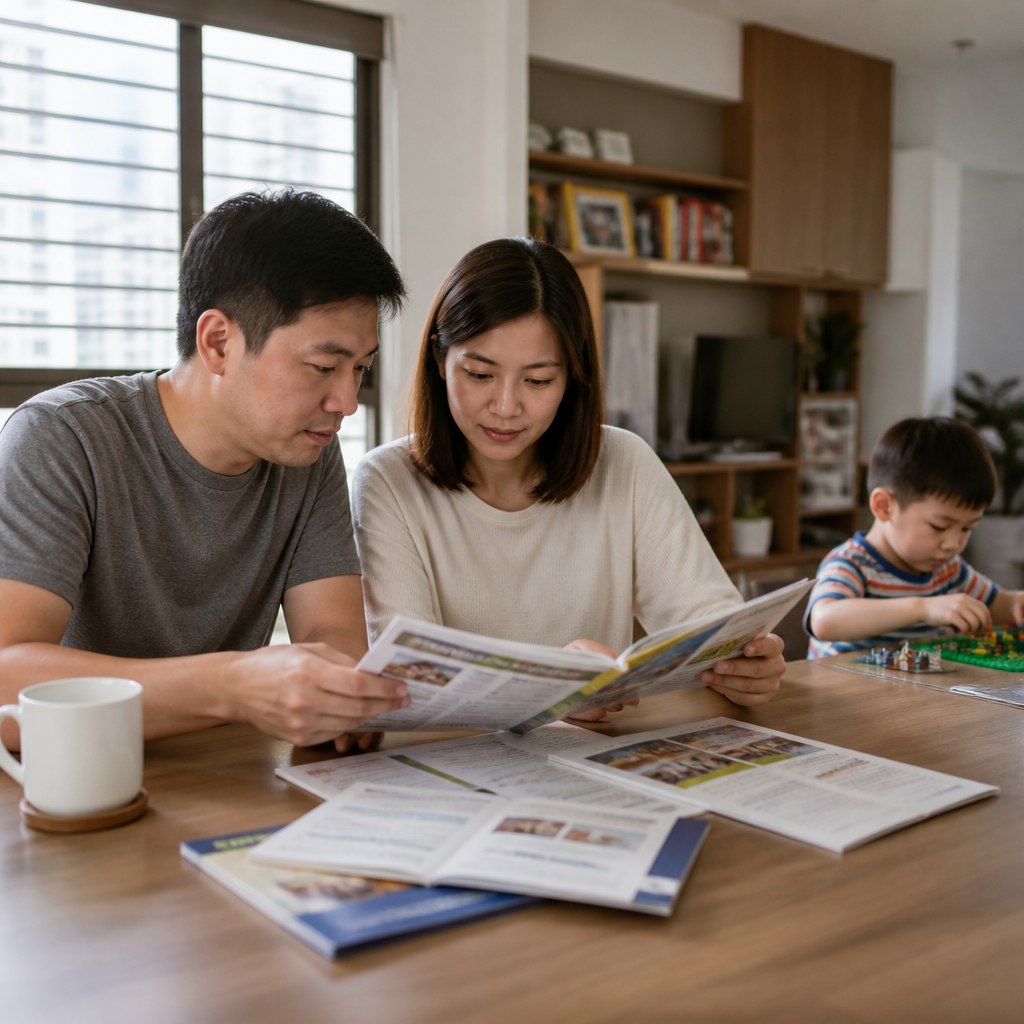
Strengths and possible limitations
Montessori can be especially helpful for children who get distracted or overwhelmed in noisier, less organised settings. The calm structure gives them something many young children need, a sense of purpose and predictability.
Still, there are trade-offs. Some children need more pretend play, more spontaneous interaction, and more messy collaborative learning than certain Montessori settings naturally offer. If your child loves dramatic play, open-ended art, or high-energy social learning, a stricter Montessori implementation may feel limiting.
Singapore parents should also look closely at language and school transition. Not all Montessori programmes place the same emphasis on bilingual support or explicit school-readiness routines. A child may become very independent, yet still need more support with Chinese vocabulary, group listening, or responding in a more conventional classroom format later on.
If Montessori appeals to you, but you are unsure about literacy, numeracy, or Chinese foundations, ask how these are taught day to day. If needed, some families add light support outside school. If you would like gentle support for your child’s early literacy, numeracy, or Chinese exposure alongside preschool, learn more about our preschool tutors.
Reggio Emilia-Inspired And Inquiry-Based Preschools: Excellent For Thinking And Expression
Reggio-inspired programmes often attract parents who want their child to be curious, articulate, and confident. At the same time, they can make some families uneasy because the learning may look less obviously structured.
What Reggio-inspired learning usually emphasises
Rather than relying heavily on pre-set tasks, Reggio Emilia-inspired classrooms often build learning around children’s questions, interests, observations, and projects. Teachers listen closely, document children’s thinking, and extend learning through discussion, art, construction, storytelling, and collaborative work.
A group of children interested in rain, for instance, may spend days drawing clouds, talking about puddles, measuring water, reading related books, and building models. From the outside, this can look loose. In a strong programme, it is not loose at all. The teacher is intentionally guiding language, reasoning, observation, and expression through something the children genuinely care about.
Who this approach may suit
This can be a strong fit for children who are expressive, imaginative, and motivated by meaningful conversation rather than repetitive drills. It may also suit families who value communication skills, collaboration, confidence, and creative thinking.
Where parents may hesitate
Not every child responds equally well to open-ended learning. The best preschool curriculum for a four-year-old in Singapore often depends on whether that child can engage with flexibility without becoming lost or overstimulated. Some children still need clearer routines and more direct instruction.
Parents also sometimes get drawn in by beautiful project displays and documentation boards. These can reflect thoughtful teaching, but they are not proof on their own. Ask how the school supports phonological awareness, early number sense, fine motor control, and bilingual confidence alongside inquiry work.
Play-Based Preschool: Child-Friendly And Developmentally Appropriate, But Quality Varies Widely
Play-based learning is one of the most misunderstood preschool terms in Singapore. Some parents hear it and worry their child will be underprepared. Others assume it automatically means a gentle, ideal learning experience. Both reactions can miss the point.
What good play-based learning actually means
A strong play-based curriculum is not a free-for-all. It uses play intentionally to build language, self-regulation, social skills, problem-solving, and early academic foundations.
A pretend supermarket corner can support vocabulary, turn-taking, money concepts, and print awareness. A block area can build spatial reasoning, persistence, and cooperative planning. The child may feel like they are simply playing, but the learning underneath is very real.
Good teachers in play-based settings do more than supervise. They observe, model language, ask thoughtful questions, extend ideas, and shape the environment carefully. The play feels natural, but the teaching is deliberate.
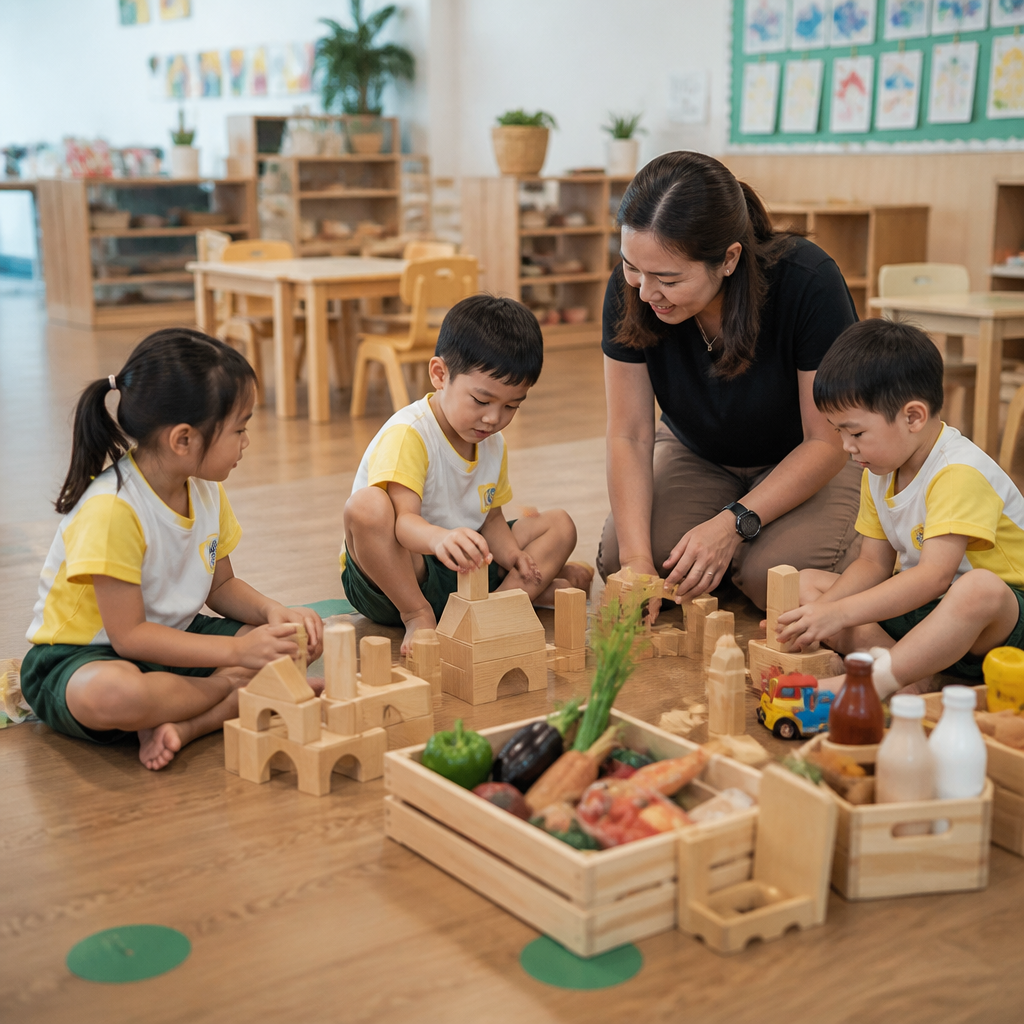
Why “play-based” can be excellent, or disappointingly vague
This is where many parents get stuck. One preschool may describe itself as play-based and run rich, language-filled, developmentally strong sessions. Another may use the same label while offering very little intentional teaching.
That is why comparing Montessori and play-based preschool should never be reduced to “structured versus fun.” In weaker classrooms, play-based can become under-guided. Children enjoy themselves, but there may be limited progress in listening, pre-writing, bilingual exposure, or early numeracy. In stronger classrooms, play becomes the vehicle for serious developmental growth.
If your child is active, social, or resistant to seatwork, a well-run play-based preschool may actually prepare them better than a more academic one, because it keeps them engaged enough to learn. But if your child is already five, shy in groups, and needing clearer phonics or Chinese support, you may want a play-based setting with stronger guidance rather than a very loose model.
MOE Kindergarten And Structured School-Readiness Approaches: Reassuring For Primary 1 Transition
For many families, MOE Kindergarten or centres with a stronger school-readiness approach feel familiar and reassuring. In Singapore, that makes sense. Formal schooling is coming, and parents want their child to cope confidently.
What MOE Kindergarten generally represents
The MOE Kindergarten curriculum framework emphasises purposeful play, early literacy and numeracy, social and emotional development, bilingual exposure, and positive learning dispositions. It is not designed to be pure academic drilling. At the same time, it often feels more aligned with local expectations around routines and Primary 1 transition. You can read more at MOE Kindergarten curriculum.
For some children, that balance works very well. They benefit from familiar routines, circle time expectations, guided language work, and gradual preparation for a more structured school setting.
When structured approaches help
A structured curriculum may help if your child needs clear expectations, regular practice, and explicit support in literacy or numeracy. It can also reassure parents who worry that a very open-ended programme may leave gaps.
For children who feel anxious when they do not know what is coming next, structure can feel calming rather than restrictive. It can also support those who need repeated exposure before concepts stick, especially in phonics, counting, pencil control, and classroom listening.
When they may feel too heavy
More structure is not always better. Some young children become overly dependent on worksheets or adult direction, and then struggle when asked to think more freely. Later on, they may look “prepared” on paper but find open-ended tasks, conversation, or adaptability much harder.
This is where the academic versus holistic preschool debate in Singapore often gets too polarised. Strong school-readiness programmes do not have to feel dry. Strong holistic programmes do not have to be weak academically. What matters is whether the school builds foundational skills without making learning feel tense too early.
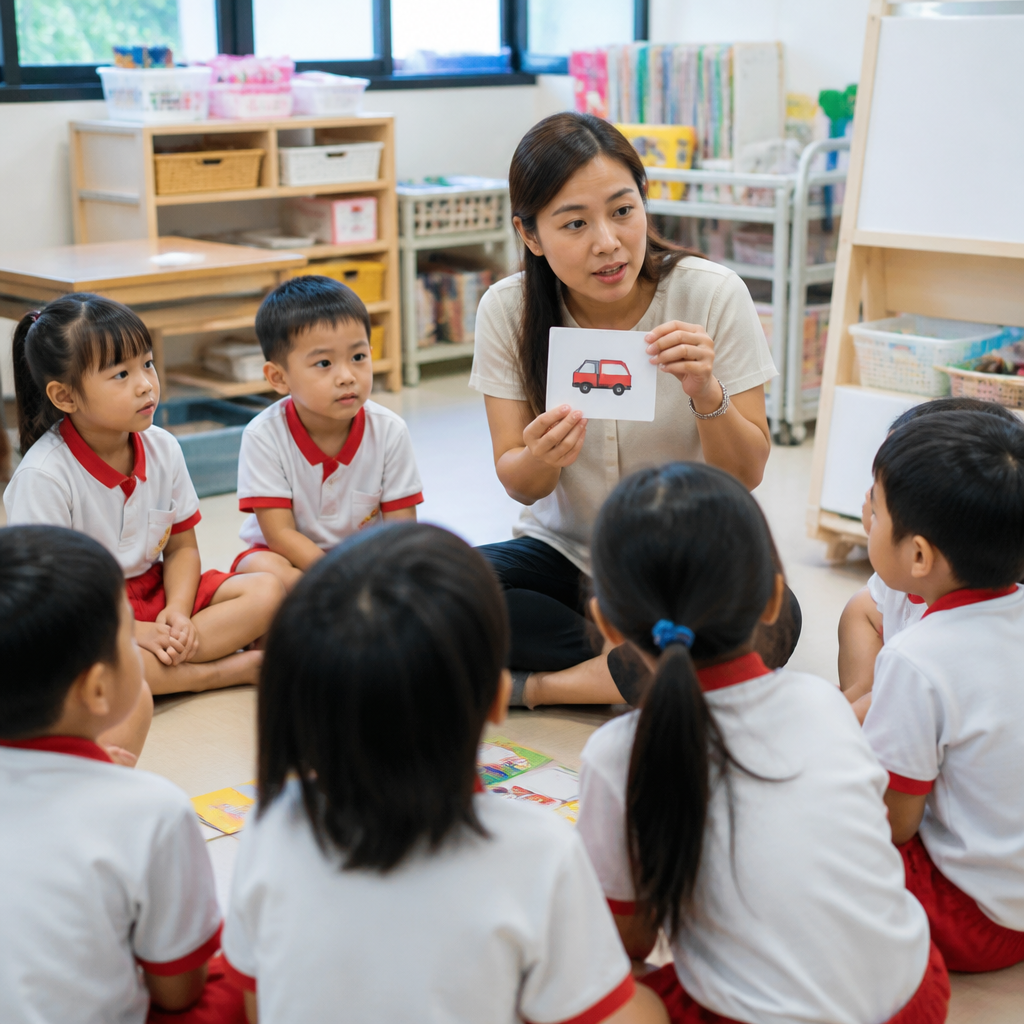
How To Choose A Preschool Curriculum In Singapore
By this point, many parents realise the real question is not which preschool curriculum is best in general. It is how to choose a preschool curriculum in Singapore for one specific child living one specific daily life.
Before deciding, it helps to compare the approaches side by side.
Match the curriculum to your child’s temperament
Watch your child in ordinary moments, not just ideal ones. Do they like repeating tasks until they master them, or are they always looking for novelty? Do routines calm them, or do they become bored and oppositional? Are they verbal, cautious, sensory-seeking, shy, or highly social?
A child who melts down after noisy childcare days may need a calmer, more ordered environment. A child who lights up during pretend play and storytelling may need richer imaginative and social opportunities than a more rigid setting can offer.
Think about the full-day reality
A curriculum can sound wonderful during a school tour, but preschool is experienced across long weekdays. If your child is in full-day care, ask what the day feels like at 8.30am, 1pm, and 5pm. Some children can cope well with a stimulating environment for short periods, then become dysregulated over a full day.
This matters especially for four-year-olds. At that age, many children are more capable than before, but still tire easily and get emotionally flooded. A preschool that looks excellent for a short enrichment session may feel very different as a full-day childcare routine.
Clarify your priorities around bilingual learning and Primary 1
In Singapore, English confidence can sometimes hide weaker Mother Tongue development. A child may seem generally confident but avoid speaking Chinese or struggle to understand common classroom instructions. If bilingual development matters to your family, ask specific questions about how exposure happens. Songs and occasional vocabulary are not quite the same as consistent, meaningful language use.
Also ask what readiness means to the school. Does it only mean recognising letters and copying neatly, or does it also include listening, resilience, speaking up, and managing transitions? A child who can read simple words but cannot separate calmly or follow group routines is not fully “ready” in the broader sense.
For practical parent guidance, the ECDA preschool selection resource is also useful at ECDA’s guide to choosing a preschool.
Frequently Asked Questions
Which preschool curriculum is best if my child is shy?
A shy child does not automatically need the quietest or gentlest curriculum. Some shy children do well in predictable, structured settings because they know what to expect. Others open up more in play-based or inquiry-based environments where there is less pressure to produce fixed right answers. The more useful question is whether your child needs security first, or more room to express themselves.
Is Montessori better than play-based preschool for Primary 1 preparation?
Not necessarily. Montessori may build independence, concentration, and practical self-management, all of which can help in Primary 1. A strong play-based programme can also prepare children very well by developing language, self-regulation, problem-solving, and social confidence. The deciding factor is usually how well the approach is carried out, not the label itself.
Which preschool programme suits my child if Chinese is a weak area?
Look beyond broad claims about bilingualism. Ask how often Chinese is used meaningfully, whether children are expected to respond, and how teachers support hesitant speakers. Some children need repeated, low-pressure exposure before they become confident. If the preschool environment is not enough, light support outside school may help without turning language into a daily struggle.
Should I avoid a curriculum that seems less academic at K1 or K2?
Not automatically. Some programmes that look less academic still do a strong job building the foundations that later support reading, writing, and numeracy. The concern comes in only when there is very little intentional teaching, weak guidance, or poor progression over time. A child who is curious, communicative, and self-regulated often adjusts better later than one who has only been trained to complete tasks.
Conclusion
So, which preschool curriculum is best in Singapore?
The most honest answer is this, the best curriculum is the one that fits your child’s temperament, language needs, developmental stage, and your family’s real priorities.
Montessori may be excellent for independence and concentration. Reggio-inspired and inquiry-based programmes can be wonderful for expression, curiosity, and deep thinking. Play-based learning, when done well, is far more rigorous than many parents assume. MOE Kindergarten and structured school-readiness models can offer a reassuring bridge into local primary school expectations. None of these is automatically best for every child.
If you feel torn, that is normal. Many Singapore parents are trying to balance emotional wellbeing, bilingual development, and school readiness all at once. Start by observing your child carefully, then look past the curriculum label, and finally pay attention to the day-to-day teaching reality.
If you would like gentle support for your child’s early literacy, numeracy, or Chinese exposure alongside preschool, learn more about our preschool tutors.