


A pattern question can look deceptively simple, then suddenly leave a child staring at the page with no idea what to do next. Perhaps it is 9pm after CCA, corrections are still unfinished, and the numbers do not increase by the same amount. It is understandable for parents to wonder whether to explain it again, give the answer, or step back before a small homework task becomes an argument.
Learning to solve Primary School Maths pattern questions is less about memorising a trick and more about noticing change carefully. Primary Maths patterns can involve numbers, shapes, repeated objects, or growing arrangements. Some are straightforward, while others use alternating rules or require children to work backwards. With a reliable process, unfamiliar questions become more manageable and less intimidating.
Key Takeaways
- Look for what changes before guessing the answer. Compare each term, shape, or group with the one immediately before it instead of jumping straight to a familiar rule such as “add 2”.
- Test a rule more than once. A rule that works for only one pair of numbers may be a coincidence, so check at least two more changes before trusting it.
- Use a table or drawing for growing patterns. Listing the figure number, number of objects, and changes between figures can reveal a rule hidden by a crowded diagram.
- Watch for alternating rules. Odd and even positions may follow separate rules, such as adding 3 in one set of positions and adding 6 in the other.
- Build or sketch the next step. For shape and visual patterns, drawing the next figure prevents children from relying only on an uncertain mental image.
- Check whether the answer fits the full pattern. Substituting a missing number or recounting a new figure catches many careless errors before a child moves on.
Use a Reliable Method Before Calculating
The most useful Primary Maths problem-solving strategies are often quiet habits a child uses before writing an answer. Pattern questions reward observation. When children rush straight into calculations, they can miss the relationship completely.
Identify exactly what is changing
Start by asking, “What changes from one item to the next?” In the sequence 4, 7, 10, 13, the value rises by 3 each time. In a shape sequence, colour may repeat every three shapes while direction rotates each time. These are separate changes, so both need attention.
For a growing pattern, the change may involve squares, matchsticks, dots, or sides. A child who says “it gets bigger” has noticed something, but not enough to solve the question. Gently prompt them to be more precise: “How many more squares are added each time, and where are they added?”
Test the proposed rule
Suppose the sequence is 3, 6, 12, 24. Adding 3 works only once. Doubling works throughout: 3 × 2 = 6, 6 × 2 = 12, and 12 × 2 = 24. The next term is 48.
Testing matters because tired pupils often spot the first difference and stop. They may write “+3” based on the first pair, then continue confidently even when the later terms no longer fit. A useful rule must explain the whole pattern, not only the beginning.
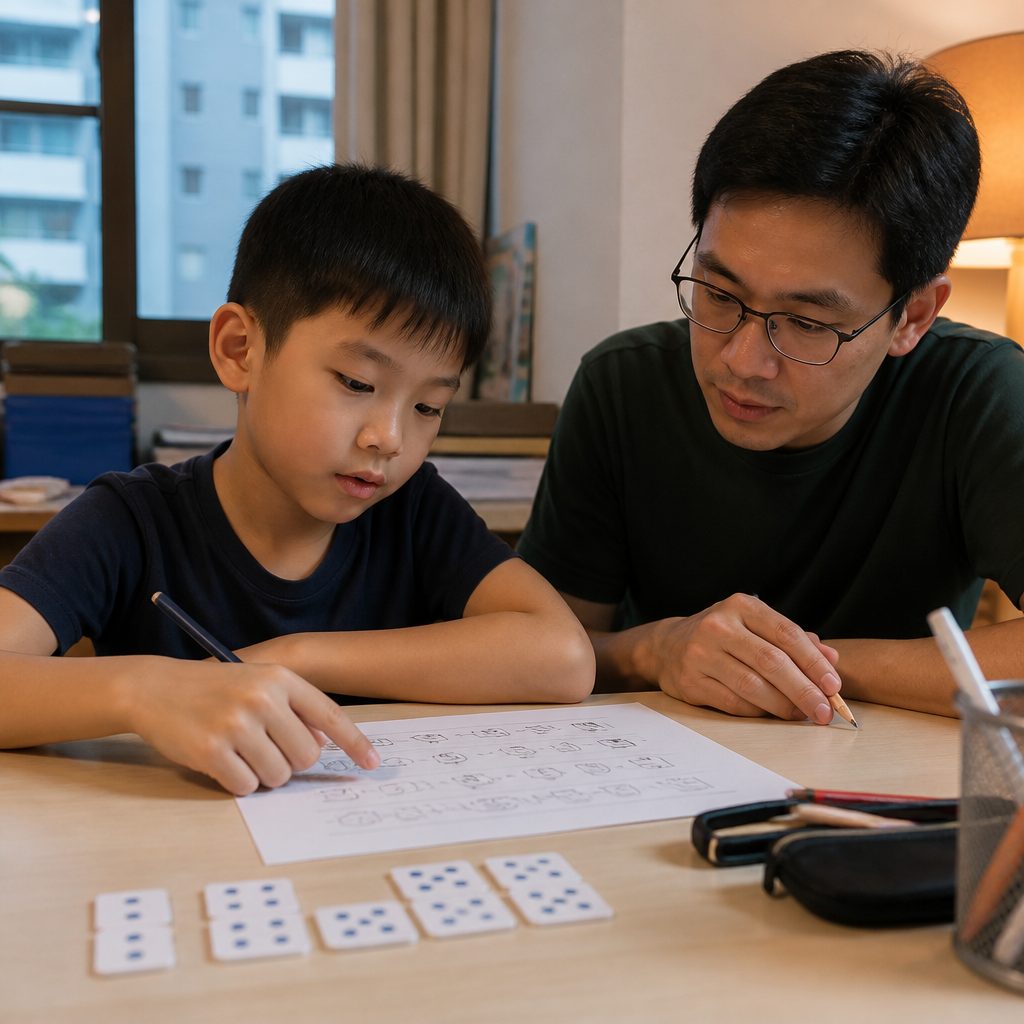
Organise the information
For a figure pattern, a simple table can make the relationship much clearer:
The number of squares increases by 2, so Figure 4 has 9 squares. This separates the figure number from the total number of objects, which is especially helpful when upper-primary diagrams become larger.
Form the next step, then check it
Once a rule is identified, create the next item and compare it with the earlier items. If the answer is a number, work forward once more. If it is a drawing, count every object carefully.
This final pause is small but valuable, especially in PSLE-style Maths questions where one missed detail can change the whole answer. Tutors often notice that children who check calmly often know more than they first show, they simply need a habit that slows down the rush to finish.
Recognise Number Sequence Rules
Number sequences test whether pupils can recognise relationships rather than complete isolated calculations. Lower-primary questions may use simple addition or subtraction, while upper-primary questions can combine operations or alternate rules.
Start with the differences
Consider: 18, 23, 28, 33, __.
Write the changes underneath: +5, +5, +5. The missing number is 38. This is a sensible first check, but pupils should not assume every sequence has a constant difference.
Now consider: 2, 6, 12, 20, __.
The differences are +4, +6, +8. The increases themselves rise by 2, so the next increase is +10. The answer is 30. Recording differences helps children see the second layer of the pattern instead of becoming stuck on “add 4”.
Separate alternating positions
Try: 5, 10, 8, 16, 11, 22, __.
Two patterns are interwoven:
The missing term is 14. Separating odd and even positions is often clearer than trying random operations across one long row.
Use multiplication and division only when they fit
A sequence such as 81, 27, 9, 3, __ divides by 3 each time, giving 1. However, not every large jump means multiplication or division. Encourage children to state the full rule aloud: “Each term is divided by 3.” Saying it clearly makes the rule easier to test.
If your child regularly freezes after trying differences and alternating positions, targeted practice may be more useful than simply doing more worksheets. Primary Maths tutors can help identify whether the difficulty is pattern recognition, calculation accuracy, or uncertainty about how to begin.
Read Shape Patterns as Complete Units
Visual pattern questions can feel easier because children can see them, yet they bring different mistakes. A pupil may notice that a circle follows a triangle but overlook changing colours, direction, size, or the number of shapes in each group.
Track more than one feature
Imagine this sequence: small red circle, small blue triangle, small green square, small red circle, small blue triangle, __.
The repeating unit has three items, so the next shape is a small green square. Ask, “What repeats as a complete group?” This encourages the child to identify the unit rather than guess from the last shape alone.
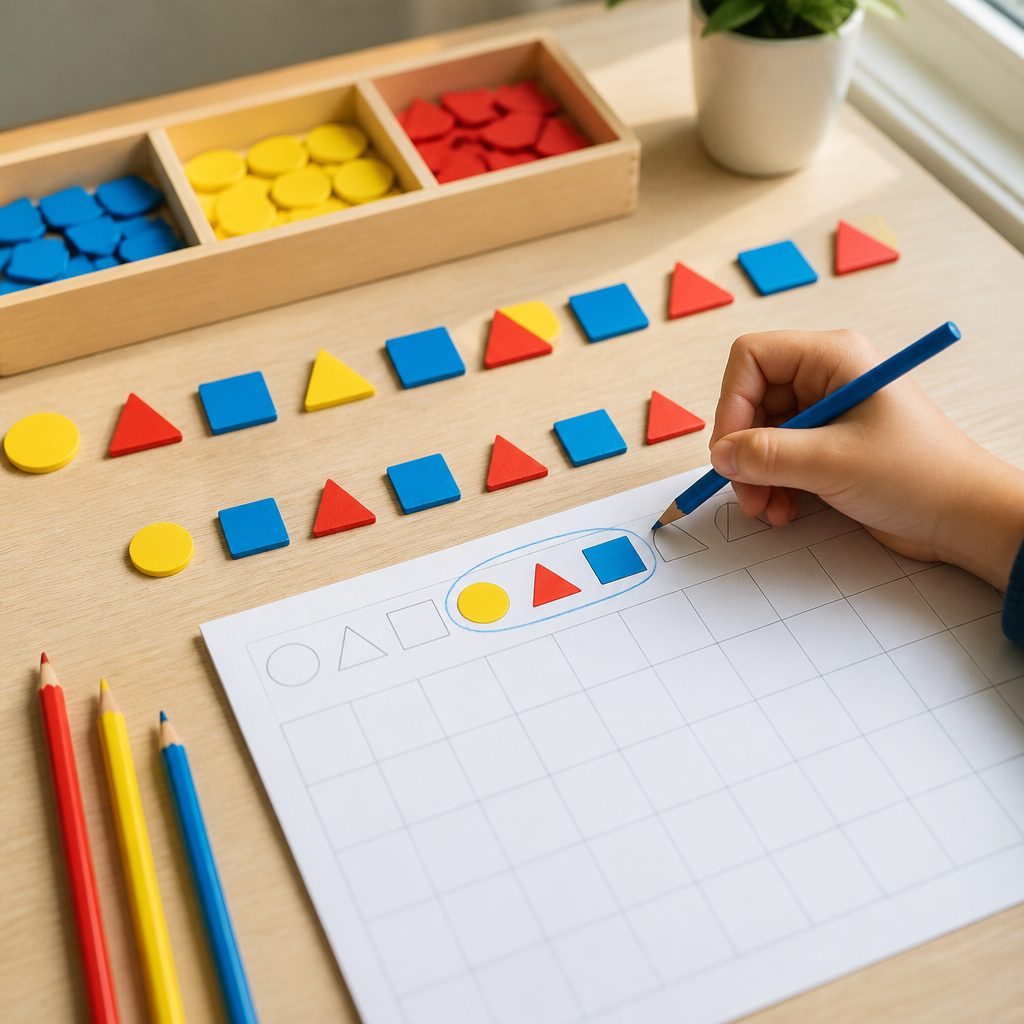
A more demanding example may use an arrow that turns clockwise while colours repeat red, blue, green. Direction and colour operate independently. A quick two-column note, one for direction and one for colour, can stop a child from blending the two rules together.
Copy the whole group
When a pattern is made of groups such as △ ○ ○, △ ○ ○, △ ○ ○, pupils sometimes continue with another ○ because it was the final symbol they saw. Ask them to circle one complete repeated group. Once they can point to the unit, they can repeat it accurately.
Avoid offering too many possible rules at once. Begin with a specific observation, such as “Count the shapes in one group.” If that does not unlock the answer, move on to colour, direction, or position. Pattern work should build attention, not become a guessing contest where the adult does all the noticing.
Solve Growing Patterns With Tables and Drawings
Growing patterns require pupils to connect a diagram with a numerical relationship. They may be shown figures made from squares, sticks, or dots and asked about a later figure. The challenge is not simply counting, particularly when the figure number becomes large.
Record each figure and total
Suppose Figure 1 has 4 dots, Figure 2 has 7 dots, and Figure 3 has 10 dots:
Figure 4 has 13 dots, and Figure 10 has 31 dots. Rather than drawing all ten figures, a pupil can see that there are nine increases of 3 after Figure 1: 4 + (9 × 3) = 31.
Explain where new objects are added
For a more complex pattern, the total may increase differently because a new row and a new column are added. Sketching the next figure is essential. If a student writes a number rule without checking the diagram, they may miss a corner square shared by two parts or count an overlap twice.
This is why some pupils complete simple number sequences confidently but struggle with PSLE Maths patterns. A common pattern among students is that they hunt for arithmetic operations, while the visual structure is actually the main clue.
Work backwards when needed
If Figure 6 has 22 matchsticks and each new figure adds 3 matchsticks, Figure 5 has 19, Figure 4 has 16, and so on. Working backwards is useful when a question asks about an earlier stage, and it also checks whether a forward rule makes sense.
The MOE Primary Mathematics Syllabus emphasises reasoning, communication, and problem-solving alongside mathematical skills. Pattern questions are a practical way for children to explain why a rule works, not only name an answer.
Avoid These Common Pattern Mistakes
Feeling stuck does not always mean a child lacks ability. Many errors come from a rushed approach, especially after a full school day when concentration is already low.
Assuming a constant difference too soon
For 1, 4, 9, 16, __, the differences are +3, +5, +7. The next increase is +9, so the answer is 25. Instead of saying, “Look harder,” ask your child to write every difference. The written record often makes the pattern visible.
Missing an alternating operation
In 30, 27, 54, 51, 102, __, the operations alternate: subtract 3, then multiply by 2. The answer is 99. A useful question is, “Does the same rule work at every jump?” If not, look for two operations or two separate position patterns.
Failing to verify the answer
A student may identify the correct rule but make an arithmetic slip. Checking is not a sign of uncertainty, it is a normal part of mathematical thinking. Pupils should also read whether a question asks for the next figure, the number of objects in a specific figure, or an explanation. Families preparing for PSLE can check the latest SEAB PSLE examination formats alongside relevant school guidance.
Frequently Asked Questions
Why can my child solve simple sequences but not pattern diagrams?
Number sequences show information in a single row. Pattern diagrams require children to count accurately, notice spatial changes, and connect the picture to a number rule. Ask your child to draw the next figure first, then make a table showing figure number and total objects.
Should my child memorise common sequence rules?
Knowing common rules, such as adding a fixed number, doubling, or alternating operations, can save time. However, memorising rules without checking them can backfire. The stronger habit is to test every proposed rule against the full sequence.
How much practice is enough for PSLE-style pattern questions?
Short, focused practice is usually more useful than completing many similar questions mechanically. Two or three questions where your child explains the rule, draws a table, and checks the result can be more valuable than ten answers copied from a model solution.
What should I say when my child becomes frustrated?
Start by acknowledging the feeling: “This one is unfamiliar, so it makes sense that it feels hard.” Then reduce the task to one observation, such as counting what was added from Figure 1 to Figure 2. Giving the answer immediately ends the struggle, but it can also teach a child that difficult patterns always need an adult.
Build Confidence One Pattern at a Time
Solving Primary School Maths pattern questions means slowing down enough to identify change, test the rule, organise information, form the next step, and verify it. Whether the question involves repeating shapes, a growing dot arrangement, or a multi-step number rule, the same careful habits apply.
Progress may look gradual. A child who once guessed may begin by writing differences, then later spot alternating rules independently. Those small shifts build the reasoning needed for more demanding Primary Maths questions. For personalised support with problem-solving strategies, revision, and mathematical confidence, parents can contact our primary Maths tuition team.